
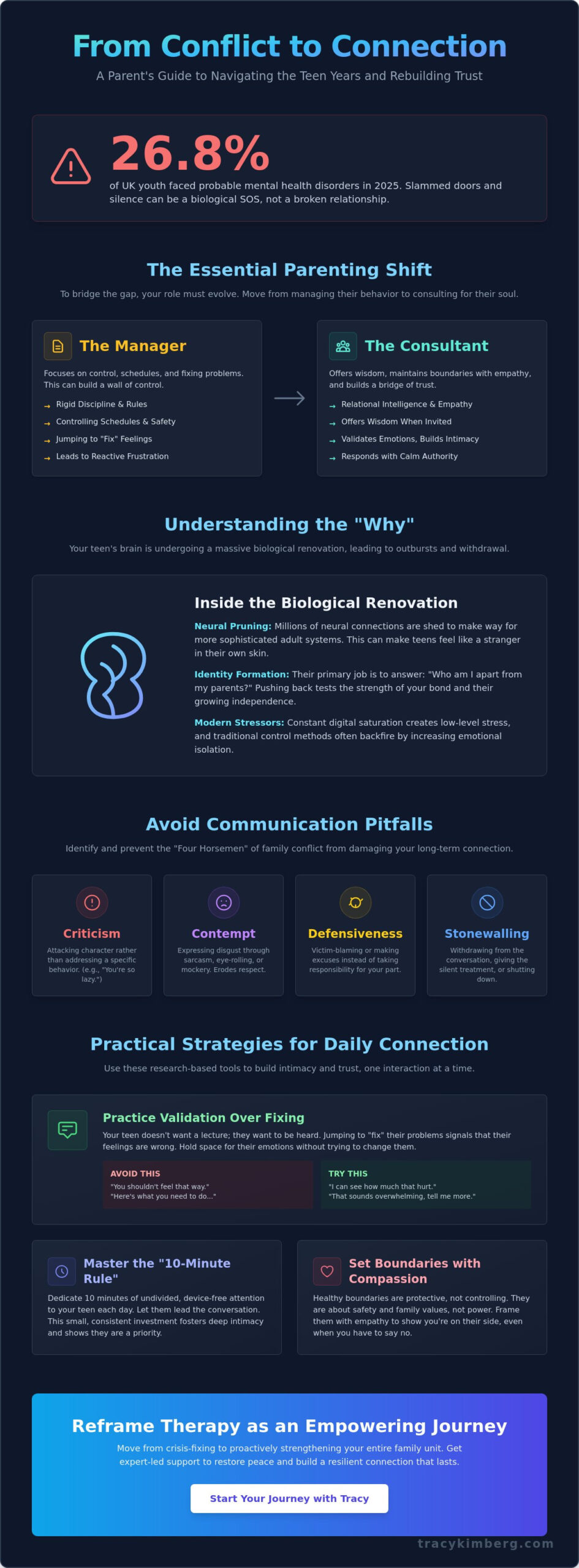
What if the slammed doors and stony silences aren’t actually signs of a broken relationship, but a biological SOS? It’s exhausting to walk on eggshells in your own home, constantly fearing that one wrong word might trigger a crisis or push your child further away. You remember the close bond you once had, and now, as you watch the 2025 statistic of 26.8% of UK youth struggling with mental health disorders, that fear of failing feels incredibly heavy. You’re likely looking for parenting support for teenagers that goes deeper than just managing their daily outbursts.
Hi, I’m Tracy, and I want you to know that healing is possible. I’ll show you how to shift from being a manager of their behavior to a consultant for their soul, transforming constant conflict into a meaningful, resilient connection that lasts into adulthood. We’ll explore expert-led psychological frameworks to help you understand the “why” behind the defiance and restore peace to your household. By looking beneath the surface of the behavior, we can begin the journey of rebuilding trust and intimacy in your home.
Key Takeaways
- Learn to decode the biological re-wiring of the adolescent brain so you can respond with calm authority instead of reactive frustration.
- Discover how effective parenting support for teenagers shifts the focus from rigid discipline to Relational Intelligence and validation.
- Identify the “Four Horsemen” of family conflict, including criticism and stonewalling, to prevent them from damaging your long-term connection.
- Master practical connection strategies like the “10-minute rule” to foster deeper intimacy and trust during daily interactions.
- Reframe therapy for teenagers as a proactive and empowering journey that strengthens the entire family unit rather than just a crisis fix.
The Shift: Why Parenting Support for Teenagers is Vital in 2026
Parenting support for teenagers shouldn’t be a fire extinguisher you only grab when the house is already on fire. Instead, I invite you to see it as a proactive journey of discovery. Your teen’s brain is currently undergoing a massive biological renovation, shedding millions of neural connections to make room for the sophisticated systems they’ll need as adults. This re-wiring can make them feel like a stranger in their own skin, leading to the outbursts or withdrawals that leave you feeling exhausted. If you feel lost, please know that’s a completely normal response. You’re navigating the delicate space between the child they were and the adult they’re becoming.
To bridge this gap, we must look at how parenting styles evolve during these years. You’re moving from a “Manager” role, where you controlled schedules and safety, to a “Consultant” role. A consultant offers wisdom when invited, maintains boundaries with empathy, and trusts the “client” to take the lead. This shift is the heartbeat of effective parenting support for teenagers. It’s about building a bridge of trust rather than a wall of control.
Understanding the Adolescent Identity Crisis
During this stage, your teen’s primary job is to answer one question: “Who am I apart from my parents?” This is why they suddenly prioritise peer connection over family dinners. Their friends are the laboratory where they test their new identity. When they push back against your rules, they aren’t necessarily being defiant for the sake of it. They’re testing the strength of your bond to see if it can withstand their growing independence. Adolescence is a second birth of the self.
The Impact of Modern Stressors in 2026
The world our teenagers inhabit in 2026 is uniquely demanding. Digital saturation means your teen never truly “leaves” the social arena, creating a constant state of low-level stress. With 26.8% of UK young people facing probable mental health disorders as of 2025, the stakes are higher than ever before. Traditional methods of control often backfire in this high-speed environment because they don’t address the underlying emotional isolation. Modern parenting support for teenagers requires us to help them build an internal compass rather than just following external maps. We must help them find their voice in a world that’s constantly trying to drown it out with digital noise.
A Research-Based Approach to Supporting Young Minds
Connection is the only currency that carries value in the parent-teen relationship. While many traditional models focus on compliance, I believe that true parenting support for teenagers must be rooted in Relational Intelligence. This isn’t about having all the answers. It’s about developing the capacity to stay present when things get messy. When we prioritize empathy and validation over rigid discipline, we create a “secure base.” This is a psychological sanctuary where your teen feels safe enough to explore their world, knowing they have a soft place to land when they stumble. By adopting the principles of Emotional Coaching, as pioneered by John Gottman, we learn to view every emotional outburst as an opportunity for connection rather than a challenge to our authority.
Foundational resources like the Essentials for Parenting Teens offer excellent evidence-based guidance, but the transformation happens when you apply these concepts to your unique family dynamic. If you’re feeling overwhelmed by the weight of these changes, you might find that specialised therapy for teenagers provides the tailored roadmap your family needs to move forward with confidence.
The Power of Validation Over Fixing
It’s a natural instinct to want to solve your child’s problems. However, when we jump straight to “fixing,” we inadvertently signal that their feelings are a problem to be solved rather than an experience to be felt. This often causes teenagers to shut down. They don’t want a lecture; they want to be heard. “Holding space” means sitting with their big emotions without trying to change them. Try using phrases like, “I can see how much that hurt,” or “That sounds incredibly overwhelming, tell me more.” These simple acknowledgments open the door to intimacy that advice-giving often slams shut.
Establishing Boundaries with Compassion
Boundaries are often misunderstood as tools for control, but in a healthy relationship, they’re tools for protection. Controlling boundaries are about power; protective boundaries are about safety and values. You can increase compliance by involving your teen in the rule-making process. When they understand the “why” and feel their voice matters, they’re more likely to respect the limits set. Boundaries are the banks of the river that allow the teen to flow safely. Without them, the water dissipates; with them, the current has direction and purpose. This collaborative approach fosters the autonomy they crave while maintaining the structure they still desperately need.
Navigating Common Roadblocks in the Parent-Teen Relationship
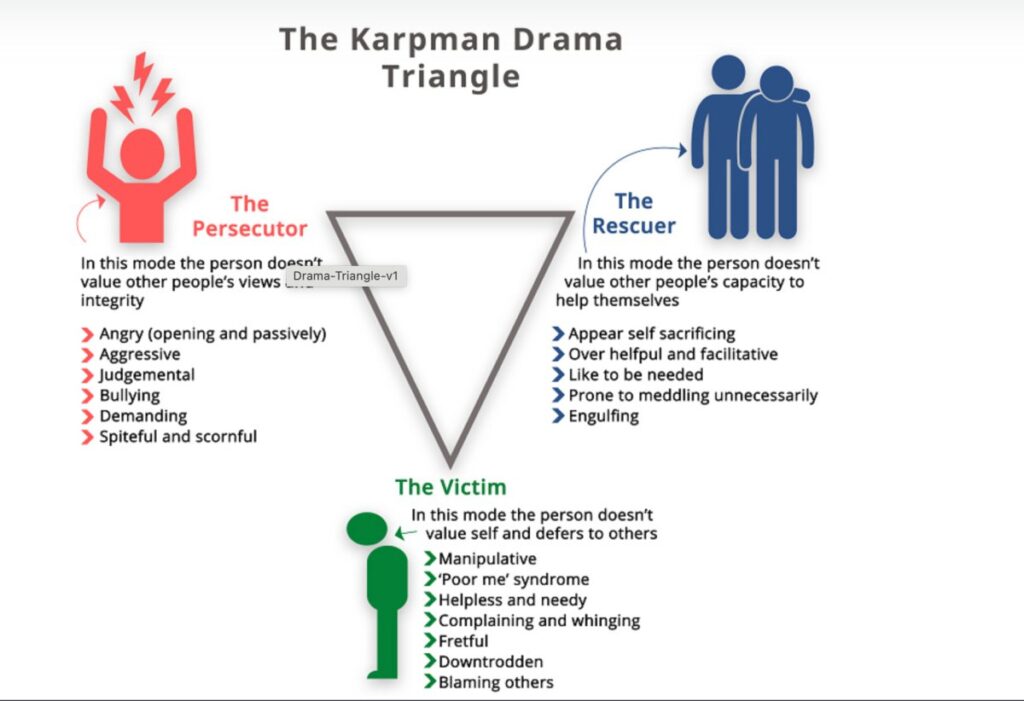
“My teen won’t talk to me anyway.” I hear this phrase more than almost any other in my practice. It’s a painful place to be, feeling like an intruder in the life of the person you love most. But silence isn’t usually a sign that they don’t care; it’s often a protective shield. When the “Four Horsemen” of conflict, criticism, contempt, defensiveness, and stonewalling, take up residence in your home, the psychological safety your teen needs to be vulnerable vanishes. If you’re attacking their character instead of their actions, or if they’ve started withdrawing to avoid your judgment, the bond is being eroded by these toxic communication patterns. Professional parenting support for teenagers provides the tools to dismantle these barriers and replace them with curiosity. Often, it’s our own parental anxiety that shuts them down. When we’re terrified of their choices, we stop being their “consultant” and start being their interrogator. This shift from connection to control is what drives them further away.
Utilising research-based parenting strategies helps us understand that the goal isn’t to win the argument, but to preserve the relationship. If you “win” a fight through sheer power or volume, you’ve actually lost a piece of their trust. The repair after a blowout is where the real growth happens. It takes courage to go to your teen and say, “I didn’t like how I handled that; I was frustrated and I’m sorry.” This vulnerability creates a bridge they can actually walk across. It’s about building a resilient relationship that can survive the friction of the adolescent years.
Breaking the Silence: When Teens Withdraw
It’s vital to know the difference between healthy privacy and concerning isolation. A teen who wants to spend time in their room is often just processing their emerging identity; however, a teen who stops engaging with friends or loses interest in their passions may be flagging a deeper struggle. To bridge the gap, try low-pressure connection. Side-by-side activities, such as a car ride or a walk, remove the intense pressure of eye contact and make sharing feel safer. Use “I statements” to express your own feelings. Instead of saying, “You’re always so secretive,” try, “I feel a bit disconnected lately and I miss our chats.” This invites them in without making them feel hunted or judged.
Managing Conflict without Escalation
I recommend the “Stop-Light” method for identifying when a conversation is becoming toxic. Green means you’re both calm and listening. Yellow means voices are rising and your heart is starting to race. Red means you must stop immediately. Nothing productive happens at Red; it’s just two nervous systems in a state of fight-or-flight. When you feel yourself hitting Red, call a “time-out” for the relationship. Practical parenting support for teenagers isn’t about never fighting; it’s about learning how to de-escalate in real-time so that conflict leads to understanding rather than resentment. Let’s talk about how to turn these heated moments into opportunities for deeper intimacy.
Practical Strategies for Daily Parenting Support
Transformation doesn’t happen in a single marathon conversation; it happens in the quiet, daily rhythms of your home. To move from conflict to connection, we need to implement consistent parenting support for teenagers that feels like a natural part of your life rather than a clinical chore. One of the most potent tools is the “10-minute rule.” This involves giving your teen ten minutes of completely undivided attention every day, where they lead the conversation and your phone is out of sight. During this time, focus on “Shared Joy.” Whether it’s laughing at a meme they found or listening to a song they like, these small deposits into their emotional bank account build the resilience needed for harder conversations later.
To keep this momentum, I suggest a 5-step daily ritual to ground your relationship. Start with a warm morning greeting that doesn’t include a “to-do” list. Follow this with a low-pressure check-in during transit, then the 10-minute rule of child-led connection. Later, offer a specific moment of verbal validation for something they did well, and conclude with a peaceful evening “reset” where you both agree to let go of the day’s friction. These steps create a predictable environment of safety. If you’re ready to deepen these skills, I invite you to explore my masterclasses on relationship building to turn these strategies into lasting habits.
Mastering Active Listening
Active listening is the bridge to intimacy. It requires you to mirror back what you hear without immediately offering a solution. Many parents fall into the “Interrogator” block, where every response is a question designed to extract information. This makes teens feel hunted rather than heard. Instead, use reflective techniques like, “It sounds like you felt really let down when that happened.” Ask open-ended questions that invite a narrative, such as, “What was the most surprising part of your day?” This allows them to share their internal world at their own pace.
Co-Regulation: The Secret to a Calm Home
A teenager’s nervous system is incredibly sensitive; it often mirrors the state of their parent’s system. If you enter a room with high anxiety or frustration, your teen will likely react with defensiveness or withdrawal. Co-regulation is the anchor in the adolescent storm. This means you must regulate your own emotions before engaging in a difficult talk. Take three deep breaths, step away for a moment, or practice a brief grounding exercise. When you remain calm, you provide a biological signal of safety that helps your teen settle their own internal chaos. Your calm is contagious, and it’s the most powerful tool you have for parenting support for teenagers.
Professional Support: Starting Your Journey with Tracy Kimberg
Choosing to seek professional parenting support for teenagers isn’t an admission of defeat; it’s a profound act of love and leadership. It takes immense strength to acknowledge when the tools you currently have aren’t enough for the complex journey ahead. I view therapy for teenagers not as a clinical necessity for “broken” families, but as a potent and proactive adventure. My approach is fundamentally person-centered and non-judgmental, rooted in the belief that every family has the capacity for healing. We don’t just look at the behaviour; we look at the dynamic between you, stripping away the shame to reveal the connection that’s been waiting to resurface.
Whether you join me for face-to-face therapy in Dorchester or connect through global online consultations, the goal remains the same: a resilient, happy relationship. In a world where over half a million young people were on NHS waiting lists as of July 2025, taking a private, proactive step ensures your family doesn’t have to wait for a crisis to find peace. I offer a space where you can be vulnerable without fear, providing the expert-led frameworks needed to navigate this transition from manager to consultant with grace. Seeking support shows your teen that you’re committed to the relationship, which is the most powerful message a parent can send.
What to Expect in a Session
Walking into a session can feel daunting, but I strive to create an environment that feels as warm as a living room and as safe as a sanctuary. Unlike generic parenting classes that offer one-size-fits-all advice, our work is deeply individualised. We’ll explore the specific emotional “blueprints” of your family, identifying where communication breaks down and how to rebuild it. My focus is always on “happy outcomes” and long-term emotional health. We aren’t just looking for a temporary truce; we’re building a foundation of trust that will support your child well into their adult years. It’s about creating a sustainable intimacy that survives the friction of adolescence.
Let’s Talk: Taking the First Step
The journey to a restored bond doesn’t require you to have all the answers right now. It only requires the willingness to start. Every meaningful transformation in a parent-teen relationship begins with a single, honest conversation. If you’re tired of the constant conflict and the feeling of walking on eggshells, let’s talk about how we can bring peace back to your home. Your relationship is worth the investment, and the path to connection is closer than you think. Start Your Journey Here.
Reclaiming Your Connection and Restoring Peace
The transition from a manager of behavior to a consultant of the soul isn’t easy, but it’s the most rewarding work you’ll ever do. We’ve explored how understanding the biological re-wiring of the adolescent brain can turn frustration into empathy. By prioritizing Relational Intelligence and validation, you replace the “Four Horsemen” of conflict with a secure base that your teen can always return to. This shift is the heart of effective parenting support for teenagers, moving your family from a state of crisis to one of calm optimism.
I’m here to guide you through this process. As a Relationship Expert grounded in the research of Gottman and Perel, I offer both face-to-face sessions at my Dorchester clinic and global online support. We’ll work together to build a resilient bond that lasts long after the teenage years have passed. You don’t have to navigate this journey alone. Let’s talk: Start your journey toward a better relationship with your teen today. Healing is possible, and a happier household is well within your reach.
Frequently Asked Questions
How do I know if my teenager needs professional parenting support?
Look for persistent changes in mood, withdrawal from activities they used to love, or a breakdown in communication that lasts more than 14 days. If your home has become a place of constant conflict where you feel like you’re walking on eggshells, seeking parenting support for teenagers can help you identify underlying emotional needs before they escalate. It’s a proactive step that shows you’re committed to the relationship’s long-term health.
What is the best way to communicate with a teenager who refuses to talk?
The most effective approach is to shift from direct questioning to “side-by-side” connection, such as chatting while driving or cooking together. This removes the intense pressure of eye contact, which many adolescents find confrontational or overstimulating. Focus on validation rather than fixing, showing them that you’re a safe harbor for their thoughts without the immediate threat of a lecture or judgment.
Is it normal for my teen to prefer their friends over their family?
Yes, this is a healthy and necessary developmental milestone known as individuation, where peers become the laboratory for testing their emerging identity. While it feels like a loss of the bond you once had, it’s actually a sign they’re developing the independence they’ll need as adults. Your role is shifting from a manager to a consultant who provides wisdom and support when they’re ready to seek it.
How can parenting support help with my teen’s anxiety or school stress?
Professional guidance helps you create a home environment that acts as a secure base to buffer external pressures. We work on co-regulation techniques, ensuring your own calm state helps settle their nervous system when academic stress peaks. This approach is vital when we consider that over 30% of teenage girls report clinically significant anxiety symptoms as of 2025, requiring a specialized, empathetic response from the family unit.
Can I seek parenting support even if my teenager refuses to attend therapy?
Absolutely, because you’re 50% of the relationship dynamic and changing your approach often triggers a profound shift in theirs. By learning new ways to “hold space” and set empathetic boundaries, you can unilaterally influence the household atmosphere and de-escalate conflict. Many parents find that when they transform their own communication style, their teen eventually becomes more open to joining the therapeutic process.
What is the difference between parenting coaching and family therapy?
Parenting coaching focuses on specific, actionable skills and strategies to improve the current relationship dynamic, while family therapy often dives deeper into historical patterns or psychological wounds. Coaching is a goal-oriented journey designed to build your confidence and communication skills in real-time. Both aim for “happy outcomes,” but the path depends on whether you need a tactical roadmap or deep emotional processing of family narratives.
How long does it typically take to see improvements in our relationship?
While every family is unique, many clients notice a shift in the household atmosphere within the first three to four sessions. Lasting change is an evolving process rather than a static treatment, requiring consistent application of new habits. By using rituals like the “10-minute rule,” you’ll begin to see the “Four Horsemen” of conflict recede as trust and intimacy are slowly but surely rebuilt in your daily interactions.
Do you offer online parenting support for families outside the UK?
Yes, I provide global online consultations to ensure that distance isn’t a barrier to your family’s journey toward healing. These sessions offer the same potent and person-centered care as my face-to-face clinic in Dorchester, tailored to your specific time zone and cultural context. Whether you’re in the UK or abroad, we can work together to navigate the complexities of the teenage years and build a resilient bond.

Article by
Tracy Kimberg
Tracy Kimberg is a Relationship Expert, Couples Therapist and Coach with a dedicated focus on helping couples and individuals rebuild connection, trust and emotional safety in their relationships. Drawing on the research of John and Julie Gottman, the relational insights of Esther Perel, and years of hands-on therapeutic experience, Tracy offers a warm, non-judgemental and deeply compassionate approach to modern relationships.
Based in Dorset, Tracy works with couples navigating communication breakdowns, betrayal, intimacy challenges, separation, family dynamics and life transitions. Known for creating a safe and grounded therapeutic space, she combines practical tools with emotional depth to help clients move beyond survival patterns and towards meaningful, lasting change.
With a reputation for empathy, professionalism and dedication to her clients’ growth, Tracy is passionate about helping people feel seen, understood and empowered — both within their relationships and within themselves.
Disclaimer
Disclaimer:
The information shared in this article is intended for educational and informational purposes only and should not be considered a substitute for professional therapeutic, psychological, medical or legal advice. Every individual and relationship is unique, and the perspectives offered are based on general therapeutic principles, research and professional experience.
Reading this article does not establish a therapist-client relationship with Tracy Kimberg. If you are experiencing significant emotional distress, relationship crisis, trauma, or mental health concerns, it is important to seek support from a qualified professional appropriate to your individual circumstances.
All content remains the intellectual property of Tracy Kimberg and may not be reproduced or distributed without permission.