

What if the growing distance between you isn’t a sign that the love has died, but a symptom of a relational system that simply needs a new architecture? It’s exhausting to live in the “roommate phase”, where conversations feel like administrative tasks and every disagreement circles back to the same unresolved pain. You might feel that your partnership is beyond repair, especially in the devastating aftermath of an affair or when the word “divorce” starts to feel like an inevitable escape. Engaging with a structured couples therapy programme offers more than just a place to vent. It provides a clinical and compassionate framework to dismantle old patterns and rebuild trust from the ground up.
I recognise the weight of this uncertainty, but there is a path through the noise. This article explores how a dedicated 12-week programme can transform your connection by blending the scientific rigour of the Gottman Method with the systemic insights of Esther Perel and trauma-informed care. We’ll look at the specific roadmap for healing that takes you from cyclical conflict to restored emotional intimacy. You’ll gain practical tools to handle contempt and find the clarity you need to either reimagine your partnership or move toward a conscious separation with dignity.
Key Takeaways
- Learn why a structured couples therapy programme creates the necessary momentum for change by using time-bound goals to move past the stagnant “roommate phase”.
- Discover how to integrate the research-led techniques of John Gottman and Esther Perel to dismantle conflict patterns and reignite desire whilst maintaining emotional security.
- Understand the week-by-week transition from de-escalating core relational wounds to building a robust toolkit for lasting trust and communication.
- Explore why infidelity and emotional neglect don’t have to signal the end, and how to navigate the specific stages of rebuilding a resilient, reimagined partnership.
- Gain the clarity needed to decide your future, whether that involves restoring deep intimacy or pursuing a healthy, conscious separation through professional guidance.
Why a Structured Couples Therapy Program is the Turning Point You Need
Many couples arrive at my door feeling like they’ve been running in circles for years. They’re stuck in what we call the “Roommate Phase”, where the passion has been replaced by a polite, hollow rhythm of managing chores and children. This isn’t just a lack of effort; it’s often a failure of the system you’ve built together. A structured couples therapy program shifts the focus from simply talking about your problems to actively re-engineering the space between you. Instead of aimless venting, we use a 12-week recovery process designed as a goal-oriented intervention. This timeframe isn’t arbitrary; it creates a healthy sense of urgency that prevents the “wait and see” procrastination that often leads to the divorce courts.
We’re moving beyond traditional talk therapy. Whilst understanding the “why” is important, it doesn’t always change the “how” of your daily interactions. We focus on emotional recalibration, teaching you how to feel safe in each other’s presence again. It’s about dismantling deep-seated resentment and replacing it with a new, resilient architecture for your partnership. By framing the work as a time-bound project, we can tackle the hard truths without the fear that therapy will become a permanent, painful fixture in your life.
The Sweet Spot of Habit Formation
Changing how you relate to your partner requires more than just good intentions; it requires neuroplasticity. Our brains are wired to follow the path of least resistance, which is often the defensive, reactive behaviour we’ve used for years. Research suggests that 90 days is the clinical benchmark for truly establishing new communication patterns. In a 2026 psychological context, relational habit restructuring is the intentional recalibration of neural pathways through repeated, micro-interventions that replace defensive reactivity with secure attachment behaviours. By the time you reach the end of the 12 weeks, these new ways of connecting start to feel like your default setting rather than a forced effort.
Structured vs. Open-Ended Therapy
Traditional Couples therapy can sometimes feel like a boat without a rudder, where you drift from one weekly crisis to the next without a clear destination. This open-ended approach often causes anxiety, particularly for hesitant partners who fear they’ll be trapped in a clinical setting indefinitely. A structured programme provides a weekly roadmap with a clear end-date. It allows you to see the progress you’re making in real-time. Having a Wise Guide to manage the pace of recovery ensures that you don’t get overwhelmed by the hard truths, but you don’t stall in your growth either. It’s a proactive adventure that transforms the weight of your problems into a manageable, step-by-step path toward healing.
The Science of Connection: Integrating Gottman, Perel, and Maté
Connection is rarely a straight line. It’s a complex weave of biological responses, childhood echoes, and learned behaviours. To truly heal a relationship, we can’t rely on a single lens. That’s why this structured couples therapy program integrates the world’s most effective clinical frameworks into one cohesive journey. We don’t just look at what you’re saying; we look at the physiological and psychological architecture of your bond. By blending these diverse perspectives, we create a more robust path to healing that addresses the heart, the mind, and the nervous system.
Using the Gottman Method, we identify the specific communication patterns that predict relationship failure with startling accuracy. But we go deeper. By incorporating Gabor Maté’s trauma-informed insights, we begin to understand why certain words from your partner feel like a physical blow. It’s often because they’ve brushed against an old, unhealed wound. When we layer this with Esther Perel’s wisdom on erotic intelligence, we create a space where you can be both safe and surprised by one another. This eclectic, evidence-based approach ensures that we aren’t just patching up a leak, but rebuilding the entire vessel.
Dismantling the Four Horsemen
During the first phase of the program, we focus on identifying the “Four Horsemen”: Criticism, Contempt, Defensiveness, and Stonewalling. These are the specific toxins that erode trust and intimacy in daily life. We don’t just point them out; we spend the first four weeks replacing them with Gottman Antidotes. For instance, we trade Criticism for a “Gentle Start-up” and Defensiveness for taking responsibility. As your therapist, I act as a referee in these high-conflict moments, helping you slow down the conversation so you can actually hear what’s being said beneath the anger. If you’re ready to move beyond the surface and explore these dynamics, you might find that working with a specialist provides the breakthrough you’ve been searching for.
Eroticism and Security: The Perel Paradox
One of the hardest challenges for long-term couples is balancing the need for security with the need for mystery. Esther Perel teaches us that intimacy requires both closeness and distance. If you’re too close, there’s no room for desire. If you’re too far, there’s no safety. Our recovery process addresses these intimacy issues without making them feel clinical or forced. We use practical exercises to help you reconnect emotionally and physically amongst the chaos of work and family life. This helps you rediscover the person you fell in love with, whilst maintaining the secure base you need to weather life’s storms together.
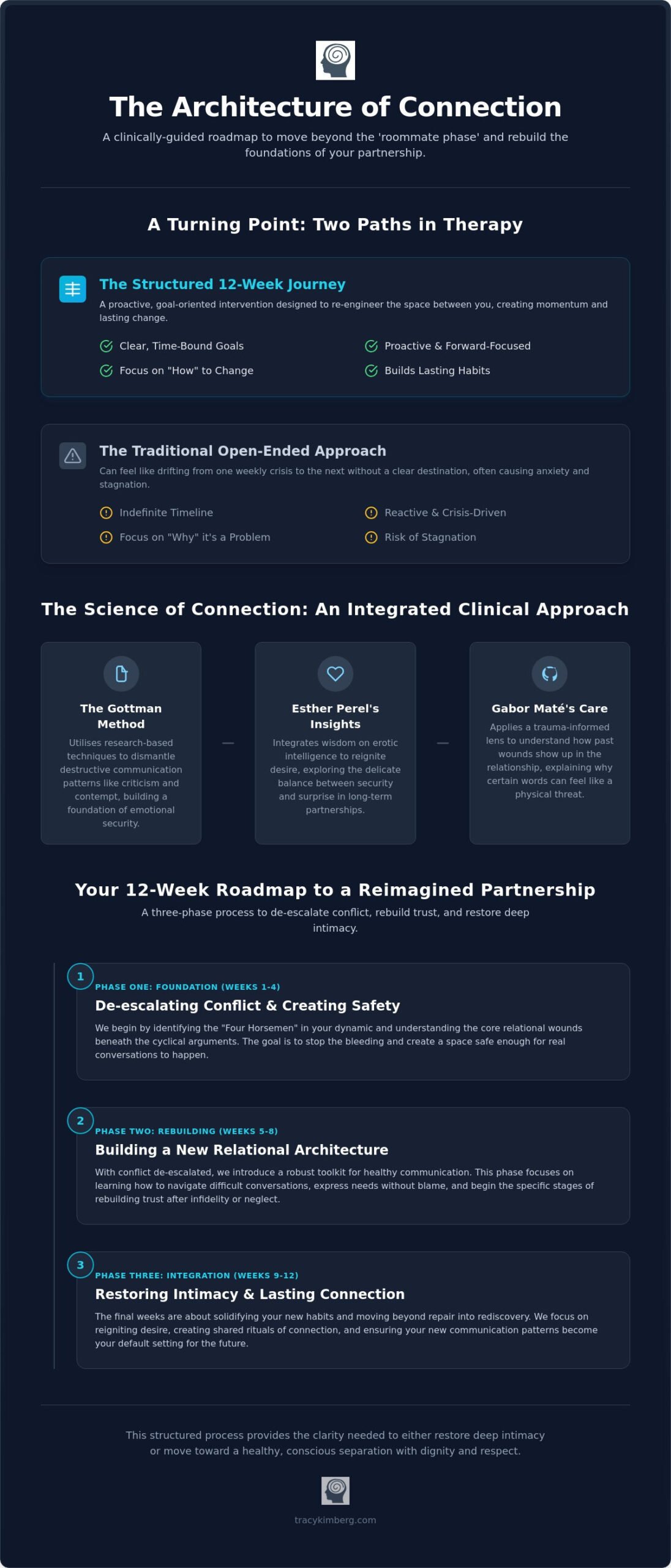
Breaking the Cycle: A Week-by-Week Roadmap of the Recovery Process
Healing often feels like trying to navigate a forest in the dark. Without a map, you’re likely to stumble into the same thickets of resentment you’ve been trying to escape. A structured couples therapy program serves as that map, offering a predictable rhythm to an otherwise chaotic emotional experience. Over 12 weeks, we move from crisis management to sustainable connection, ensuring that every session builds on the last. This isn’t about a quick fix; it’s about a deliberate, clinical arc that respects the complexity of your bond.
The real transformation happens in the 167 hours between our sessions. Homework and consistent practice are vital; they solidify the progress we make in the room and turn new behaviours into lasting habits. By following a structured path, we ensure that no stone is left unturned, from the initial assessment to the final integration of your new relational skills.
Phase 1: Stabilisation and Safety (Weeks 1-3)
The first three weeks are about “stopping the bleeding”. We create a safe, non-judgemental space where both of you can speak without the fear of being attacked or dismissed. We implement immediate truce protocols, giving you the tools to de-escalate arguments before they spiral out of control. During this phase, the initial assessment determines the specific 12-week trajectory by pinpointing the unique relational wounds and attachment styles that have brought you to this point. We focus on validation and hearing each other’s pain, perhaps for the first time in years.
Phase 2: The Deep Work of Rebuilding (Weeks 4-8)
Once the relationship is stable, we dive into the issues that have been simmering beneath the surface. This is where we tackle the hard truths: sexual disconnect, parenting friction, or the heavy weight of financial stress. If you’re navigating the aftermath of an affair, these weeks are dedicated to the arduous but possible task of rebuilding trust step-by-step. We use courageous conversations to help you express needs without blame. Individual reflection sessions within the couples framework often happen here, allowing each partner to explore their own triggers and contributions to the dynamic without the other partner present.
Phase 3: Integration and The New Normal (Weeks 9-12)
The final month focuses on future-proofing your partnership. We establish a “new normal” that isn’t just a return to how things were, but a reimagined way of being together. We focus on:
- Establishing daily rituals of connection that fit your busy lives.
- Mastering conflict resolution tools that prevent the return of contempt.
- Developing a shared vision for your future, whether that’s a renewed marriage or a healthy, conscious separation.
By week 12, the goal is for you to feel equipped with a toolkit that you can use long after our time together has concluded.
Addressing the Hard Truths: Infidelity, Contempt, and Emotional Neglect
Entering a structured couples therapy program means looking directly at the parts of your relationship you’ve likely tried to bury. It’s about facing the “shadow” of the partnership, where betrayal and long-term neglect reside. We don’t avoid these sharp edges; we lean into them with clinical precision and deep empathy. These hard truths aren’t necessarily the end of your story. Often, they’re the catalyst for a much deeper, more authentic connection if you’re both willing to do the work. We create a space where the “unspeakable” can finally be processed and understood.
Whether you’re reeling from a physical betrayal or the slow erosion of your emotional bond, the 12-week arc provides a container for this pain. We move beyond the surface-level anger to find the underlying wounds that allowed these patterns to take root. This process isn’t about assigning blame; it’s about taking radical responsibility for the future you want to build together.
The Path Through Infidelity
Betrayal is a profound trauma that shatters your shared reality. Whilst it feels final, infidelity doesn’t have to be the end. We look for the “why” behind the affair without ever excusing the behaviour. Our recovery follows three essential clinical stages: Atonement, where the hurt is fully acknowledged and transparency is established; Attunement, where we learn to hear the needs that went unmet; and Attachment, where the bond is rebuilt on new, more honest ground. Often, an emotional affair hurts more than a physical one because the non-physical betrayal feels like a deeper invasion of the heart’s private sanctum. If you’re struggling to find a way back, exploring Couples Therapy for Infidelity: Rebuilding Trust can provide the focused, trauma-informed support you need right now.
Recognising Emotional Neglect
Sometimes the greatest threat isn’t a single explosion like an affair, but the quiet, persistent chill of emotional neglect. It’s that “lonely in a relationship” feeling where you’re sitting next to each other but feel miles apart. We distinguish between simple disappointment, which is a normal part of life, and contempt, which is a toxic sense of superiority that erodes your partner’s self-worth. We use practical exercises to help you reconnect through “bids for attention”. These are the small, daily moments where you reach out for a look, a touch, or a word. If the emotional gap has grown too wide to bridge, we pivot to a Conscious Separation. This isn’t a failure; it’s a healthy, respectful way to conclude a chapter whilst protecting the emotional well-being of everyone involved. If you find yourself at this crossroads, book a consultation to explore your path forward.
Reclaiming Your Partnership with Tracy Kimberg
Choosing to embark on a structured couples therapy program is a profound act of courage. It’s a declaration that your relationship, despite its current fractures, is worth the effort of restoration. In my role as your Wise Guide, I don’t just observe your struggles; I walk alongside you through the transformational journey. We move beyond the weight of the problems to focus on the possibility of healing. This isn’t just about surviving a crisis; it’s about thriving in a reimagined partnership built on research-led foundations.
The flexibility of our work ensures that support is accessible, no matter your location or schedule. Whether you prefer face-to-face sessions or the convenience of online therapy from anywhere in the world, the quality of care remains constant. For busy UK and international couples, this digital accessibility means that healing can happen within the flow of your daily life, rather than becoming another logistical burden. Once the 12 weeks conclude, the journey doesn’t end. You’ll leave with the resilience and emotional health tools necessary to maintain your new normal for the long term.
A Personalised, Expert Approach
My approach blends the clinical depth of psychological therapy with the forward-moving energy of coaching. This “best of both worlds” experience allows us to heal past wounds whilst simultaneously building a concrete plan for your future. I provide a safe, non-judgemental environment where even the most vulnerable conversations can take place without fear of shame. If you’re curious about the mechanics of our work together, you can learn more about Relationship Coaching for Couples: What to Expect and how it integrates with the therapeutic process.
Your Next Steps Today
To maximise the 12-week window, I encourage you to come with an open heart and a willingness to be seen. It’s completely normal for one partner to feel more hesitant than the other. If you’re facing partner resistance, remember that this programme is designed to be manageable and supportive, not an interrogation. Taking the first proactive step is often the hardest part, but it’s also the most rewarding. I invite you to Begin your 12-week recovery journey with Tracy Kimberg today by booking your initial discovery call. Let’s explore the possibilities for your partnership together.
Reimagining Your Future Together
Rebuilding a partnership isn’t about erasing the past; it’s about integrating your shared history into a more resilient future. We’ve explored how a structured couples therapy program provides the clinical framework necessary to move beyond the “roommate phase” and address deep wounds like infidelity or emotional neglect. By blending the research-led insights of Gottman and Perel with a trauma-informed perspective, you can move from reactive conflict to secure, lasting attachment.
Whether you’re seeking expert support for an emotional disconnect or navigating the complexity of a betrayal, you don’t have to navigate this landscape alone. This transformational process is available both online and face-to-face in the UK, offering a safe, non-judgemental space to rediscover the intimacy you thought was lost. It’s time to stop surviving and start thriving in a partnership that feels safe, seen, and vibrant.
Book Your Discovery Call for the 12-Week Relationship Recovery Process
Your relationship has a unique story that deserves to be honoured. I’m here to help you write the next chapter with clarity and compassion.
Frequently Asked Questions
Is 12 weeks really enough time to fix a marriage that has been struggling for years?
Twelve weeks is designed to be a powerful catalyst for change rather than a complete life overhaul. Whilst deep-seated issues take time to heal, this timeframe creates the necessary urgency to break stagnant patterns and implement new communication habits. It provides a solid foundation for long-term growth by teaching you the tools to continue the work independently once the initial programme concludes.
What happens if my partner refuses to participate in the relationship recovery programme?
How does this 12-week process differ from traditional, open-ended couples counselling?
Traditional therapy often follows a “crisis of the week” format, which can feel aimless and slow. This structured process follows a clinical roadmap with specific milestones, moving from assessment to deep work and finally integration. Having a clear end date reduces anxiety and ensures we stay focused on your long-term relational health rather than just putting out fires in each session.
Can this programme help us if there has been a physical or emotional affair?
Healing after a betrayal is a core component of this recovery process. We use a trauma-informed approach to navigate the stages of rebuilding trust, whether the affair was physical or emotional. By creating a safe space for honest disclosure and emotional repair, we help you understand the “why” behind the betrayal whilst focusing on establishing a new, more transparent bond for the future.
Is the 12-week relationship recovery available for couples outside of the UK?
What if we realise during the 12 weeks that we actually want to separate?
Realising that separation is the healthiest path is a valid and successful outcome of our work together. If we determine that the emotional gap is too wide to bridge, I provide support for a Conscious Approached Divorce and separation. This ensures that you can conclude your partnership with dignity and respect, protecting the emotional well-being of everyone involved as you move forward.
Do we need to attend sessions face-to-face, or is online therapy just as effective?
Online therapy is proven to be just as effective as face-to-face sessions for relationship improvement. A 2024 study confirmed that programmes based on the Gottman principles show equal results regardless of the setting. Whether we meet in person or via a screen, the focus remains on the human connection and the research-led techniques that drive your recovery and long-term resilience.
What is the commitment level required for the homework and exercises between sessions?
The real transformation happens in the 167 hours between our weekly sessions. You’ll need to commit to small, daily exercises and “bids for connection” to solidify the progress we make in the room. This isn’t about overwhelming tasks; it’s about intentional micro-habits that recalibrate your nervous system and build a more resilient partnership over the 90-day clinical benchmark for habit formation.

Article by
Tracy Kimberg
Tracy Kimberg is a Relationship Expert, Couples Therapist and Coach with a dedicated focus on helping couples and individuals rebuild connection, trust and emotional safety in their relationships. Drawing on the research of John and Julie Gottman, the relational insights of Esther Perel, and years of hands-on therapeutic experience, Tracy offers a warm, non-judgemental and deeply compassionate approach to modern relationships.
Based in Dorset, Tracy works with couples navigating communication breakdowns, betrayal, intimacy challenges, separation, family dynamics and life transitions. Known for creating a safe and grounded therapeutic space, she combines practical tools with emotional depth to help clients move beyond survival patterns and towards meaningful, lasting change.
With a reputation for empathy, professionalism and dedication to her clients’ growth, Tracy is passionate about helping people feel seen, understood and empowered — both within their relationships and within themselves.
Disclaimer
Disclaimer:
The information shared in this article is intended for educational and informational purposes only and should not be considered a substitute for professional therapeutic, psychological, medical or legal advice. Every individual and relationship is unique, and the perspectives offered are based on general therapeutic principles, research and professional experience.
Reading this article does not establish a therapist-client relationship with Tracy Kimberg. If you are experiencing significant emotional distress, relationship crisis, trauma, or mental health concerns, it is important to seek support from a qualified professional appropriate to your individual circumstances.
All content remains the intellectual property of Tracy Kimberg and may not be reproduced or distributed without permission.