

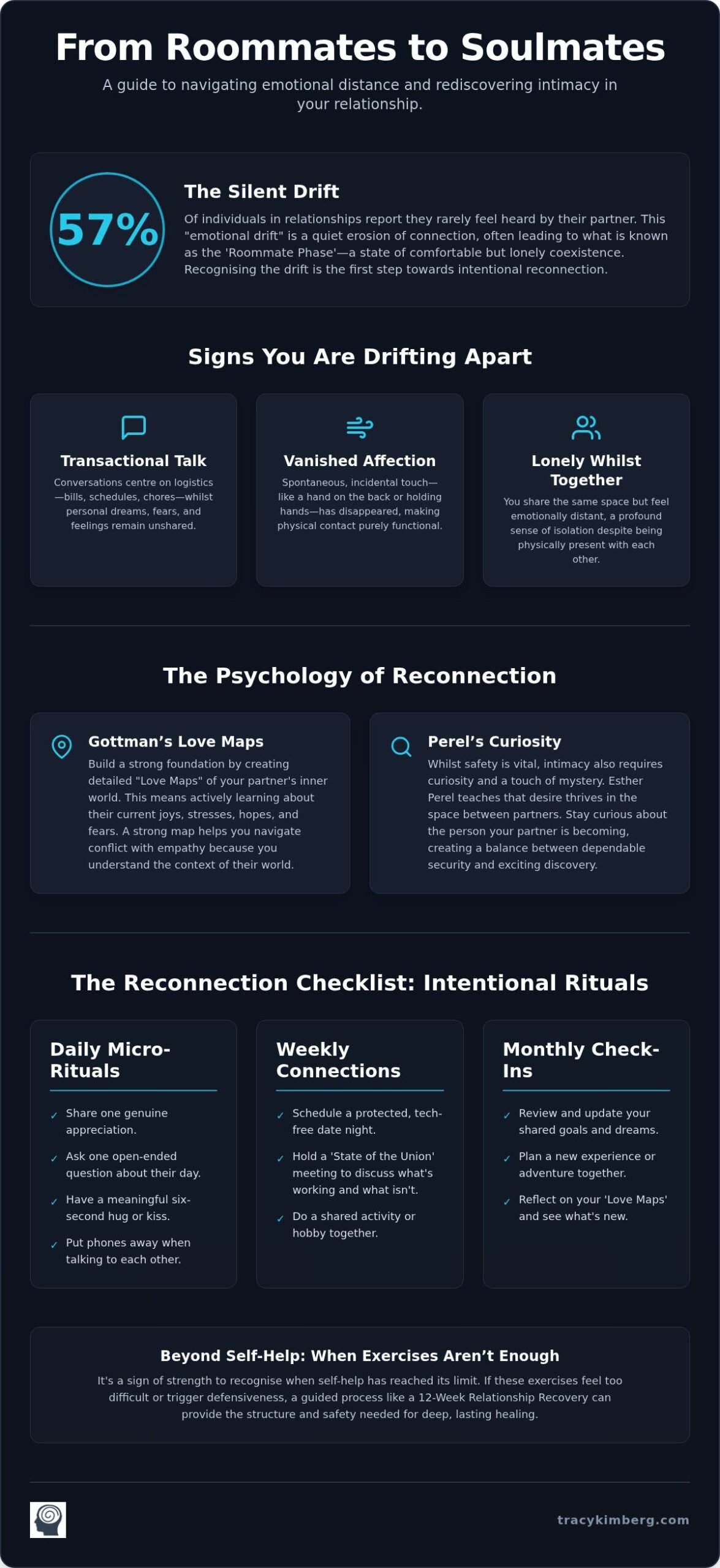
Have you ever sat on the sofa with your partner, both of you scrolling through your phones in a silence that feels more like a wall than a sanctuary? You aren’t arguing, yet you aren’t really together either. It’s that unsettling realisation that you’ve become accidental roommates. Research suggests you aren’t alone; 57% of individuals in relationships say they rarely feel heard by their partner. If you’re searching for exercises for couples to reconnect, it’s likely because you feel that the spark has faded and you’re anxious about how to bring it back. However, the distance between you isn’t a dead end; it’s often just a lack of intentional movement.
In this guide, I’ll share seven research-backed techniques that bridge the emotional gap and lower the tension in your home. We’ll explore practical micro-rituals and provide a checklist to help you move back towards being soulmates. You’ll discover a clear path forward to rediscover the intimacy you thought was lost, including how to recognise when you might need the more intensive support of the 12-Week Relationship Recovery Process. Connection is not a destination but a practice of intentional rituals that balance safety with curiosity.
Key Takeaways
- Recognise the subtle signs of “Emotional Drift” to prevent your partnership from slipping into a comfortable but disconnected “roommate phase”.
- Utilise research-backed frameworks from experts like Gottman and Perel to rebuild your Love Maps and balance security with curiosity.
- Implement practical exercises for couples to reconnect that prioritise “safe space” communication and avoid the triggers of defensiveness.
- Create a sustainable rhythm of intimacy through micro-connections, using a structured checklist of daily and weekly rituals to build your emotional bank account.
- Identify when self-help reaches its limit and understand how a guided 12-Week Relationship Recovery Process can provide the safety needed for deep healing.
The Silent Drift: Why Even Healthy Couples Lose Connection
We often imagine that relationships end in a grand explosion of conflict. In reality, they are more likely to erode through a quiet, almost imperceptible process called emotional drift. This occurs when small omissions, like forgetting to ask how a meeting went or failing to look up from a screen when your partner enters the room, accumulate over months or years. You aren’t fighting; you’re simply fading out of each other’s inner lives. It’s a slow retreat from the shared vulnerability that defines what an intimate relationship is at its core.
This state is frequently referred to as the ‘Roommate Phase’. It’s a natural result of complacency where the logistics of life take precedence over the soul of the union. Whilst it feels safe, it’s a dangerous plateau. Recognising this gap and seeking exercises for couples to reconnect is a sign of relational health. It shows you value the bond enough to fight the gravity of the mundane. True connection requires a conscious, daily effort to bridge the gaps that life naturally creates amongst the chaos of work, family, and social obligations.
Signs You Are Drifting into the Roommate Phase
- Conversations are purely transactional. You discuss the mortgage, the children’s schedules, or what’s for dinner, but you haven’t discussed your personal dreams or fears in weeks.
- Incidental touch has vanished. You no longer hold hands whilst walking or offer a spontaneous squeeze of the shoulder. Physical contact has become functional rather than affectionate.
- You feel lonely whilst together. This specific type of isolation is the most common indicator of a disconnect. You are in the same room, but you feel miles apart emotionally.
The Role of Stress and Modern Life
Our modern, cortisol-heavy lifestyles are often the primary culprits. When our nervous systems are stuck in ‘survival mode’ due to work pressures or financial stress, intimacy feels like a luxury we can’t afford. We begin to ignore what John Gottman calls ‘bids for connection’, those small, subtle attempts to get attention or affection. Digital distractions worsen this; it’s often easier to scroll through a social feed than to engage in a potentially difficult conversation with the person sitting next to you.
In the UK, the traditional ‘stiff upper lip’ can add another layer of difficulty. We are often culturally conditioned to keep our struggles to ourselves, which directly hinders the emotional openness needed for deep reconnection. Breaking this silence is a proactive adventure. Practising specific exercises for couples to reconnect helps lower the emotional stakes, making it safer to speak your truth and move from accidental roommates back to intentional soulmates.
The Psychology of Reconnection: Research-Based Frameworks
To begin the journey back to one another, we must first change how we view the work. Many couples approach exercises for couples to reconnect with a sense of dread, fearing they are a final test of the relationship’s viability. I invite you to view these as experiments instead. This shift in perspective, inspired by the clinical wisdom of experts like Gabor Maté, allows us to lower performance anxiety. Maté teaches us that our present-day triggers often stem from past attachment wounds. By treating reconnection as a curious exploration rather than a clinical necessity, we create the safety required for genuine vulnerability.
Gottman’s Love Maps: Knowing Your Partner’s Inner World
John Gottman’s research highlights the ‘Sound Relationship House’, where the foundation is built on Love Maps. A Love Map is essentially the cognitive space you hold for your partner’s history, joys, and current stresses. It is the difference between knowing they like coffee and knowing why they find that specific morning ritual so grounding. We change constantly; therefore, updating your map is vital. If you don’t, you risk loving a version of your partner that no longer exists. Practising therapy-based relationship exercises to ask open-ended questions helps you navigate conflict more successfully because you truly understand the context of your partner’s reactions.
Perel’s Curiosity: Balancing Safety with Mystery
Whilst Gottman emphasises the need for safety, Esther Perel reminds us that intimacy also requires a degree of distance. In her view, the tension between the need for security and the need for adventure is what fuels desire. Too much closeness can lead to a sense of fusion where the ‘spark’ is extinguished. To rediscover each other, you must maintain your individual identities. Reconnection isn’t just about becoming ‘one’; it’s about being two distinct people who choose to see each other anew. Specific exercises for couples to reconnect should encourage you to look at your partner with the curiosity of a stranger, noticing the parts of them that exist outside of your domestic roles.
If exploring these complex psychological landscapes feels overwhelming, professional support can provide the structured guidance you need. Engaging with relationship counselling and coaching can help you translate these theories into lasting, positive change for your partnership.
Foundational Communication Exercises to Break the Silence
If you’ve spent months or years in a quiet withdrawal, the prospect of deep intimacy can feel overwhelming. Before diving into complex emotional work, it’s helpful to begin with foundational exercises for couples to reconnect that focus on safety rather than intensity. Creating a ‘Safe Space’ is about ensuring that neither partner feels ambushed. One of the most effective ways to do this is through ‘Gentle Start-ups’. Instead of leading with a grievance, start with your own feelings and a positive need. For example, ‘I’ve been feeling a bit lonely lately, and I’d love to spend ten minutes just chatting tonight’ is far more inviting than ‘You never talk to me anymore.’
Establishing non-negotiable rituals helps to lower the anxiety surrounding these interactions. A Ten-Minute Daily Check-In provides a predictable container for connection. During this time, the focus isn’t on household chores or the children’s schedules. It’s a dedicated window to check the temperature of your relationship. To balance this, I often recommend an Appreciation Journal. Each day, write down one thing you appreciate about your partner. Shifting your focus from their flaws to your favourite qualities about them can fundamentally alter the emotional atmosphere of your home.
The Speaker-Listener Technique
This exercise is designed to stop the cycle of defensiveness. One partner holds the ‘floor’ whilst the other listens without interrupting, judging, or offering immediate solutions. As the listener, your only job is to summarise what you’ve heard. You might say, ‘So, what I’m hearing is that you feel overwhelmed by the morning routine and you need more support with the school run. Is that right?’ This ensures your partner feels truly seen and heard. Crucially, remember that validation does not always mean agreement. You can acknowledge that your partner’s feelings are real and valid to them, even if you remember the situation differently.
The High-Low-Buffalo Exercise
For couples with demanding careers or young children, finding the energy for deep dialogue is difficult. The High-Low-Buffalo exercise is a low-pressure way to build a shared narrative of your separate days. You each share your ‘High’ (the best part of the day), your ‘Low’ (the most challenging part), and your ‘Buffalo’ (something random or unexpected). These small exercises for couples to reconnect might seem simple, yet they act as micro-connections. They prevent the ‘silent drift’ by ensuring you remain witnesses to the small, everyday details of each other’s lives, rebuilding the friendship that serves as the bedrock of your intimacy.
The Reconnection Checklist: Daily, Weekly, and Monthly Rituals
Rebuilding intimacy doesn’t always require a grand, cinematic gesture. In fact, lasting change is more likely to grow from small, consistent habits that scale with your daily energy levels. I often encourage couples to think of these exercises for couples to reconnect as deposits into an emotional bank account. When life gets difficult, a high balance of positive interactions provides the cushion you need to navigate stress without turning on each other. By integrating micro-connections into your schedule, you transform the domestic routine into a series of opportunities for closeness.
Daily Micro-Rituals (The 5-Minute Plan)
Consistency is the heartbeat of a healthy partnership. Start with the ‘Six-Second Kiss’, a technique championed by John Gottman. A six-second kiss is long enough to feel like a moment of genuine connection and triggers the release of oxytocin, the ‘bonding hormone’. It’s a simple way to transition from the stress of work back into the safety of home. Combine this with a ‘Morning Send-off’. Before you part ways, ensure you know at least one significant thing happening in your partner’s day. This small act of witnessing their life outside your shared home builds a bridge of interest that lasts until you reunite. Finally, establish a ‘Device-Free Zone’ during dinner or the thirty minutes before sleep. Turning off the screens allows you to be fully present, making space for the spontaneous conversations that keep intimacy alive.
Weekly and Monthly Deep Dives
Whilst daily habits build the foundation, weekly and monthly rituals provide the structural support for long-term growth. I recommend a ‘Weekly State of the Union’ meeting. This is a dedicated time to discuss any ‘niggles’ or logistical frustrations before they harden into resentment. Balance this by sharing three specific things you admired about your partner during the week. This practice of ‘Weekly Appreciation’ trains your brain to scan for the positive rather than the negative. On a monthly basis, step outside your domestic roles with a ‘Monthly Adventure’. Whether it’s a ‘Digital Detox Date’ or a ‘Future Dreaming’ session where you plan a trip for the next year, these activities introduce the ‘mystery’ Esther Perel speaks of. They remind you that you are individuals with shared dreams, not just co-parents or co-habitants.
If these exercises for couples to reconnect feel like they are highlighting deeper cracks rather than mending them, you don’t have to navigate this alone. You can book a session for relationship counselling and coaching to gain the professional tools and safe environment required to truly heal your bond.
Beyond Self-Help: When Exercises Aren’t Enough
Whilst self-directed exercises for couples to reconnect are powerful tools for many, there are moments when the emotional weight of a disconnect requires more than a checklist. It’s vital to recognise when your efforts at home are being blocked by deeper, systemic issues. Certain “red flags” suggest that self-help has reached its limit. If your interactions are consistently defined by contempt, a total withdrawal from communication, or the presence of unaddressed trauma, trying to “fix” things alone can often lead to further frustration. In these instances, seeking a professional, guided environment is not a sign of failure; it’s a courageous step towards a more profound healing.
Relational coaching offers a proactive space where you can dismantle destructive patterns without the fear of the conversation spiralling out of control. When trust has been significantly damaged, perhaps through infidelity or long-term neglect, professional guidance provides the necessary scaffolding. It allows you to move beyond simple crisis management and towards a state of intentional thriving. This structured approach ensures that both partners feel safe enough to be vulnerable, which is the only state in which true reconnection can occur.
The 12-Week Relationship Recovery Process
For couples who find that individual exercises aren’t providing the lasting change they crave, the 12-Week Relationship Recovery Process offers a transformational journey. This programme is designed to provide a clear, time-bound structure that demystifies the therapeutic process. By moving through specific stages of recovery, you aren’t just treating symptoms; you’re rebuilding the very foundation of your partnership. Professional coaching acts as a compass, helping you navigate the complexities of your history whilst teaching you the research-based skills needed for a resilient future. It’s about creating a new narrative for your relationship, one grounded in mutual respect and renewed intimacy.
Taking the First Step Toward Healing
Inviting a partner into coaching can feel daunting, especially if there is a history of reluctance or defensiveness. The key lies in shifting your language from “blaming” to “longing.” Instead of focusing on what your partner is doing wrong, express your own desire for closeness and your fear of losing the bond you once shared. You might say, “I miss the version of us that felt like a team, and I’d love some professional help to find our way back there.” This approach invites your partner into a collaborative solution rather than a lecture. If you’re ready to explore how a structured path could change your lives, you can book a discovery call to explore the 12-Week Relationship Recovery Process and take that first decisive step toward a brighter emotional future.
Choosing an Intentional Path Toward Closeness
The journey from being accidental roommates back to intentional soulmates doesn’t happen overnight; it begins with a single, conscious choice. We have explored how the silent drift can be reversed through research-backed frameworks and practical micro-rituals. By updating your Love Maps and embracing techniques like the Speaker-Listener method, you shift the domestic atmosphere from logistical coldness to emotional warmth. These exercises for couples to reconnect are your first steps toward rebuilding the intimacy that daily chaos often crowds out.
If you find that your patterns are too deeply ingrained for self-help alone, there is no shame in seeking a Wise Guide. As a specialist in relationship recovery, I offer a safe and non-judgemental environment inspired by the methodologies of Gottman and Perel. Whether you start with small daily habits or require the structural scaffolding of a professional programme, the possibility of healing is always within reach. You deserve a partnership that feels like a sanctuary rather than a chore. Rediscover your connection with the 12-Week Relationship Recovery Process and begin your proactive adventure toward a more vibrant, connected future today.
Frequently Asked Questions
What are the best exercises for couples to reconnect after a long period of distance?
The most effective approach involves small, research-based rituals that prioritise safety and friendship. I recommend starting with Gottman’s “Love Maps” to update your knowledge of your partner’s current inner world. These exercises for couples to reconnect work best when they focus on low-pressure curiosity rather than tackling deep-seated conflicts immediately. By learning about your partner’s latest dreams or stresses, you rebuild the foundation required for deeper emotional intimacy.
Can these exercises help if only one partner is willing to try?
One partner’s shift in behaviour can often transform the entire relationship dynamic. Whilst a healthy partnership requires two people for full intimacy, your individual commitment to being more curious and less defensive can lower the tension in your home. This change creates a safer environment that may eventually invite a reluctant partner to join the process. If unilateral efforts feel insufficient, professional coaching can provide the necessary tools to navigate this imbalance.
How long does it take to see results from emotional connection exercises?
Many couples notice a subtle shift in their emotional atmosphere within the first week of consistent practice. Short micro-rituals, such as the six-second kiss or daily check-ins, provide immediate deposits into your emotional bank account. However, reversing years of emotional drift is a gradual process. Significant, lasting transformation typically requires several months of intentional effort. This is why a structured 12-Week Relationship Recovery Process is often more effective than sporadic self-help.
What should we do if an exercise leads to an argument instead of a connection?
It is helpful to view an argument as a sign that you’ve touched a raw spot that needs gentle attention. If tension rises, take a “self-soothing” break for at least twenty minutes to lower your cortisol levels. Once you are both calm, return to the conversation with curiosity instead of blame. Ask yourself what underlying need or fear was triggered. Seeing these moments as data rather than failure helps you stay on the path.
Are there specific exercises for couples to reconnect after infidelity?
Reconnecting after infidelity requires specialised exercises that prioritise transparency and the slow rebuilding of safety. Initial work often focuses on emotional attunement and creating a non-judgemental space for the betrayed partner to express their pain. Because trust has been compromised, these exercises for couples to reconnect are most successful when conducted within the scaffolding of a professional environment, such as a guided recovery programme that addresses the root causes of the breach.
How often should we perform these reconnection exercises?
Consistency is far more vital than intensity when you are rebuilding a bond. Daily micro-rituals, such as a five-minute check-in, should be non-negotiable habits. Weekly deep dives, like a “State of the Union” meeting, help you address larger niggles before they turn into resentment. Think of these practices as the heartbeat of your relationship. Regular, small interactions prevent the roommate phase from returning and keep your emotional connection active and evolving.
Can online relationship coaching be as effective as face-to-face therapy?
Online therapy is a highly effective and flexible way to access specialised support for your relationship. It allows you to engage in deep emotional work from the comfort and safety of your own home, which can often lower initial anxiety. Whether you choose online or face-to-face sessions, the most critical factor is the quality of the therapeutic relationship and the use of research-based methodologies inspired by experts like Gottman and Perel.
What is the most important factor in making these exercises work?
The most vital factor is intentionality combined with a genuine desire for connection. No exercise will be effective if it’s treated as a chore or a way to prove your partner wrong. You must approach the work with a spirit of calm optimism and a willingness to be vulnerable. Success comes when both partners commit to the process as a proactive adventure, focusing on the possibility of healing rather than the weight of the problems.

Article by
Tracy Kimberg
Tracy Kimberg is a Relationship Expert, Couples Therapist and Coach with a dedicated focus on helping couples and individuals rebuild connection, trust and emotional safety in their relationships. Drawing on the research of John and Julie Gottman, the relational insights of Esther Perel, and years of hands-on therapeutic experience, Tracy offers a warm, non-judgemental and deeply compassionate approach to modern relationships.
Based in Dorset, Tracy works with couples navigating communication breakdowns, betrayal, intimacy challenges, separation, family dynamics and life transitions. Known for creating a safe and grounded therapeutic space, she combines practical tools with emotional depth to help clients move beyond survival patterns and towards meaningful, lasting change.
With a reputation for empathy, professionalism and dedication to her clients’ growth, Tracy is passionate about helping people feel seen, understood and empowered — both within their relationships and within themselves.
Disclaimer
Disclaimer:
The information shared in this article is intended for educational and informational purposes only and should not be considered a substitute for professional therapeutic, psychological, medical or legal advice. Every individual and relationship is unique, and the perspectives offered are based on general therapeutic principles, research and professional experience.
Reading this article does not establish a therapist-client relationship with Tracy Kimberg. If you are experiencing significant emotional distress, relationship crisis, trauma, or mental health concerns, it is important to seek support from a qualified professional appropriate to your individual circumstances.
All content remains the intellectual property of Tracy Kimberg and may not be reproduced or distributed without permission.