

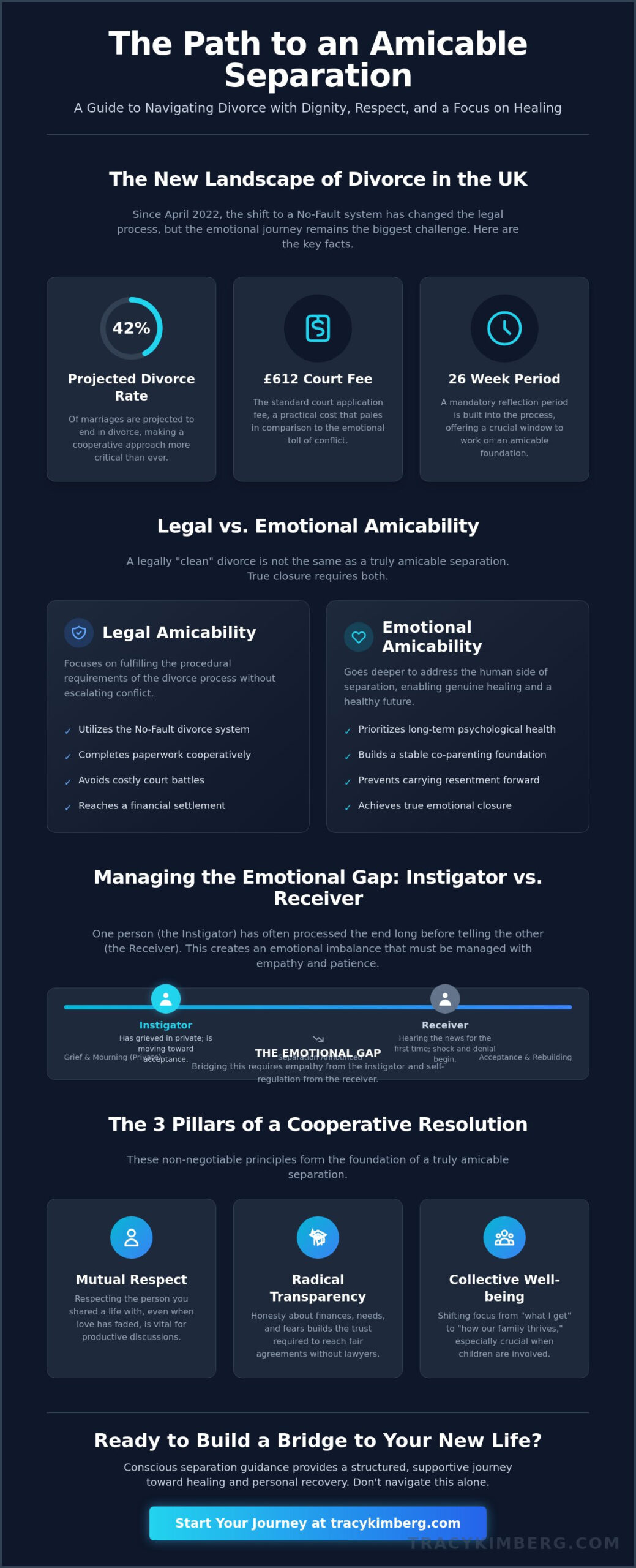
Hi, I’m Tracy, and I want to ask: what if the end of your marriage didn’t have to feel like a battlefield? While 42% of marriages are projected to end in divorce, the legal shift to a no-fault system in April 2022 means your story doesn’t have to be defined by blame. You might feel overwhelmed by the £612 court fee or the mandatory 26 week reflection period, but the deepest challenge is often the emotional distance between you both. Seeking professional amicable separation guidance is about more than just paperwork; it is about protecting your peace and your children’s stability.
It’s natural to fear losing your identity or drowning in conflict during this transition. I know the gap between the person ready to leave and the one feeling left behind feels impossible to bridge right now. This article shows you how to close this chapter with mutual respect and psychological health. You’ll discover a clear roadmap to reduce conflict, establish a healthy co-parenting relationship, and find your way back to yourself. We will explore how to navigate the practical steps of a conscious closure while ensuring your personal recovery remains the priority. Start your journey here.
Key Takeaways
- Learn how to move beyond basic legal requirements to achieve true emotional amicability through a cooperative, non-adversarial mindset.
- Understand the “instigator vs. receiver” dynamic to manage differing grief timelines and prevent defensive conflict during the transition.
- Master “business-like” communication strategies and establish designated “Safe Zones” to keep practical discussions productive and calm.
- Discover how to maintain a united front for your children, focusing on a healthy co-parenting framework that prioritizes their long-term psychological health.
- Access professional amicable separation guidance through a structured 12-week recovery process designed for lasting personal growth and healing.
What is Amicable Separation? Redefining the End of a Relationship
Separation is often framed as a battle to be won or a disaster to be survived. I prefer to see it differently. An amicable separation is a cooperative, non-adversarial approach where both partners commit to ending the relationship with dignity. It isn’t about ignoring the pain of the breakup. Instead, it’s about choosing a path that prioritizes healing over hostility. Since the introduction of the No-Fault Divorce law in April 2022, the legal system in England and Wales has made it easier to avoid the “blame game.” However, legal paperwork is only one side of the coin.
There is a vital distinction between legal amicability and emotional amicability. You can have a legally “clean” divorce without ever reaching emotional resolution. True closure requires both. While the court handles the £612 application fee and the 26 week timeline, emotional work ensures you don’t carry resentment into your future. This is where professional amicable separation guidance becomes essential. It helps you navigate the “Conscious Separation” process, which is a proactive choice for long-term psychological health. This approach shares roots with the concept of Conscious uncoupling, which focuses on mutual growth rather than mutual destruction.
One common myth is that an amicable split means there is no sadness or disagreement. That’s simply not true. You will feel grief. You will likely have moments of intense frustration. Amicability doesn’t mean you agree on everything; it means you’ve agreed on how to disagree. It’s about maintaining respect even when the conversation feels difficult.
The Core Principles of a Cooperative Resolution
At the heart of any successful transition are three non-negotiable pillars:
- Mutual Respect: This is the foundation. Even if the romantic love has faded, respecting the person you shared a life with is vital for productive discussions.
- Radical Transparency: Being honest about your financial needs and emotional fears builds the trust necessary to reach a fair agreement without entering an adversarial legal cycle.
- Collective Well-being: You shift the focus from “what do I get?” to “how does our family thrive?” This is especially crucial for the 42% of marriages projected to end in divorce where children are involved.
Why Amicability is a Strategic Choice, Not Just a Feeling
Choosing an amicable path is a smart investment in your future stability. Research shows that reduced conflict leads to lower emotional trauma and a significantly faster recovery for everyone involved. When you start with cooperation, you set a positive tone for your future co-parenting relationship. It’s about building a bridge to your new life rather than burning the one you’re standing on. Conscious separation is a guided transition that transforms a sudden, painful break into a structured journey toward healing. If you’re ready to explore how this works for your specific situation, let’s talk. Start your journey here.
Managing the Emotional Gap: The Instigator vs. the Receiver
One of the most significant hurdles I see in my practice isn’t the legal paperwork, but the emotional distance between partners. In almost every case, there is an “instigator” and a “receiver.” The instigator has often spent months or even years mourning the relationship in secret before they speak up. By the time they announce the end, they’ve already moved toward acceptance. The receiver, however, might be hearing the news for the first time. This creates a dangerous imbalance. When the instigator pushes for quick progress during the 20 week reflection period required by law, the receiver often reacts with defensive “heel-digging” to slow things down.
Bridging this gap requires a specific kind of amicable separation guidance that prioritizes patience over speed. If you’re the instigator, your job is to practice radical empathy. You must allow your partner the space to process their shock without labeling them as “difficult.” If you’re the receiver, your focus should be on self-regulation. Finding your own sense of agency is vital so you don’t feel like a passive victim of someone else’s timeline. With a median marriage duration of 12.7 years in the UK, the loss of shared identity is a heavy weight. You both need time to adjust to this new reality.
Navigating the Five Stages of Separation Grief
The path to closure isn’t linear. Most couples cycle through Denial, Anger, Bargaining, Depression, and Acceptance at completely different speeds. You might be ready to discuss financial transparency while your partner is still stuck in the anger phase. This mismatch often leads to “emotional hijacking,” where a practical conversation about the future is derailed by a past hurt. Recognizing that you are simply at different stages of the same journey can lower the temperature of your discussions. It’s about understanding that their anger isn’t necessarily an attack on you, but a symptom of their own pain.
Bridging the Gap with Professional Support
Successful joint negotiations rarely happen in a vacuum. I often find that individual therapy is a necessary prerequisite for healthy couple’s work. It gives each person a safe space to vent and heal so they don’t bring that raw volatility to the negotiation table. Before you reach the point of separation, understanding couples therapy what to expect can help you decide whether professional support might first help you repair or consciously close your relationship. As a relationship expert, my role is to facilitate these difficult conversations and keep you both focused on the future rather than the mistakes of the past. My approach to Conscious Separation is designed to demystify this process, making it feel potent and not as daunting as you think. If the emotional gap feels too wide to cross alone, let’s talk about how to build a bridge together.
Essential Communication Strategies for an Amicable Transition
When the emotional gap feels wide, shifting your communication style is the first step toward stability. I often suggest treating this transition as a project to be managed with professional care. This “Business-Like” approach doesn’t mean you’ve stopped caring; it means you’re prioritizing clarity over conflict. By following structured amicable separation guidance, you can learn to separate your role as a former partner from your role as a co-manager of your family’s future. It’s about creating a container for the difficult work so it doesn’t spill into every corner of your life.
Establishing “Safe Zones” is an essential tool for maintaining peace. Don’t let separation talk bleed into every dinner or car ride. Instead, agree on specific times, perhaps an hour on a Tuesday evening, to discuss logistics. Outside of these windows, the topic remains off-limits. When you do speak, lean on “I” statements. Saying “I feel anxious when we discuss the house” is far more productive than “You always make the house discussions difficult.” This small shift prevents your partner from feeling attacked and keeps the focus on your needs rather than their perceived failings.
One of the most powerful boundaries you can set is the “Pause and Reflect” rule. In our world of instant messaging, a single triggering text can ignite a firestorm. If a message makes your heart race, commit to a 24-hour waiting period before responding to non-urgent matters. This prevents the “emotional hijacking” we discussed in the previous section and ensures your replies are guided by logic rather than temporary pain.
Gottman-Informed Tools for Separation Talk
Even as you close this chapter, avoiding the “Four Horsemen” – criticism, contempt, defensiveness, and stonewalling – remains vital. These behaviors are the primary drivers of high-conflict separations. Try using a “Softened Start-up” when raising heavy topics like finances or property division. Instead of “We need to talk about your spending,” try “I’m feeling worried about our budget and would like to look at the numbers together.” If a conversation begins to spiral, don’t be afraid to make a “Repair Attempt.” A simple apology or a request for a five-minute break can reset the energy of the room.
Practical Boundaries for Digital and Social Communication
Clear rules for digital spaces prevent public hurt and private misunderstandings. Agree on how and when to update social media profiles so neither of you is caught off guard by a change in relationship status. For daily logistics, I recommend the “BIFF” method: keep your communication Brief, Informative, Friendly, and Firm. This is particularly effective for email and text. If verbal conversations consistently lead to arguments, move to written communication for a while. It provides a clear record of agreements and gives you both the necessary time to think before you speak. If you need help setting these boundaries, let’s talk. Start your journey here.
Prioritising Children: Creating a Healthy Co-Parenting Framework
Children are incredibly resilient, but their stability depends on how you and your partner handle the transition. Research from the Office for National Statistics (ONS) shows that 42% of marriages are projected to end in divorce; however, it is the level of parental conflict, not the separation itself, that most impacts a child’s long-term psychological health. When you seek amicable separation guidance, you are making a conscious choice to protect your children from the crossfire of adult emotions. By focusing on cooperation, you ensure that their world remains secure even as it changes shape.
Presenting a united front is the most powerful gift you can give your family. When you sit down to explain the changes, do it together. Use age-appropriate language and avoid assigning a “villain” to the story. For a five-year-old, this might mean saying, “Mummy and Daddy are going to live in different houses, but we both love you very much.” For a teenager, it involves more transparency about logistics without oversharing emotional burdens. The goal is to provide a narrative that is honest but safe, ensuring they don’t feel forced to choose sides. This approach preserves their sense of belonging in both homes. For practical guidance on navigating this sensitive conversation, our how to tell kids about separation guide offers a psychologically grounded, age-appropriate framework to help you find the right words.
Predictability is the antidote to the anxiety children feel during a split. While flexibility is important, a consistent routine helps them understand what to expect. Use digital tools or shared calendars to track school events and holidays. This reduces the need for last-minute negotiations that can trigger stress. A child who knows exactly where they will be on a Tuesday night is a child who can focus on being a kid rather than worrying about their parents’ relationship. This structure is a vital part of the 20 week reflection period required by UK law, allowing everyone time to adjust to the new family dynamic.
The ‘Golden Rule’ of Amicable Co-Parenting
Never use your child as a messenger or a confidant for your adult pain. It’s tempting to ask, “What did your dad say about the weekend?” but this places a heavy burden on their shoulders. Instead, validate their feelings. If they are sad, let them be sad without trying to “fix” it by blaming the other parent. A child-centred approach means the needs of the child always come before the egos or grievances of the adults. It’s about being the wise guide your children need during this journey.
Designing a Collaborative Parenting Plan
A truly effective plan goes beyond a simple calendar. It should outline shared values, discipline styles, and how you will handle holiday traditions. Managing “firsts,” such as the first birthday after the split or the first school play, requires grace and planning. You don’t have to be best friends, but you do need to be effective colleagues in the business of raising your children. For more support, you can explore our How to Tell Kids About Separation guide. If you’re struggling to find common ground, let’s talk about creating a framework that works for everyone. Start your journey here.
How Conscious Separation Guidance Facilitates Lasting Healing
Hi, I’m Tracy. While legal professionals handle the mandates of the No-Fault Divorce law that came into effect in April 2022, my role is to guide the heart through the transition. Professional amicable separation guidance differs from traditional legal mediation because it doesn’t just look at the division of assets. It looks at the division of lives. While mediation focuses on the “what,” our coaching focuses on the “how”-how you communicate, how you heal, and how you rebuild. This emotional support is what prevents the 26 week minimum legal timeframe from becoming a period of stagnant pain.
My 12-Week Relationship Recovery Process offers a structured path to post-separation health. It’s designed to move you toward “Post-Traumatic Growth,” a concept that suggests ending a relationship isn’t just a loss; it’s a profound opportunity for personal evolution. By closing this chapter with dignity, you prevent “unfinished business” from leaking into your future relationships. You deserve to move forward without the heavy anchor of unresolved resentment. This process ensures that the 42% of marriages projected to end in divorce don’t just end, but transform into something manageable and respectful.
The importance of closure cannot be overstated. When a relationship ends in high conflict, the emotional wounds often remain open for years, affecting your mental health and your ability to trust again. An amicable end provides a clear boundary. It allows you to process the 12.7 years of a median marriage duration with a sense of perspective rather than just pain. This clarity is the foundation of a healthy future.
From Couple to Individuals: Reclaiming Your Identity
After years of being part of a “we,” it’s easy to lose sight of who you are as an “I.” I encourage using this separation period as a time for intense self-discovery. This often involves individual therapy for adults to unpack old patterns and rediscover personal passions. You’ll also need to build a new support network that doesn’t rely on your former partner. My masterclasses are a fantastic way to learn new relational skills, ensuring your next chapter is built on a foundation of self-awareness and strength. Reclaiming your identity isn’t a betrayal of the past; it’s a celebration of your future.
Starting Your Journey Toward a Positive Future
I know that reaching out can feel like the hardest part. Please remember that therapy is potent and not as daunting as you think. It’s a proactive and positive adventure toward a life where you feel empowered and at peace. You’ve already navigated the hardest days of realizing the relationship has changed. Now, let’s focus on building your “happy” outcome through a collaborative and supportive process. Let’s talk about your path to an amicable separation. Start your journey here.
Reclaiming Your Future with Dignity and Hope
Choosing to end a partnership doesn’t have to mean destroying the foundation you’ve built. By mastering “business-like” communication and respecting the differing grief timelines of the instigator and the receiver, you protect your psychological health and your family’s future. We’ve discussed how the 20 week reflection period under the 2022 No-Fault Divorce law provides a vital space for this work. Professional amicable separation guidance ensures that this time is used for growth rather than conflict, allowing you to emerge as a stronger individual.
As a Relationship Expert with a clinical and research-based background, I provide specialized support for couples and individuals navigating conscious separation. My online consultations are available worldwide, offering discreet and expert care from the comfort of your own home. You don’t have to navigate this transition alone. This process is potent and not as daunting as you think. Start Your Journey Toward an Amicable Separation Here. Let’s talk about how we can build your path toward a peaceful and positive new beginning. Start your journey here.
Frequently Asked Questions
Is an amicable separation possible if my partner cheated?
Yes, an amicable separation is possible after infidelity, provided both parties are willing to separate the emotional betrayal from the logistical transition. While the pain is significant, focusing on a “Conscious Separation” helps you avoid a retaliatory legal battle. Success often depends on the “instigator” allowing the “receiver” time to process the shock. Individual therapy is a crucial tool here to manage the intense feelings of vulnerability without derailing the negotiation process.
What is the difference between an amicable separation and legal mediation?
Amicable separation guidance focuses on the psychological and emotional health of the family, whereas legal mediation is a structured process to reach financial or childcare agreements. Mediation is often a legal requirement before court, but it doesn’t address the “emotional gap” between partners. My coaching provides the relational skills needed to make those legal meetings productive and respectful. It bridges the gap between clinical expertise and practical, day-to-day communication strategies.
How long does it typically take to reach an amicable agreement?
In England and Wales, the minimum legal timeframe for a no-fault divorce is 26 weeks. This includes a mandatory 20 week reflection period designed for couples to consider their future. Reaching an agreement through amicable separation guidance usually happens within this window if both partners remain committed to transparency. However, the emotional journey to true closure often extends beyond the Final Order, making a structured recovery process essential for long-term healing.
Do I still need a solicitor if we are separating amicably?
Yes, most couples still use a solicitor to draft a Consent Order, which makes your financial agreements legally binding. Even with amicable separation guidance, having a legal professional review your paperwork ensures that your future is protected. The goal of an amicable approach isn’t to skip the law, but to reduce the conflict that usually drives up legal fees. By agreeing on the big issues first, you keep your legal interactions brief and purposeful.
What happens if we start amicably but things become high-conflict later?
It’s common for conflict to flare up during high-stress moments like property sales or holiday planning. If things become heated, it’s vital to use the “Pause and Reflect” rule we discussed earlier. You might need to step back from joint discussions and return to individual therapy for a few weeks. Re-establishing “Safe Zones” for communication can help lower the temperature and prevent a temporary disagreement from turning into a permanent, adversarial legal battle.
Can we separate amicably while still living in the same house?
Yes, many couples choose to live together during the 20 week reflection period for financial or childcare reasons. Success in this arrangement requires very clear boundaries and a “Business-Like” communication style. You must agree on separate spaces, shared household costs, and a schedule for “separation talk” to avoid constant tension. It’s about maintaining a united front for the children while beginning the internal process of reclaiming your individual identities. Start your journey here.
How do I convince my partner to try an amicable approach?
Start by highlighting the shared benefits, such as reduced emotional trauma for your children and the avoidance of high legal fees. You might say, “I want us to end this with respect so we can be healthy co-parents.” Framing it as a “Conscious Separation” rather than a failure makes the process feel less daunting. Invite them to a masterclass or an initial consultation to demystify the process and show that a “happy” outcome is actually possible.
What are the most common mistakes that ruin an amicable separation?
The most frequent mistake is the “instigator” rushing the “receiver” before they’ve processed the shock of the split. Another common error is using children as messengers or confidants for adult pain, which ruins the “Child-Centred” framework. Finally, failing to set digital boundaries on social media can lead to public hurt that triggers defensive “heel-digging.” Avoiding these pitfalls requires a commitment to the core principles of transparency, mutual respect, and regulated communication throughout the journey.

Article by
Tracy Kimberg
Tracy Kimberg is a Relationship Expert, Couples Therapist and Coach with a dedicated focus on helping couples and individuals rebuild connection, trust and emotional safety in their relationships. Drawing on the research of John and Julie Gottman, the relational insights of Esther Perel, and years of hands-on therapeutic experience, Tracy offers a warm, non-judgemental and deeply compassionate approach to modern relationships.
Based in Dorset, Tracy works with couples navigating communication breakdowns, betrayal, intimacy challenges, separation, family dynamics and life transitions. Known for creating a safe and grounded therapeutic space, she combines practical tools with emotional depth to help clients move beyond survival patterns and towards meaningful, lasting change.
With a reputation for empathy, professionalism and dedication to her clients’ growth, Tracy is passionate about helping people feel seen, understood and empowered — both within their relationships and within themselves.
Disclaimer
Disclaimer:
The information shared in this article is intended for educational and informational purposes only and should not be considered a substitute for professional therapeutic, psychological, medical or legal advice. Every individual and relationship is unique, and the perspectives offered are based on general therapeutic principles, research and professional experience.
Reading this article does not establish a therapist-client relationship with Tracy Kimberg. If you are experiencing significant emotional distress, relationship crisis, trauma, or mental health concerns, it is important to seek support from a qualified professional appropriate to your individual circumstances.
All content remains the intellectual property of Tracy Kimberg and may not be reproduced or distributed without permission.