

Did you know that researchers can now predict the future of a relationship with over 90% accuracy based on how a couple manages conflict? Despite these clear warning signs, the average couple waits six years after their relationship begins to fracture before seeking professional support. By the time partners explore relationship coaching for couples, they often feel less like lovers and more like polite roommates managing a shared household. You might recognize this pattern through circular arguments that never resolve or the heavy silence that follows a breach of trust. It’s exhausting to live in a state of emotional hyper-vigilance, wondering if the spark you once shared has permanently flickered out.
Hi, I’m Tracy, a Relationship Expert who believes your partnership is worth saving. Through structured, research-based interventions, we can move beyond mere venting about the past and focus on strategic, future-oriented growth. This approach utilizes clinical insights to transform your dynamic from the inside out. We will explore the scientific tools needed to manage conflict without escalation and provide a clear roadmap to move your partnership from roommates back to lovers.
Key Takeaways
- Learn why relationship coaching for couples is a proactive, goal-oriented journey that focuses on your future rather than just dwelling on the past.
- Discover how clinical insights from the Sound Relationship House can help you rebuild emotional security and reignite long-lost desire.
- Understand the differences between coaching and counselling to determine which intensive path best fits your current situation.
- Find out how to identify your “North Star” during the initial consultation to ensure your recovery process remains purposeful.
- Gain a research-backed roadmap for transitioning from a polite roommate dynamic back into a deeply connected, intimate partnership.
What is Relationship Coaching for Couples?
When you find yourself stuck in a cycle of repetitive arguments, it’s easy to feel like your relationship has hit a dead end. Relationship coaching for couples is not a post-mortem of your failures; it’s a proactive, goal-oriented partnership designed to bridge the gap between where you are and where you want to be. While traditional therapy often spends years deconstructing the “why” of your past, coaching focuses on the “how” of your future. It’s about giving you the mechanical tools to rebuild intimacy and respect in real-time. When exploring What is Relationship Coaching, it’s helpful to view it as a collaborative process aimed at unlocking a couple’s potential by focusing on actionable growth.
In our sessions, I step in as a neutral facilitator and a Wise Guide. I don’t sit in judgment or take sides. Instead, I help you identify the invisible patterns that keep you disconnected. We move the needle from simply surviving the week to actually thriving in each other’s presence. It’s a shift from being reactive to being intentional, turning the relationship back into a source of strength rather than a source of stress.
The Core Philosophy: Future-Focused Growth
The beauty of this approach lies in its focus on actionable strategies. We don’t ignore the past, but we refuse to be held hostage by it. We set clear, measurable goals for your partnership. Perhaps your goal is to reduce the “recovery time” after a disagreement from three days of silence to thirty minutes of productive conversation. By creating a safe container for these difficult discussions, coaching allows you to express vulnerability without the fear of the house burning down. This structure ensures that every conversation moves you closer to your “North Star” of emotional security.
Who is Relationship Coaching For?
This journey is specifically designed for partners who feel they’ve drifted into the “roommate phase.” Research by the Gottman Institute indicates that 67% of new parents experience a significant drop in relationship satisfaction; coaching provides the framework to navigate these transitions. It’s also vital for couples facing the physiological and emotional shifts of menopause or those trying to find a structured path forward after trust has been compromised. If you’re asking yourself how to save my relationship and want to stop the circular arguments and start building a research-backed future, relationship coaching for couples offers the clarity you’ve been searching for.
The Science of Connection: Research-Based Methods
Love is often described as a mystery, but decades of clinical research suggest it follows a surprisingly predictable architecture. When we engage in relationship coaching for couples, we lean heavily on the work of Dr. John Gottman and his “Sound Relationship House” theory. Gottman’s research, spanning over 40 years and thousands of couples, proves that successful partnerships aren’t built on grand gestures. Instead, they thrive on “micro-connections.” These are the tiny, daily bids for attention, like a shared glance or a brief touch, that build a reservoir of emotional goodwill. Relational intelligence is the sophisticated ability to navigate your partner’s internal world with curiosity rather than judgment.
Understanding The Science of Relationship Coaching allows us to move beyond guesswork. It gives us a framework to understand why some couples collapse under pressure while others grow stronger. It’s about learning the mechanics of how we attach and how we repair when those attachments are strained. By focusing on these evidence-based strategies, we can demystify the process of falling back in love.
The Gottman Method in Practice
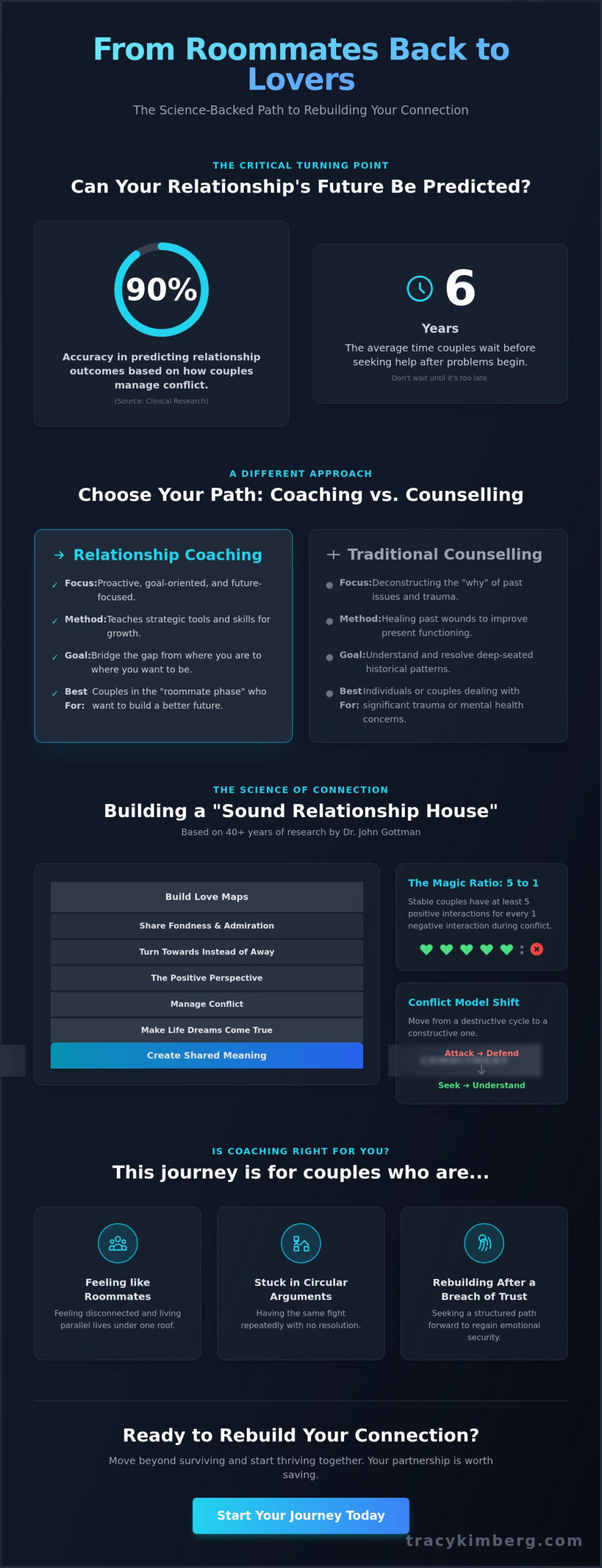
In practice, this means shifting the way you handle friction. Most struggling couples fall into an “attack-defend” loop that triggers the nervous system’s fight-or-flight response. We work on moving toward a “seek-understand” model. A key metric here is the 5:1 ratio. Research conducted by the Gottman Institute shows that stable relationships maintain at least five positive interactions for every one negative interaction during conflict. We also focus on building “Love Maps,” which is the practice of keeping track of your partner’s evolving world, their current stresses, and their future dreams. This prevents the “roommate” feeling by ensuring you actually know the person sitting across from you today, not just the version of them you married years ago. When patterns of eye-rolling and sarcasm begin to replace genuine connection, overcoming contempt in a relationship becomes one of the most urgent priorities, as Gottman identifies it as the single greatest predictor of relationship breakdown.
Esther Perel and the Paradox of Intimacy
While Gottman focuses on the foundation of friendship, Esther Perel explores the erotic tension required to keep a relationship alive. She highlights a fundamental paradox: we need security to feel safe, but we need mystery to feel desire. Coaching helps you manage this tension. When a marriage feels stagnant, it’s often because the partners have become too fused, leaving no room for the “otherness” that sparks attraction. By creating emotional safety, we actually allow for the healthy distance necessary for desire to return. This research-led framework is also vital when navigating the aftermath of infidelity, focusing on whether a new, more honest version of the relationship can be built from the ashes. If you are struggling with the trauma of betrayal, exploring couples therapy for infidelity can provide the structured, compassionate roadmap needed to rebuild trust and connection. If you feel your connection is fading, you might choose to start your journey here to rediscover that lost spark.
Coaching vs. Counselling: Which Path is Right for You?
Deciding between counselling and coaching is like choosing between surgery and physical therapy. One heals the wound; the other rebuilds the muscle. Traditionally, counselling dives deep into the “why” of your pain, digging into the roots of your childhood or past betrayals to find healing. In contrast, relationship coaching for couples focuses on the “what now.” It’s a high-intensity, time-bound intervention that demands active participation from both partners. You aren’t just a patient in this process; you’re a co-creator of your relationship’s new architecture.
I often see couples who’ve spent years in traditional therapy without seeing a shift in their daily interactions. They understand their problems intellectually, but their behavior hasn’t changed. This is where my hybrid approach becomes potent. We use clinical depth to identify your attachment styles, but we use a coaching framework to drive real-world change. By Building Stronger Relationships through targeted values and skills, we ensure that the insights you gain in my office actually translate to your kitchen table. It’s a common misconception that coaching is the “light” version of therapy. In reality, it’s often more challenging because it requires you to test new behaviors in the heat of your real-world interactions.
When to Choose Relationship Coaching
This path is ideal if you’re tired of talking in circles and want a structured programme with a clear start and end. You should choose relationship coaching for couples if you’re ready to do “homework” and practice specific communication skills between our sessions. We don’t just analyze the ghosts of your past. We actively design a new future by focusing on actionable strategies and measurable goals. It’s for those who are ready to move from understanding their resentment to actively dismantling it. It’s also worth noting that if your partner is hesitant to attend together, individual relationship counselling can be a powerful first step, as shifting your own patterns unilaterally changes the dynamic of the entire relationship.
The 12-Week Recovery Advantage
The 12-Week Relationship Recovery Process is designed to prevent “therapy fatigue.” This is the point where couples stop seeing progress because their sessions feel like a never-ending loop of grievances. A structured 90-day journey provides a psychological finish line. It keeps you both focused on the 12 specific milestones required for recovery. This sense of momentum is often what saves a partnership when hope is running thin. Knowing there’s a roadmap to follow provides immense relief, transforming a vague desire to “work on things” into a tangible mission to restore intimacy.
What to Expect in Your First Coaching Journey
Stepping into the unknown can feel daunting, especially when the stakes are as high as your marriage. Your first experience with relationship coaching for couples begins with an initial consultation to assess the “relational temperature.” We aren’t looking for a villain or a victim; we’re looking at the dance between you. Once we understand the patterns, we move to Step 2: Goal Setting. This is where we identify your “North Star,” a shared vision that guides every session. Step 3 involves Skill Acquisition, where you learn the specific mechanics of repair and active listening. In Step 4, Integration, you apply these tools to real-world triggers, like that recurring argument about chores or the cold silence during dinner. Finally, Step 5 focuses on Review and Maintenance to ensure your new relational health is sustainable for the long haul.
This structured path is designed to provide immediate relief while building a foundation for the future. By breaking down the complex work of intimacy into these five manageable stages, we remove the overwhelm that often leads couples to give up. Each step is a milestone toward a more conscious and connected partnership.
Preparing for Your First Session
I ask all my clients to arrive with an “open-heart” policy. This doesn’t mean you have all the answers; it just means you’re willing to be seen. It’s perfectly normal for one partner to feel more reluctant than the other. In fact, in about 40% of the couples I see, one person starts the journey with a degree of healthy skepticism. Whether we meet face-to-face in my Dorchester office or connect through global online sessions, the process remains equally potent. The goal is to create a space where both of you feel safe enough to put down your defensive shields and speak your truth.
The Role of Vulnerability
If you find yourself feeling “the feels” during our time together, please know that this is a sign of profound progress. Vulnerability isn’t a weakness; it’s the bridge to intimacy. Many partners fear being “found out” or judged, but my role as a Relationship Expert is to be your Wise Guide, not your critic. When you allow yourself to be vulnerable, you stop performing and start connecting. This shift is essential because you cannot repair a relationship while wearing armor. If you are ready to move from distance to deep connection, I invite you to start your journey here and rediscover the partnership you deserve.
Start Your Journey with Tracy Kimberg
Hi, I’m Tracy. I believe every couple deserves a partnership that serves as a sanctuary. My approach to relationship coaching for couples isn’t a collection of surface-level fixes; it’s a deep, clinical dive into the heart of your connection. I’ve spent years blending rigorous psychological research with a warm, person-centered methodology. This isn’t therapy that drags on indefinitely without a clear objective. Instead, I offer the 12-Week Relationship Recovery Process. This program is the gold standard for change, providing a structured, 90-day roadmap that moves you from crisis to clarity.
Whether you’re looking for face-to-face sessions in Dorchester or London, or you prefer the flexibility of global online coaching, the quality of care remains the same. By choosing relationship coaching for couples, you’re investing in a future where connection is the default, not the exception. I’ve worked with hundreds of couples across different continents to bridge the gap between polite roommates and intimate lovers. My goal is to make the therapeutic process feel potent and accessible, acknowledging your anxiety while offering immediate, clinical comfort.
Why Tracy Kimberg?
I specialize in the complex, often messy realities of modern life that many practitioners overlook. My clinical background ensures we aren’t just talking about feelings; we’re rebuilding the architecture of your attachment. I act as your Wise Guide through issues such as:
- Infidelity Recovery: We work through the delicate process of rebuilding trust after a significant breach. If you are navigating the aftermath of betrayal, learn more about how couples therapy for infidelity can offer a compassionate and structured path toward healing.
- Menopause and Intimacy: We manage the profound physiological and emotional shifts that can alter your relationship dynamics.
- Teenager Dynamics: I provide expert guidance for families managing the volatile nature of adolescent transitions.
We focus on “happy” outcomes, ensuring that the work we do today supports your emotional health for the next 20 years. I offer a non-judgmental space where sustainable healing is the priority, rather than just venting about current frustrations. This commitment to long-term health is what sets my practice apart.
Taking the First Step
The path to a better relationship doesn’t have to be daunting. My “Let’s Talk” philosophy is built on a low-pressure, high-impact connection. It’s a simple invitation to explore what’s possible for your partnership without the weight of clinical coldness. You can book your initial 12-week recovery consultation today to begin the process of reclaiming your intimacy. Don’t wait another six years to address the cracks in your foundation. You have the power to transform your dynamic, and I have the tools to help you do it. Start Your Journey Here.
Your Path Toward Relational Renewal
Your partnership doesn’t have to remain stuck in the “roommate phase” indefinitely. Applying the research-backed methods of John Gottman and Esther Perel can shift your dynamic from cold disconnection to deep, resonant intimacy. The 12-Week Relationship Recovery Programme provides the specific milestones needed to ensure your partnership doesn’t just survive but truly thrives. Whether you join me for face-to-face sessions in Dorchester or London, or connect through worldwide online coaching, the tools for repair are within your reach.
Engaging in relationship coaching for couples is a brave commitment to your shared future. It’s about deciding that your bond is worth the effort of transformation. If you’re ready to stop the circular arguments and start building a new architecture for your love, let’s talk. You can Book Your Relationship Discovery Call with Tracy today. Healing is potent and much closer than you think. It starts with a single, intentional conversation.
Frequently Asked Questions
How is relationship coaching different from marriage counselling?
Relationship coaching for couples focuses primarily on the future and the specific behaviors needed to reach your goals. While traditional counselling explores the historical “why” of your pain, coaching provides the “how” for your recovery. It’s a proactive, action-oriented partnership that gives you the mechanical tools to rebuild intimacy and manage conflict in real-time. We move beyond simple venting to create a strategic roadmap for your partnership.
Can relationship coaching save a marriage after infidelity?
Recovery after a breach of trust is possible when both partners commit to a research-led framework for repair. We use clinical insights to move through the trauma of betrayal and establish a new foundation for honesty. It’s about deciding if a more resilient version of your connection can be built from the ruins. This process requires radical vulnerability and a structured path to restore emotional security over time.
How long does relationship coaching usually take?
A structured journey typically follows a 12-week timeline to ensure consistent momentum and prevent therapy fatigue. This 90-day window allows enough time for you to acquire new communication skills and integrate them into your daily life. Having a clear start and end point keeps both partners accountable. We focus on specific milestones that track your progress from the initial consultation to long-term maintenance.
What happens if my partner is reluctant to attend coaching?
It’s common for one partner to feel more hesitant, but the process can still begin with a low-pressure discovery call. You don’t need both partners to be equally enthusiastic on day one to see results. Often, when one person starts to change their own reactive patterns, it shifts the entire dynamic of the relationship. This shift frequently encourages the more reluctant partner to engage once they see tangible progress. In these situations, exploring individual relationship counselling can be a highly effective way to begin transforming your partnership from the inside out.
Do you offer relationship coaching online for couples outside the UK?
Yes, global online sessions are available to ensure that distance isn’t a barrier to expert support. These digital meetings provide the same clinical depth and personal connection as face-to-face sessions in Dorchester or London. We use secure platforms to create a safe container for your most difficult conversations. This flexibility allows you to integrate deep relational work into your existing schedule, regardless of your location.
Is relationship coaching worth the investment?
Investing in relationship coaching for couples is a proactive step that prevents the 100% emotional and financial toll of a high-conflict separation. Building sustainable intimacy provides a foundation for your long-term health and family stability. The skills you learn during these 12 weeks are designed to last for the next 20 years of your life. It’s an investment in the most significant part of your human experience: your connection to others.
What is the 12-Week Relationship Recovery Process?
This is a specialized, milestone-driven program designed to move couples from a state of crisis back to a state of connection. We spend 90 days working through a specific roadmap that includes assessment, goal setting, and skill integration. It’s the gold standard for partners who want a tangible mission rather than open-ended talk. Each week builds upon the last to ensure your new relational habits are permanent and sustainable.
Do we need to be in crisis to benefit from coaching?
You don’t need to be on the brink of divorce; coaching is highly effective for partners in the “roommate phase” or those facing life transitions. Research shows the average couple waits 6 years after problems begin before seeking help. Addressing small fractures during career changes or parenthood prevents them from becoming insurmountable issues later. Coaching acts as a preventative tool to keep your bond strong before a crisis ever occurs. If you are currently navigating that painful drift and wondering how to save my relationship before it reaches a breaking point, our compassionate guide offers psychologically-grounded steps to help you reconnect.

Article by
Tracy Kimberg
Tracy Kimberg is a Relationship Expert, Couples Therapist and Coach with a dedicated focus on helping couples and individuals rebuild connection, trust and emotional safety in their relationships. Drawing on the research of John and Julie Gottman, the relational insights of Esther Perel, and years of hands-on therapeutic experience, Tracy offers a warm, non-judgemental and deeply compassionate approach to modern relationships.
Based in Dorset, Tracy works with couples navigating communication breakdowns, betrayal, intimacy challenges, separation, family dynamics and life transitions. Known for creating a safe and grounded therapeutic space, she combines practical tools with emotional depth to help clients move beyond survival patterns and towards meaningful, lasting change.
With a reputation for empathy, professionalism and dedication to her clients’ growth, Tracy is passionate about helping people feel seen, understood and empowered — both within their relationships and within themselves.
Disclaimer
Disclaimer:
The information shared in this article is intended for educational and informational purposes only and should not be considered a substitute for professional therapeutic, psychological, medical or legal advice. Every individual and relationship is unique, and the perspectives offered are based on general therapeutic principles, research and professional experience.
Reading this article does not establish a therapist-client relationship with Tracy Kimberg. If you are experiencing significant emotional distress, relationship crisis, trauma, or mental health concerns, it is important to seek support from a qualified professional appropriate to your individual circumstances.
All content remains the intellectual property of Tracy Kimberg and may not be reproduced or distributed without permission.