

What if the sneer across the dinner table or the sharp sarcasm you’ve started using isn’t a sign that you’re a “mean” person, but a desperate, mismanaged cry for a boundary that was never set? It is profoundly exhausting to feel lonely whilst sitting right next to your partner, watching your connection erode into a cycle of eye-rolling and bitterness. You might even feel a deep sense of shame, wondering if you have simply become someone you no longer recognise. Overcoming contempt in a relationship feels like an uphill battle when every conversation feels like a battlefield, especially since research indicates this behaviour is the primary predictor of divorce.
We agree that the weight of this hostility is heavy, but it doesn’t have to be the end of the road. We promise to show you how contempt can be replaced with a culture of mutual appreciation and safety. This guide provides a compassionate roadmap to stop the “mean” communication, restore respect, and help you determine if your relationship is worth saving through the healing process of modern therapy. Together, we can explore how to move from a place of disgust to one of genuine connection.
Key Takeaways
- Recognise why contempt is defined as the “sulfuric acid” of connection and how it creates a damaging sense of superiority over your partner.
- Discover the path toward overcoming contempt in a relationship by reframing hostile outbursts as a mask for unexpressed grief or a cry for connection.
- Learn how to replace immediate judgment with curiosity to neutralise bitterness and restore a sense of emotional safety within your home.
- Understand the importance of building a culture of fondness and appreciation to transform your daily interactions and rebuild your bond.
- Identify when professional support, such as a structured 12-week relationship recovery process, is necessary to heal chronic patterns of communication.
Overcoming Contempt in a Relationship: Defining the “Sulfuric Acid” of Love
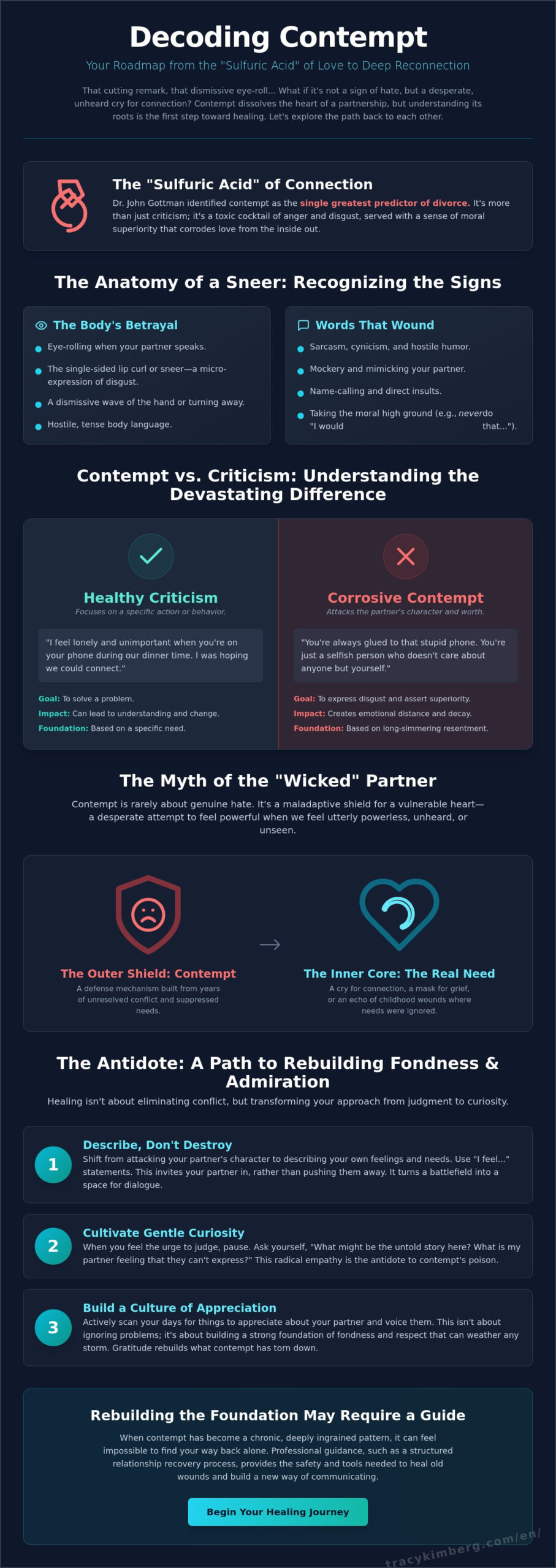
Dr John Gottman, the renowned relationship researcher, famously described contempt as the “sulfuric acid” of love. It is a vivid and unsettling image. Just as acid eats through solid metal, contempt dissolves the very foundation of a partnership until there is nothing left to hold. But what exactly are we dealing with? At its core, the definition of contempt involves a complex cocktail of anger and disgust, served with a side of perceived superiority. Unlike a simple disagreement, it is a statement that says, “I am better than you, and you are beneath my consideration.”
Many couples fear that this feeling is a permanent character flaw or a sign they have become “bad” people. This is a common myth. In reality, contempt is a learned communication behaviour, a defensive habit picked up over years of unresolved conflict. Whilst extreme contempt is easy to spot, most couples struggle with a more subtle version. It is the quiet dismissal, the intellectual “tut”, or the way one partner explains things as if the other is a child. Overcoming contempt in a relationship begins with identifying these small, corrosive moments before they become the air you breathe.
The Anatomy of a Sneer: Signs You Are Moving into Contempt
The body often speaks before the tongue. Look for the “single-sided lip curl”, a micro-expression of disgust, or the chronic eye-roll during a partner’s explanation. These aren’t just rude gestures; they are physical manifestations of a closing heart. Verbally, contempt hides in sarcasm and “humour” used to belittle. When you find yourself taking the “higher moral ground” by saying, “I would never do that,” you aren’t just stating a fact. You are positioning yourself as the superior judge in the relationship.
Why Contempt Feels Like a Survival Strategy
If contempt is so destructive, why do we use it? Often, it is a shield. If I can look down on you, your opinions and your potential to hurt me carry less weight. From a trauma-informed perspective, contempt acts as a protective layer against emotional overwhelm. It’s a way to create distance when intimacy feels dangerous. In our “stiff upper lip” culture, many of us were taught to prize logic over messy emotions. When we suppress our needs whilst feeling unappreciated, that repressed resentment curdles. Over time, it transforms into a cold, intellectual superiority that feels safer than being vulnerable. Understanding this is the first step toward overcoming contempt in a relationship and moving back toward softness.
The Myth of the “Wicked” Partner: Why Contempt is a Cry for Connection
Gabor Maté often reminds us that our adult behaviours are frequently the echoes of past survival strategies. When we see a partner sneer or hear them use cutting sarcasm, it’s easy to label them as “wicked” or “mean.” However, those of us who work deeply with the intricacies of human connection recognise that contempt is rarely about hate. It is often a mask for deep, unexpressed grief. When a partner feels invisible or neglected, they don’t always have the tools to say, “I am lonely.” Instead, they take a psychological shortcut. They move from “I am hurt” to “You are defective.” This shift provides a temporary, albeit toxic, sense of power in a situation where they feel utterly powerless.
According to The Gottman Institute on contempt, this behaviour is the strongest predictor of relationship failure. Yet, if we look through a trauma-informed lens, we see that adult contempt often stems from childhood emotional neglect. If a child’s needs were consistently ignored, they may grow into an adult who uses superiority as a weapon. It’s a way to ensure they are never that vulnerable again. Understanding this history is a vital part of overcoming contempt in a relationship, as it allows us to see the wounded child behind the defensive adult.
Reframing the Narrative: From Defect to Unmet Need
Contempt is a maladaptive protective layer for a vulnerable heart. When your partner lashes out, try to see the longing behind the strike. Are they truly being “mean,” or are they simply overwhelmed by a lack of safety? Spotting the difference requires us to pause and look for the unmet need. Is it a need for respect, for help with the children, or simply to be seen? Overcoming contempt in a relationship requires both partners to move from a place of judgment to one of compassionate inquiry.
The Role of Resentment in Breeding Contempt
Resentment is a slow burn. It is the accumulation of small, unaddressed grievances that we “let go” without actually processing. Over the years, these grievances pile up until the foundation of the relationship is buried. This is why early intervention is so critical. If you find yourself in this cycle, learning how to save my relationship through open, honest dialogue can prevent that resentment from hardening into permanent disdain. We often suggest that couples explore these patterns in a safe, professional environment before the “acid” of contempt causes irreparable damage. Our 12-week relationship recovery process is designed to help you dismantle these barriers and rediscover the softness that originally brought you together.
Contempt vs. Criticism: Understanding the Hierarchy of Relational Hurt
Whilst both criticism and contempt leave scars, they occupy very different levels on the hierarchy of relational hurt. Criticism is an attack on a partner’s character or personality, often framed as a “you always” or “you never” statement. Contempt, however, adds a layer of disgust. It is an attack launched from a position of moral superiority. As noted by The Gottman Institute on Contempt, this shift makes the recipient feel not just wrong, but fundamentally despised and worthless. This distinction is vital when overcoming contempt in a relationship because the repair for a character attack is very different from the repair for a superiority attack.
Criticism often acts as a gateway drug to full-blown contempt. It starts with small complaints about a partner’s behaviour. When these go unaddressed, they harden into character assassinations. Eventually, the “Moral Superiority” trap sets in. You might tell yourself, “I am the organised one” or “I am the one who actually cares about our future.” These self-assigned titles become weapons. They allow you to look down on your partner, transforming a simple difference in personality into a reason for disdain.
The Comparison Table: Spotting the Difference
Understanding the nuances between these communication styles can help you identify where your relationship currently stands. The table below illustrates how a simple need can escalate into a destructive force.
| Type of Communication | Example Statement | Underlying Feeling |
|---|---|---|
| Complaint | “I’m upset the bins weren’t emptied this morning.” | Frustration about a specific event. |
| Criticism | “You always forget the bins. You’re so inconsiderate.” | Attack on the partner’s personality. |
| Contempt | “A toddler could manage the bins better than you. Are you actually incompetent?” | Disgust and superiority. |
Receiving contempt triggers a profound physiological response. Research shows that heart rates often spike above 100 beats per minute during these exchanges, leading to “flooding.” In this state, the brain’s rational centre shuts down, and the survival-oriented amygdala takes over. It becomes impossible to resolve conflict when your body feels like it is under physical attack.
Why the Hierarchy Matters for Recovery
The good news is that understanding this hierarchy provides a path back. You can come back from criticism more easily than from contempt, but even deep-seated disdain can be de-escalated. The “Point of No Return” is often a myth. By acknowledging the superiority trap, you can begin the work of overcoming contempt in a relationship. If you are unsure where your partnership sits on this spectrum, it might be time to ask, can your relationship be saved? Recognising the stage you are in is the first step toward deciding whether to repair or let go.
From “Sulfuric Acid” to Softness: Practical Steps to Neutralise Contempt
The journey of overcoming contempt in a relationship often begins with the body. Before a sarcastic comment even leaves your lips, your nervous system has already decided to go to war. You might feel a tightness in your chest or a heat rising in your neck. Somatic grounding, such as taking a slow, diaphragmatic breath or noticing the weight of your feet on the floor, can interrupt this physiological “flooding.” It creates the heartbeat of space required to choose softness over a sneer. By calming your internal state, you move from a place of reactive disgust to one of proactive connection.
John Gottman’s research highlights the “5:1 Ratio” as a vital benchmark for relational health. For every negative interaction, a stable relationship needs five positive ones to maintain its equilibrium. This isn’t about grand, expensive gestures. It is about building a “Culture of Appreciation” through small, daily deposits of kindness. When we focus on what is going right rather than what is going wrong, we begin to neutralise the acid of disdain. To truly transform your dynamic, consider exploring our 12-week relationship recovery process to build these habits into your daily life.
Step 1: Ownership of the Feeling
The I-statement is the primary tool for de-escalating contempt. Instead of launching a character attack with “You are useless,” try owning the underlying vulnerability by saying, “I feel unappreciated when the housework isn’t shared.” This is the “Hula Hoop” technique in action. You stay inside your own emotional boundaries, speaking only for yourself. It prevents your partner from feeling the need to defend against a position of moral superiority.
Step 2: Practising Active Appreciation
Adopting a “Small Things Often” philosophy can feel counterintuitive when you are angry, but it is essential. Find one specific thing to thank your partner for every single day. Perhaps they made a favourite cup of tea or handled a difficult phone call. Reintroducing eye contact and gentle physical touch also helps break the contempt cycle, as these actions signal to the brain that your partner is a friend, not a foe.
Step 3: Reintroducing Curiosity and Play
Contempt is the ultimate erotic killer. You cannot desire someone you feel superior to, and this loss of respect often leads to a total collapse of intimacy. Esther Perel suggests that we must see our partner as a “mysterious stranger” again rather than a familiar problem. Overcoming contempt in a relationship requires you to trade judgment for curiosity. Ask yourself, “I wonder why they feel that way?” instead of assuming you already know. Reintroducing playfulness and rediscovering the parts of their personality you once adored can help reignite the flame that contempt has nearly extinguished.
Rebuilding the Foundation: When Professional Guidance Becomes Necessary
When contempt becomes the primary language of your home, it feels as though the walls are closing in. It’s no longer a series of isolated incidents but a chronic climate of hostility that leaves both partners feeling emotionally drained. At this stage, overcoming contempt in a relationship often requires more than just willpower; it requires a neutral centre where both partners feel safe enough to lower their shields. This type of deep-seated pattern is rarely about a lack of love. Instead, it’s a powerful signal that the current system of communication has fundamentally broken down under the weight of past hurts and unmet needs.
For couples who find that contempt is fueled by intense frustration or unresolved anger, it can be helpful to visit Citizen Coaching and Counselling for specialized support in managing these complex emotions and restoring a sense of calm.
Sometimes, the journey back to connection starts with the self. Engaging in individual relationship counselling allows you to unpick your own contemptuous patterns in a private, non-judgmental space. It provides the opportunity to explore why your protective layers have become so sharp and how to soften them without feeling exposed. By working on your internal landscape, you transform the energy you bring to the partnership, often creating the necessary breathing room for your partner to do the same. This individual work acts as a vital foundation for systemic change.
The 12-Week Recovery Path
For many couples, a structured timeline is the key to moving from “Survival Mode” into “Connection Mode.” Our 12-week relationship recovery process offers a clear, manageable roadmap through the emotional wilderness. Having a professional guide provides a “neutral centre,” ensuring that difficult conversations don’t spiral back into the same old battles. This structure creates a container of safety, allowing you to move beyond the immediate crisis and begin the proactive work of rebuilding trust. It is about moving from a place of reactive disgust to a shared vision for the future.
Taking the First Step Toward Healing
Admitting that you have been contemptuous takes immense bravery. It requires looking in the mirror and acknowledging that your survival strategies have hurt the person you once promised to cherish. When you are ready to invite your partner into this healing process, try to do so without a hint of criticism. You might say, “I’ve realised that the way we’ve been talking to each other isn’t who we really are, and I want to find a way back to us.” This vulnerability is the first, vital step in overcoming contempt in a relationship. For couples who want a structured, evidence-based framework to guide this process, exploring Gottman method therapy UK can provide the research-led roadmap needed to transform repetitive conflict into lasting connection.
If you are tired of the loneliness and the constant exhaustion of being on guard, we are here to help. You don’t have to navigate this transition alone. We invite you to book a discovery call to see how we can work together to transform your relationship dynamics and restore the respect you both deserve. Healing is a proactive adventure, and it begins with a single, courageous conversation.
Choosing a Path Back to Connection
The presence of disdain in your home doesn’t mean your love is dead; it means the system you’ve been using to protect yourselves is no longer working. By trading judgment for curiosity and building a culture of appreciation, you can begin the profound work of overcoming contempt in a relationship. We’ve seen that this behaviour is often a mismanaged cry for safety or an echo of past trauma. Now, the choice is to move from survival into a proactive adventure of healing.
Our work together is grounded in a research-based approach, drawing on the insights of Gottman and Perel to provide you with a safe, non-judgemental environment. Whether you require face-to-face therapy or the convenience of global online support, we are here to guide your transition from bitterness to belonging. You are invited to Book a Discovery Call to Begin Your 12-Week Relationship Recovery and start rebuilding your foundation. Your relationship is an evolving story, and this challenging chapter doesn’t have to be the final one.
Frequently Asked Questions
Can a relationship really survive contempt once it has started?
Yes, relationships can certainly survive if both partners are committed to dismantling the underlying patterns of superiority. Whilst research identifies contempt as a primary predictor of separation, it is a symptom of a broken communication system rather than a final verdict. Overcoming contempt in a relationship involves moving from a state of reactive disgust to a shared culture of appreciation. This process requires patience and often a structured approach to rebuild the safety that has been eroded.
How do I stop being contemptuous towards my partner when I feel so hurt?
To stop the cycle, you must first acknowledge the vulnerability and pain hidden beneath your defensive anger. Contempt often acts as a protective shield to prevent further emotional injury. Instead of lashing out with sarcasm, try to identify your unmet needs and express them using clear I-statements. Owning your feelings allows you to communicate without attacking your partner’s character. It is about choosing softness over the temporary power that disdain provides.
What is the fastest way to neutralise an atmosphere of contempt at home?
The fastest way to shift the energy is to intentionally reintroduce small, daily acts of gratitude and fondness. Start by finding one specific thing your partner does well each day and expressing genuine thanks for it. This small things often approach acts as a buffer against negativity. Physical touch and soft eye contact also signal to your nervous systems that you are safe with one another, helping to dissolve the coldness that contempt creates.
Is contempt always a sign of emotional abuse?
Not always, though it can be a component of an abusive dynamic if used to maintain systematic power and control. In many struggling couples, contempt is a maladaptive survival strategy born from years of unresolved resentment and emotional neglect. It is important to distinguish between a partner who is overwhelmed and reactive and one who uses superiority to diminish your self-worth. If you feel consistently unsafe or belittled, seeking professional guidance is essential.
How can I tell if my partner is being contemptuous or just sarcastic?
The difference lies in the intent and the feeling of superiority behind the words used during your interactions. Sarcasm can sometimes be playful amongst friends, but in a partnership, it becomes contempt when it is used to mock or belittle. Look for physical micro-expressions like the single-sided lip curl or chronic eye-rolling. If the joke makes you feel despised or “less than” rather than just wrong, it has crossed the line into contemptuous territory.
What should I do if my partner refuses to acknowledge their contemptuous behaviour?
If your partner is in denial, focus on expressing how their communication style affects your emotional well-being without labelling them. Use specific examples of how you feel when they roll their eyes or use sharp sarcasm. If direct conversation fails to bring change, suggesting a neutral third party can help. Overcoming contempt in a relationship often requires an external mediator to hold a mirror up to these destructive patterns when one partner is too defensive to see them.
Does contempt mean we have fallen out of love for good?
Contempt usually suggests you have fallen out of “like” and lost your sense of friendship, but the underlying love often remains. Disgust and love can coexist in a state of high conflict. The presence of these sharp feelings is a sign that your intimacy has been buried under layers of resentment. By unpicking these layers and restoring mutual respect, many couples find that the love they thought was lost was simply waiting to be rediscovered.

Article by
Tracy Kimberg
Tracy Kimberg is a Relationship Expert, Couples Therapist and Coach with a dedicated focus on helping couples and individuals rebuild connection, trust and emotional safety in their relationships. Drawing on the research of John and Julie Gottman, the relational insights of Esther Perel, and years of hands-on therapeutic experience, Tracy offers a warm, non-judgemental and deeply compassionate approach to modern relationships.
Based in Dorset, Tracy works with couples navigating communication breakdowns, betrayal, intimacy challenges, separation, family dynamics and life transitions. Known for creating a safe and grounded therapeutic space, she combines practical tools with emotional depth to help clients move beyond survival patterns and towards meaningful, lasting change.
With a reputation for empathy, professionalism and dedication to her clients’ growth, Tracy is passionate about helping people feel seen, understood and empowered — both within their relationships and within themselves.
Disclaimer
Disclaimer:
The information shared in this article is intended for educational and informational purposes only and should not be considered a substitute for professional therapeutic, psychological, medical or legal advice. Every individual and relationship is unique, and the perspectives offered are based on general therapeutic principles, research and professional experience.
Reading this article does not establish a therapist-client relationship with Tracy Kimberg. If you are experiencing significant emotional distress, relationship crisis, trauma, or mental health concerns, it is important to seek support from a qualified professional appropriate to your individual circumstances.
All content remains the intellectual property of Tracy Kimberg and may not be reproduced or distributed without permission.