

What if the heavy silence between you isn’t the absence of love, but a protective wall built out of emotional exhaustion? When you’re stuck in a loop of circular arguments or feeling more like polite roommates than intimate lovers, the question of how to save my relationship can feel both urgent and deeply daunting. It’s a painful space to inhabit, especially when the fear of a final separation or the shadow of infidelity begins to loom over your shared history.
You probably feel as though you’ve tried everything to be heard, yet the distance only grows. We understand that this drift isn’t a sign of failure; it’s a signal that your relational system needs a new way of breathing. In this guide, you’ll discover psychologically-grounded steps to move from a state of disconnect to a deeper, more resilient partnership. We’ll explore how to restore intimacy and foster effective communication without the shouting, providing you with a clear roadmap to becoming a team once again.
Key Takeaways
- Understand why “relational drift” turns lovers into roommates and how to recognise the subtle signs that your partnership needs urgent care.
- Identify the “Four Horsemen” of conflict whilst learning to balance domestic stability with the mystery and eroticism essential for long-term desire.
- Assess the health of your bond by looking for “bids for connection” and discover how to save my relationship even when silence has become the norm.
- Transition from a culture of blame to one of radical curiosity to silence the shout-fights and rebuild a foundation of emotional safety.
- Learn why simple willpower is rarely enough for deep repair and how a structured approach can help you move from a state of crisis to a resilient team.
Understanding the Relational Drift: Why You Feel the Need to Save Your Relationship
Most people imagine that relationships end with a sudden explosion. They picture a massive row or a dramatic betrayal. In reality, the end often starts with a quiet, persistent whisper. This is what we call relational drift. It is the slow, almost imperceptible loss of intimacy and shared meaning that leaves you wondering how to save my relationship before the connection disappears entirely. You aren’t failing; you’re simply experiencing a natural erosion that happens when a partnership stops being nurtured.
A healthy intimate relationship thrives on a constant, rhythmic exchange of vulnerability and curiosity. When that exchange stops, you often land in the “roommate phase”. This is a common but dangerous plateau. It feels manageable because there is less conflict, but it’s actually a state of stagnation. You are co-habiting and managing a household, but you aren’t co-creating a life. The psychological weight of feeling lonely whilst sitting on the same sofa as your partner is immense. Your anxiety is not something to be suppressed. It’s a vital signal that your bond deserves your attention and care.
The Difference Between a Rupture and a Slow Fade
It helps to identify what kind of distance you’re dealing with. A rupture, such as infidelity or a major lie, is a sudden break in the fabric of trust. It is loud and demands immediate triage. A slow fade, however, is the result of prolonged emotional neglect. This is where small “bids for connection” go unanswered day after day. This neglect can be just as damaging as active conflict because it starves the relationship of the oxygen it needs to survive. Take a moment to reflect. Is there a specific wound you can point to, or has the colour simply drained out of your daily interactions over time?
Signs Your Relationship is Drifting into the Roommate Phase
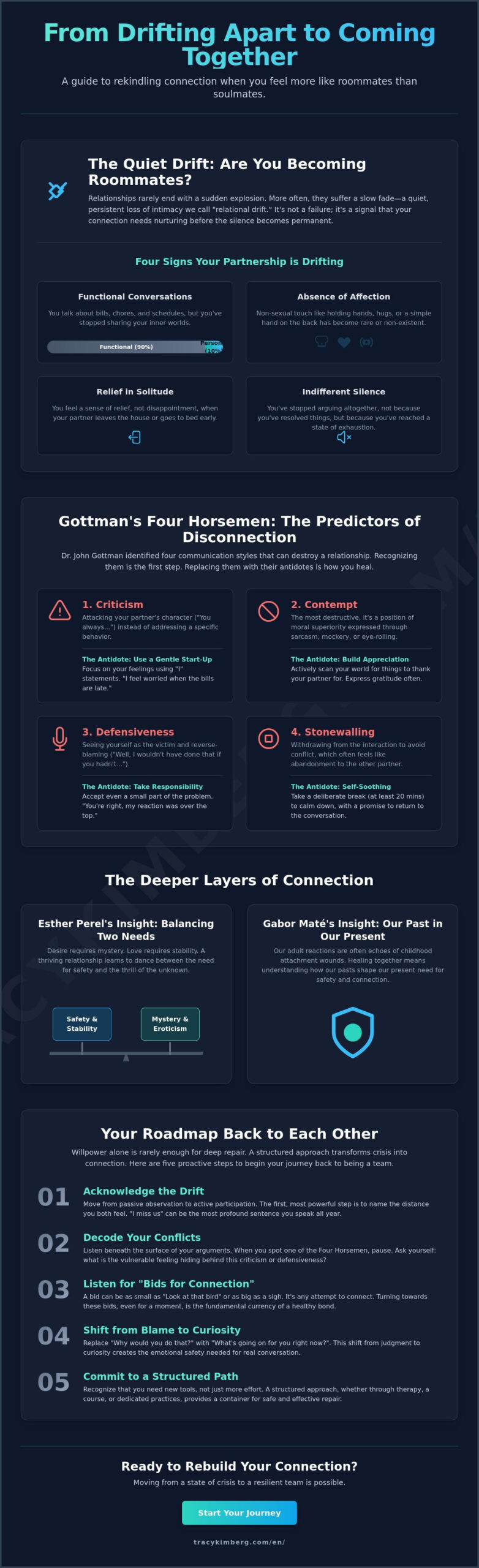
When you’re living parallel lives, you coexist in the same space without ever truly meeting. You might notice your conversations have become entirely transactional. You talk about the bins, the mortgage, or the children’s schedules, but you no longer ask about each other’s inner worlds. You should look for these specific indicators of drift:
- Your conversations are 90% functional and 10% personal.
- A noticeable lack of physical touch, even non-sexual affection like holding hands.
- You feel a sense of relief when your partner leaves the house or goes to bed.
- You’ve stopped arguing because you’ve reached a point of indifferent silence.
If these points resonate, it is essential to check for the signs of emotional neglect in marriage early on. Acknowledging that you’ve drifted is the first step in learning how to save my relationship. It allows you to move from passive observation to a proactive, positive adventure in healing.
The Psychology of Repair: Lessons from Gottman, Perel, and Maté
Repairing a bond isn’t about fixing a broken person; it’s about altering the frequency of your connection. If you are searching for how to save my relationship, you must first understand that you are part of a system. When one person changes their steps, the entire dance must shift. We can look to the masters of relational health, John Gottman, Esther Perel, and Gabor Maté, to find the map through this complex emotional landscape.
John Gottman’s decades of research identify specific behaviours that act as early warning signs for a partnership. Meanwhile, as Esther Perel suggests, we often struggle to balance the need for domestic safety with the need for erotic mystery. Gabor Maté adds a final, crucial layer by teaching us that our adult reactions are often rooted in childhood attachment. When you understand how to save my relationship through the lens of attachment, the conflict becomes less about who is right and more about how you can feel safe together. Together, these perspectives show us that saving a partnership is a proactive and positive adventure in self-discovery.
Breaking the Cycle of the Four Horsemen
Gottman’s “Four Horsemen” are Criticism, Contempt, Defensiveness, and Stonewalling. These aren’t just bad habits; they are predictors of failure. To stop the drift, you must apply the specific antidotes. Replace criticism with a gentle start-up that focuses on your feelings rather than your partner’s flaws. Counter defensiveness by taking responsibility for even a small part of the problem. Most importantly, eliminate contempt, which often manifests as eye-rolling or sarcasm. Contempt is the sulphuric acid of relationships; it dissolves the very bond it seeks to correct. If you recognise this pattern in your own dynamic, understanding the full process of overcoming contempt in a relationship can help you replace hostility with a culture of mutual appreciation before it causes irreparable damage. For couples who want a structured, evidence-based framework to address these destructive patterns, Gottman method therapy UK offers a research-led roadmap trusted by clinicians worldwide to help you manage conflict and rebuild intimacy.
The Role of Attachment and Personal History
Your attachment style, whether anxious or avoidant, dictates how you handle emotional distance. Anxious partners often pursue whilst avoidant partners retreat. This creates a painful push-pull dynamic that leaves both people exhausted. Understanding that your partner’s withdrawal might be a trauma response, rather than a lack of love, changes the entire narrative. This is why individual relationship counselling can be so transformative; it allows you to unpick your own personal patterns so you can show up differently for your partner. By linking past wounds to current triggers, you foster a sense of empathy that makes reconnection possible.
If you feel ready to move from these insights into a structured path of healing, exploring a professional approach can help you navigate these shifts with confidence and care.
Assessing the Damage: Can Your Relationship Be Saved?
When you reach the point of asking how to save my relationship, you’re standing at a crossroads. It’s a heavy, often lonely place to be. Assessing the damage isn’t about counting every past mistake; it’s about looking at the foundation to see if there is still enough stone to rebuild upon. We look for “bids for connection”—those small, often subtle requests for attention, a shared look, or a brief touch. If you or your partner are still making these bids, even if they are clumsy or frequently missed, the pulse of the relationship is still there.
A common fear is that silence means the end. You might think that if the shouting has stopped, the love has followed. However, silence is frequently a protective shield rather than a sign of indifference. It’s a way of saying, “I don’t know how to talk to you without hurting or being hurt.” Whilst repair is ultimately a bilateral process, it often begins with one person deciding to lower their shield. By changing your own reactions, you disrupt the old, painful patterns and invite your partner into a new way of being together.
Green Lights for Relational Repair
How do you know if the work will be worth the effort? We look for green lights: a shared history of friendship, core values that still align, and a mutual, underlying desire for things to be different. Interestingly, “fighting” is often a sign of life; it shows there is still passion and a desire to be understood. Indifference is the real danger. If you’re unsure where you stand, you can use the Can Your Relationship Be Saved? guide to help distinguish between a “hard” relationship—one that requires growth—and a truly toxic one that erodes your well-being.
Addressing the Fear of Infidelity
If your relationship has been rocked by betrayal, the question of how to save my relationship feels even more complex. The pain is visceral, yet many couples find that they can move into a phase of “Post-Traumatic Growth.” This isn’t about forgetting what happened, but about building a “second marriage” with the same person, based on radical honesty. Engaging in couples therapy for infidelity provides a structured, compassionate pathway to rebuild trust from the ground up. It’s possible to move from the wreckage of betrayal to a partnership that is more transparent and resilient than before.
5 Proactive Steps to Save Your Relationship Today
Moving from the “roommate phase” back into a vibrant partnership requires more than just good intentions; it requires a deliberate shift in your daily choreography. If you are focused on how to save my relationship, you must move from passive hope to active participation. This isn’t about grand, sweeping gestures. It’s about the small, consistent choices that rebuild the bridge between two people who have drifted apart. By implementing these five steps, you can begin to transform the atmosphere of your home from one of tension to one of possibility.
Step 1: Shifting the Narrative from “You” to “We”
Conflict often becomes a battle of “my truth” versus “your truth”. To break this cycle, you must practice radical curiosity. Instead of attacking your partner’s behaviour, get curious about the pain behind it. Use “I” statements to express your needs. For example, “I feel lonely when we don’t talk” is far more inviting than “You never talk to me”. Acknowledging your partner’s reality doesn’t mean you have to agree with it; it simply means you recognise their perspective as valid. In a relationship, there is no winner; either you both win, or you both lose.
Step 2 & 3: Practical Rituals for Reconnection
John Gottman often speaks about “Rituals of Connection” as the anchors of a resilient partnership. These are predictable moments that ensure you don’t become strangers. A simple, six-second kiss before leaving the house or a dedicated ten-minute daily check-in can work wonders. These rituals help you build emotional intimacy by prioritising the bond over the “to-do” list. You might also consider a weekly “Relationship State of the Union” meeting. This is a safe space to discuss what went well that week and where you might need a little more support, preventing small resentments from festering into major ruptures.
Step 4 involves taking radical responsibility for your own emotional regulation. Gabor Maté’s work reminds us that our triggers are often our own responsibility to manage. If you feel yourself becoming “flooded” or overwhelmed, take a twenty-minute break to calm your nervous system before continuing the conversation. Finally, Step 5 is knowing when to seek help. You don’t have to wait for a crisis to peak before reaching out. Professional guidance can provide the structure and safety you need to navigate these complex emotional landscapes. If you feel ready to move from crisis to connection, exploring Relationship Counselling and Coaching for Couples can be the catalyst for the deeper, more resilient partnership you both deserve.
Moving from Crisis to Connection: A Structured Path Forward
Willpower often feels like trying to hold back a tide. You might promise to stop shouting or try harder to listen, but without a structural change to the relational system, old habits eventually win. This is why the question of how to save my relationship isn’t just about trying harder; it’s about trying differently. A structured approach provides the scaffolding you need whilst you’re still feeling emotionally fragile. It moves the focus away from sporadic effort and toward a consistent, rhythmic healing process.
Think of a professional therapist as a “Wise Guide” for your partnership. They aren’t there to judge who is right or wrong, but to observe the system from a neutral vantage point. They see the invisible threads of attachment and the historical echoes that influence your current behaviour. This perspective is essential because it shifts the narrative from individual blame toward a collaborative solution. By working with a specialist, you gain a mirror that reflects the patterns you’re too close to see yourself.
Why Self-Work is the Catalyst for Partnership Change
Gabor Maté often reminds us that our adult reactions are frequently the shadows of our childhood survival strategies. When you begin to heal your own trauma, you change how you show up for your partner. You stop reacting from a place of wounding and start responding from a place of presence. It’s a profound shift. When you change your own “steps” in the dance, the whole choreography of the relationship must adapt. Practising self-compassion during this time is vital. You aren’t “fixing” yourself; you’re simply expanding your capacity for connection.
The 12-Week Relationship Recovery Process
Healing requires a manageable timeline. A vague promise to “work on things” can lead to frustration when progress feels slow or non-linear. This is why a 12-week relationship recovery process is so effective. It offers a clear, structured path that moves you from initial de-escalation—stopping the immediate pain—into deep, meaningful reconnection. This framework provides the safety and accountability needed to turn how to save my relationship from a desperate plea into a lived reality.
Transformation doesn’t happen in a single, massive event. It’s built through the accumulation of tiny, intentional acts. Healing is a journey of many small, brave choices. By choosing a structured path, you’re giving your partnership the best possible chance to flourish into a resilient, joyful team once again. You’ve already taken the first step by being here. Now, the adventure of reconnection truly begins.
Taking Your First Step Toward a New Partnership
Choosing to look for how to save my relationship is a brave act of hope. It’s an acknowledgement that whilst the current “dance” feels exhausting, the music hasn’t stopped yet. We’ve explored how shifting from blame to radical curiosity and implementing small, consistent rituals can disrupt the drift that turns lovers into roommates. You now understand that your personal history and attachment style aren’t obstacles; they are the keys to unlocking deeper empathy for one another.
Real change rarely happens through willpower alone. It requires a safe space and a proven map. Our research-based approach, grounded in the work of experts like Gottman and Perel, offers the clarity you’ve been missing. Whether you prefer online sessions or face-to-face support, we provide a non-judgemental environment to explore your dynamics. You don’t have to navigate this complex emotional landscape without a guide. Begin your journey to reconnection with a 12-Week Relationship Recovery programme and transform your crisis into a proactive and positive adventure. Your partnership has the capacity for incredible resilience. It’s time to start building your future together, one small, intentional choice at a time.
Frequently Asked Questions
Is it possible to save a relationship if only one person is trying?
It is absolutely possible to initiate change even if you are currently the only one leaning in. Because a relationship is a system, when you alter your own reactions and behaviours, you disrupt the existing loop and force the “dance” to shift. Whilst a resilient partnership eventually requires two active participants, your individual growth can often be the catalyst that invites your partner back into the connection.
How do I know if my relationship is worth saving or if it’s time to let go?
You can determine if a relationship is worth saving by looking for the presence of mutual respect and a shared history of friendship. If you still experience small bids for connection or share core values, there is a foundation to rebuild upon. However, if the partnership is defined by persistent toxicity or a complete refusal to engage in repair after significant effort, we can help you explore a conscious approach to separation.
Can communication really be fixed after years of circular arguments?
Communication can certainly be restored even after years of repetitive, circular arguments. The key is moving away from the surface-level topic and focusing on the underlying emotional needs and “raw spots” that trigger the conflict. By learning to de-escalate these moments and re-establishing emotional safety, you can replace old defensive patterns with a new language of radical curiosity and understanding.
What is the first thing I should say to my partner to start saving our relationship?
The most effective way to start is by leading with vulnerability rather than accusation. You might say, “I’ve been feeling lonely lately and I miss the connection we used to have. I’d really like to find a way for us to feel like a team again.” This shifts the focus from your partner’s perceived failings to your own desire for closeness, which is far less likely to trigger a defensive response.
How long does it typically take to see progress in relationship repair?
You can often see small, positive shifts in the atmosphere of your home within just a few weeks of consistent effort. Whilst deep, structural repair takes time, a structured 12-week approach provides a clear timeline for moving from crisis to reconnection. This period allows you to establish new rituals and stabilise your communication, making the question of how to save my relationship feel like a manageable, positive adventure.
What happens if we try to save the relationship but it still doesn’t work?
If you put in the work and the relationship still doesn’t survive, the effort is never wasted because you have gained profound self-awareness. You will have learned how to regulate your emotions and communicate your needs more clearly, which are vital skills for your future. In these cases, we support couples through a conscious approach to divorce, ensuring the transition is handled with as much respect and care as possible whilst you figure out how to save my relationship with yourself.
Is online relationship coaching as effective as face-to-face therapy?
Online therapy has proven to be just as effective as face-to-face sessions for relationship repair. Many couples find that being in their own environment allows them to feel more relaxed and open, which can actually accelerate the therapeutic process. Whether you choose online or face-to-face support, the quality of the guidance and your commitment to the process remain the most important factors for success.
How do we handle the “roommate phase” without making things awkward?
You can navigate the roommate phase by introducing small, low-pressure rituals of connection that don’t feel forced. Start with non-sexual touch, such as a hand on a shoulder or a longer hug, and try to re-establish curiosity about each other’s daily lives. By acknowledging the distance without judgement, you reduce the tension and create a safe space where intimacy can naturally begin to breathe again.

Article by
Tracy Kimberg
Tracy Kimberg is a Relationship Expert, Couples Therapist and Coach with a dedicated focus on helping couples and individuals rebuild connection, trust and emotional safety in their relationships. Drawing on the research of John and Julie Gottman, the relational insights of Esther Perel, and years of hands-on therapeutic experience, Tracy offers a warm, non-judgemental and deeply compassionate approach to modern relationships.
Based in Dorset, Tracy works with couples navigating communication breakdowns, betrayal, intimacy challenges, separation, family dynamics and life transitions. Known for creating a safe and grounded therapeutic space, she combines practical tools with emotional depth to help clients move beyond survival patterns and towards meaningful, lasting change.
With a reputation for empathy, professionalism and dedication to her clients’ growth, Tracy is passionate about helping people feel seen, understood and empowered — both within their relationships and within themselves.
Disclaimer
Disclaimer:
The information shared in this article is intended for educational and informational purposes only and should not be considered a substitute for professional therapeutic, psychological, medical or legal advice. Every individual and relationship is unique, and the perspectives offered are based on general therapeutic principles, research and professional experience.
Reading this article does not establish a therapist-client relationship with Tracy Kimberg. If you are experiencing significant emotional distress, relationship crisis, trauma, or mental health concerns, it is important to seek support from a qualified professional appropriate to your individual circumstances.
All content remains the intellectual property of Tracy Kimberg and may not be reproduced or distributed without permission.