

What if the secret to a lasting connection wasn’t found in a “gut feeling,” but in four decades of clinical data? You might feel like you’re trapped in a loop of the same three arguments, wondering if your bond has simply frayed beyond repair. It’s exhausting to love someone deeply whilst feeling like you’re speaking two different languages. Many couples feel a natural scepticism towards vague or unstructured counselling, searching instead for something that actually works. This is where Gottman method therapy UK offers a refreshing change. Using a framework trusted by over 135,000 clinicians worldwide, it replaces guesswork with a structured, research-led roadmap designed to help you manage conflict and rebuild intimacy.
Your relationship is your most precious investment. You deserve a path forward that balances scientific rigour with deep emotional empathy. In this guide, we’ll explore how this evidence-based approach transforms repetitive friction into meaningful connection. We’ll look at the specific tools that can help you move from a place of disconnect to a shared sense of hope. Whether you’re seeking a 12-week relationship recovery process or face-to-face support, you’ll discover how to turn the data of your life into a lived experience of love.
Key Takeaways
- Learn why Gottman method therapy UK is shifting the landscape from reactive crisis management to proactive relationship coaching.
- Discover the Sound Relationship House framework and how building “Love Maps” creates a resilient foundation for your partnership.
- Understand the unique assessment process that uses validated tools to move beyond vague conversation into actionable change.
- Identify the “Four Horsemen” behaviours and learn how replacing criticism with gentle start-ups can protect your bond.
- Explore the “Atone, Attune, Attach” model for navigating high-conflict issues like infidelity with a structured roadmap for recovery.
Understanding Gottman Method Therapy in the UK Context
Gottman method therapy UK is more than a trend; it’s a response to a fundamental human need for clarity. Developed by Drs John and Julie Gottman, this research-led approach brings the precision of a laboratory to the delicate art of love. In the UK, we’ve traditionally viewed therapy as a reactive “crisis” measure, something you do only when the bags are packed. However, there’s a significant shift happening amongst modern couples. Many are now moving toward proactive relationship coaching, seeking structured frameworks that offer more than just a space to vent. They want to understand the mechanics of their connection through a lens that is both clinical and compassionate.
The Science of Stability and Connection
The foundation of this work lies in “The Love Lab,” where the Gottmans conducted longitudinal studies over four decades. By observing thousands of couples, they discovered that relationship success isn’t a mystery; it’s a series of observable behaviours. This data-driven insight allows therapists to identify patterns like The Four Horsemen of the Apocalypse, which are specific conflict styles that predict dissolution. This scientific rigour is incredibly grounding when you’re trying to figure out if your relationship can be saved. Instead of relying on abstract feelings that change with the weather, we look at the tangible ways you interact, turn toward each other, or shut down. It’s about looking at the data of your heart with honesty and hope.
Why “Just Talking” Isn’t Always Enough
Generic counselling often lacks a clear destination, which can leave you feeling like you’re simply treading water. This is why Gottman method therapy UK has become a preferred choice for those who value efficiency alongside empathy. The approach is different because it uses the “Sound Relationship House” as a diagnostic roadmap. It allows us to pinpoint exactly where the structural integrity of your partnership has weakened, whether it’s in your shared friendship or your ability to manage conflict. As your therapist, I don’t just sit back and listen whilst you repeat the same arguments. I act as a Wise Guide, providing active interventions and psychological tools to help you rebuild. We focus on a thorough “Assessment Phase,” using validated questionnaires to ensure the therapy is tailored to your specific needs. This transition from static treatment to an evolving experience is what makes the process feel both powerful and manageable.
The Architecture of Love: Exploring the Sound Relationship House
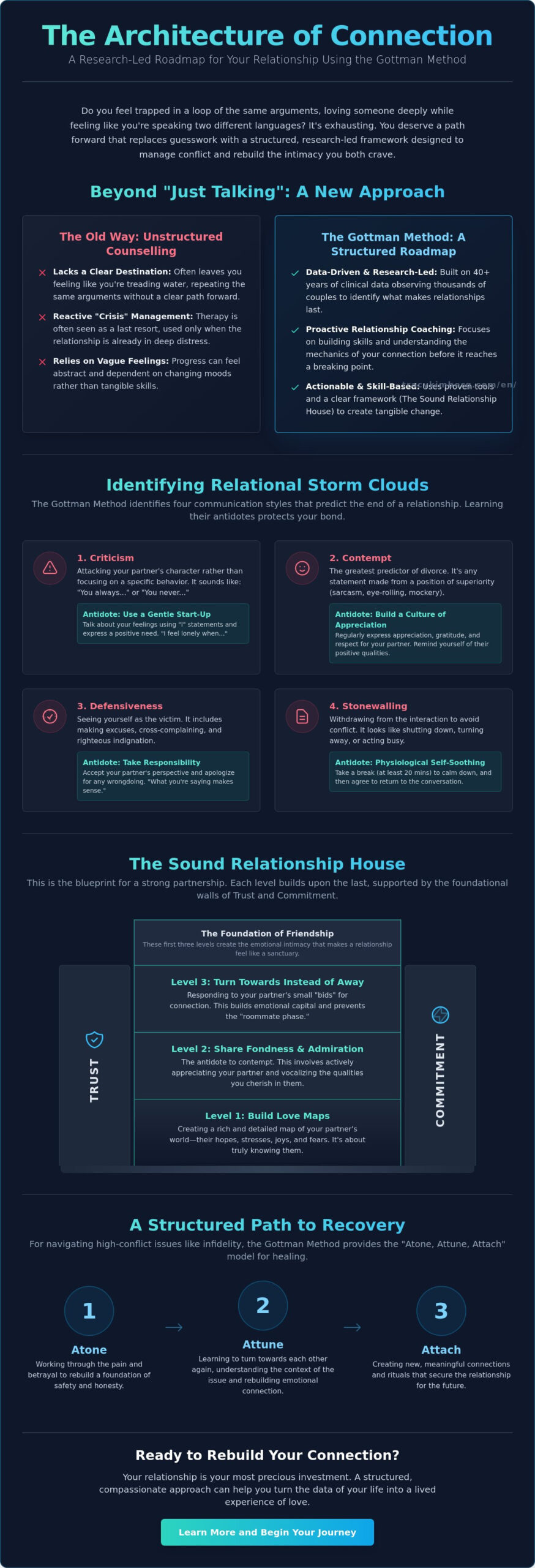
Think of your relationship as a physical structure. For it to withstand the inevitable storms of life, it requires more than just a roof and four walls; it needs a blueprint. The Sound Relationship House is that blueprint. It’s the core framework used in Gottman method therapy UK to help couples understand where their bond is strong and where the mortar has begun to crumble. At the very edges of this house are the two protective walls: Trust and Commitment. These aren’t just abstract concepts. They are active, structural supports that ensure both partners feel safe and valued. When these walls are solid, the house remains upright, even when the internal rooms are under renovation. These levels are not fixed traits, but skills that can be practised and mastered amongst any couple willing to do the work.
Friendship as the Foundation
The first three levels of the house focus on the friendship that keeps a couple connected. It starts with “Love Maps,” which is the psychological space you hold for your partner’s world. It’s about knowing their favourite coffee, their current work stresses, and their deepest childhood hopes. Above this, we build “Fondness and Admiration.” This level acts as a powerful antidote to contempt, reminding you of the qualities you cherish in your partner. Finally, we look at “Turning Towards,” where you respond to your partner’s small bids for connection. Mastering these levels prevents that dreaded “roommate phase” where couples drift into parallel lives. It fosters a deep emotional intimacy that makes the relationship feel like a sanctuary rather than a source of stress.
Managing Conflict and Shared Meaning
Once the foundation of friendship is secure, we move into the “Positive Perspective,” where you naturally give each other the benefit of the doubt. This is essential for the next level: Managing Conflict. One of the most liberating realisations in Gottman method therapy UK is the discovery that 69% of relationship problems are perpetual. These are the recurring disagreements about money, parenting, or social lives that never truly go away because they are rooted in personality differences. The goal isn’t to “fix” them but to manage them with dialogue and humour. By using research-based interventions, couples can move from painful gridlock to mutual understanding. The house is completed by “Making Life Dreams Come True” and “Creating Shared Meaning,” where you build a legacy and a culture of support. If you’re ready to start drafting your own blueprint, exploring professional relationship coaching can provide the guidance you need to begin this proactive adventure.
Beyond Traditional Counselling: Why the Gottman Approach is Different
Many couples arrive at my practice feeling “talked out.” They’ve spent months or years replaying their grievances in traditional settings, yet the needle hasn’t moved. Gottman method therapy UK stands apart because it doesn’t just analyse your history; it actively equips you for your future. The process begins with a rigorous Assessment Phase. This isn’t a quick chat. It involves a joint session, individual interviews, and validated questionnaires that give us a high-definition picture of your relational health. This data-driven start ensures that we aren’t just guessing. We are targeting the specific areas where your connection needs reinforcement.
In the room, the work is “dyadic.” This means my primary focus is the relationship itself, rather than taking sides or focusing solely on individual histories. We use active tools like the “Gottman Rapoport” intervention to help you truly hear one another, or “Dan Wile” interventions where I might speak for a partner to help unblock a stuck dialogue. We also pay close attention to your bodies. When you’re in conflict, you might experience “flooding,” a physiological state where your heart rate spikes and your brain loses the ability to process information. We teach you to recognise this and use self-soothing techniques to stay present. It’s about making the therapeutic process powerful yet manageable.
A Proactive vs. Reactive Stance
Traditional models often leave couples feeling “opened up” at the end of a session, only to send them home without a way to close the wound. I prefer a more supportive rhythm. By choosing Gottman method therapy UK, you’re opting for a model that provides tangible tools, such as the Gottman Card Decks app, to help you maintain your bond between sessions. This proactive approach turns your daily life into a positive adventure of discovery. You’ll have “homework” that feels like a shared project rather than a clinical necessity, ensuring that progress continues whilst you’re outside the therapy room.
The Focus on Positive Affect
Whilst many approaches focus on “fixing” what’s broken, we place equal weight on building what’s good. In stable relationships, the research shows a 5:1 ratio of positive to negative interactions. This means for every one moment of friction, you need five moments of connection to keep the emotional bank account in credit. The Gottman Method for Healthy Relationships teaches you how to intentionally increase these positive bids. By focusing on these small, daily wins, you can begin saving your relationship through compassionate reconnection. It’s a path grounded in optimism, showing that healing isn’t just about reducing pain, but about inviting joy back into your shared life.
Recognising the Four Horsemen: Identifying Relational Conflict at Home
In the quiet moments of a British home, conflict often takes on a predictable shape. Gottman method therapy UK identifies four specific behaviours, known as the Four Horsemen, that serve as the most reliable predictors of relationship breakdown. Recognising these isn’t about assigning blame; it’s about identifying the roadblocks that prevent you from reaching each other. Criticism is often the first to arrive. It’s the difference between saying, “I’m upset the kitchen wasn’t tidied,” and “You’re so selfish, you never think of anyone else.” The latter attacks your partner’s character rather than a specific behaviour, which naturally triggers a cycle of hurt.
When conflict becomes too intense, one partner might engage in Stonewalling. This isn’t just “the silent treatment” used as a weapon; it’s often a physiological response to feeling overwhelmed. As we explored when discussing flooding, the heart rate climbs, and the person simply shuts down to protect themselves. In a session, we learn the power of a structured “Time Out.” It’s a vital tool that allows you both to de-escalate before the conversation turns into a battleground, ensuring that you return to the table only when you can hear each other again.
The Toxicity of Contempt
Contempt is the most poisonous of the horsemen. It goes beyond criticism by adding a layer of moral superiority. It’s the eye-roll, the sneer, or the “joke” that’s actually a barb designed to make a partner feel small. When you feel superior to your partner, you can no longer see them as an equal or a friend. This is why overcoming contempt is the highest priority in any therapeutic journey. The antidote is intentional: we work on building a culture of appreciation and respect, finding the small things your partner does right whilst letting go of the need to be “better” than them.
Breaking the Cycle of Defensiveness
Defensiveness is essentially a way of saying “The problem isn’t me, it’s you,” which shuts down all collaborative repair. It’s a natural shield, but it prevents any real resolution from taking place. To break this cycle, we practise the antidote of taking responsibility. Even if you only agree with a tiny fraction of your partner’s complaint, owning that small part changes the entire dynamic. It moves the conversation from “me versus you” to “us versus the problem.” Identifying these patterns is the vital first step in my Relationship Recovery Process. If you recognise these horsemen in your own home, you can book a session for couples coaching to start replacing these destructive habits with research-led tools.
Navigating Your Journey: How Gottman-Informed Therapy Facilitates Recovery
Healing from deep betrayal or the weight of past trauma requires more than just time; it requires a map. When a relationship is in crisis, the “wait and see” approach often leads to further erosion of the bond. This is why Gottman method therapy UK is so effective for high-conflict situations. We don’t just talk about the pain. We navigate it using the “Atone, Attune, Attach” model. This phased approach is essential for rebuilding trust after infidelity. It begins with the “Atone” phase, where the betrayal is fully acknowledged and the “why” is explored without the wall of defensiveness. From there, we move into “Attuning” to each other’s needs and eventually “Attaching” to a new version of the partnership that is stronger than the one that came before.
As your therapist, I act as a Compassionate Expert, guiding you through these complex emotional landscapes with a steady hand. We look at the observable behaviours that have led to the current disconnect and use scientific tools to repair them. This process isn’t about blaming one person; it’s about understanding the systemic dynamics that have allowed the relationship to fray. It’s about looking at the data of your interactions whilst maintaining a deep sense of empathy for the human beings behind the data points.
The 12-Week Relationship Recovery Framework
Many couples find that open-ended therapy feels like treading water. To counter this, I offer a structured 12-week recovery program designed to move you from stagnancy to active evolution. This timeframe isn’t arbitrary. It provides enough space for a deep, data-driven assessment whilst ensuring the work remains focused and purposeful. Over these three months, we move through the layers of the Sound Relationship House, building the skills you need to manage conflict and deepen intimacy. It turns the therapeutic process into a manageable journey with a clear destination, providing the momentum needed to break through years of stuck patterns.
A Holistic Perspective: Gottman, Perel, and Maté
My practice involves more than just following a single manual. Whilst Gottman provides the essential “how-to” of relationship health, I integrate the systemic insights of Esther Perel to address the complexities of desire and eroticism. We look at how to maintain the “otherness” that keeps passion alive whilst building the safety that Gottman emphasises. Additionally, I bring a trauma-informed lens inspired by Gabor Maté. By understanding how our nervous systems were shaped by early experiences, we can begin to see why we react with such intensity to our partners. This holistic approach ensures that your healing is both clinically accurate and deeply human. It transforms Gottman method therapy UK from a clinical necessity into a proactive adventure in love, where you don’t just survive your challenges, but thrive amongst them.
Your Journey Toward a Renewed Connection
Choosing to work on your relationship is a courageous step away from repetitive conflict and toward a shared future. We’ve explored how the Sound Relationship House provides a structural blueprint for intimacy, and why identifying the Four Horsemen is the first step in protecting your bond from erosion. By integrating the scientific rigour of Gottman method therapy UK with a compassionate, trauma-informed perspective, you can move beyond simply “talking” and begin truly healing. Whether you are navigating the aftermath of betrayal or simply want to strengthen your friendship, a roadmap exists to guide you home.
I am here to support you with specialised 12-week Relationship Recovery Processes and research-led tools inspired by the work of Gottman and Perel. This isn’t just about managing a crisis; it’s about evolving together in a way that feels powerful and sustainable. You don’t have to navigate these complex emotional landscapes alone. Begin your proactive adventure in healing with a structured Relationship Recovery Process. Healing is possible, and the tools to achieve it are within your reach.
Frequently Asked Questions
Is the Gottman Method effective for couples on the brink of divorce?
Yes, the Gottman Method is particularly effective for couples on the brink of divorce because it focuses on the specific behaviours that research identifies as predictors of relationship failure. By identifying these patterns early, we can implement active interventions to de-escalate conflict and rebuild safety. This structured approach provides the clarity and hope needed when you feel you’ve reached the end of the road, moving you from a state of emergency to a proactive adventure in healing.
How many sessions of Gottman Method therapy are usually required?
Every relationship moves at its own pace, but the process usually begins with a thorough assessment phase conducted over three sessions to map out your unique dynamics. For those seeking a clear roadmap, my 12-week Relationship Recovery Process provides a focused timeframe to move from crisis to connection. This structured approach ensures that the work feels manageable and purposeful, rather than an open-ended clinical necessity that lacks a clear destination or measurable progress.
What is the difference between a Level 1, 2, and 3 Gottman-trained therapist?
Training is divided into three distinct levels before a therapist enters the final certification track. Level 1 is an introductory stage with no prerequisites, whilst Level 3 is an advanced clinical training that requires a relevant master’s or doctoral degree and completion of the previous stages. A certified therapist has completed all three levels plus a rigorous consultation process, ensuring they have the specialised expertise to apply

Article by
Tracy Kimberg
Tracy Kimberg is a Relationship Expert, Couples Therapist and Coach with a dedicated focus on helping couples and individuals rebuild connection, trust and emotional safety in their relationships. Drawing on the research of John and Julie Gottman, the relational insights of Esther Perel, and years of hands-on therapeutic experience, Tracy offers a warm, non-judgemental and deeply compassionate approach to modern relationships.
Based in Dorset, Tracy works with couples navigating communication breakdowns, betrayal, intimacy challenges, separation, family dynamics and life transitions. Known for creating a safe and grounded therapeutic space, she combines practical tools with emotional depth to help clients move beyond survival patterns and towards meaningful, lasting change.
With a reputation for empathy, professionalism and dedication to her clients’ growth, Tracy is passionate about helping people feel seen, understood and empowered — both within their relationships and within themselves.
Disclaimer
Disclaimer:
The information shared in this article is intended for educational and informational purposes only and should not be considered a substitute for professional therapeutic, psychological, medical or legal advice. Every individual and relationship is unique, and the perspectives offered are based on general therapeutic principles, research and professional experience.
Reading this article does not establish a therapist-client relationship with Tracy Kimberg. If you are experiencing significant emotional distress, relationship crisis, trauma, or mental health concerns, it is important to seek support from a qualified professional appropriate to your individual circumstances.
All content remains the intellectual property of Tracy Kimberg and may not be reproduced or distributed without permission.