

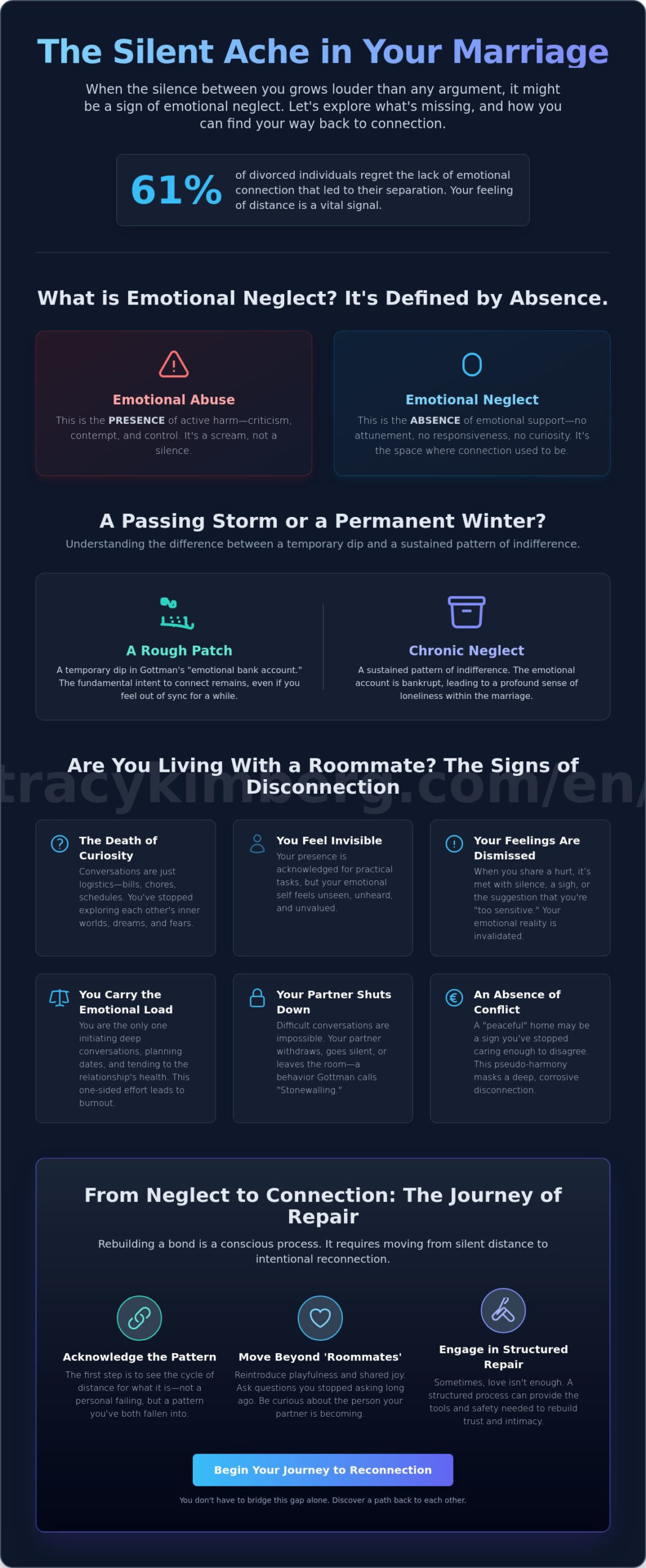
Hello. Why does it feel as though you are living with a stranger you have known for a lifetime? It is a quiet, hollow ache that often goes unspoken because there isn’t a loud, explosive conflict to point to. You might be searching for the signs of emotional neglect in marriage because the silence in your home has become louder than any argument you’ve ever had. Research shows that 61% of divorced spouses regret the lack of emotional connection before their separation; this suggests that your intuition about this distance is a vital signal that shouldn’t be ignored.
I recognise that feeling invisible to your partner is an exhausting experience, especially when your communication has dwindled to surface-level logistics about the household. Whether you are experiencing the “Alpine divorce” phenomenon of feeling abandoned in a crisis or simply feeling like roommates, you deserve to feel seen once more. In this guide, I will help you identify the subtle markers of neglect and offer a compassionate framework to understand the disconnect. You’ll discover actionable steps to move away from this distance and begin a journey of repair, whilst learning how a structured relationship recovery process can help you bridge the gap and rediscover the intimacy you’ve lost.
Key Takeaways
- Understand that emotional neglect is defined by what is missing, specifically the absence of attunement and responsiveness, rather than the presence of active conflict.
- Identify the subtle signs of emotional neglect in marriage, such as when your daily interactions focus solely on household logistics whilst your emotional world feels ignored.
- Discover the psychological roots of disconnection, including how childhood experiences and attachment styles can shape the way you and your partner respond to intimacy.
- Recognise the hidden costs of chronic silence and how it erodes self-esteem; this often leads to the “Walkaway Wife” or “Miserable Husband” syndrome.
- Learn actionable frameworks to break the cycle of distance, move beyond the “roommate phase”, and begin a conscious journey of repair and reconnection.
What is Emotional Neglect in a Marriage?
Emotional neglect isn’t a scream; it’s a silence. It is the consistent failure to respond to your partner’s emotional bids for connection. When we ask what is emotional neglect, we are essentially looking at the space between two people where curiosity and attunement used to live. Unlike emotional abuse, which involves active harm through criticism or contempt, neglect is defined by what does not happen. It is the absence of a comforting hand when you’re stressed, the lack of interest in your internal world, and the slow fading of shared joy.
In my work with couples, I often see how this “invisible” issue takes root. Esther Perel frequently explores the tension between the domestic and the erotic. Neglect occurs when the domestic logistics—the bills, the school runs, the household chores—completely swallow the erotic vitality of the partnership. The “erotic” here isn’t just about sex; it’s about the life force, the playfulness, and the deep interest in who your partner is becoming. When you stop being curious about each other, the relationship begins to starve. Because there is no “event” like an affair or a massive row, neglect often goes unnoticed by friends and family, leaving the couple to suffer in a vacuum of indifference.
The Difference Between a ‘Rough Patch’ and Chronic Neglect
Every marriage has seasons of busyness where you might feel slightly out of sync. A rough patch is a temporary dip in what John Gottman calls the “emotional bank account.” You might have a few weeks of lower intimacy, but the fundamental intent to connect remains. Chronic neglect is different. It is a sustained pattern of indifference where the account has reached bankruptcy. You begin to experience a profound sense of loneliness in a crowded room. You are physically present with your spouse, yet you feel emotionally stranded. If this sense of isolation has become your “new normal” rather than a passing phase, you are likely seeing the signs of emotional neglect in marriage.
Why It Is Often Misunderstood as ‘Peace’
There is a dangerous misconception that a lack of fighting equals a healthy relationship. Many couples exist in a state of “pseudo-harmony,” where they avoid conflict by also avoiding intimacy. You don’t argue because you’ve stopped caring enough to disagree. This quietness is often a mask for deep-seated disconnection. A “peaceful” marriage where you never share your fears or dreams is actually a marriage in peril. This silence eventually leads to a sudden separation that blindsides outsiders, but for the person living through it, the end was written in years of unreturned glances and ignored emotional needs.
10 Signs of Emotional Neglect: Identifying the Roommate Phase
Living in the roommate phase is a specific kind of grief. You share a mortgage, a kitchen, and perhaps even a bed, yet you feel miles apart. This isn’t the presence of a storm; it is the absence of the sun. When you are looking for the signs of emotional neglect in marriage, you aren’t usually looking for what your partner said, but rather for the echoes of what they didn’t say. You might feel invisible, as though your presence is acknowledged for logistics but your inner world is left to gather dust. It’s a profound loneliness that occurs when your partner stops being your witness.
One of the clearest 10 Signs of Emotional Neglect is the death of curiosity. In the early days, you were explorers of each other’s minds. Now, conversations are reduced to the “logistics” of life. You discuss the kids’ schedules, the rising cost of utilities, or the grocery list, but you never touch upon your dreams, fears, or the small joys of your day. If you share a hurt and it’s met with a sigh, silence, or the dismissive claim that you’re “too sensitive,” your emotional reality is being systematically ignored. This parallel living creates a hollow shell of a partnership where you are together, yet entirely alone.
Communication Breakdowns and Emotional Labour
Often, one partner carries the entire emotional load. You are the one facilitating conversations, planning dates, and checking in on the relationship’s health. When this effort isn’t reciprocated, it leads to burnout. You may also encounter “Stonewalling,” a term coined by John Gottman to describe when a partner shuts down and withdraws from interaction. This isn’t just a pause in the conversation; it’s an active form of neglect. Learning how to fix communication in a relationship starts with naming this silence. If you feel like you’re shouting into a void, my Relationship Counselling and Coaching can help you find a shared language again.
The Physical and Intimate Toll
Emotional neglect eventually migrates to the body. When the heart is neglected, the skin often follows. You might experience “touch starvation,” where the lack of non-sexual affection makes you feel brittle and unloved. Sex, if it happens at all, becomes mechanical or “performative,” lacking the soul-to-soul connection that intimacy requires. This physical withdrawal is a protective mechanism, a way the body copes with being emotionally abandoned. It is essential to perform a relationship check up to assess these levels of intimacy. Recognising these signs of emotional neglect in marriage is the first step toward reclaiming the warmth you both deserve.
Why Does Emotional Neglect Happen? The Psychological Roots
To understand why a partner withdraws, we must look beneath the surface of their current behaviour. It is rarely a conscious choice to be cold. Instead, the signs of emotional neglect in marriage often stem from what we call Childhood Emotional Neglect (CEN). We tend to repeat the relational patterns we don’t repair. If your spouse grew up in a home where their emotional bids were met with silence or “stiff upper lip” stoicism, they may simply lack the internal vocabulary required for deep intimacy. They aren’t withholding love; they are speaking a language they were never taught.
Gabor Maté often speaks about how chronic stress forces the brain into survival mode. In this state, the prefrontal cortex—the part of the brain responsible for empathy and connection—effectively shuts down. When a partner is overwhelmed by work, financial pressure, or the “Technoference” of our digital age, they may retreat into a shell. This digital wall, where scrolling replaces soul-searching, serves as a buffer against a world that feels like too much. Understanding these Signs and Coping Mechanisms for Emotional Neglect allows us to see the spouse not as an enemy, but as someone struggling with their own internal regulation.
Attachment Styles and the Dance of Distance
The Anxious-Avoidant trap is one of the most common dynamics in neglected marriages. One partner pursues connection, whilst the other, feeling engulfed, withdraws to find safety. This “Dismissive-Avoidant” stance is a defence mechanism designed to prevent vulnerability. Recognising this pattern in real-time—seeing the withdrawal as a plea for space rather than a rejection—is transformative. Often, individual relationship counselling is the most effective way for an avoidant partner to unpick these tendencies without feeling the immediate pressure of a joint session.
Trauma and the ‘Shutdown’ Response
Neglect is frequently a “freeze” response to perceived emotional threat. For some, deep intimacy feels inherently unsafe due to past trauma or previous relational wounds. When the emotional stakes get too high, they “flatline” as a way to cope. By reframing the signs of emotional neglect in marriage as a protective shutdown rather than a lack of affection, we can foster empathy. This shift in perspective is the first step toward creating a “secure base” where both partners feel safe enough to be seen again. It turns a battle of resentment into a collaborative journey of healing.
The Cost of Silence: How Neglect Erodes Your Partnership
Silence in a relationship is rarely neutral. It is an active force that slowly dismantles a person’s sense of self. When the signs of emotional neglect in marriage persist over years, the neglected partner often begins to internalise the lack of response. They start to believe they are fundamentally unworthy of attention or that their inner life is uninteresting. This erosion of self-esteem is one of the most painful costs of a disconnected partnership. It transforms a once-vibrant individual into a shadow of themselves, surviving on the crumbs of interaction.
Eventually, this leads to what we call “Walkaway Wife” or “Miserable Husband” syndrome. This is the point of no return. One partner has spent so long trying to bridge the gap that they simply run out of fuel. They stop complaining. They stop asking for more. To the neglectful partner, it might look like peace has finally been achieved. In reality, it is the silence of a fire that has completely burned out. By the time the “peaceful” partner realises something is wrong, the other has often already mourned the relationship and moved on emotionally.
We must also consider the atmosphere we create for our children. Kids don’t just hear what we say; they breathe in the emotional climate of the home. If they grow up amongst parents who live like polite strangers, they learn that intimacy is secondary to logistics. This can lead to significant mental health challenges, including chronic anxiety or a sense of “aloneness” that follows them into adulthood. If you recognise these patterns in your home, my Relationship Counselling and Coaching for Couples offers a way to break the cycle before it becomes a legacy.
The Risk of Infidelity and External Seekers
Emotional neglect creates a vacuum. When your partner no longer provides validation or curiosity, the human heart naturally looks elsewhere to fill the void. This is often how emotional affairs begin. It isn’t necessarily about a lack of moral character, but a desperate search for the feeling of being “seen” again. If the neglect has already led to a breach of trust, you may need couples therapy for infidelity to navigate the complex path of rebuilding. An affair is frequently a symptom of a marriage that has been starving for emotional oxygen for a very long time.
Physical Health and the Body’s Protest
Gabor Maté famously wrote about how the body says “no” when the mind cannot. Relational stress is not just “all in your head.” Chronic emotional neglect keeps your nervous system in a state of low-grade alarm. This constant drip of cortisol and adrenaline can eventually suppress the immune system and manifest as physical illness. Your body might protest through chronic fatigue, migraines, or digestive issues. These are not coincidences. They are signals that the signs of emotional neglect in marriage are taking a toll on your biological health. Learning to listen to these signals is a vital part of your recovery journey.
For those in high-pressure ministry roles, this recovery is essential for long-term health; the Empowering Pastors Ministry — Dr. Micheal Spencer provides a 12-Week Leadership Cohort designed to offer Christian leaders the intensive training and peer accountability they need to thrive.
From Neglect to Connection: Steps to Repair Your Bond
Repair is not a return to how things were; it is an evolution into something more resilient. Once you have identified the signs of emotional neglect in marriage, the path forward requires a departure from the safety of silence. It begins with naming the distance without weaponising it. Instead of saying, “You never listen to me,” try standing in your own vulnerability by saying, “I feel lonely and I miss our connection.” This shift from blame to “I” statements invites your partner into a collaborative space rather than a defensive one. It signals that you are fighting for the relationship, not against each other.
To bridge the gap, you must actively practice curiosity. John Gottman’s concept of “Love Maps” is essential here. It involves rediscovering the intricate details of your partner’s inner world. Ask questions that have no logistical purpose: “What is your biggest worry this week?” or “What is a dream you’ve been hesitant to share?” This isn’t about solving problems; it is about witnessing one another. Curiosity is the direct antidote to neglect. By scheduling “Intimacy Dates” that focus on shared vulnerability rather than household management, you begin to reclaim the erotic vitality that neglect so often stifles.
Daily Exercises for Reconnection
Healing happens in the small, mundane moments of the day. I often suggest starting with specific exercises for couples to reconnect to build momentum. One of the most effective is the “10-minute check-in” rule. For ten minutes each evening, you speak only about your feelings and internal experiences. No talk of kids, bills, or schedules is permitted. Additionally, you should consciously build a culture of appreciation. Neglect thrives in a vacuum of gratitude. By vocalising one thing you admire about your partner daily, you begin to counter the “negativity bias” that has likely taken root during your period of disconnection.
The 12-Week Relationship Recovery Path
Sometimes, the cycles of neglect are too deeply etched to be broken by effort alone. If you feel as though you are going in circles, a structured, professional framework can provide the safety needed to address long-standing wounds. My 12-week relationship recovery process is designed to guide you through this transformational journey. We move beyond surface-level talk to unpick the attachment styles and trauma responses that drive withdrawal. This structured approach moves the partnership from a state of mere survival to one of thriving. It turns the daunting task of repair into a manageable, proactive adventure where you can finally feel seen, heard, and cherished amongst the complexities of modern life.
Reclaiming the Heart of Your Partnership
The journey from a “roommate” existence back to a vibrant partnership is not one you have to walk alone. By understanding that the signs of emotional neglect in marriage often stem from unmet needs and historical patterns rather than a lack of love, you can begin to shift the atmosphere of your home. We’ve explored how curiosity acts as an antidote to indifference and why a structured approach is vital for breaking the cycles of silence that erode your bond.
If you’re ready to move from surviving to thriving, I invite you to take a proactive step toward healing. Using a research-based approach inspired by the work of Gottman and Perel, I provide a safe, non-judgemental environment where transformation can truly happen. My specialised expertise in relational disconnect ensures that your path to repair is grounded in clinical accuracy and deep human empathy. Book your initial consultation for the 12-Week Relationship Recovery Process today.
Your marriage doesn’t have to remain a place of isolation. With the right guidance and a commitment to shared vulnerability, you can rediscover the warmth and intimacy that first brought you together. There’s always a way back to each other.
Frequently Asked Questions
Is emotional neglect a form of emotional abuse?
Emotional neglect is distinct from emotional abuse because it is defined by what does not happen rather than active harm. Whilst abuse involves overt actions like criticism or control, neglect is the persistent absence of attunement and responsiveness. However, the impact on your nervous system can be just as profound. It is the difference between being attacked and being invisible, and both require a compassionate, trauma-informed approach to healing.
Can a marriage survive years of emotional neglect?
Yes, a marriage can certainly survive and even flourish after years of neglect if both partners commit to a conscious recovery process. Many couples find that naming the silence is the first step toward reclaiming their bond. By using a structured framework, such as a 12-week relationship recovery process, you can begin to rebuild the emotional bank account that has been depleted by years of parallel living and indifference.
How do I tell my husband I feel emotionally neglected without him getting defensive?
The key is to use “I” statements that focus on your own feelings of loneliness rather than his perceived failures. Instead of saying “You always ignore me,” try saying “I feel lonely and I miss the connection we used to share.” This approach invites him into a conversation about your needs rather than a battle over his behaviour. It moves the dialogue from a place of blame to one of shared vulnerability.
What are the most common causes of emotional neglect in a relationship?
The most common causes include childhood emotional neglect, avoidant attachment styles, and the overwhelming pressure of modern stress. Often, a partner is simply repeating the relational patterns they learned in their family of origin. When you understand these roots, you can view the signs of emotional neglect in marriage as a systemic challenge to be solved together, rather than a personal rejection or a lack of love.
Is it normal to feel lonely while sitting right next to my spouse?
It is a very common experience in marriages where emotional attunement has faded over time. This “loneliness in a crowded room” occurs when physical proximity is no longer matched by emotional presence. It is a painful signal from your heart that your bids for connection are going unanswered. Recognising this feeling is often the vital catalyst that leads couples to seek relationship counselling to rediscover their shared inner worlds.
How do I know if I am the one being emotionally neglectful?
You may be the neglectful partner if you find yourself withdrawing from your spouse’s emotional bids or prioritising household logistics over intimacy. If you feel overwhelmed by your partner’s needs and respond with silence or “stonewalling,” you might be experiencing a “freeze” response. Reflecting on your own attachment style through individual therapy can help you understand why you find vulnerability challenging and how to safely re-engage.
What is the ‘Roommate Phase’ and how do we get out of it?
The ‘Roommate Phase’ is a period where a couple lives parallel lives, focusing on co-parenting and household management whilst neglecting their emotional connection. To exit this phase, you must consciously reintroduce curiosity and playfulness into your daily life. Scheduling “Intimacy Dates” and practicing Gottman’s Love Maps are practical ways to transition from being mere co-habitants back to being lovers, confidants, and true partners.
When should we seek professional help for emotional disconnect?
You should seek professional support when you feel stuck in a cycle of silence or “pseudo-harmony” that you cannot break on your own. If your attempts at connection lead to more distance, or if you have reached a point of deep resentment, a structured intervention is necessary. Professional coaching, such as the support offered by Mag. Christian Asperger, provides the safety required to address deep-seated signs of emotional neglect in marriage and move toward a more vibrant, connected future.

Article by
Tracy Kimberg
Tracy Kimberg is a Relationship Expert, Couples Therapist and Coach with a dedicated focus on helping couples and individuals rebuild connection, trust and emotional safety in their relationships. Drawing on the research of John and Julie Gottman, the relational insights of Esther Perel, and years of hands-on therapeutic experience, Tracy offers a warm, non-judgemental and deeply compassionate approach to modern relationships.
Based in Dorset, Tracy works with couples navigating communication breakdowns, betrayal, intimacy challenges, separation, family dynamics and life transitions. Known for creating a safe and grounded therapeutic space, she combines practical tools with emotional depth to help clients move beyond survival patterns and towards meaningful, lasting change.
With a reputation for empathy, professionalism and dedication to her clients’ growth, Tracy is passionate about helping people feel seen, understood and empowered — both within their relationships and within themselves.
Disclaimer
Disclaimer:
The information shared in this article is intended for educational and informational purposes only and should not be considered a substitute for professional therapeutic, psychological, medical or legal advice. Every individual and relationship is unique, and the perspectives offered are based on general therapeutic principles, research and professional experience.
Reading this article does not establish a therapist-client relationship with Tracy Kimberg. If you are experiencing significant emotional distress, relationship crisis, trauma, or mental health concerns, it is important to seek support from a qualified professional appropriate to your individual circumstances.
All content remains the intellectual property of Tracy Kimberg and may not be reproduced or distributed without permission.