

What if the distance you feel from your partner isn’t a sign that the love has died, but simply a signal that your emotional frequencies have drifted out of sync? It’s deeply painful to sit across the dinner table from the person you once knew best and feel like you’re living with a stranger. You’re likely familiar with that nagging anxiety that the spark has permanently gone, leaving only a quiet, heavy space where intimacy used to thrive. We understand that this drifting is rarely about a lack of love; it is often about a loss of attunement. Using specific, research-based exercises for couples to reconnect can help you navigate this terrain and find your way back to one another.
Discover a research-based checklist of exercises designed to bridge the emotional gap and foster a deeper sense of attunement with your partner. These methods move beyond simple logic and instead focus on the somatic and emotional bonds that define a healthy partnership. We’ll explore seven ways to help you organise your emotional landscape, reclaim vulnerability, and finally feel seen and heard by your partner once again. By making space for these intentional moments, you can begin to recognise the patterns that kept you apart and start building a more resilient, connected future together.
Key Takeaways
- Understand the psychological mechanics of “relational drift” and how to move beyond the roommate phase by prioritising emotional needs over functional ones.
- Learn to create a “Secure Base” using somatic grounding techniques, ensuring both partners feel safe enough to embrace vulnerability without triggering defensiveness.
- Explore a research-based checklist of exercises for couples to reconnect that balances cognitive communication with deep somatic attunement.
- Distinguish between the need for verbal “Love Maps” and physical “Sensate Focus” to tailor your approach to your partnership’s unique rhythm.
- Discover how to sustain progress through consistent practice and learn healthy ways to repair the connection when an exercise inadvertently triggers a conflict.
Why Relationships Drift: Understanding the Psychology of Disconnect
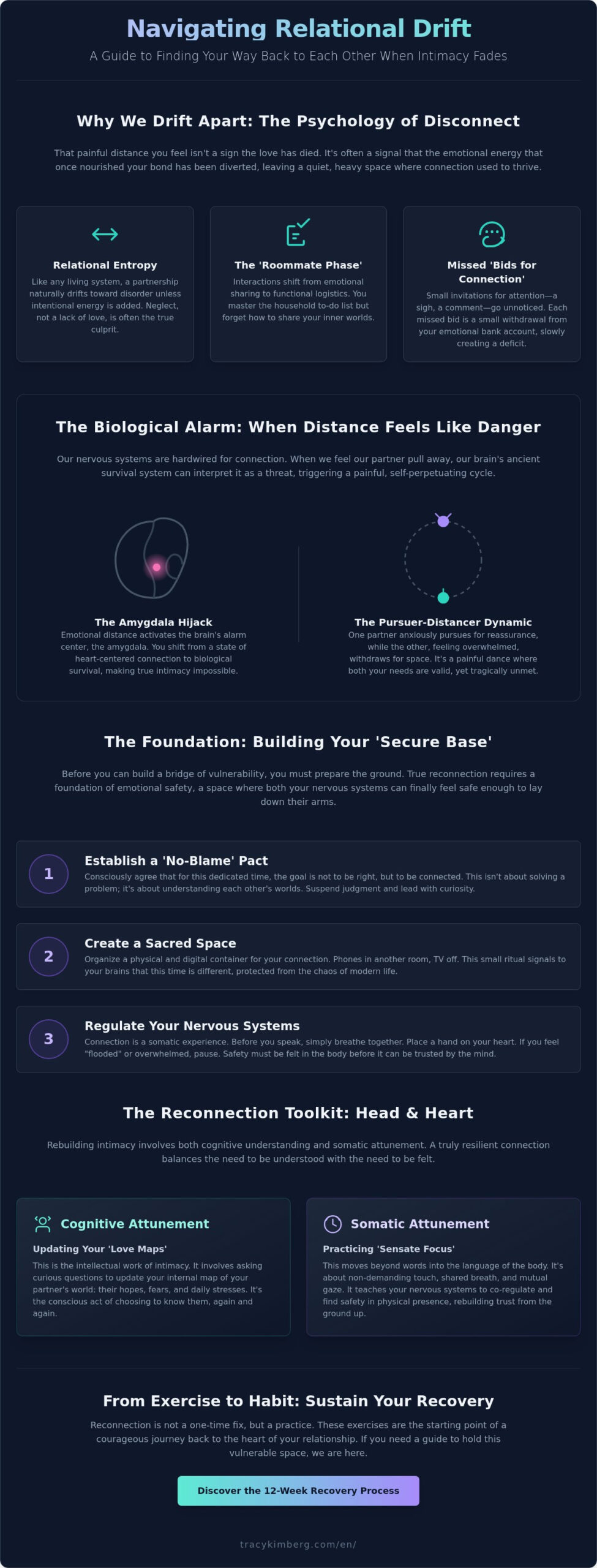
Relationships are not static entities; they are living, breathing ecosystems that require constant nourishment. In the world of physics, entropy describes the natural slide of any system into disorder unless energy is added. Your partnership follows a similar law. When intentionality fades, relational drift begins. This isn’t a sign that you’ve stopped loving each other, but rather that the energy required to bridge the gap between two separate lives has been diverted elsewhere. Over time, the “Relational Space” between you can become polluted with unspoken resentments or the simple dust of neglect. Understanding the psychology of emotional disconnect is the first step toward clearing that space.
Many couples find themselves trapped in the “Roommate Phase.” This occurs when your interactions shift from emotional sharing to functional logistics. You become experts at discussing who is picking up the dry cleaning or what’s for dinner, but you stop sharing your inner worlds. John Gottman describes this as missing “Bids for Connection.” A bid might be a simple comment about a bird outside or a sigh after a long day. When these small invitations for attention are ignored, the emotional bank account depletes. Without intentional exercises for couples to reconnect, these missed moments accumulate, creating a wall of silence that feels impossible to scale.
The Biology of Disconnection
Our nervous systems are hardwired to view emotional distance as a threat to our survival. When we feel disconnected, our brain’s alarm system, the amygdala, often interprets this as a lack of safety. This frequently triggers the “Pursuer-Distancer” dynamic. One partner may become anxious and pursue the other with demands for attention, whilst the other partner feels overwhelmed and withdraws to find peace. It’s a painful cycle where your favourite person’s behaviour triggers your deepest insecurities. Trying harder in this state often leads to more conflict because you’re both operating from a place of biological survival rather than heart-centred connection.
From Functional to Relational
Modern life is designed to distract us from our most precious bonds. Between the demands of work, the beautiful but exhausting chaos of raising children, and the constant glow of digital devices, your relationship often gets the leftovers of your energy. For parents navigating these pressures, specialized resources like De Relatiespecialist offer support tailored to the unique dynamics of couples with children. Moving from a functional partnership back to a relational one requires a conscious choice to prioritise attunement over logistics. Acknowledging that you’ve drifted isn’t an admission of failure; it’s a courageous act of honesty. By identifying these patterns, you can begin using specific exercises for couples to reconnect that move you away from the logistics of life and back into the warmth of each other’s presence.
The Foundation: Creating Emotional Safety Before You Begin
Before you dive into specific exercises for couples to reconnect, we must consider the soil in which these seeds will grow. You cannot build a bridge of vulnerability on a foundation of fear. In my work, I often see couples attempt deep conversations whilst their nervous systems are still in a state of high alert. Attachment theory teaches us that for vulnerability to be transformative, we first need a “Secure Base.” This is a psychological and emotional anchor that tells your brain it is safe to let down its guard. Without this perceived safety, any attempt at intimacy will likely feel like a threat, triggering the very defensiveness you’re trying to dismantle.
Creating this safety requires a physical and environmental “No-Blame” pact. This is a conscious agreement that for the duration of your practice, the goal isn’t to be right, but to be connected. You must organise a dedicated space free from the hum of digital distractions. Phones should be in another room; the television must be off. If the drift between you feels particularly wide, a structured 12-week relationship recovery process can offer the professional scaffolding needed to hold this space whilst you learn to navigate it together.
Regulating the Nervous System
Connection is a somatic experience as much as a mental one. If your heart is racing or your chest feels tight, you’re “flooded,” and your prefrontal cortex—the part of the brain responsible for empathy—effectively shuts down. To counter this, start by breathing together. Sit closely and synchronise your exhales. A powerful tool for immediate regulation is the 20-second hug. Research suggests this duration is the “sweet spot” required to trigger a significant release of oxytocin whilst lowering cortisol levels. It signals to your body that the person holding you is a source of comfort rather than a source of stress.
The Art of Softened Start-ups
How you begin a conversation almost always determines how it will end. Many of the Gottman Institute communication exercises emphasise the “softened start-up” as a vital skill. Instead of leaden phrases like “We need to talk,” which often sound like a summons to court, try an invitation rooted in your own feelings. Saying “I miss our closeness” or “I’d love to feel more connected to you tonight” shifts the dynamic from criticism to desire. In a secure relationship, a spirit of deep curiosity replaces the sharp edge of judgement, allowing you to wonder about your partner’s inner world rather than assuming you already know it.
Navigating the Reconnection Toolkit: Communication vs Somatic Exercises
Reconnection is a multi-layered process that requires us to engage both the mind and the body. We often mistakenly believe that intimacy is purely a cognitive problem to be solved through better conversation. Whilst talking is vital, true attunement is often felt in the body long before it’s processed in the brain. Cognitive exercises engage the prefrontal cortex, helping us organise our thoughts and map our partner’s changing inner world. Somatic exercises, by contrast, bypass the narrative and speak directly to the nervous system. Choosing the right exercises for couples to reconnect depends heavily on your current emotional climate. If conflict is high, talking may lead to further friction, whereas a silent, shared physical experience can lower the temperature and restore a sense of safety.
Establishing “Rituals of Connection” is the secret to moving from temporary fixes to a sustained sense of belonging. These rituals provide a predictable structure that your nervous system can rely on. Whether you’re engaging in a deep dialogue or a quiet somatic practice, the goal is to move away from a scorekeeping mentality. By focusing on the “Relational Space” between you, you can begin to treat the relationship as a third entity that requires its own specific care and nourishment. Complementing these rituals with a structured relationship check up can provide a clear framework for assessing where you are and mapping the path toward deeper intimacy.
Cognitive Exercises: Rebuilding the Love Map
The “Love Map” is a term used to describe the detailed psychological knowledge we hold about our partner. Over time, these maps become outdated as we grow and change. We forget their current favourite songs or the specific anxieties they carry about their career. A simple “Daily Temperature Check” is a ten-minute habit where you share one appreciation, one new piece of information about your day, and one request for support. This structured habit ensures you stay current with each other’s lives. Understanding how to build emotional intimacy through these small, consistent moments of sharing is often the foundation upon which a lasting Love Map is rebuilt. For many, engaging in individual therapy for adults can be a helpful way to clarify personal needs before bringing them into these joint cognitive practices.
Somatic Exercises: Restoring the Physical Bond
When words feel too heavy or laden with past hurt, somatic practices offer a path back to trust. Eye gazing is a profound example; sitting in silence and looking into each other’s eyes for three minutes can create a powerful sense of neural resonance. It forces us to truly “see” the human being behind the conflict. Similarly, the “Lend a Hand” exercise involves physical cooperation on a simple task, like folding laundry or gardening, to mirror emotional support. These exercises for couples to reconnect use non-sexual touch as a bridge, rebuilding intimacy through the senses rather than the intellect.
Your Reconnection Checklist: 7 Practical Exercises to Try Today
To reclaim your bond, you must organise your week around these moments of attunement. Reconnection is not a grand, one-time gesture; it is a quiet, persistent rhythm. When you use these exercises for couples to reconnect, remember that consistency always outweighs intensity. It is far better to spend ten minutes in genuine presence every day than to wait for a weekend getaway that may never come. These practices are designed to help you move from a state of parallel living back into a shared emotional life.
Exercise 1-3: Low-Stakes Connection
- The Appreciation Jar: Every day, write down one small thing your partner did that you appreciate and place it in a jar. It might be the way they made the coffee or a kind word they said whilst you were stressed. Documenting these small wins shifts your focus from what is missing to what is present in your partnership.
- The 10-Minute ‘State of the Union’: This is a dedicated time to talk about the relationship itself, not the household chores, the budget, or the children’s schedules. Ask each other: “What did I do this week to make you feel loved?” and “How can I support you better in the coming days?”
- Music Share: Play a song for each other that reminds you of a specific feeling or a moment in your history. Music often reaches the emotional centres of the brain that words simply cannot find, allowing you to communicate through melody and lyrics.
Exercise 4-5: Deepening the Dialogue
- The ‘I Feel’ Vulnerability Loop: Move past the surface of “I’m fine” or “I’m just tired.” Use a structured loop to share a deeper emotion: “I feel [emotion] about [specific event], and what I need is [support/listening].” This prevents the conversation from devolving into a list of complaints.
- Reminiscing: Spend time looking at old photos or talking about your favourite memories from when you first met. Your shared history acts as a vital anchor, reminding you of the “us” that existed before the drift began. Shared meaning is built when we align our individual aspirations into a collaborative vision for our life together.
Exercise 6-7: Somatic & Non-Verbal Bonding
- Extended Eye Contact: Sit in silence and look into each other’s eyes for four minutes without speaking. This bypasses the ego and the need for narrative, allowing a deep, non-verbal resonance to emerge that can feel both intense and incredibly healing.
- The ‘Stress-Reducing Conversation’: Spend twenty minutes talking about a stressor outside the relationship. The listener’s only job is to provide empathy without trying to solve the problem, building a “we against the world” mentality.
If these practices feel impossible to start or if they consistently trigger immediate conflict, it may be time to gently consider can your relationship be saved and how to know when it is time to seek professional repair. For couples ready to commit to a deeper transformation, my 12-week relationship recovery process offers a guided, structured path to reclaim the intimacy you deserve.
From Exercise to Habit: Sustaining Your Relationship Recovery
Think of these exercises for couples to reconnect as gym equipment for the heart. You don’t build physical strength by lifting a weight once; you build it through the quiet, daily commitment to showing up. The goal here isn’t just to complete a checklist. Instead, you’re developing a level of “relational fitness” where attunement becomes your default setting rather than a chore. If an exercise inadvertently triggers a conflict, try not to view it as a failure. View it as a diagnostic tool. It is simply highlighting an area where the emotional muscle is weak and needs more focused, gentle attention to repair.
Sustaining this progress requires you to move from “doing” to “being.” When you organise your life around the health of your bond, you create a resilient ecosystem that can weather external stresses. My 12-Week Relationship Recovery Process is designed to act as the ultimate masterclass for your partnership, providing the professional scaffolding needed to turn these individual moments of connection into a permanent way of life. It’s about moving beyond temporary fixes and into a profound, systemic shift in how you relate to one another.
Overcoming the Awkwardness
It is perfectly normal for these new communication patterns to feel clunky or even a bit staged at first. You’re learning a new emotional language, and fluency takes time. If you find your partner’s behaviour doesn’t shift as quickly as you’d like, stay committed to your own part of the dance. Practising self-compassion is vital during this transition. Often, individual relationship counselling can provide the necessary space to work on your own internal triggers, which in turn transforms the energy you bring back to the partnership.
When to Seek Professional Support
Whilst self-help tools are powerful, they have their limits. If you’re navigating deep-seated relational trauma, the aftermath of infidelity, or high-conflict cycles that feel like quicksand, professional intervention is the most compassionate choice. A structured approach provides the safety needed to dismantle long-standing barriers that exercises for couples to reconnect alone might not reach. I invite you to view this work as a proactive and positive adventure rather than a clinical necessity. Whether you prefer face-to-face therapy or the flexibility of online therapy, taking that first step is a powerful declaration that your connection is worth the investment. Reach out today to begin your collaborative journey toward a healthier, more vibrant future together.
Reclaiming the Heart of Your Partnership
Rebuilding intimacy is a courageous journey that begins with a single, intentional choice to turn toward your partner. We’ve explored how understanding the psychology of disconnect and prioritising emotional safety can transform your daily interactions. By integrating consistent exercises for couples to reconnect into your routine, you move away from the “roommate phase” and back into a space of deep attunement. These tools are the building blocks of a more resilient and vibrant life together. They help you move beyond simple logistics and back into the warmth of a shared emotional world.
Whilst self-guided practice is a powerful start, some landscapes are easier to navigate with a guide. My 12-Week Relationship Recovery Process offers a structured, research-based approach inspired by the work of experts like Gottman and Perel. I provide a safe, non-judgemental environment where you can dismantle old patterns and foster genuine healing. It’s time to stop drifting and start thriving. You don’t have to navigate this transition alone; professional support can provide the clarity and scaffolding your relationship needs to flourish.
Book a Discovery Call to Start Your 12-Week Relationship Recovery and rediscover the joy of feeling truly seen and heard. Healing is possible, and the path forward is closer than you think.
Frequently Asked Questions
How often should we do these reconnection exercises?
You should aim for a “little and often” approach, ideally engaging in low-stakes connection daily and deeper practices once a week. Research from the Gottman Institute suggests that successful couples spend about six hours a week in intentional connection. By making these exercises for couples to reconnect a non-negotiable part of your schedule, you prevent the buildup of emotional debt and keep your “Love Map” current and vibrant.
What if my partner refuses to participate in these activities?
If your partner is hesitant, start by focusing on your own emotional regulation and behaviour. Often, a partner’s refusal is rooted in a fear of failure or a feeling of being criticised rather than a lack of love. You might find that by changing your own “dance” first, you create a safer space for them to join you later. Inviting them with curiosity rather than a demand for change can shift the dynamic from pressure to possibility.
Is it normal to feel awkward or ‘fake’ when starting these exercises?
Feeling clunky or “fake” is a completely natural part of the process when you’re breaking old, familiar patterns. You’re effectively learning a new emotional language, and fluency only comes through repetition. Think of it as physiotherapy for the heart; it might feel stiff and uncomfortable at first, but this discomfort is a sign that you’re stretching muscles that have been dormant for too long. Stay with the process and the awkwardness will eventually fade.
Can these exercises really save a marriage on the brink of divorce?
These exercises can act as a vital bridge, but they are often most effective when used alongside professional guidance in high-crisis situations. Research indicates that over 75% of couples see improvement through therapy, and these tools provide the practical skills needed to sustain that progress. Whilst they offer a powerful pathway to repair, deep-seated resentment or complex trauma may require the structured scaffolding of a 12-week recovery process to ensure lasting change.
How long does it take to feel a shift in our emotional connection?
You might feel an immediate sense of relief after a single somatic exercise, but a sustained shift typically takes several weeks of consistent practice. Neuroplasticity suggests that it takes time to rewire the brain’s “threat response” to your partner. Most couples report a noticeable change in their daily communication and emotional safety after about four to six weeks of dedicated, intentional effort. Patience is a vital component of the healing journey.
Which exercise is best if we are currently in a high-conflict phase?
When conflict is high, it’s often best to start with somatic, non-verbal exercises like eye gazing or the 20-second hug. These practices bypass the cognitive “story” of your argument and speak directly to the nervous system to restore a sense of safety. By lowering the physiological temperature first, you create the necessary calm required for a productive conversation later on. It’s about finding quietude before you attempt to find words.
Should we do these exercises if there has been recent infidelity?
If you’re navigating recent infidelity, these exercises for couples to reconnect should be introduced within a safe, professionally guided environment. The breach of trust creates a profound trauma that requires specific, sequential steps to repair. Whilst these tools are transformative, attempting deep vulnerability before the initial trauma has been stabilised can sometimes lead to further flooding and emotional setbacks. Safety must be established before you can begin to rebuild the bond.
What is the difference between a connection exercise and therapy?
A connection exercise is a specific tool designed to practice a skill, whereas therapy is a comprehensive process that explores the “why” behind your patterns. Therapy provides a secure, expert-led space to uncover the systemic issues and individual histories that drive your disconnect. Think of exercises as the gym equipment and therapy as the personal trainer who ensures you’re using the right form to avoid further injury and achieve long-term health.

Article by
Tracy Kimberg
Tracy Kimberg is a Relationship Expert, Couples Therapist and Coach with a dedicated focus on helping couples and individuals rebuild connection, trust and emotional safety in their relationships. Drawing on the research of John and Julie Gottman, the relational insights of Esther Perel, and years of hands-on therapeutic experience, Tracy offers a warm, non-judgemental and deeply compassionate approach to modern relationships.
Based in Dorset, Tracy works with couples navigating communication breakdowns, betrayal, intimacy challenges, separation, family dynamics and life transitions. Known for creating a safe and grounded therapeutic space, she combines practical tools with emotional depth to help clients move beyond survival patterns and towards meaningful, lasting change.
With a reputation for empathy, professionalism and dedication to her clients’ growth, Tracy is passionate about helping people feel seen, understood and empowered — both within their relationships and within themselves.
Disclaimer
Disclaimer:
The information shared in this article is intended for educational and informational purposes only and should not be considered a substitute for professional therapeutic, psychological, medical or legal advice. Every individual and relationship is unique, and the perspectives offered are based on general therapeutic principles, research and professional experience.
Reading this article does not establish a therapist-client relationship with Tracy Kimberg. If you are experiencing significant emotional distress, relationship crisis, trauma, or mental health concerns, it is important to seek support from a qualified professional appropriate to your individual circumstances.
All content remains the intellectual property of Tracy Kimberg and may not be reproduced or distributed without permission.