

Infidelity is often the crisis that ends your first relationship, but it doesn’t have to be the end of your story together. When the safety of your home collapses, you’re left with intrusive ‘mind movies’ and the crushing fear that things will never feel good again. It’s an exhausting place to be, and you might wonder if couples therapy for infidelity can actually fix the damage or if it’s simply delaying the inevitable. It’s natural to feel that the ground beneath you is permanently broken, yet this crisis can also be the catalyst for a deeper level of honesty and connection than you previously thought possible.
We’re here to show you how specialised support can transform this trauma into a foundation for a partnership that is more resilient than the one you lost. You’ll discover a structured roadmap designed to stop the cycle of constant arguing and help you understand the ‘why’ behind the behaviour without ever excusing it. This guide explores the path to restoring an intimacy that feels authentic, giving you the clarity needed to consciously build a second, stronger relationship together.
Key Takeaways
- Understand why betrayal acts as a profound trauma to your attachment system and why simply ‘moving on’ rarely leads to lasting healing without professional support.
- Learn how integrating the Gottman Method with Esther Perel’s insights can help you reconstruct your ‘Sound Relationship House’ whilst finding new meaning in your connection.
- Navigate the three essential stages of couples therapy for infidelity, moving from the initial stabilisation of the first eight weeks into a deeper phase of narrative building.
- Challenge common myths about cheating with psychological evidence that supports the possibility of genuine, lasting change and relationship growth.
- Discover the path to your ‘Second Marriage’—a more conscious and resilient version of your partnership built through a structured recovery process.
Navigating the Trauma of Betrayal: Why Infidelity Counselling is Essential
When an affair is discovered, your world doesn’t just change; it shatters. This isn’t merely a “rough patch” or a series of poor choices. It is a profound disruption of your attachment security system, a psychological wound often called betrayal trauma. Because the person you rely on for safety has suddenly become the source of your deepest pain, your brain struggles to organise this new, terrifying reality. Attempting to “just move on” or “put it behind you” rarely works because the injury is systemic. This is why understanding infidelity as a traumatic event is the first step toward any hope of recovery.
You’ll likely find yourself oscillating between white-hot anger and a hollow, exhausting numbness. There is often an obsessive “need to know” every detail, which is a desperate attempt by your mind to fill the gaps in a story that no longer makes sense. Professional couples therapy for infidelity provides a neutral “third space” where these emotions can be processed without the relationship collapsing under the weight of the disclosure. In this setting, the therapist ensures the truth becomes a tool for rebuilding rather than a weapon for further destruction.
Understanding the Nervous System in Crisis
Betrayal sends your body into a state of high alert. Your nervous system becomes trapped in a “fight-flight-freeze” response, which explains why the betrayed partner often suffers from hyper-vigilance and intrusive “mind movies”. It’s as if your body is constantly scanning the horizon for the next threat. A skilled therapist acts as a container for these shattered emotions. By helping both of you co-regulate your nervous systems, we can move you out of survival mode and into a state where you can actually hear one another again.
Moving Beyond the ‘Detective Phase’
In the early weeks following a betrayal, relationships often enter what we call the “detective phase”. The betrayed partner may ask the same questions repeatedly, searching for inconsistencies or hidden truths. Whilst this is a natural response to a loss of predictability, it can easily turn into a cycle of re-traumatisation for both people. Therapy helps you transition from “investigation” to “understanding” through a structured approach:
- Setting boundaries: Establishing specific times to discuss the betrayal so it doesn’t bleed into every hour of the day.
- Meaning-making: Shifting the focus from the mechanics of what happened to the meaning of why it happened.
- Emotional safety: Creating “sanctuary zones” where the trauma is put aside to focus on the present moment.
By shifting the focus from the “how” to the “why” in couples therapy for infidelity, you begin to protect the fragile remains of your connection. This transition is vital. It allows you to move away from being an investigator and a defendant, and toward becoming two partners trying to understand a shared crisis.
The Science and Soul of Healing: Research-Based Approaches to Recovery
Healing from a betrayal isn’t a matter of simply “trying harder” or waiting for time to dull the pain. It requires a map. To navigate the wreckage of an affair, we combine clinical science with deep psychological insight. According to the American Association for Marriage and Family Therapy, couples therapy for infidelity is a specialised process that moves through specific stages of safety and understanding. By blending the research-based strategies of John Gottman with the relational wisdom of Esther Perel, we provide a framework that addresses both the structural and emotional needs of your partnership.
We also look through the lens of Gabor Maté, recognising that many relational crises are rooted in deeper, often unconscious, trauma. This trauma-informed approach ensures we aren’t just treating the “symptom” of the affair, but the underlying vulnerabilities in the relationship’s soil. Whether you engage in relationship counselling or coaching, the focus remains on moving from a state of high-stress reactivity to one of conscious, calm connection. Counselling helps heal the historical wounds, whilst coaching offers the practical tools to manage your daily life as you rebuild.
The Gottman Method: Atonement, Attunement, and Attachment
John Gottman’s work focuses on the “Sound Relationship House.” After a betrayal, the foundation of this house has collapsed. Recovery begins with Atonement. This is where the partner who was unfaithful takes full, non-defensive accountability for their actions. It’s about sitting with the other’s pain without making excuses. Once safety is established, we move to Attunement. You’ll learn to “turn towards” each other’s small emotional needs again. Finally, Attachment focuses on creating a new shared narrative. You aren’t trying to fix the old relationship; you’re building a new one with stronger, more honest foundations.
The Esther Perel Influence: Understanding the ‘Why’
Whilst Gottman provides the structure, Esther Perel provides the nuance. She invites us to move beyond the simple “victim and villain” narrative. In our couples therapy for infidelity, we explore the affair as an expression of longing or a search for a lost version of oneself. This doesn’t excuse the behaviour, but it makes it understandable. By exploring these complexities, you can eventually reintroduce intimacy without it feeling like a betrayal of your own boundaries. It allows you to transform the crisis into a “second marriage” between the same two people, built on a foundation of radical honesty and newfound desire.
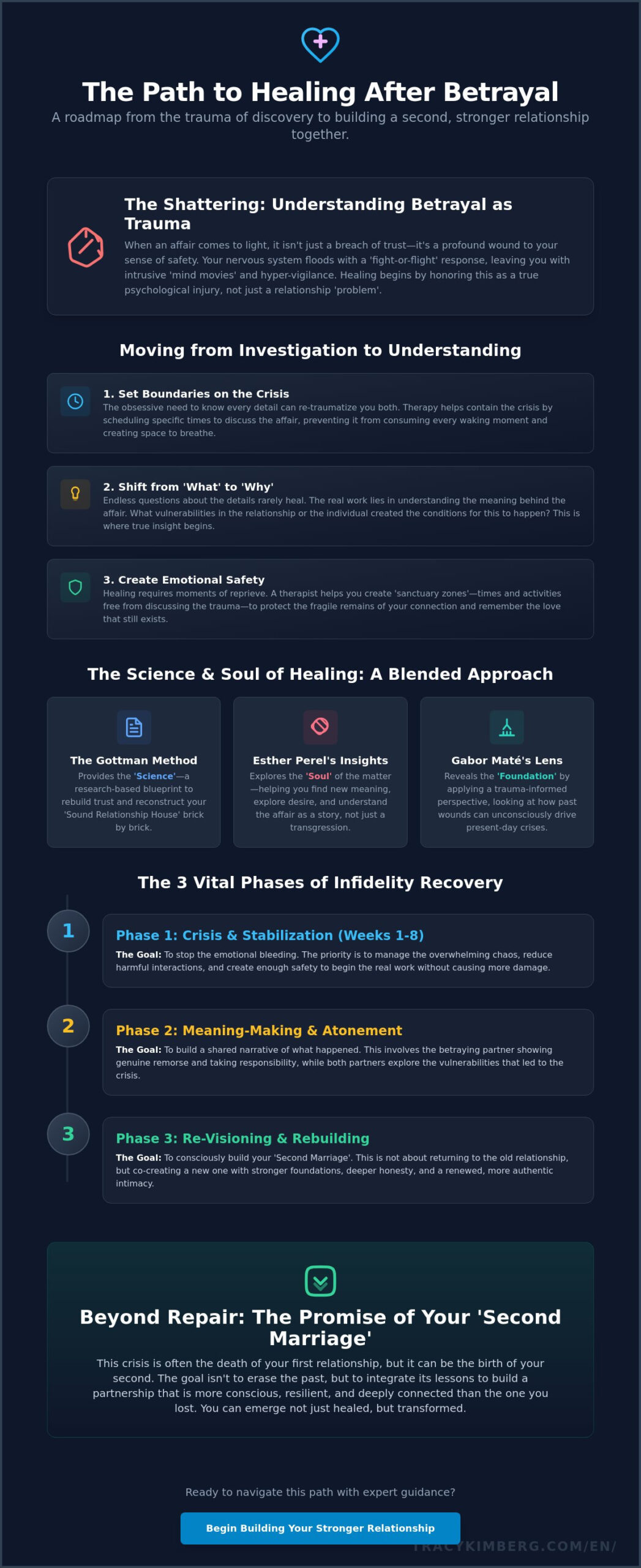
The Three Vital Phases of Infidelity Recovery in Therapy
Recovery from betrayal is a process, not a single event. It’s a journey that requires a map, especially when you feel lost in a landscape of pain and confusion. Clinical research into infidelity treatment and recovery suggests that a structured, three-phase approach offers the best chance for long-term healing. It’s rarely a linear path; you’ll likely take two steps forward and one step back. Patience is your most necessary ally during this time, as your relationship moves through stabilisation, exploration, and eventually, integration. Understanding the specific infidelity recovery stages can help you recognise where you are in the process and what psychological milestones lie ahead.
Phase 1: Stopping the Bleeding
The first four to eight weeks of couples therapy for infidelity are dedicated to crisis management. You can’t begin to rebuild whilst the wound is still actively bleeding. In this stage, we focus on establishing “non-negotiables” for transparency to create a baseline of safety. This might include sharing phone passcodes, being precise about schedules, or committing to radical honesty about daily interactions. Transparency is the currency of trust. We also work on tools to manage “emotional floods,” those sudden surges of panic or rage that happen between sessions. By learning to self-regulate, you prevent the trauma from causing further daily destruction to your home life.
Phase 2: Constructing the Story
Once the initial crisis has subsided, we move into the deep work of narrative building. This is where we explore the “how” and “why” of the betrayal. It’s vital to discuss the affair without getting lost in “erotic detail,” which often serves no purpose other than to re-traumatise the betrayed partner. Instead, we look for the “cracks” that existed in the relationship’s foundation long before the affair happened. This isn’t about shifting blame, but about understanding the systemic vulnerabilities of the partnership. Not all betrayals begin with a physical act; many start as emotional affairs that gradually crossed the line from friendship, and recognising this distinction is a crucial part of building an honest shared narrative. You’ll learn to listen to the “pain behind the anger” for both partners, allowing the betrayer’s guilt and the betrayed’s agony to be witnessed and understood.
Phase 3: Integration and Visioning
The final phase is about deciding the future of the partnership. It’s the point where the trauma is no longer the central focus of your lives, but a part of your shared history. You’ll work on integrating the lessons learned into a new vision for your relationship. This is where you decide if you can build a “second marriage” together, one that is more conscious, honest, and resilient than the first. Whether you choose to stay together or part ways through a conscious approach, this phase ensures you do so with clarity, respect, and a sense of personal peace.
Addressing the Doubts: Can a Relationship Truly Recover from Cheating?
Doubt is a constant companion after a betrayal. You’ve likely heard the “Once a Cheater” myth echoed by friends or on social media, but clinical experience tells a far more nuanced story. People are complex. Whilst some individuals do have chronic patterns of deception, many use the crisis of an affair as a painful wake-up call to undergo profound personal transformation. In couples therapy for infidelity, we don’t just look at the act of betrayal; we look at the capacity for honest change and the willingness to do the hard work of repair.
We often apply the 80/20 rule here. In many partnerships, 80% of the relationship was actually functioning well; it’s the 20% of unmet needs, poor communication, or personal coping mechanisms that led to the crisis. The question “Will I ever trust them again?” is valid and heavy. Trust doesn’t return in a single moment of forgiveness. It’s rebuilt through a thousand tiny, consistent actions over time. However, if there is a persistent lack of remorse or a refusal to take accountability, those are clear signs that the relationship may not be salvageable.
The Role of Genuine Remorse vs. Guilt
There is a vital distinction between these two emotions. Guilt is often self-centred; it’s the discomfort of being “the bad person” and wanting the partner to stop being upset so the guilt goes away. Remorse, however, is deeply empathetic. It’s the ability to sit in the fire of your partner’s pain without trying to extinguish it with excuses. If you’re wondering Can Your Relationship Be Saved?, look for this shift from “I feel bad” to “I see how much I hurt you.” A therapist can help identify if the unfaithful partner is truly “in the work” or just waiting for the storm to pass.
Individual Healing Within the Couple
Recovery isn’t just a team sport. The betrayed partner often needs a separate, safe space to process their grief, away from the person who caused it. This prevents our joint sessions from devolving into “blame loops” where no progress is made because both people are too triggered to listen. Engaging in Individual Relationship Counselling allows each person to bring a more stable, self-aware version of themselves back to the partnership. It provides the breathing room needed to decide if staying is the right choice for you.
If you’re ready to explore whether your partnership can move from crisis to connection, you can reach out to our specialist team to begin a structured recovery process today.
Beyond Repair: Transforming Your Partnership with a Structured Recovery Process
The relationship you once knew is gone, and in many ways, that’s a necessary ending. To move forward, we must embrace Esther Perel’s profound concept: your first marriage is over, but you have the opportunity to build a second one with the same person. This “Second Marriage” isn’t a patched-up version of the old one. It’s a conscious, honest, and entirely new partnership that acknowledges the past whilst refusing to be defined by it. By using couples therapy for infidelity as a turning point rather than an end point, you can create a connection that’s actually more resilient and authentic than what you had before the crisis.
Moving from a state of surviving the day to thriving in your partnership requires more than just time. It requires a deliberate shift in how you relate to one another. You stop being defined by the betrayal and start being defined by the repair. This transformation happens when you stop looking for the relationship you lost and start focusing on the one you’re currently co-creating. It’s a choice to see the wreckage not as a permanent ruin, but as the raw material for a more sophisticated and deeply bonded future together.
The 12-Week Relationship Recovery Framework
Many couples avoid seeking help because they fear being trapped in “endless therapy” where they simply repeat their pain every week. To combat this, we utilise a structured 12-Week Relationship Recovery Process. This time-bound programme provides a clear sense of movement and progress, which is vital when you feel stuck in the mud of betrayal trauma. The framework is organised into three distinct monthly focuses:
- Month 1: Safety. We focus on stabilisation, stopping the “bleeding” of constant conflict, and establishing transparency.
- Month 2: Meaning. We dive into the narrative of the affair, understanding the vulnerabilities without making excuses.
- Month 3: Growth. We look toward the future, reintroducing intimacy and visioning your “Second Marriage.”
This process is often supplemented by specialised masterclasses. These sessions allow you to absorb psychological insights and tools at your own pace, ensuring that our face-to-face time is spent on the deep, relational work that only happens in the room together.
Taking the First Step Toward Healing
Approaching your partner about starting couples therapy for infidelity can feel daunting. It’s best to frame the invitation as a proactive step for your own healing rather than a demand for theirs. You might say, “I’m struggling to process this on my own, and I’d like us to have a professional guide to help us find a way through.” Whether you choose online therapy for the comfort of your own home or face-to-face sessions for a more contained environment, the most important thing is simply to begin. Healing isn’t a destination you arrive at; it’s a choice you make every single day to turn toward each other with honesty and hope.
Choosing a New Path Together
Infidelity is a devastating earthquake, yet the rebuilding process allows you to design a structure that is more grounded than the original. You now understand that betrayal is a physiological trauma, not just a moral failing. True healing requires moving through structured phases of safety and meaning-making. Engaging in specialised couples therapy for infidelity offers the map you need to navigate this complex emotional landscape with a Wise Guide by your side.
We provide a safe, non-judgemental space for both online and face-to-face sessions, specialising in Gottman and Perel-inspired methods. Our structured 12-week programme is designed to offer clear, measurable progress, moving you away from the exhaustion of repetitive cycles and toward a resilient future together. If you’re ready to stop surviving and start rebuilding, we invite you to book your initial consultation for the 12-Week Relationship Recovery Process today. Healing is not a matter of chance; it’s a choice you make, one day at a time.
Frequently Asked Questions
How long does it typically take to recover from infidelity in therapy?
Full emotional recovery and the integration of the trauma usually take between eighteen months and two years. Whilst the acute crisis can be stabilised within our 12-week framework, rebuilding a deep sense of safety is a gradual process. It requires consistent effort and patience as you move from the initial shock into a new way of relating.
What is the success rate of couples therapy for infidelity?
Research indicates that approximately 60 to 75 per cent of marriages survive an affair when the couple undergoes therapeutic intervention. Evidence-based models like Emotionally Focused Therapy (EFT) show even higher rates, with about 70 to 75 per cent of couples moving from distress to recovery. These figures suggest that with the right guidance, healing is a very realistic outcome.
Should we do individual therapy or couples therapy first after an affair?
It’s often beneficial to begin with couples therapy to establish immediate transparency and safety within the home. This joint approach allows the therapist to manage the crisis in real-time. However, if one partner is experiencing severe trauma symptoms or “flooding,” we may suggest concurrent individual sessions to help with emotional regulation and personal processing.
What if my partner refuses to talk about the affair in therapy?
Resistance to talking usually stems from a place of deep shame or a fear of causing further damage. In couples therapy for infidelity, we create a structured environment where the unfaithful partner can share without feeling attacked. This safe container helps shift the conversation from a defensive “interrogation” to a meaningful dialogue about the vulnerabilities that led to the crisis.
Can online couples therapy be effective for dealing with betrayal?
Online therapy is highly effective and offers the distinct advantage of allowing you to process difficult emotions from the safety of your own home. Studies confirm that the therapeutic bond formed in virtual sessions is just as strong as in-person work. It provides a convenient and private way to access specialist support during a time when your world feels upside down.
How do I know if I should stay or leave after being cheated on?
You don’t need to have the final answer right now; therapy is the process of finding that clarity. We look for indicators of potential success, such as genuine remorse and a willingness to be radically honest. If there’s a persistent lack of accountability or a refusal to end contact with the affair partner, we help you navigate those “red flags” to make the best decision for your future.
What is the ‘Gottman Method’ and how does it help with trust?
The Gottman Method is a research-based framework that focuses on rebuilding the “Sound Relationship House” through atonement, attunement, and attachment. It provides practical tools to help partners “turn towards” each other instead of away. By focusing on small, daily interactions, it helps you reconstruct a foundation of reliability and friendship that was shattered by the betrayal.
Is it possible to have a better relationship after an affair than before?
Many couples find that their “second marriage” is more authentic and intimate because the crisis forced them to dismantle old, unhealthy patterns. Whilst the pain of the betrayal is never something one would choose, the deep work of couples therapy for infidelity often leads to a level of honesty and connection that wasn’t present before. It’s about building a partnership that’s truly conscious and resilient.

Article by
Tracy Kimberg
Tracy Kimberg is a Relationship Expert, Couples Therapist and Coach with a dedicated focus on helping couples and individuals rebuild connection, trust and emotional safety in their relationships. Drawing on the research of John and Julie Gottman, the relational insights of Esther Perel, and years of hands-on therapeutic experience, Tracy offers a warm, non-judgemental and deeply compassionate approach to modern relationships.
Based in Dorset, Tracy works with couples navigating communication breakdowns, betrayal, intimacy challenges, separation, family dynamics and life transitions. Known for creating a safe and grounded therapeutic space, she combines practical tools with emotional depth to help clients move beyond survival patterns and towards meaningful, lasting change.
With a reputation for empathy, professionalism and dedication to her clients’ growth, Tracy is passionate about helping people feel seen, understood and empowered — both within their relationships and within themselves.
Disclaimer
Disclaimer:
The information shared in this article is intended for educational and informational purposes only and should not be considered a substitute for professional therapeutic, psychological, medical or legal advice. Every individual and relationship is unique, and the perspectives offered are based on general therapeutic principles, research and professional experience.
Reading this article does not establish a therapist-client relationship with Tracy Kimberg. If you are experiencing significant emotional distress, relationship crisis, trauma, or mental health concerns, it is important to seek support from a qualified professional appropriate to your individual circumstances.
All content remains the intellectual property of Tracy Kimberg and may not be reproduced or distributed without permission.