

What if the most significant threat to your relationship isn’t a secret physical encounter, but the “innocent” text message you feel the need to hide? It’s a common dilemma that leaves many feeling stuck in a painful grey area, wondering where a supportive bond ends and infidelity begins. You might feel a nagging sense of guilt over secret conversations or find yourself feeling like a “second best” priority to your partner’s new best friend. Because there is no physical touch, it’s easy to rationalise the behaviour as harmless, yet the emotional weight tells a different story. Understanding the nuance of an emotional affair vs friendship is often less about who you are with and more about the “walls” you build around your partner and the “windows” you open to an outsider.
I recognise how disorienting this confusion can be for your heart and your sense of security. In this guide, you will discover the psychological markers that distinguish a healthy platonic connection from emotional infidelity, giving you the clarity you need to move forward. We will explore a research-based framework for setting healthy boundaries and offer a path of hope for rebuilding the deep, authentic intimacy you truly desire with your partner.
Key Takeaways
- Learn to distinguish an emotional affair vs friendship by looking beyond the absence of physical touch and focusing on the depth of secrecy and emotional intimacy.
- Understand the “Walls and Windows” metaphor to identify if you are unintentionally shutting your partner out whilst opening up to someone else.
- Identify critical red flags, focusing on internal feelings like guilt or comparative excitement, to assess if a boundary has been crossed.
- Master the “Softened Start-up” technique to initiate difficult conversations about emotional disconnect and re-establish healthy relationship boundaries.
- Explore how a structured 12-Week Relationship Recovery Process can provide the safe environment needed to heal from betrayal and rebuild lasting trust.
The Subtle Shift: When Does a Platonic Friendship Become Emotional Infidelity?
Relationships rarely fracture in a single, explosive moment. Instead, they often erode through a series of small, seemingly insignificant choices. One of the most challenging transitions to navigate in modern partnership is the drift between an emotional affair vs friendship. It’s a shift that typically begins with a shared joke, a supportive text during a stressful week, or a mutual understanding that feels uniquely validating. Because these interactions don’t involve physical touch, many people convince themselves they are staying within the lines of loyalty.
An Emotional affair is a bond that mimics the deep, exclusive intimacy of a committed partnership without the sexual component. This lack of physical contact creates a false sense of security. You might tell yourself that because you haven’t “done anything,” your behaviour remains innocent. In reality, the absence of sex can allow the emotional bond to deepen even more dangerously. You’re diverting the vital energy, vulnerability, and attention that belongs to your primary relationship and pouring it into someone else. This is where “micro-cheating” begins, as you start prioritising this outsider’s needs or opinions over those of your partner.
For the partner on the outside, the experience is incredibly painful. They often sense a change in the relationship’s “weather” long before they have proof. When they raise their concerns, they are frequently told they’re being “crazy,” “jealous,” or “insecure.” This dismissal is a secondary betrayal. It invalidates their intuition and leaves them feeling isolated whilst the other person enjoys the “best” version of their spouse.
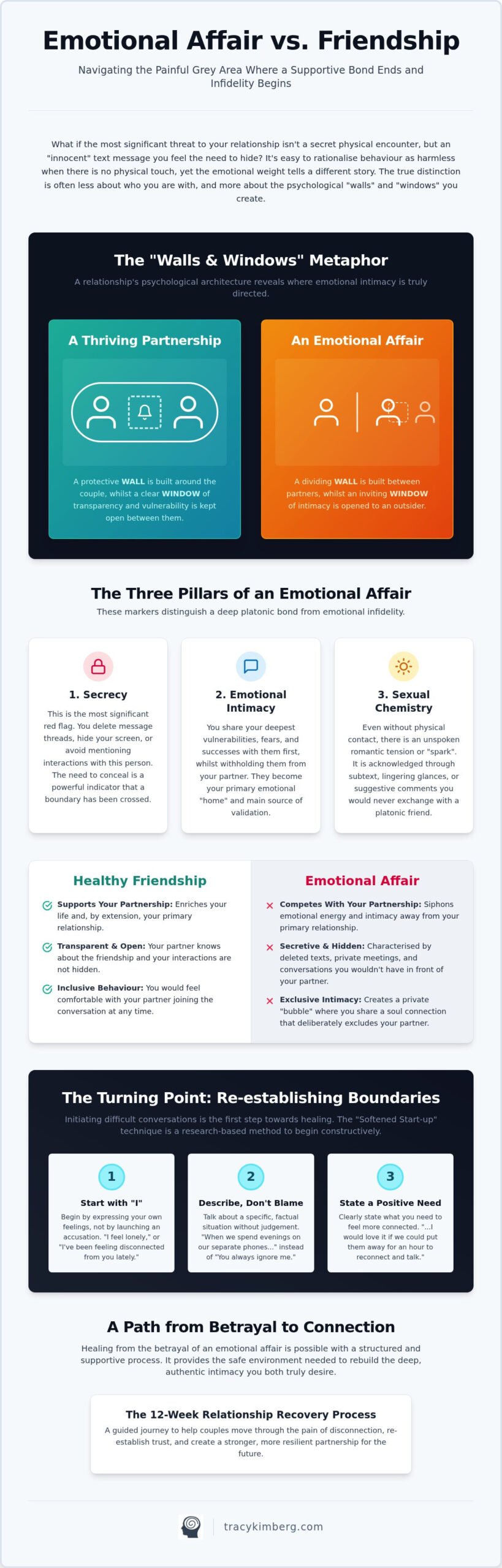
The Three Pillars of an Emotional Affair
- Secrecy: This is the most significant red flag. If you’re deleting message threads, hiding your screen, or wouldn’t feel comfortable saying those exact words in front of your partner, you’ve moved beyond a platonic bond.
- Emotional Intimacy: You’ve started sharing your deepest vulnerabilities, fears, or successes with this person whilst actively withholding them from your spouse. They’ve become your primary emotional “home.”
- Sexual Chemistry: Even without physical contact, there’s an unspoken romantic tension. It’s the “spark” that you both acknowledge through subtext, lingering glances, or suggestive comments that you’d never trade with a typical friend.
Why ‘Just Friends’ is a Dangerous Label
The label of “friendship” often serves as a psychological shield against guilt. It allows individuals to bypass their own internal moral compass whilst engaging in behaviours that feel like betrayal. The “work spouse” dynamic is a classic example of this. Constant proximity and shared professional stress can quickly bypass traditional boundaries, creating a bubble of intimacy that excludes the partner at home. There’s a profound difference between shared interests, like a favourite hobby, and shared emotional souls. True friendship supports your marriage; an emotional affair competes with it.
Walls and Windows: The Psychological Architecture of an Emotional Affair
Relationships are built on a specific psychological architecture. In a thriving partnership, you maintain a clear window into your partner, allowing for transparency and vulnerability, whilst keeping a solid wall around the couple to protect your privacy from the outside world. When the line blurs between an emotional affair vs friendship, this architecture flips. You begin building a wall between yourself and your partner, whilst opening a wide, inviting window to an outsider. It is a subtle, often unconscious redirection of your most precious resource: your emotional intimacy.
This shift often starts with what feels like an innocent conversation. You might vent about your partner’s habit of leaving dishes in the sink or share a small frustration about your career. Each time you share a piece of your heart with a friend that you’ve withheld from your spouse, you place another brick in that internal wall. Navigating Emotional Infidelity requires us to look at where our transparency actually lives. In the digital age, this is amplified by 24/7 access via WhatsApp or social media. These platforms create a “constant presence” of the outsider, allowing them into your private spaces, even when you’re lying in bed next to your partner.
Building the Wall: The Act of Emotional Withdrawal
Withdrawal is a quiet process. You might stop sharing your “small wins” or the minor anxieties of your day because you’ve already “spent” that emotional energy elsewhere. This often leads to the “Roommate Phase,” where communication becomes purely functional. When John Gottman’s “Four Horsemen,” particularly contempt and criticism, enter the home, the wall grows taller. You stop seeing your partner as a safe harbour and start viewing the outsider as your only source of empathy. If you find yourself in this cycle, professional Relationship Counselling and Coaching can help you identify these cracks before they become chasms.
Opening the Window: The Fantasy of the Outsider
The outsider has a distinct advantage; they don’t have to deal with your real-world friction. They see the “best version” of you, the one that is funny, engaged, and unburdened by bills or parenting stress. This creates a dangerous, curated fantasy that is difficult for a long-term partner to compete with.
- The connection feels like a “soulmate” bond because it lacks the weight of domestic reality.
- Every notification provides a dopamine hit that your predictable home life might lack.
- You begin to compare your partner’s flaws with the outsider’s curated highlights.
This isn’t necessarily a reflection of the outsider’s perfection. It is a reflection of the window you’ve opened at your partner’s expense. When you stop inviting your partner into your inner world, the relationship starves, making the outsider’s attention feel even more addictive.
Friendship or Affair? 7 Red Flags to Help You Identify the Difference
Identifying the line in an emotional affair vs friendship isn’t always about a single dramatic event. It’s often a slow, quiet drift. To gain clarity, you must look inward at the emotional “charge” of the connection. Distinguishing between Emotional Cheating vs. Friendship is less about the time spent and more about the emotional space occupied. If you’re unsure where you or your partner stand, consider these diagnostic markers:
- The First Person Rule: When you have big news, a promotion, or a crushing disappointment, who is the first person you want to tell? If it’s consistently the friend rather than your partner, the emotional priority has shifted.
- The Comparison Trap: You begin comparing your partner’s “real world” flaws, like their morning breath or their stress over bills, to the friend’s curated “perfection.”
- Preoccupation: You find yourself mentally rehearsing what you’ll tell the friend next or constantly checking your phone for their name.
- Sexual Undercurrent: There’s a “charge” to the connection. Even if it’s never acted upon, you’re aware of a romantic tension that doesn’t exist in your other platonic bonds.
- Defensive Reactions: When your partner asks about the friend, your immediate response is anger or “gaslighting” them by calling them jealous.
- Dismissing the Partner: You share vulnerabilities with the friend that you’ve actively decided your partner “wouldn’t understand.”
- The Secrecy Test: You’ve started deleting message threads or tilting your phone screen away.
The Secrecy Test: Transparency vs. Privacy
Healthy relationships allow for privacy, but they don’t require secrecy. Privacy is “I don’t need to show you every text because there’s trust.” Secrecy is “I must delete this text because if you saw it, you’d be hurt.” Changing a friend’s name in your phone or “clearing history” are clear signs that a boundary has been crossed. It’s the act of hiding that transforms a friendship into a betrayal of integrity.
The Emotional Energy Balance
We all have a finite amount of emotional “fuel.” In an emotional affair, you’re often “saving” your best stories, your deepest empathy, and your most vibrant energy for the outsider. You might feel “drained” by the domesticity of your partner but feel “lit up” and energised the moment you see the friend’s name on your screen. Notice your language; a shift from “we” to “I” and “they” often signals that the partner is no longer part of your inner circle.
The Turning Point: How to Address Emotional Disconnect and Re-establish Boundaries
Realising you’ve crossed the line from an emotional affair vs friendship is a heavy, disorienting moment. Yet, this realisation is the essential “exit ramp” you need to begin the work of repair. To move forward, you must transition from a state of reactive secrecy to one of conscious reconnection. This isn’t merely about “stopping” the outside connection; it’s about reinvesting the emotional currency you’ve been spending elsewhere back into your primary partnership.
Initiating this conversation requires what John Gottman calls a “Softened Start-up.” Instead of leading with accusations or defensive justifications, begin with your own vulnerability. Use “I” statements to express your feelings: “I’ve noticed I’ve been pulling away, and I want to find our way back to each other.” This approach lowers the immediate wall of defensiveness and invites your partner into a collaborative space. It’s vital to acknowledge that whilst there may not have been a “betrayal of body,” a “betrayal of heart” has occurred. For many, the emotional intimacy shared with an outsider feels more threatening than a physical encounter because it involves the soul’s private sanctuary.
To allow the relationship to breathe, a period of “No Contact” with the outsider is usually non-negotiable. This isn’t a punishment; it’s a necessary boundary to stop the “dopamine hits” from the outside connection and allow your internal focus to return home. Without this space, the primary relationship remains in a state of starvation whilst the outsider continues to receive the “best” version of you.
Setting Radical Boundaries for Recovery
Recovery demands a shift toward radical transparency. In practice, this often looks like an open-phone policy or shared digital calendars to rebuild the foundation of trust. You must also re-organise your social life to prioritise the partnership, which means identifying and avoiding “High-Risk” situations. These might include late-night drinking sessions with colleagues or solo trips that provide the anonymity where emotional drift thrives. By proactively closing these windows to the outside, you strengthen the walls around your commitment.
Addressing the Underlying ‘Why’
We must also look at the relationship’s “Emotional Bank Account.” Often, an emotional affair is a symptom of an account that has been overdrawn for years. Drawing on Gabor Maté’s perspective, we shouldn’t just ask “why the affair” but “why the pain.” What void was the outside connection trying to soothe? Was it a need for validation, a desire to be “seen,” or an escape from domestic stagnation? Moving from “You did this” to “How did we get here?” allows you to address the root causes of the disconnect rather than just the symptoms. If you find yourselves stuck in a cycle of blame, our Relationship Counselling and Coaching for Couples provides a structured, safe container to navigate these volatile emotions and find a path back to intimacy.
From Betrayal to Connection: Rebuilding Trust Through Relationship Coaching
Healing after an emotional betrayal isn’t about erasing the past; it’s about integrating the experience into a stronger, more resilient future. Whilst the discovery of an emotional betrayal often feels like the end of a story, it can actually be the catalyst for a much more honest and profound chapter. When you’ve navigated the murky waters of an emotional affair vs friendship, the resulting damage can feel insurmountable. However, professional coaching provides the “safe container” necessary to hold these volatile emotions without letting them destroy the foundation you’ve built.
The goal of our work together isn’t simply “staying together” or returning to the status quo. After all, the previous version of the relationship was the one that allowed the emotional drift to occur. Instead, we aim for a transformational new version of your partnership. This involves a shift from a relationship based on habit to one based on conscious, daily choice. Even amongst the rubble of a broken heart, healing is possible when both partners are willing to look deeply at the systemic issues that allowed the outsider in.
The 12-Week Relationship Recovery Process
Moving from chaos to clarity requires more than just time; it requires a proactive plan. Our signature 12-Week Relationship Recovery Process is designed to remove the “guesswork” from healing. We don’t just wait for things to get better. Instead, we move through three research-based stages: Atonement, Attunement, and Attachment.
- Atonement: The partner who crossed the line takes full accountability, providing the transparency needed to begin the slow process of rebuilding integrity.
- Attunement: We re-learn how to hear each other. This stage focuses on understanding the “why” behind the drift and healing the underlying disconnect.
- Attachment: We work on creating a secure, primary bond where both partners feel seen, valued, and emotionally safe once again.
Taking the First Step Toward Healing
There is a profound difference between “talking about” your problems and “working through” them with an expert guide. Whilst friends might offer well-meaning advice, professional Relationship Counselling and Coaching for Couples offers a clinical perspective grounded in human connection. We invite you to join a discovery call or a masterclass to explore your current dynamic and see if this structured path is right for you. You don’t have to navigate this landscape alone. Book a consultation for Relationship Coaching and start your recovery today.
Choosing a Path Toward Authentic Intimacy
Navigating the delicate boundary of an emotional affair vs friendship is a profound challenge, yet it’s also an opportunity to build a more resilient partnership. By understanding the “Walls and Windows” in your relationship and applying the “Secrecy Test” to your external bonds, you’ve already taken the first step toward clarity. True healing requires moving beyond mere avoidance; it’s about addressing the underlying voids and reinvesting your emotional energy into your primary commitment.
As a specialist in infidelity and emotional disconnect, I offer a research-based approach inspired by the works of Gottman, Perel, and Maté. Whether you prefer online therapy or face-to-face sessions, I provide a safe, non-judgemental environment to explore your dynamic. You don’t have to stay stuck in the pain of betrayal or the confusion of emotional drift. Take the first step toward healing your relationship with Tracy Kimberg’s 12-Week Recovery Process.
There is a transformational version of your relationship waiting on the other side of this work. Trust can be rebuilt, and intimacy can be deeper than ever before. It’s a journey worth taking together.
Frequently Asked Questions
Is an emotional affair worse than a physical one?
Emotional betrayal is often perceived as more damaging because it involves the intimate sharing of one’s inner world and soul. Whilst physical infidelity is a breach of the body, an emotional affair is a breach of the heart’s sanctuary. Research indicates that 83% of women find emotional affairs more distressing than sexual ones, as it suggests a deeper redirection of love and priority away from the marriage.
Can you be ‘just friends’ with someone you’re attracted to whilst in a relationship?
You can maintain a platonic bond with someone you find attractive, but it requires rigorous self-awareness and radical transparency. The key is to ensure that the attraction remains unacknowledged and un-nurtured. If you find yourself seeking out that person to satisfy an emotional need your partner isn’t meeting, you’re drifting from a healthy emotional affair vs friendship dynamic into dangerous territory.
How do I tell my partner I think they are having an emotional affair without them getting defensive?
Approach the conversation by focusing on your own feelings and the health of the relationship rather than launching an accusation. Use “I” statements like, “I’ve been feeling lonely lately and I’ve noticed a shift in our connection.” This avoids triggering an immediate defensive response and invites your partner to look at the emotional distance between you rather than just their outside bond.
What are the stages of an emotional affair?
Most emotional betrayals progress through four distinct stages: a platonic friendship, the introduction of shared secrets, the development of emotional intimacy, and finally, full emotional dependence. It begins with “innocent” venting and ends with the outsider becoming the primary source of support. Recognising these stages early can help you pull back before the bond becomes a secondary “home” for your heart.
Is it possible to recover from an emotional affair and stay together?
Recovery is entirely possible, and many couples emerge with a stronger, more honest connection than before. Statistics show that whilst only 15% of relationships survive infidelity alone, this rate increases to 60-75% with specialised therapy. Rebuilding requires a structured commitment to transparency and a willingness to address the underlying disconnect that allowed the drift to happen in the first place.
How do I end an emotional affair without hurting the other person too much?
Your priority must be the health of your primary partnership, which often means delivering a clear and firm ending rather than a “soft” one. Attempting to spare the other person’s feelings by staying in touch only prolongs the betrayal and prevents your marriage from healing. A brief, honest message stating that you are focusing on your relationship and require no further contact is the most respectful path.
What if my partner says I’m ‘controlling’ for asking them to stop talking to their friend?
Distinguish between controlling behaviour and a request for emotional safety. Asking a partner to stop a specific behaviour that has caused a breach of trust is a boundary, not an act of control. If the friendship has compromised the marriage’s integrity, your partner’s refusal to prioritise your feelings over the outsider is a significant red flag that requires professional intervention.
How long does it take to rebuild trust after an emotional betrayal?
Rebuilding trust is a marathon, not a sprint, typically taking between 18 months and two years of consistent effort. There are no shortcuts to restoring safety. It requires the betraying partner to demonstrate ongoing transparency and the betrayed partner to eventually allow for the possibility of new trust. Patience and a structured recovery process are essential during this volatile period.

Article by
Tracy Kimberg
Tracy Kimberg is a Relationship Expert, Couples Therapist and Coach with a dedicated focus on helping couples and individuals rebuild connection, trust and emotional safety in their relationships. Drawing on the research of John and Julie Gottman, the relational insights of Esther Perel, and years of hands-on therapeutic experience, Tracy offers a warm, non-judgemental and deeply compassionate approach to modern relationships.
Based in Dorset, Tracy works with couples navigating communication breakdowns, betrayal, intimacy challenges, separation, family dynamics and life transitions. Known for creating a safe and grounded therapeutic space, she combines practical tools with emotional depth to help clients move beyond survival patterns and towards meaningful, lasting change.
With a reputation for empathy, professionalism and dedication to her clients’ growth, Tracy is passionate about helping people feel seen, understood and empowered — both within their relationships and within themselves.
Disclaimer
Disclaimer:
The information shared in this article is intended for educational and informational purposes only and should not be considered a substitute for professional therapeutic, psychological, medical or legal advice. Every individual and relationship is unique, and the perspectives offered are based on general therapeutic principles, research and professional experience.
Reading this article does not establish a therapist-client relationship with Tracy Kimberg. If you are experiencing significant emotional distress, relationship crisis, trauma, or mental health concerns, it is important to seek support from a qualified professional appropriate to your individual circumstances.
All content remains the intellectual property of Tracy Kimberg and may not be reproduced or distributed without permission.