

Did you know that whilst only 15.6% of couples survive an affair on their own, between 60% and 75% of those who seek professional therapy manage to stay together? This statistic isn’t just a number; it’s a testament to the fact that healing is possible when you have the right framework. Right now, you likely feel as though your world has splintered into a thousand pieces. The weight of betrayal trauma can make the future feel like an impossible concept, leaving you trapped between obsessive thoughts and a deep sense of isolation. Navigating the infidelity recovery stages isn’t about simply forgetting what happened; it’s about metabolising the pain to build something entirely new.
We understand the profound confusion you’re experiencing, and we know that the path forward feels daunting. In this guide, we’ll help you make sense of the emotional chaos by identifying the specific psychological milestones of recovery. You’ll discover practical tools to manage the immediate volatility of your emotions and gain a clear perspective on how to move from the initial shock toward a restored, deeper connection. There is a way to transition from the agony of betrayal to a relationship grounded in transparency and renewed hope.
Key Takeaways
- Recognise that the initial shock is a physical trauma response and learn how to stabilise your emotional state through radical transparency.
- Gain a clear roadmap of the five infidelity recovery stages to move from acute crisis toward a structured and predictable path of healing.
- Discover how to explore the systemic “why” behind the betrayal without excusing the behaviour, allowing for genuine meaning-making and insight.
- Understand the role of true accountability, where the involved partner makes a long-term commitment to bearing the burden of the pain they caused.
- Shift your perspective from “getting back to normal” to creating a “second marriage”; a relationship built on conscious choice and deeper vulnerability.
Stage 1: Crisis and Discovery – Surviving the Initial Shock
The moment of discovery is often described as a rupture in time. It is an “atomic” shock that shatters your sense of reality, leaving you to grapple with profound psychological damage that affects both mind and body. This is the first of the infidelity recovery stages, characterised by acute betrayal trauma and a total loss of emotional equilibrium. You aren’t just upset; you’re in a state of physiological crisis. Your brain is frantically trying to reconcile the person you thought you knew with the person who has caused this pain.
During this stage, your primary goal isn’t to fix the relationship or decide whether to leave. It’s simply to survive. You might find yourself trapped in a cycle of obsessive questioning, asking for every minute detail of the affair. Whilst this is incredibly painful, it’s actually your brain’s attempt to find safety. By gathering information, you’re trying to rebuild a map of your life that has been completely torn apart. You’re looking for the ground beneath your feet as you begin to navigate the infidelity recovery stages for the first time.
The Nervous System in High Alert
Betrayal trauma often mirrors the symptoms of PTSD. You may experience “flooding,” a term coined by Dr John Gottman to describe the state where your nervous system is so overwhelmed that you can no longer process information rationally. When you’re flooded, your heart rate often exceeds 100 beats per minute, and your “fight or flight” response takes over. In the first 48 hours, focus on the basics. Drink water, try to eat small meals, and avoid making impulsive public disclosures on social media. Your only job right now is to regulate your breathing and stay physically safe.
Setting Immediate Boundaries
Because your judgement is clouded by trauma, a temporary “moratorium” on major life decisions is essential. Don’t feel pressured to decide the fate of your relationship whilst you’re still in shock. You might need to communicate a need for physical space or separate sleeping arrangements to feel secure. This isn’t about punishment; it’s about containment. If the emotional volatility feels unmanageable, this is the time to reach out for professional support. Our 12-Week Relationship Recovery Process is specifically designed to provide the structure needed to contain this initial chaos and prevent further damage to your long-term emotional health.
Stage 2: Stabilization and Safety – Finding Solid Ground
Once the initial shock begins to subside, you enter a period of stabilisation. This is often the most exhausting part of the infidelity recovery stages. You’ve stopped the literal bleeding, but the wound is still incredibly raw. In this phase, the primary objective is to create a predictable, contained environment where healing can actually take root. This requires the involved partner to commit to “radical transparency.” It’s a daunting standard to meet, but trust cannot be rebuilt in the dark. It requires a level of openness that may feel uncomfortable at first, yet it’s the only way to quiet the “detective” mind of the hurt partner.
Crucially, the affair must be completely over. There is no room for “grey area” contact or lingering friendships with the third party. Any secret communication acts like a slow-release poison, preventing the relationship from ever reaching solid ground. You should expect a “rollercoaster” effect during this time. You might experience a morning of genuine connection followed by an afternoon of intense despair. This isn’t a sign of failure; it’s a sign that your brain is trying to metabolise the trauma in manageable waves. Be patient with the process, as this instability is a normal part of the path.
Establishing New Rules of Engagement
Transparency isn’t just about sharing passwords or location data. It’s about a proactive shift in behaviour. The involved partner should offer information before it is asked for, which effectively reduces the burden on the hurt partner. This period of openness aligns with the Trust Revival Method, which emphasises atonement as the first step toward reconciliation. Emotional safety is the foundation upon which all subsequent healing is built. Without this bedrock, any attempt at intimacy will feel like building on shifting sands.
Managing Triggers and Flashbacks
Triggers are inevitable. A song, a street corner, or even a specific scent can send the hurt partner spiralling back into the moment of discovery. When this happens, the involved partner must resist the urge to become defensive. Instead, they need to offer empathy and presence. We often recommend creating a “safety plan,” which is a pre-agreed set of actions for when overwhelm hits. This might include taking a break from a social event or simply holding space for the pain without trying to “fix” it immediately.
Processing this level of personal agony is difficult to do alone. If you are the hurt partner, understanding that your racing thoughts and physical exhaustion are a biological response to betrayal is an important first step; our guide on healing after being cheated on offers a psychologically grounded path to regulate your nervous system and reclaim your sense of self. Engaging in individual relationship counselling can provide a vital outlet to work through your own trauma whilst the couple focuses on the partnership. If you find yourselves stuck in a loop of reactivity, our Relationship Counselling and Coaching can help you find the structure needed to move forward through the infidelity recovery stages with more clarity and less fear.
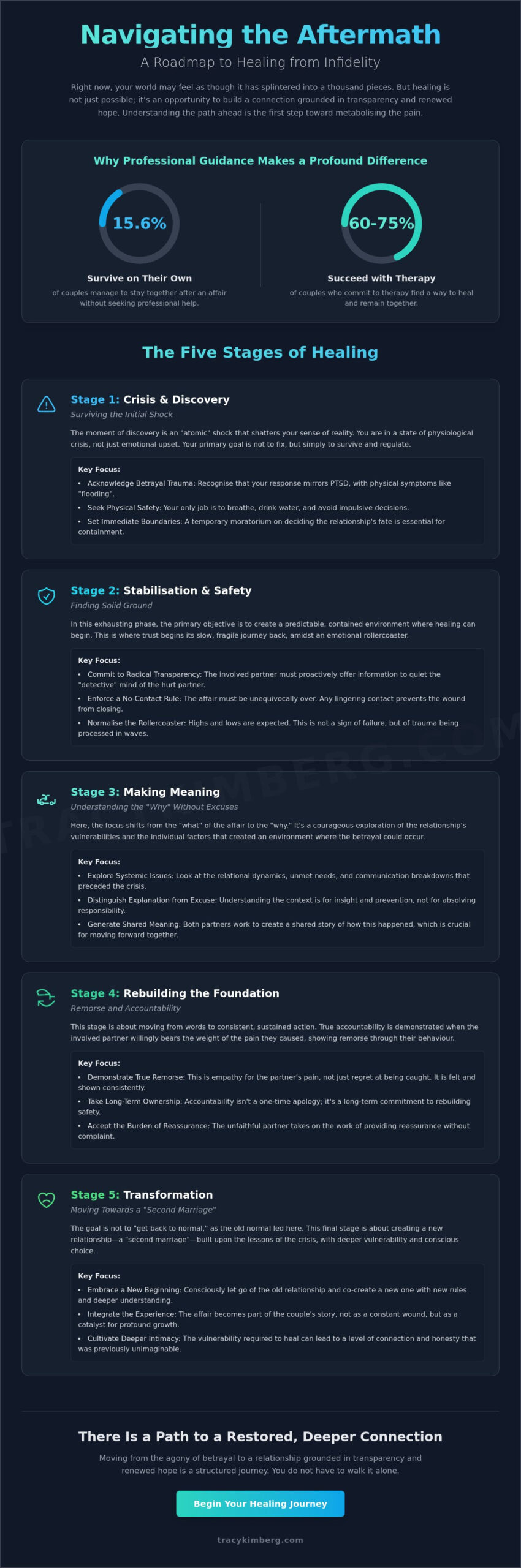
Stage 3: Making Meaning – Understanding the “Why” Without Excuses
Once the dust of the initial explosion settles and you’ve achieved a level of safety, you reach perhaps the most complex of the infidelity recovery stages: making meaning. This isn’t about finding a justification for the betrayal. Instead, it’s a deep, often painful dive into the “why” of the situation. We must distinguish between explaining the affair and excusing the behaviour. An explanation provides a map of how you got here; an excuse attempts to absolve the involved partner of responsibility. True healing requires the former whilst strictly rejecting the latter. You’re looking for the narrative thread that connects your past choices to your current reality.
Relationships don’t exist in a vacuum. We look at the systemic factors-the interplay between individual histories, the relationship dynamic, and the external environment. As Esther Perel often suggests, an affair is rarely just about a search for a new partner; it’s frequently a search for a lost version of the self. It may be an attempt to reconnect with a sense of vitality or autonomy that felt smothered by the weight of domestic responsibility. Simultaneously, we consider The Gottman Institute’s Trust Revival Method, which highlights “sliding doors” moments. These are the small, daily opportunities to turn toward one another that were missed, leading to a slow, silent emotional disconnect long before the physical betrayal occurred. Recognising these patterns is a vital part of navigating the infidelity recovery stages with integrity.
The Involved Partner’s Internal Journey
For the partner who strayed, this stage requires a profound shift from guilt to remorse. Guilt is self-centred; it’s about the discomfort of being the “bad person” and the desire to hide. Remorse is other-centred; it’s about the deep ache of seeing the pain you’ve caused and staying present for it. Identifying the “void” the affair was meant to fill is a crucial part of this journey. Whether it was a need for validation, an escape from grief, or a response to internalised trauma, understanding the “why” is the only way to prevent a future recurrence.
Deconstructing the Old Relationship
It’s helpful to view the infidelity as the catastrophic end of your “first marriage.” That relationship is gone. You’re now tasked with deciding whether to build a second one together with the same person. This requires an honest assessment of your previous dynamics without shifting blame onto the hurt partner. It’s about looking at the cracks in the foundation that existed before the earthquake. Navigating these conversations is delicate work, which is why couples therapy for infidelity is so vital. It creates a container where you can deconstruct the past safely, ensuring that the “why” leads to growth rather than more destruction.
Stage 4: Rebuilding the Foundation – Remorse and Accountability
Reaching this point in the infidelity recovery stages signifies a shift in focus. You’ve moved from the “why” of the past to the “how” of the present. True accountability isn’t a one-time apology or a fleeting moment of regret; it’s a long-term commitment to a new way of being. In the Gottman method, this is known as the “Atonement” phase. It requires the involved partner to willingly bear the burden of the pain they caused without getting defensive or demanding that the hurt partner “just move on.” You’re essentially building a new foundation on the ruins of the old one, and that requires consistent, daily effort.
Research confirms that this level of honesty is the best predictor of success. Couples who openly address the affair in a therapeutic setting have a 57% chance of staying together, whilst those who minimise or hide the truth see that success rate drop to just 20%. Healing happens in the light. By shifting the focus to your behaviour today, you begin to replace old patterns of neglect or secrecy with new rituals of emotional connection. This might be as simple as a daily ten-minute “stress-reducing conversation” or a weekly date night where the affair is explicitly not the topic of discussion.
The Architecture of Remorse
A transformative apology does more than say “I’m sorry.” It validates the hurt partner’s entire reality, acknowledging the depth of the betrayal trauma without caveats. Consistency is the primary currency of trust here. You must do what you say you will do, every single time, no matter how small the task. We also encourage the involved partner to initiate “check-ins” about the affair. When you bring it up first, you signal to your partner that you haven’t forgotten their pain, which allows them to finally let go of the “detective” role.
Re-authoring Your Story
As you move through the infidelity recovery stages, you’ll begin to integrate this event into your history without letting it become the only chapter. You’re learning “attunement,” which is the ability to read your partner’s emotional cues with a new-found sensitivity. It’s about turning toward each other rather than away. Because this process is so intensive, a structured approach like our 12-week relationship recovery process is vital. It provides the momentum and professional guidance needed to ensure you don’t stall in your progress. If you’re ready to move from survival to genuine stability, our Relationship Counselling and Coaching for Couples offers a safe, expert-led space to navigate this transition.
Stage 5: Transformation – Moving Towards a “Second Marriage”
When couples reach the final of the infidelity recovery stages, they often ask when life will return to “normal.” The reality, whilst challenging at first, is quite profound: you don’t return to the old version of your relationship. That marriage ended with the betrayal. Transformation is about building your “second marriage” with the same partner, a partnership forged in the fires of honesty rather than the comfort of habit. This new normal is defined by a level of vulnerability that likely didn’t exist before. You’ve moved through the fire, and whilst the scars remain, they no longer dictate the rhythm of your daily life. Instead, they serve as quiet reminders of your resilience and the conscious effort you’ve both invested.
This stage isn’t a static destination but a proactive adventure in emotional health. It’s the moment where you stop looking over your shoulder at the affair and start looking forward at the life you’re choosing to lead together. You’ve metabolised the trauma, and in doing so, you’ve developed a more sophisticated understanding of each other’s inner worlds. It’s a relationship built on intentional choice rather than just shared history. You’ve moved from a state of clinical crisis into a space of expansive growth, where the partnership becomes a container for your mutual evolution.
Conscious Intimacy and Vulnerability
Physical and emotional closeness often feel like the final frontier of healing. In this stage, intimacy is rediscovered through a lens of safety and radical consent. It’s a transition from merely surviving the day to genuinely thriving as a couple. You begin to experience joy that isn’t shadowed by the past. To maintain this, we recommend regular “emotional check-ups” or continuing with our Relationship Counselling and Coaching. Keeping the partnership “conscious” ensures that you don’t slip back into the old patterns of neglect that once left the door ajar for disconnect.
When the Path Leads to a Conscious Separation
Sometimes, despite the most dedicated efforts through the infidelity recovery stages, you may find that the healthiest path forward is apart. Healing the individuals involved is always the priority, even if the partnership cannot be sustained. If reconciliation isn’t the right choice for your long-term emotional health, we support you through a Conscious Approached Divorce and separation. This process allows you to conclude your story with dignity and awareness rather than further conflict. Regardless of the outcome, the work of recovery is never wasted. You’ve gained a deeper understanding of yourself and your capacity for healing, which is a gift that will serve you in every future chapter of your life.
Rebuilding a Partnership Grounded in Truth
The journey through the infidelity recovery stages is rarely linear, yet it’s one of the most profound opportunities for personal and relational growth you may ever face. By moving from the initial shock of discovery into a space of radical transparency and meaning-making, you aren’t just repairing a broken bond. You’re actively deciding to co-create a new, more resilient version of your partnership. Whether you find yourselves at the beginning of this path or are ready to embrace the concept of a “second marriage,” remember that the goal is not to erase the past, but to integrate it into a future built on conscious choice.
We provide a safe, non-judgemental environment where you can explore these complexities using a research-based approach inspired by the work of Gottman and Perel. If you’re ready to begin your journey of healing, we’re here to help you navigate this transition through our online therapy or face-to-face sessions. Explore my 12-Week Relationship Recovery Process to find the structure and support you need. There’s hope for a deeper connection; let’s find it together.
Common Questions About the Path to Healing
How long do the infidelity recovery stages typically take?
The process of fully reconciling after an affair typically takes between two and five years. This timeline isn’t a fixed rule, but it reflects the reality that rebuilding a shattered sense of safety requires significant time. Whilst the initial acute pain often begins to settle after the first twelve months, the deeper work of integration and creating a new relationship foundation often spans several years of consistent effort.
Is it possible to ever truly trust my partner again after an affair?
Yes, trust can be rebuilt, but it will look different than the “blind trust” you once had. In the later infidelity recovery stages, trust is replaced by “earned trust,” which is based on a long-term track record of transparency and consistency. You learn to trust your partner because they have shown up, stayed present for your pain, and prioritised your emotional safety over their own comfort.
Should we tell our children or family members about the infidelity?
Deciding who to tell depends on the age of your children and the level of support you need. Generally, we advise against sharing adult details with children, as it often forces them into a “parentified” role where they feel responsible for your emotional health. With family, choose only those who can remain non-judgemental and supportive of your decision to work on the relationship rather than those who might fuel further conflict.
What is the difference between an emotional affair and a physical one in terms of recovery?
Both types of betrayal cause significant trauma, but emotional affairs often involve a deeper sense of replacement that can be harder to untangle. Whilst physical affairs focus on the breach of sexual exclusivity, emotional affairs involve a breach of intimacy and friendship that can be particularly difficult to define and address. In terms of recovery, the work remains the same: you must still move through the infidelity recovery stages to address the underlying disconnect and rebuild safety.
Can a relationship be better after an affair, or is that just a myth?
It is not a myth; many couples report that their “second marriage” is more honest and intimate than their first. This isn’t because the affair was a positive event, but because the recovery process forced you to address issues that were previously ignored. You develop a new vocabulary for your needs and a higher capacity for vulnerability, which can lead to a more conscious and resilient partnership than before.
How do I know if my partner is genuinely remorseful or just sorry they got caught?
Genuine remorse is characterised by a partner’s willingness to stay present for your pain without getting defensive. If they are only sorry they got caught, they will likely push you to “get over it” quickly or focus on their own guilt. A truly remorseful partner understands that they have lost the right to a timeline and will proactively offer transparency and consistency to help you feel safe.
What should I do if my partner refuses to talk about the affair during the recovery process?
Silence often indicates that the involved partner is overwhelmed by shame or fear of causing more pain. However, recovery cannot happen without dialogue. If you hit a wall of silence, it’s often helpful to engage a professional who can facilitate these conversations. A therapist provides the structure needed to discuss the betrayal safely, ensuring that the “why” is explored without causing further emotional flooding or secondary trauma.
Is individual therapy or couples therapy better for infidelity recovery?
Both serve different purposes in the healing journey. Individual therapy allows each partner to process their own trauma, shame, or family-of-origin issues in a private space. Couples therapy is essential for rebuilding the bridge between you, as it focuses on the interpersonal dynamics and the creation of a new foundation. Most successful recoveries involve a combination of both individual and joint work to ensure holistic healing.

Article by
Tracy Kimberg
Tracy Kimberg is a Relationship Expert, Couples Therapist and Coach with a dedicated focus on helping couples and individuals rebuild connection, trust, and emotional safety in their relationships. Drawing on the research of John and Julie Gottman, the relational insights of Esther Perel, and years of hands-on therapeutic experience, Tracy offers a warm, non-judgemental and deeply compassionate approach to modern relationships. Based in Dorset, Tracy works with couples navigating communication breakdowns, betrayal, intimacy challenges, separation, family dynamics, and life transitions. Known for creating a safe and grounded therapeutic space, she combines practical tools with emotional depth to help clients move beyond survival patterns and towards meaningful, lasting change. With a reputation for empathy, professionalism, and dedication to her clients’ growth, Tracy is passionate about helping people feel seen, understood, and empowered — both within their relationships and within themselves.
Disclaimer
Disclaimer: The information shared in this article is intended for educational and informational purposes only and should not be considered a substitute for professional therapeutic, psychological, medical, or legal advice. Every individual and relationship is unique, and the perspectives offered are based on general therapeutic principles, research, and professional experience. Reading this article does not establish a therapist-client relationship with Tracy Kimberg. If you are experiencing significant emotional distress, relationship crisis, trauma, or mental health concerns, it is important to seek support from a qualified professional appropriate to your individual circumstances. All content remains the intellectual property of Tracy Kimberg and may not be reproduced or distributed without permission.