

What if the recurring friction in your love life isn’t a sign that you’re “broken,” but rather a reflection of an outdated internal map? You might find yourself caught in a cycle of intense anxiety during dating or feel an instinctive urge to withdraw just as things start to get serious. These reactions are often deeply rooted in our early experiences. Through attachment style therapy, you can begin to understand the “why” behind your behaviour and start the vital work of rewiring how you connect with others.
It’s exhausting to feel like you’re constantly chasing a partner who shuts down or trying to soothe someone who clings too tightly. You deserve a connection that feels like a safe harbour rather than a source of constant stress. I will show you how to break these repetitive relationship patterns to build a secure, lasting bond with yourself and those you love. We’ll explore the clinical foundations of attachment theory and provide a clear preview of how professional support can transform your relational blueprint into one of safety and deep, authentic intimacy.
Key Takeaways
- Understand how your early life experiences shaped a subconscious roadmap for how you give and receive love in your adult partnerships.
- Identify the “pursuer-distancer” dynamic in your relationship and learn how these patterns influence your ability to navigate conflict and repair.
- Discover how attachment style therapy harnesses neuroplasticity to help you rewire your brain and move towards a state of earned security.
- Learn the practice of mentalisation to help you interpret emotional cues more accurately, reducing anxiety and improving intimacy with your partner.
- See how a structured, research-based approach can transform your relational blueprint and foster a deeper sense of connection with yourself and others.
The Silent Architect: What is Attachment Style Therapy?
Imagine an architect who designed your home decades ago. You might not remember their name, but you live within the walls they built every single day. In our emotional lives, Attachment Theory serves as that original blueprint. Attachment style therapy isn’t just about digging through the past for the sake of it; it’s a roadmap that helps us understand how we’ve learned to give and receive love. Whilst the foundations were laid by John Bowlby and Mary Ainsworth in the mid-20th century, the real power of this work lies in how it transforms our adult partnerships today.
It’s vital to remember that your relational blueprint isn’t a life sentence. It is simply a starting point for growth. We aren’t talking about clinical “attachment disorders,” which are rare and typically stem from severe early neglect. Instead, we’re looking at the common attachment styles that most of us carry into our relationships. These are the subtle, often invisible, forces that dictate why we feel safe or why we panic when a partner pulls away. By engaging with attachment style therapy, you begin to see these patterns for what they are: learned responses that can be unlearned.
The Core Premise: Why Your Past Informs Your Present
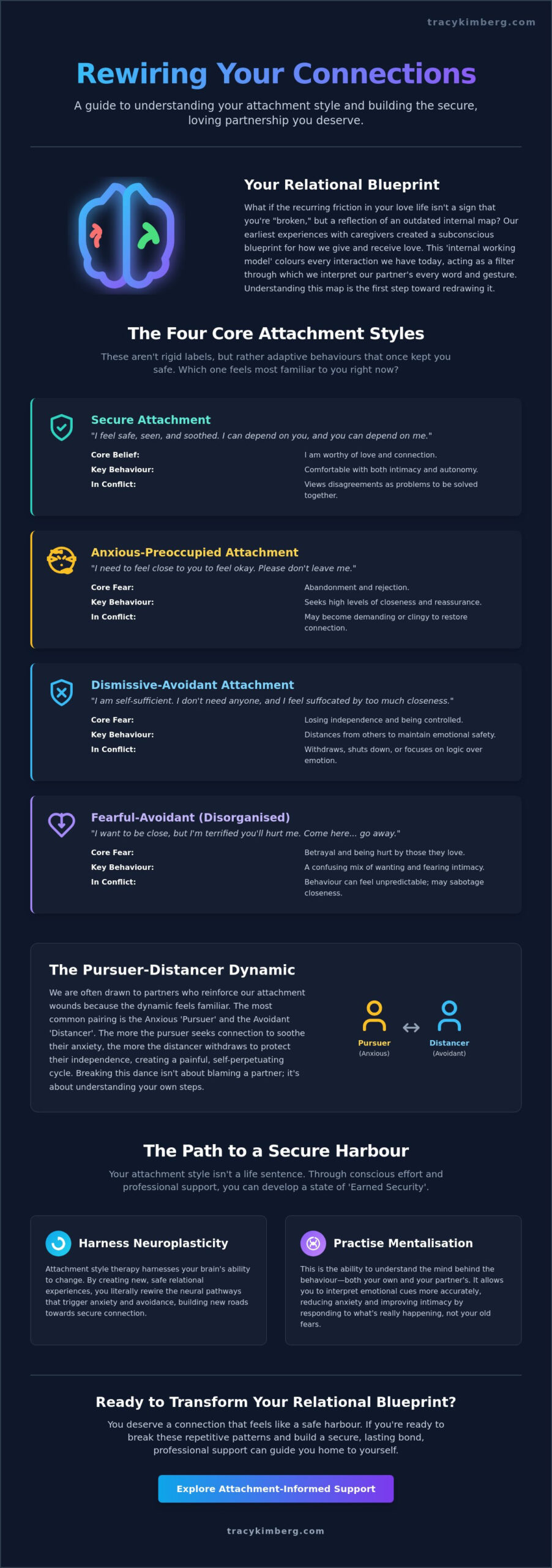
Your brain’s limbic system is incredibly efficient at memorising what safety and threat looked like during your earliest years. Gabor Maté often suggests that attachment is a fundamental survival mechanism, not a personality flaw. If a child’s needs aren’t met with consistency, they don’t stop loving the parent; they stop loving themselves. This creates “internal working models,” essentially a set of subconscious expectations about whether others are reliable and whether we are worthy of care. These models colour every interaction we have today, acting as a filter through which we interpret our partner’s every word and gesture.
Moving Beyond Labels: Anxious, Avoidant, and Disorganised
We typically categorise these patterns into four distinct groups:
- Secure: Comfortable with intimacy and independence; able to communicate needs clearly.
- Anxious-Preoccupied: Seeking high levels of closeness and often worrying about a partner’s commitment.
- Dismissive-Avoidant: Distancing oneself from others to maintain a sense of self-sufficiency and emotional safety.
- Fearful-Avoidant: A complex mix of wanting closeness whilst simultaneously feeling frightened by it.
Rather than seeing these as pathological diagnoses, think of them as adaptive behaviours. At some point in your life, these strategies kept you safe. The trouble is that we often “dance” between these styles depending on our partner’s behaviour. You might feel secure with one person but find yourself becoming anxious or avoidant with another. Understanding this dance is the first step toward changing the rhythm of your relationship.
The Relational Mirror: How Attachment Styles Play Out in Partnership
Relationships are often the most profound mirrors we encounter. We don’t just fall in love with a person; we frequently fall into a familiar dynamic that echoes our earliest bonds. This is where understanding What is Attachment-Based Therapy? becomes so relevant for modern couples. It helps us see that our choice of partner isn’t accidental. We are often subconsciously drawn to individuals who reinforce our existing attachment wounds because, on some level, that specific type of tension feels like home. It’s a pull toward the familiar, even when the familiar is painful.
Our attachment styles dictate how we handle conflict and, perhaps more importantly, how we repair. A secure partner sees a disagreement as a temporary hurdle. However, for those with insecure styles, a minor spat can feel like an existential threat to the bond. This is why attachment style therapy is so transformative. It moves the focus from “who is right” to “how do we feel safe together.” Exploring these mirrors in a neutral environment, such as individual relationship counselling, allows you to examine your triggers without the immediate heat of a partner’s reaction. If you find yourself stuck in these loops, working on your own internal map can be a vital first step in changing the dynamic of your partnership.
The Pursuer-Distancer Dynamic
John Gottman famously described the “pursuer-distancer” cycle, which is the hallmark of the Anxious-Avoidant Trap. When tension rises, the avoidant partner may experience “flooding,” a physiological state where their nervous system is so overwhelmed they simply shut down to survive. To the anxious partner, this withdrawal feels like total abandonment, triggering “protest behaviour.” This might look like clinging, critiquing, or escalating emotions to force a connection. It’s a tragic loop where both people are desperately seeking safety, but their methods of finding it drive the other person away. Over time, this cycle can leave both partners feeling lonely in a relationship, physically present but emotionally miles apart.
Attachment and Intimacy: The Esther Perel Perspective
Esther Perel teaches us that there is a permanent tension between our need for security and our need for mystery. When attachment styles are insecure, this balance often breaks. Anxious partners may seek “enmeshment,” trying to merge so closely that the “otherness” required for desire vanishes. Conversely, avoidant partners may use distance as a shield, which keeps the relationship safe but emotionally cold. Intimacy requires the safety to be known and the space to be separate. Without that vital space, the erotic spark often fades into the background of survival.
Breaking the Cycle: How Attachment Style Therapy Rewires the Brain
The most common question people ask when they first learn about their relational blueprint is: “Can I actually change?” It’s a valid fear. If these patterns were etched into our nervous systems during infancy, they can feel like a permanent part of our identity. However, modern neuroscience offers a resounding message of hope through the concept of neuroplasticity. Our brains are not static; they are designed to be reshaped by new experiences. Whilst your early years provided the initial code, attachment style therapy acts as a conscious software update. It allows you to move from autopilot reactions, like shutting down or lashing out, to intentional, conscious responses that foster closeness rather than distance.
This healing happens through what we call a “Corrective Emotional Experience.” When you enter the therapeutic space, you aren’t just discussing theories; you are engaging in co-regulation. This is the process where one nervous system helps calm another. When a therapist remains present, empathetic, and steady whilst you navigate painful memories or current relationship stressors, your brain begins to register a new kind of safety. Over time, this consistent experience of being seen and understood begins to overwrite the old scripts of abandonment or intrusion. You start to realise that intimacy doesn’t have to be a threat.
The Therapeutic Relationship as a Secure Base
In attachment style therapy, the therapist serves as a temporary “secure base.” Just as a child needs a safe home to explore the world, an adult needs a safe emotional harbour to explore their deepest fears. This connection relies on “limbic resonance,” a deep, non-verbal attunement between two people. Many wonder if this level of intimacy is possible through a screen, but online couples therapy UK has proven that emotional safety isn’t bound by physical proximity. The presence, tone, and steady gaze of a specialist can create a powerful container for healing, no matter where you are located.
From Blame to Understanding: Healing the Inner Narrative
Gabor Maté often highlights that self-compassion is a prerequisite for any real relational change. Healing isn’t about finding someone to blame, nor is it about getting stuck in resentment toward your parents or past partners. Instead, it’s about understanding the context of your wounds. When you move from thinking “I am too much” or “I am not enough” to “I have a history that I am now healing,” the narrative shifts. You stop being a victim of your past and become the conscious architect of your future. This shift in perspective is what allows you to finally break the cycle and build the secure, lasting bond you deserve.
Towards Earned Security: Your Roadmap to Relational Freedom
Relational freedom is not a gift of birth; it is a hard-won achievement of the adult heart. Whilst we cannot change our childhood history, we can absolutely change how that history lives within us today. This process is known as “Earned Secure Attachment.” It is the state of becoming secure as an adult through conscious effort, self-reflection, and consistent practice. Through attachment style therapy, you can cultivate the specific skills needed to move from a place of reactive fear to one of grounded connection. This journey is not about becoming a different person, but about peeling back the layers of self-protection that no longer serve you.
The first vital step in this roadmap is developing “Mentalisation.” This is the ability to understand your own mental state whilst simultaneously considering your partner’s. It allows you to pause and think: “I am feeling anxious right now because they are late, but that doesn’t mean they are leaving me.” Following this, you must learn to regulate your nervous system. When you are triggered, your body enters a state of fight or flight. Learning to stay “present” through breath and grounding techniques prevents you from spiralling into old patterns of protest or withdrawal. Finally, setting healthy boundaries acts as the bridge between self-protection and connection, allowing you to stay close to others without losing yourself in the process. If you are ready to begin this transformation, you can explore how specialised relationship coaching can guide you through these steps.
The Signs of Growing Security
How do you know if the work is actually working? You might notice you are “testing” your partner less often or that you no longer feel the need to “earn” their love through perfection. A major sign of progress is the ability to “repair” quickly after a rupture. Instead of days of silence, you find the words to reconnect within hours. Relational resilience is the ability to weather storms without losing the bond. It is the quiet confidence that even when things are difficult, the relationship is strong enough to hold the tension.
Practical Exercises for Daily Life
To make the insights of attachment style therapy stick, you must bring them into your daily rituals. John Gottman’s research suggests a simple “Check-in” ritual where you spend ten minutes each day sharing your inner world without trying to solve problems. Additionally, practicing mindfulness helps you “pause” for a few seconds before a reactive behaviour takes over. When you do speak, try using “I feel” statements. Saying “I feel lonely when we don’t eat together” instead of “You always ignore me” bypasses your partner’s defensive walls and invites them into a conversation rather than a confrontation.
Finding Your Way Home: Attachment-Informed Support with Tracy Kimberg
Tracy Kimberg brings a deeply human and research-backed perspective to the work of relational healing. She doesn’t simply look at the surface-level symptoms of a struggling partnership; she looks at the heartbeat behind the behaviour. Through attachment style therapy, Tracy helps you navigate the complexities of modern British life whilst unravelling the intricate knots of your past. Her approach is grounded in the belief that we all possess the capacity for change, provided we have the right map and a steady hand to guide us. It takes immense courage to look at your relational blueprint, but it is the only way to begin building a structure that truly supports your desire for intimacy.
The 12-Week Relationship Recovery Process is a cornerstone of Tracy’s practice, specifically designed to integrate attachment work for lasting change. This process isn’t a quick fix; it’s a structured journey that moves you from the chaos of reactive patterns toward the stability of earned security. By focusing on the underlying emotional drivers of your partnership, this programme helps you and your partner move beyond blame and into a space of mutual understanding. Having a “Wise Guide” in this process is essential. Tracy understands that adult life transitions often trigger our deepest insecurities, and she provides the specialized care needed to transform those triggers into opportunities for connection. If you are based in the city and searching for the best couples coach London has to offer, understanding what makes a specialist truly effective is the essential first step.
A Safe Space for Transformation
Tracy provides a non-judgemental, empathetic environment where you can explore your vulnerabilities without fear of being “fixed” or criticised. She understands that the therapeutic process can feel daunting, so she strikes a delicate balance between clinical expertise and warm accessibility. For busy UK professionals and couples, Tracy offers the flexibility of online therapy, ensuring that seeking support fits into your life rather than adding to its stress. Many individuals and couples begin this work by asking whether the relationship can be saved. Attachment-informed support provides the clarity and tools needed to answer that question with honesty and compassion.
Your Next Steps to Connection
If you feel ready to explore your specific attachment dynamics, I invite you to book a consultation. This is your opportunity to step out of the cycle of frustration and into a proactive adventure of self-discovery. You don’t have to stay stuck in patterns that leave you feeling lonely or misunderstood. Whether you choose face-to-face sessions or online support, the goal is to help you find your way home to yourself and your partner. Healing is a journey, not a destination, and you don’t have to walk it alone. Every relationship has the potential for repair when we understand the heart behind the habit.
Step Into a New Story of Connection
Your relational blueprint doesn’t have to be your destiny. We have explored how understanding your early bonds and the “pursuer-distancer” dance can finally break the cycles that leave you feeling lonely or overwhelmed. Moving toward earned security is a profound act of courage that reshapes not just your partnerships, but your relationship with yourself. Through attachment style therapy, you can learn to navigate conflict with resilience and build the deep, authentic intimacy you’ve always craved. It is about moving from a place of survival to a place of thriving.
Healing is a collaborative process that thrives under the guidance of a compassionate expert. As a Certified Relationship Expert, Tracy Kimberg employs a research-based approach inspired by the insights of Gottman and Perel to help you find your way back to connection. Whether you choose her signature 12-Week Relationship Recovery Process or individual support, you will find a safe space to rewire your internal map and foster lasting change. Book your consultation with Tracy Kimberg to begin your journey to secure connection. You deserve a love that feels like home, and it’s entirely within your reach to create it.
Frequently Asked Questions
What is the most common attachment style addressed in therapy?
Anxious-preoccupied attachment is the most frequent style that leads individuals to seek professional support. These individuals often feel a deep hunger for connection but are plagued by persistent fears of abandonment. However, attachment style therapy often works with the relationship dynamic as a whole; specifically addressing the “pursuer-distancer” loop that occurs when an anxious partner is paired with an avoidant one, creating a cycle of frustration for both parties.
How long does attachment style therapy take to see results?
Significant shifts in perspective can occur within a few months, whilst deeper nervous system rewiring often takes longer. Many clients find that a structured 12-Week Relationship Recovery Process provides the essential tools to start breaking old habits. For deep-seated patterns to fully transform into “earned security,” many people continue their work for six months to a year to ensure the new relational blueprint is solid and sustainable.
Can you have a different attachment style with different people?
Yes, your attachment style is often a “dance” that changes depending on the person you are with. Whilst you have a primary baseline, a very secure partner can help you feel more grounded and stable. Conversely, a partner who is highly unpredictable might trigger an anxious response in someone who is usually quite secure. We call this “relational fluidity,” and it’s a key focus when exploring your history.
Is it possible for two avoidant partners to have a successful relationship?
Two avoidant partners can have a stable relationship, but it often lacks the emotional depth and intimacy required for true fulfilment. They may coexist peacefully for years by respecting each other’s need for distance. The challenge arises when a crisis occurs and neither partner knows how to lean on the other. Without intervention, these relationships can become emotionally distant even if they remain entirely conflict-free.
Does attachment therapy involve talking about my parents in every session?
Attachment work focuses on how your past lives in your present, so you won’t spend every session simply recounting childhood stories. The goal is to understand your “internal working model” and how it colours your current interactions. Whilst we acknowledge the roots of your behaviour, the primary focus remains on your current relationship and how you can choose new, healthier responses for a better future.
Can online therapy effectively treat deep-seated attachment issues?
Online therapy is remarkably effective for treating attachment issues because the therapeutic bond is built on presence and attunement rather than physical proximity. Research into “limbic resonance” shows that we can co-regulate through a screen as long as the therapist is focused and empathetic. For many, the comfort of their own home actually makes it easier to open up about vulnerable, sensitive topics.
What is the difference between anxious and disorganised attachment?
The primary difference lies in the presence of fear and the consistency of the strategy used. An anxious person has a clear goal; they want closeness and will pursue it intensely. A person with disorganised attachment feels “fright without solution.” They desperately want intimacy but simultaneously feel that people are dangerous or untrustworthy, leading to a confusing cycle of approaching and then suddenly pushing away.
How do I know if my partner has an avoidant attachment style?
You might notice “deactivating” behaviours, such as pulling away just after a period of intense closeness or vulnerability. Avoidant partners often prioritise independence above all else and may shut down or become critical when they feel “suffocated” by emotional demands. In attachment style therapy, we help partners see that this isn’t a lack of love, but a learned defence mechanism designed to keep them safe from perceived intrusion.

Article by
Tracy Kimberg
Tracy Kimberg is a Relationship Expert, Couples Therapist and Coach with a dedicated focus on helping couples and individuals rebuild connection, trust and emotional safety in their relationships. Drawing on the research of John and Julie Gottman, the relational insights of Esther Perel, and years of hands-on therapeutic experience, Tracy offers a warm, non-judgemental and deeply compassionate approach to modern relationships.
Based in Dorset, Tracy works with couples navigating communication breakdowns, betrayal, intimacy challenges, separation, family dynamics and life transitions. Known for creating a safe and grounded therapeutic space, she combines practical tools with emotional depth to help clients move beyond survival patterns and towards meaningful, lasting change.
With a reputation for empathy, professionalism and dedication to her clients’ growth, Tracy is passionate about helping people feel seen, understood and empowered — both within their relationships and within themselves.
Disclaimer
Disclaimer:
The information shared in this article is intended for educational and informational purposes only and should not be considered a substitute for professional therapeutic, psychological, medical or legal advice. Every individual and relationship is unique, and the perspectives offered are based on general therapeutic principles, research and professional experience.
Reading this article does not establish a therapist-client relationship with Tracy Kimberg. If you are experiencing significant emotional distress, relationship crisis, trauma, or mental health concerns, it is important to seek support from a qualified professional appropriate to your individual circumstances.
All content remains the intellectual property of Tracy Kimberg and may not be reproduced or distributed without permission.