

We understand how distressing it is to worry about your future together or feel trapped in “roommate syndrome”. This guide will help you discover exactly why this emotional distance happens and how to bridge the gap using research-backed relational strategies. You’ll gain a deeper understanding of the root causes behind the drift and learn actionable steps to re-engage with your partner, moving from a sense of isolation toward a proactive and positive adventure in healing your connection.
Key Takeaways
- Understand that loneliness isn’t about physical distance but a subjective gap in emotional connection that can occur even whilst sitting in the same room.
- Learn how domestic routines and the “roommate phase” contribute to feeling lonely in a relationship and why the quest for security can sometimes stifle intimacy.
- Identify the subtle warning signs of emotional disconnect, such as the “silent dinner” syndrome or the quiet grief of feeling isolated within your partnership.
- Discover how to use Gottman’s “Turning Towards” technique to respond to small bids for connection and initiate vulnerability check-ins.
- Recognise when this “quiet crisis” requires professional support to help you find your voice and transform your partnership.
The Paradox of Being Alone Together: What Relationship Loneliness Really Is
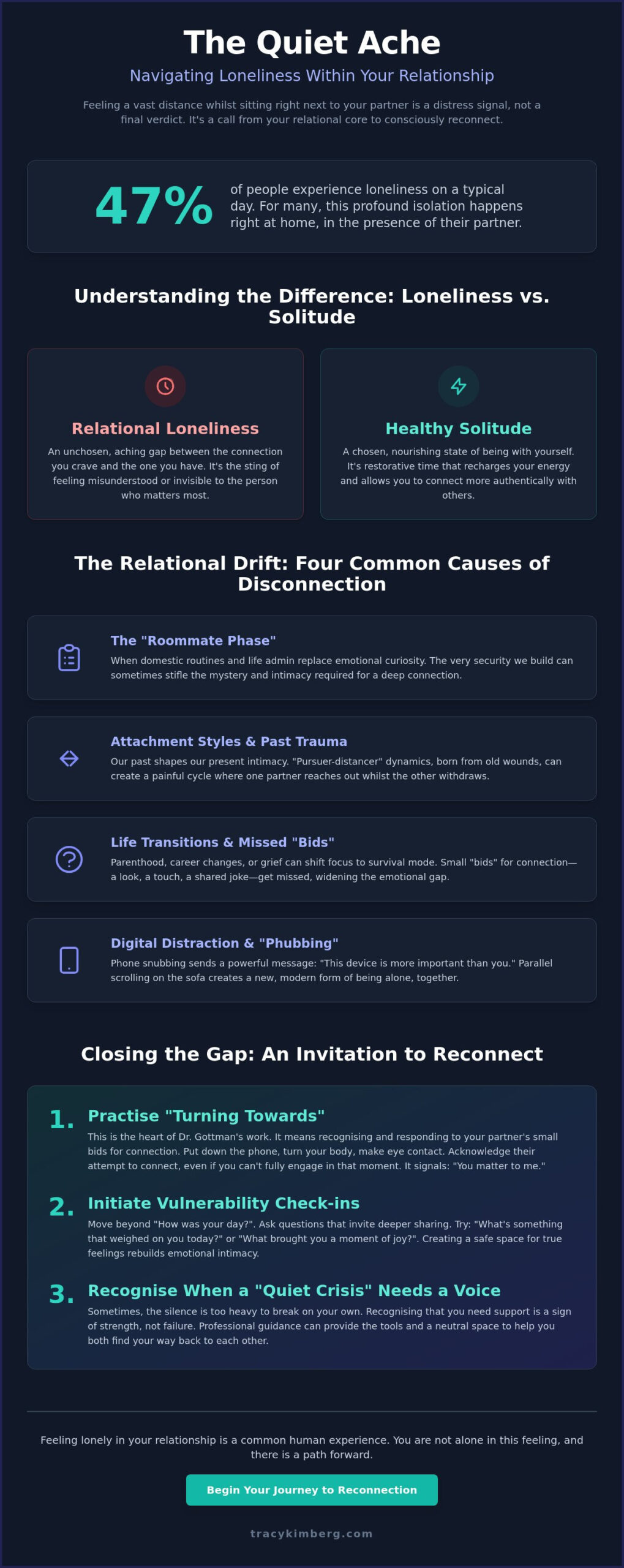
It is a peculiar and painful sensation to share a bed with someone yet feel as though you are drifting in the middle of the ocean alone. This is the essence of relational loneliness. It is not about the physical distance between two people, but rather the subjective gap between the connection you desire and the one you actually perceive. You might find yourself in a bustling household, managing school runs and sharing meals, yet experiencing a profound “lonely in a crowd” effect within your own four walls.
Physical proximity is never a guarantee of emotional intimacy. You can be arm-in-arm at a party or side-by-side on the sofa and still feel a deep sense of emotional isolation. Think of this feeling as a distress signal from your relational immune system. Just as your body uses a fever to tell you something needs attention, feeling lonely in a relationship is a vital indicator that your emotional bond requires conscious re-engagement. It’s a call to action, not a final verdict on your love.
Loneliness vs. Solitude: Knowing the Difference
We often confuse being alone with being lonely. Solitude is a chosen, nourishing state where you find peace in your own company. It’s restorative. In contrast, the loneliness you feel in a partnership is an unchosen ache. It’s the sting of being ignored or misunderstood by the person who should know you best. Paradoxically, if you don’t allow yourself space for healthy solitude, you may find that the pressure to be “on” for your partner actually increases your sense of isolation. When we lose ourselves, we lose the ability to truly connect with others.
Why This Feeling Is Often Kept in the Shadows
There’s a specific kind of shame that comes with feeling lonely in a relationship that appears “perfect” on the outside. In Britain, we often lean into the “stiff upper lip” tradition, hiding our emotional struggles behind a veneer of stoicism. We tell ourselves we should be grateful for a stable home, whilst social media feeds filled with curated “perfect couple” tropes make us feel like we’re the only ones struggling. This silence only deepens the divide. It makes the problem feel much larger than it actually is, yet acknowledging it is the first step toward healing.
The Relational Drift: Why You Are Feeling Lonely in Your Relationship
Relationships rarely end with a bang; they often fade through a series of quiet, unnoticed departures. This process, known as relational drift, is a primary reason for feeling lonely in a relationship. When you enter the “Roommate Phase”, domestic routines like organising the bins or discussing the mortgage replace emotional curiosity. Esther Perel famously suggests that the very security we crave in a partnership can sometimes kill the mystery required for connection. We become so predictable to each other that we stop looking for the person behind the partner.
Life transitions often accelerate this drift. Becoming parents, navigating career shifts, or experiencing bereavement can shift your focus from “us” to “survival”. During these times, it’s easy to ignore “bids” for connection. A bid is any attempt to get your partner’s attention; a look, a touch, or a shared joke. When these are consistently missed, the silence grows heavier and the emotional gap wider.
The Role of Attachment Styles and Past Trauma
Your history plays a massive role in how you experience intimacy. If you have an avoidant or anxious attachment style, you might find yourself in a “pursuer-distancer” dynamic. One person reaches out whilst the other withdraws, creating a cycle of isolation. Gabor Maté highlights how childhood conflicts between authenticity and attachment often resurface in adult love. If you felt you had to hide your true self to be loved as a child, you might do the same now, leading to a deep sense of being unknown. Exploring attachment style therapy can help you understand this blueprint and find your way back to each other.
Digital Distraction and the ‘Phubbing’ Phenomenon
Modern life has introduced a new barrier: “phubbing”, or phone snubbing. It happens when one partner looks at their phone during a conversation. Whilst it seems minor, it sends a powerful message: “This device is more interesting than you.” Parallel scrolling, where you both sit on the sofa but remain in separate digital worlds, creates a wall of glass. You are physically present but digitally absent, which is a major contributor to feeling lonely in a relationship. This neurological disconnect makes it harder to feel seen. If you feel this drift is becoming unmanageable, our relationship coaching for couples offers a structured path to re-engage.
Identifying the Signs of Emotional Disconnect
One of the most visible indicators of feeling lonely in a relationship is the ‘Silent Dinner’ syndrome. It isn’t the comfortable silence of two people content in each other’s company; it’s the heavy, awkward quiet of having nothing left to say beyond logistics. When your conversations are strictly limited to who is picking up the dry cleaning or what time the children need to be at football practice, the emotional pulse of the partnership has slowed. You are functioning as a unit, but you aren’t connecting as individuals.
You might also find yourself grieving the relationship whilst you are still in it. This “ambiguous loss” involves longing for the version of your partner, or the version of “us”, that seems to have vanished. It often manifests as a lack of ‘we-ness’. You begin to plan your weekends, your career moves, or even your daily joy without considering your partner’s internal world. Perhaps most tellingly, you might notice a sense of relief or a return to your “true self” only when your partner is out of the house. If the person who is supposed to be your safe harbour has become a source of exhaustion, the disconnect has reached a critical point.
The Physical and Emotional Red Flags
The erosion of intimacy often starts with the loss of ‘micro-intimacy’. These are the small, almost unconscious gestures that signal safety and belonging. You might notice:
- A decline in spontaneous touch, such as holding hands whilst walking or a brief kiss before leaving for work.
- A lack of sustained eye contact during conversation.
- A shift in focus where you only share chores and complaints rather than dreams or curiosities.
- A persistent, nagging feeling of being “too much” when you express a need or “not enough” when you try to please them.
Cognitive Signs: The Narrative of ‘Me’ vs ‘Us’
Your internal monologue provides a map of your emotional state. When you start thinking in terms of “I have to do everything” rather than “We are a team”, the cognitive shift toward isolation is complete. You may find yourself ‘predicting’ a negative response before you even open your mouth, leading you to stay silent to avoid the disappointment of being misunderstood. Relational cognitive distortion is the psychological filter that causes you to focus exclusively on your partner’s flaws or perceived slights whilst becoming blind to their genuine efforts to connect. Recognising these signs is a powerful first step. If these patterns feel familiar, our individual relationship counselling can help you navigate these feelings and find a way back to a shared narrative.
Closing the Gap: How to Stop Feeling Lonely and Reconnect
Reversing the emotional drift described earlier requires a conscious shift in how you interact daily. Dr John Gottman’s research highlights the power of ‘Turning Towards’—the simple act of acknowledging your partner’s small bids for attention. When you stop feeling lonely in a relationship, it’s often because you’ve started noticing these tiny invitations again. Whether it’s a comment about a news story or a gentle touch, responding with genuine interest builds a reservoir of emotional safety that protects against future isolation.
Esther Perel suggests that reconnection also involves looking inward. By ‘cultivating your own garden’—pursuing your own interests and passions—you become more visible and intriguing to your partner. This healthy sense of self-reliance can reignite the curiosity that domestic routines often stifle. When you are fulfilled individually, perhaps by taking the time to learn more about Truemeet and its focus on real-world group activities, you bring a more vibrant energy back to the partnership, making it easier to bridge the gap together.
How to Tell Your Partner You Feel Lonely
Communication is the bridge over the emotional gap, but the way you start the conversation matters. Focus on ‘I’ statements to express your internal experience rather than ‘You’ statements that assign blame. A ‘Softened Start-up’ technique is incredibly effective; try saying, ‘I’ve been feeling a bit lonely lately and I miss our connection.’ This invites your partner in rather than putting them on the defensive. Consider setting a specific time for a ‘State of the Union’ meeting. This is a dedicated, safe space where you can both share your needs without the fear of a sudden or heated confrontation.
Micro-Steps for Daily Reconnection
Reconnection doesn’t always require grand gestures. Small, non-negotiable ‘Rituals of Connection’ can transform your bond over time. Consider these daily habits:
- The ‘Six-Second Kiss’: A kiss that lasts at least six seconds is long enough to flood your system with oxytocin and create a moment of genuine presence.
- ‘High/Low’ Questions: Move beyond the standard ‘How was work?’ by asking about the best and most challenging parts of each other’s day.
- Digital-Free Time: Commit to putting your phones away for at least 20 minutes of active listening every evening to ensure you are truly seeing one another.
These small moments act as the glue that holds a partnership together during stressful transitions. If you find these steps difficult to initiate on your own, our 12-Week Relationship Recovery Process offers a structured and supportive path to help you re-engage and thrive as a couple.
When to Seek Professional Support for Relational Loneliness
Loneliness is often the “quiet crisis” that precedes more visible relationship breakdowns such as infidelity or separation. Whilst a loud argument demands immediate attention, the slow, silent erosion of intimacy can be far more dangerous because it’s so easy to ignore. Recognising that you are feeling lonely in a relationship is a significant moment of clarity. It signals that your emotional needs are not being met, but it also shows you still care enough to feel the absence of connection. Sometimes, the most effective way to start the repair is by focusing on your own internal landscape. Engaging in individual relationship counselling helps you find your voice and identify your boundaries, giving you the confidence to re-engage with your partner from a place of strength.
For busy professionals across the country, geographic or scheduling barriers shouldn’t stand in the way of healing. Accessing the best online couples therapy UK offers a convenient way to prioritise your partnership without the stress of a commute. This format allows you to work through complex interpersonal challenges from the comfort of your own home, making the therapeutic process feel more manageable and less clinical than traditional settings.
The 12-Week Relationship Recovery Process
If you feel like you are stuck in a cycle of “roommate syndrome”, a structured approach is often more effective than open-ended therapy. Our 12-Week Relationship Recovery Process is an intensive programme designed to bridge deep divides in a specific timeframe. It moves beyond simple “chat” sessions by providing a clear map for recovery. We address the root causes of your disconnect, focusing on everything from communication patterns to the restoration of intimacy. The ultimate aim is to help you transition from being two people living parallel lives back to being “soulmates” or “partners in adventure”. It is an active, evolving experience that transforms the way you see and interact with each other.
Finding the Right Specialist in London or Online
The success of your journey depends heavily on finding a specialist who understands the nuances of modern adult life transitions and interpersonal challenges. When looking for the best couples coach London, ensure they use a research-backed, empathetic framework. You need someone who remains a neutral, Wise Guide, rather than a judge. 2026 survey data indicates that 47% of people experience loneliness on a typical day; you aren’t alone in your struggle. Reaching out for professional support is a proactive step toward long-term emotional health. Feeling lonely in a relationship doesn’t have to be your permanent reality; it can be the catalyst for a more profound and lasting connection.
Choosing a Path Back to Each Other
You don’t have to navigate this quiet grief alone. We’ve explored how feeling lonely in a relationship is often a vital signal for re-engagement rather than a sign that your love has failed. By recognising the signs of relational drift and implementing small, daily rituals of connection, you can begin to dismantle the wall of glass that has grown between you. Whether you are navigating the “roommate phase” or coping with the impact of digital distractions, the possibility of healing remains within reach.
As a UK-based expert with global online reach, I specialise in Gottman and Perel-inspired methods to help couples move from isolation to transformational change. I provide a safe, non-judgemental environment where you can both feel seen and heard once again. This process is not just about fixing a problem; it’s about evolving together through a supportive conversation.
Book a consultation to start your 12-Week Relationship Recovery journey today. Your partnership is a proactive and positive adventure. Let’s work together to find the way back to your best selves and your favourite version of “us”.
Frequently Asked Questions
Is it normal to feel lonely in a relationship?
Yes, it is remarkably common for couples to experience periods of emotional distance at various stages of their lives. Relational loneliness is often a vital signal from your emotional system that your partnership is evolving and needs new ways to connect. It doesn’t mean your relationship is failing; it means the current way you’re interacting isn’t meeting your needs for intimacy.
Can a relationship survive if one person feels lonely?
Absolutely, a relationship can thrive after a period of isolation if the feeling is used as a catalyst for change. Loneliness is a “quiet crisis” that serves as a wake-up call for both partners. When you address the root causes of the drift early on, it often leads to a deeper and more resilient bond than you had before the disconnect began.
What is the difference between being lonely and being unhappy?
Loneliness is specifically a subjective gap in emotional connection, whereas unhappiness is a broader state of general dissatisfaction. You might be happy with your shared life, your home, and your partner’s character, but still feel a profound ache for more closeness. Unhappiness often involves a desire to leave, whilst loneliness involves a desire to be seen and heard.
How do I know if my partner is also feeling lonely?
Look for signs of quiet withdrawal or an increased focus on external distractions like work, social media, or hobbies. If your partner has stopped sharing their daily thoughts or seems to “phub” you more often, they may be struggling too. Often, both people are feeling lonely in a relationship but are too afraid of rejection to be the first to mention it.
Why do I feel lonely even though we spend all our time together?
Physical presence doesn’t equate to emotional presence. You can spend every evening in the same room but remain in separate worlds due to “parallel scrolling” or focusing strictly on domestic logistics. Connection requires active curiosity and “turning towards” each other’s bids for attention, rather than just occupying the same physical space or sharing a schedule.
How can I tell the difference between relational loneliness and depression?
Relational loneliness is usually situational, meaning your mood often improves when you’re with friends or engaged in hobbies away from your partner. Depression tends to be pervasive, affecting your interest in almost everything regardless of your company. If your sadness is specifically tied to the lack of connection within your partnership, it’s likely a relational issue rather than clinical depression.
Can therapy help if only one of us feels lonely?
Yes, individual support is incredibly powerful for shifting the dynamics of a partnership. By working on your own relational blueprint and finding your voice, you change how you show up in the relationship. This shift often encourages your partner to respond differently, creating a positive ripple effect that can transform the entire couple’s dynamic for the better.
What are the first steps to take when I realise I’m feeling lonely in my marriage?
The first step is acknowledging the feeling to yourself without any shame or judgement. Once you’ve accepted it as a valid signal, try a “softened start-up” conversation with your partner. Share that you miss the closeness you used to have and want to find ways to reconnect. Focus on your desire for more intimacy rather than assigning blame for the distance.

Article by
Tracy Kimberg
Tracy Kimberg is a Relationship Expert, Couples Therapist and Coach with a dedicated focus on helping couples and individuals rebuild connection, trust and emotional safety in their relationships. Drawing on the research of John and Julie Gottman, the relational insights of Esther Perel, and years of hands-on therapeutic experience, Tracy offers a warm, non-judgemental and deeply compassionate approach to modern relationships.
Based in Dorset, Tracy works with couples navigating communication breakdowns, betrayal, intimacy challenges, separation, family dynamics and life transitions. Known for creating a safe and grounded therapeutic space, she combines practical tools with emotional depth to help clients move beyond survival patterns and towards meaningful, lasting change.
With a reputation for empathy, professionalism and dedication to her clients’ growth, Tracy is passionate about helping people feel seen, understood and empowered — both within their relationships and within themselves.
Disclaimer
Disclaimer:
The information shared in this article is intended for educational and informational purposes only and should not be considered a substitute for professional therapeutic, psychological, medical or legal advice. Every individual and relationship is unique, and the perspectives offered are based on general therapeutic principles, research and professional experience.
Reading this article does not establish a therapist-client relationship with Tracy Kimberg. If you are experiencing significant emotional distress, relationship crisis, trauma, or mental health concerns, it is important to seek support from a qualified professional appropriate to your individual circumstances.
All content remains the intellectual property of Tracy Kimberg and may not be reproduced or distributed without permission.