

Imagine sitting at the dinner table whilst your teenager stares at their phone, offering nothing but one-word answers to every question you ask. It’s a heavy, isolating silence that leaves you feeling rejected by the person you love most. You aren’t alone in this. Recent data reveals that 40% of high school students report persistent feelings of sadness, and that internal struggle often manifests as a wall between parent and child. If you’re searching for how to communicate with my teenager without every interaction ending in a conflict, it’s vital to look beneath the surface of their behaviour.
We often mistake their need for independence as a rejection of our love, but the truth is usually found in the complexities of their developing brain and their search for a secure attachment. You can move from a place of anxiety to a peaceful home environment where your teen feels safe coming to you in a crisis. This guide provides a compassionate roadmap to reconnecting, blending clinical expertise with practical communication scripts. You’ll learn how to turn those missed emotional bids into opportunities for healing and restore the mutual respect your relationship deserves.
Key Takeaways
- Reframe your teenager’s need for distance as a vital developmental step towards autonomy rather than a personal rejection of your relationship.
- Learn to identify and respond to subtle “emotional bids,” such as a shared video or a quiet moment in the same room, to rebuild daily trust.
- Explore research-backed techniques on how to communicate with my teenager by prioritising a safe, non-judgmental environment over the specific words spoken.
- Practise emotional regulation to stay curious during heated moments, ensuring your own “parent alarm” doesn’t inadvertently silence your child’s voice.
- Understand the clear indicators that suggest professional therapy for teenagers could help bridge the gap when communication feels deeply stalled.
The Developmental Shift: Understanding Why Communication Changes
It starts with a heavy sigh, a door closing, or a phone screen held like a shield. This developmental shift in adolescence is often the most painful transition a parent will face. Suddenly, the child who once shared every detail of their day has become a stranger who treats your questions like an interrogation. It feels like a personal rejection, but it is actually a biological imperative. Your teenager is beginning the necessary, albeit messy, process of moving towards autonomy. They are testing their own identity, and to do that, they must create distance from yours.
The tension you feel is the friction between their need for a secure base and their desperate urge to explore the world. When they push back or offer a sharp retort, it is rarely about the topic at hand. Instead, it is a clumsy attempt at asserting a boundary. If we can reframe this behaviour as a developmental milestone rather than a lack of respect, we can change the entire energy of the home. Learning how to communicate with my teenager starts with understanding that their withdrawal isn’t a sign the relationship is broken; it’s a sign they are growing.
Attachment vs. Authenticity: The Adolescent Struggle
Gabor Maté often speaks about the fundamental human tension between attachment and authenticity. In early childhood, children will sacrifice their authentic selves to maintain the attachment they need for survival. As they enter their teens, the scales begin to tip. They are reclaiming their authenticity, often in ways that feel abrasive or confrontational. If your teen is pushing back, it often means they feel safe enough in your attachment to risk being their true, unvarnished selves. They are testing whether your love can hold the weight of their evolving identity.
The Teen Brain: A Work in Progress
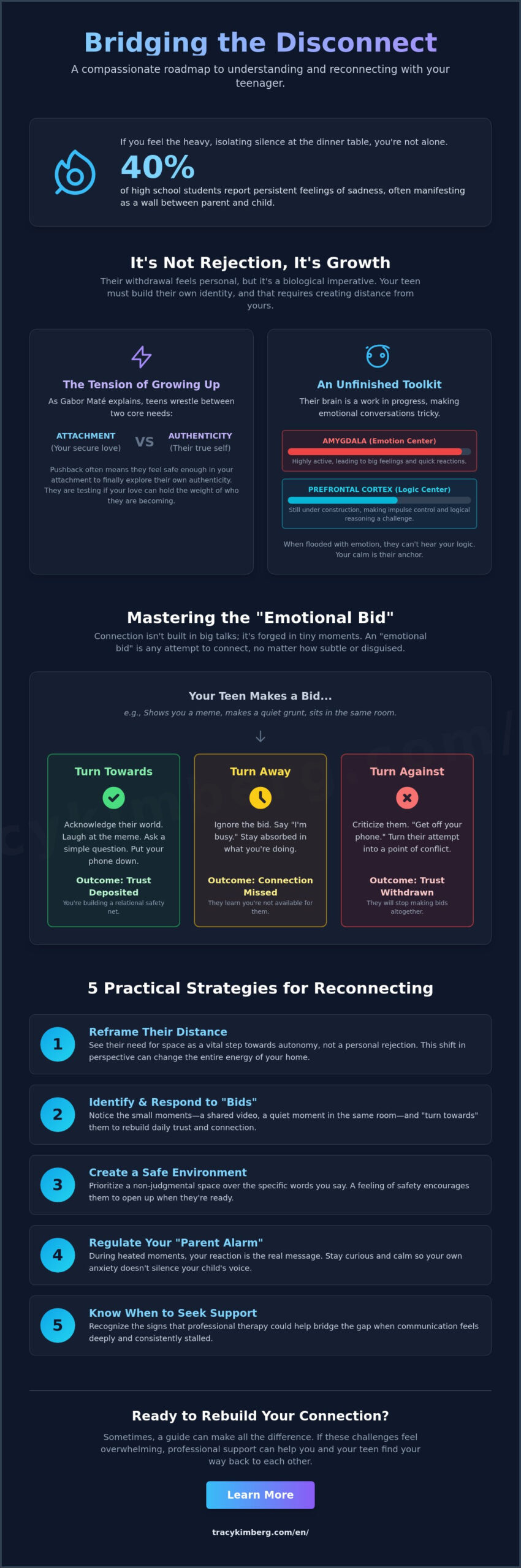
It helps to remember that your teenager is operating with an unfinished biological toolkit. Their amygdala, the brain’s emotional centre, is highly active, whilst the prefrontal cortex, the part responsible for logic and impulse control, is still under construction. This is why “logic” often fails in the heat of an argument. When they are flooded with emotion, they literally cannot hear your advice. Their brain is in survival mode, not learning mode. This biological reality means that staying calm is your most powerful tool. It allows you to be the external regulator they haven’t yet developed within themselves.
Mastering the “Emotional Bid”: Gottman’s Secret to Teen Connection
Connection with a teenager rarely happens during a scheduled “heart-to-heart” talk. Instead, it is built in the microscopic exchanges of daily life. John Gottman, a pioneer in relationship research, identified these moments as “bids for connection.” A bid is any attempt from one person to another for attention, affirmation, or some form of positive interaction. In the context of a parent-teen dynamic, Gottman’s emotional bids are often subtle, disguised, or even abrasive. It might be a meme sent to your phone, a grunt as they walk past you, or their silent presence in the kitchen whilst you cook dinner. It’s a bid.
When your teen makes a bid, you have three choices: you can turn towards, turn away, or turn against. Turning away looks like ignoring the meme because you’re busy. Turning against looks like criticising them for being on their phone. However, when you turn towards these small moments, you deposit trust into your relational bank account. Over time, these deposits create a cushion of safety. When you prioritise these tiny interactions, you are laying the groundwork for how to communicate with my teenager during the moments that actually matter.
Identifying Subtle Bids in a World of Screens
In a digital landscape where 95% of teens use YouTube and 67% are on TikTok, their bids for your attention have changed. If they show you a video or ask your opinion on a game, they are testing the waters. They are asking: “Are you interested in my world?” It is also vital to recognise the “11 pm window.” Many teenagers find it easier to open up late at night when their internal “parent alarm” is quiet. Dropping what you are doing for those spontaneous, late-night chats is one of the most powerful ways to validate their experience. If you find these moments are consistently missed, exploring therapy for teenagers can help identify the hidden barriers to these connections.
Validation: The Antidote to Defensiveness
Validation is perhaps the most misunderstood tool in a parent’s arsenal. It is not about agreeing with their behaviour or their logic; it is about acknowledging their emotional reality. When a teen feels heard, their physiological arousal drops. Their heart rate slows, and their brain moves out of a defensive “fight or flight” mode. Instead of countering their complaints with logic, try using phrases like, “I can see why that felt unfair to you,” or, “That sounds like a really heavy situation to carry.” By mirroring their emotion rather than correcting their facts, you create the psychological safety required for a real dialogue to begin. This shift from correction to connection is the essential secret to how to communicate with my teenager without triggering a conflict.
Regulating the “Parent Alarm”: Why Your Reaction is the Message
“I try to talk, but I just get so angry when they’re rude.” This is the most frequent objection parents share in my practice. It is deeply painful to feel dismissed by the person you’ve spent years nurturing. However, when we react with heat, we often miss the message. Your teenager’s behaviour is a form of communication, even if it is delivered clumsily. Learning how to communicate with my teenager requires us to first master the art of regulating our own “Parent Alarm.”
Esther Perel speaks about the “eroticism of curiosity,” which, in a family context, means staying vibrantly interested in the conflict rather than being threatened by it. When your teen pushes back, can you stay curious? Instead of thinking, “They are being disrespectful,” try wondering, “What is happening inside them that makes this the only way they can speak?” This shift moves you from a place of defence to a place of connection. It allows you to see the struggle beneath the surface of the attitude.
Our reactions are often rooted in our own past experiences or the way we were parented. If you were never allowed to talk back, your teen’s defiance might trigger a visceral “inner child” response. This is where the concept of co-regulation becomes vital. You must be the calm anchor in their storm. If two people are drowning in emotion, no one is doing the rescuing. By staying regulated, you provide the external nervous system your teen needs to eventually find their own balance.
The Power of the Pause
Self-regulation is a skill, not an instinct. When you feel your chest tighten, practise the power of the pause. Take a deep breath, name the emotion internally, or even take a “parental time-out” by saying, “I’m too upset to hear you properly right now; let’s talk in ten minutes.” Winning an argument in the moment often means losing the long-term relationship. To better understand why certain behaviours provoke such a strong reaction in you, it can be incredibly helpful to engage in individual relationship counselling to explore your own emotional triggers.
Moving from Dictator to Consultant
As your teen grows, your role must shift from a dictator who controls to a consultant who influences. A dictator demands compliance; a consultant offers expertise that can be accepted or declined. This transition is difficult because it requires letting go of the illusion of control. When you offer guidance, do it without the lecture or the interrogation. Honour their growing need for privacy as a healthy sign of individuation, whilst keeping the door open for safety. This balance ensures they still see you as a resource rather than a hurdle in their search for how to communicate with my teenager effectively.
Five Practical Strategies for Communicating with Your Teenager
Transformation in a relationship doesn’t happen through one grand gesture. It occurs through the quiet, consistent application of new habits. If you’ve felt the sting of silence or the heat of constant arguments, these strategies offer a way to lower the temperature. When considering how to communicate with my teenager, remember that the environment you create is just as important as the words you choose. You are building a bridge, and every brick requires patience and a steady hand.
Strategy 1: Embrace the Side-by-Side Conversation
For an adolescent, direct eye contact can often feel like an interrogation or a spotlight on their vulnerabilities. This is why some of the most profound breakthroughs happen in the car, whilst walking the dog, or during a shared session of cooking. These “side-by-side” activities provide a low-pressure environment where the focus is on a shared task rather than the intensity of the dialogue. This physical positioning allows a teen to feel less hunted and more free to share their internal world at their own pace.
Strategy 2: The “Curiosity Over Judgement” Approach
When we lead with judgement, we invite defensiveness. Instead, try leading with curiosity. Replace “Why did you do that?” with “Help me understand what was going through your mind at that moment.” Open-ended questions that lack a “correct” answer invite exploration rather than performance. Additionally, strive for the “three-to-one” rule: ensure you have at least three positive or neutral interactions for every one correction or critique. This balance keeps the relationship from feeling like a constant series of reprimands.
Strategy 3: Schedule “Connection Time” Without an Agenda
Dedicate a specific window of time to engage in an activity your teenager enjoys, even if it isn’t your favourite way to spend an afternoon. This time must be sacred. That means no mentions of unfinished chores, no lectures about school grades, and no probing questions about their social life. It is purely about being present in their world. For those supporting a child through deeper struggles, this help for anxious teens checklist can provide further guidance on maintaining emotional safety during these moments.
Strategy 4: Practise the 70/30 Rule
One of the most effective ways to foster connection is to simply talk less. Aim to let your teenager speak for 70% of the conversation whilst you listen for the remaining 30%. Your role is to be a container for their thoughts, not a fixer for their problems. When you resist the urge to jump in with a solution, you demonstrate that you trust their ability to navigate their own life.
Strategy 5: The Art of Repair
Conflict is inevitable, but it doesn’t have to be destructive. The secret lies in the repair. If a conversation goes off the rails, use a simple script to re-open the door: “I’m sorry that I reacted with so much heat earlier. I’d really like to hear what you were trying to say when we’re both feeling calmer. Can we try again later?” This models accountability and shows that the relationship is more important than being right. If you’re finding it difficult to break these cycles alone, online therapy can provide a neutral space to develop these skills together.
When to Seek Professional Support: Moving Beyond the Conflict
Sometimes, even with the most compassionate tools, the silence remains impenetrable or the conflict escalates beyond what feels manageable at home. It’s vital to recognise that whilst typical teen rebellion involves testing boundaries, certain “red flags” signal a deeper distress. If you notice persistent withdrawal from favourite activities, signs of self-harm, or extreme anxiety, it may be time to seek external support. Understanding how to communicate with my teenager in these moments often means admitting that a neutral, professional third party is needed to bridge the emotional gap. When approximately 40% of high school students report persistent feelings of hopelessness, seeking help is a proactive act of love, not a sign of failure.
Therapy for teenagers provides a sanctuary where your child can process their internal world without the fear of hurting or disappointing you. A therapist acts as a translator; they help decode the abrasive behaviours that often mask underlying pain. In my practice, I focus on facilitating these difficult conversations, creating a space where both parent and child feel seen and heard. This process isn’t about “fixing” a broken child. Instead, it’s about restoring the flow of connection within the entire family system. Whether we meet through Face-to-Face Therapy or the convenience of Online Therapy, the goal is to move from a place of survival to one of genuine warmth.
The Transformational Power of Family Dynamics
Real change rarely happens in isolation. When we look at a relationship through a systemic lens, we see that every member influences the other. By engaging in the process together, you begin to change the “dance” at home. When parents do their own internal work alongside their teen’s sessions, it signals to the child that the burden of change isn’t theirs alone to carry. My specialised approach ensures a safe, non-judgemental environment where you can explore how to communicate with my teenager more effectively. This collaborative shift is often what allows the teen to finally lower their guard and invite you back into their world.
Taking the First Step Towards Healing
Suggesting therapy to a teenager can feel like walking a tightrope. To avoid making your teen feel like they are “the problem,” frame the invitation as a supportive resource for the whole family. You might say, “I can see how much we’ve both been struggling to hear each other lately, and I’d like us to have some help to make things feel more peaceful at home.” Choosing a professional who respects adolescent autonomy whilst maintaining a connection to the family unit is crucial. Taking this step is a powerful way to demonstrate that your relationship is a priority. It is never too late to rebuild the bridge to your child and restore the sense of mutual respect that makes a house feel like a home.
Taking the First Step Towards a Deeper Connection
Reconnecting with your child is not about finding a perfect script; it is about creating a safe harbour where their authentic self can finally emerge. By reframing their withdrawal as a vital developmental milestone and staying curious during moments of friction, you shift the energy of your home from conflict to collaboration. You now have the tools to identify subtle emotional bids and regulate your own internal “parent alarm.” These shifts are the essential foundation for how to communicate with my teenager in a way that honours both their growing autonomy and your shared bond.
This journey towards healing is a proactive adventure, but you don’t have to navigate the emotional landscape alone. If the silence feels too heavy or the patterns of conflict too entrenched, I offer a safe, non-judgemental environment to help you move forward. My research-based approach, inspired by the insights of Gottman and Perel, provides specialised therapy for teenagers and adults focused on restoring interpersonal warmth and respect.
Book a consultation to start rebuilding your relationship with your teenager today.
It is never too late to turn towards your child. With patience and the right support, you can transform today’s distance into a lasting, meaningful connection.
Frequently Asked Questions
Why does my teenager shut down every time I ask about their day?
They often shut down because they are mentally exhausted and perceive direct questioning as an intrusion on their autonomy. After a day of navigating complex social hierarchies and academic pressure, your teen needs a “soft landing” rather than a verbal interview. If you are struggling with how to communicate with my teenager in these moments, try offering a snack and sitting in comfortable silence first. This allows them to settle their nervous system and initiate dialogue when they feel ready.
How do I talk to my teen about sensitive topics like sex or substance use?
Approach these conversations through a lens of curiosity rather than a lecture. Use a “side-by-side” setting, such as whilst driving or walking, to lower the intensity of the eye contact. Instead of focusing solely on rules, ask about their observations of the world around them. This creates a safe space for them to explore their values whilst allowing you to offer guidance without triggering immediate defensiveness.
Is it normal for my teenager to prefer being with their friends over family?
This shift is a healthy and necessary part of adolescent development known as individuation. Your teenager is biologically programmed to prioritise peer relationships as they build a social identity separate from the family unit. Whilst it can feel like a personal rejection, it is actually a sign that you have provided a secure enough base for them to feel safe venturing out into the world.
How can I tell the difference between normal teen moodiness and clinical anxiety?
The key difference lies in the intensity, duration, and how much the behaviour interferes with their daily life. Normal moodiness is usually fleeting and tied to specific events. Clinical anxiety often involves persistent sleep disruption, withdrawal from friends they usually enjoy, or physical symptoms like frequent stomach aches. If their distress prevents them from attending school or engaging in basic self-care, it is time to consult a professional.
What should I do if my teenager refuses to talk to me at all?
When a teen goes completely silent, stop pushing for words and start focusing on presence. Respect their need for physical space whilst making it clear that your door is always open without any “entry fee” of conversation. Small gestures, like sending a funny meme or leaving their favourite treat in their room, act as gentle bids for connection. These signals remind them that your love is unconditional, even during their periods of withdrawal.
How do I set boundaries without being a “dictator” or causing a fight?
Set boundaries through collaboration by explaining the “why” behind your concerns, focusing on safety and shared values. For example, explain that a curfew is about your need to know they are safe rather than a desire to limit their fun. When a teenager feels that their perspective has been heard and considered, they are far more likely to respect the limit without the need for a power struggle.
Can therapy really help if my teenager doesn’t want to go?
Therapy can be remarkably effective even if a teen is hesitant, especially when the focus is on shifting the entire family dynamic. Sometimes, the most powerful way to learn how to communicate with my teenager is for the parent to begin their own therapeutic work. When you change the way you react to their behaviour, it often shifts the way they respond to you, creating a new path for healing.
How do I handle it when my teenager says they hate me?
Recognise that “I hate you” is almost always a clumsy expression of “I am overwhelmed and don’t know how to handle these feelings.” Avoid taking the words at face value or retaliating with your own anger. Instead, stay regulated and say, “I can hear how angry you are right now. I’m going to give you some space, and we can talk when things feel calmer.” This maintains your role as the secure anchor they need. Just as communication breaks down in relationships when emotional flooding takes over, the same dynamic plays out between parents and teens, and the path forward always begins with de-escalation and safety.

Article by
Tracy Kimberg
Tracy Kimberg is a Relationship Expert, Couples Therapist and Coach with a dedicated focus on helping couples and individuals rebuild connection, trust and emotional safety in their relationships. Drawing on the research of John and Julie Gottman, the relational insights of Esther Perel, and years of hands-on therapeutic experience, Tracy offers a warm, non-judgemental and deeply compassionate approach to modern relationships.
Based in Dorset, Tracy works with couples navigating communication breakdowns, betrayal, intimacy challenges, separation, family dynamics and life transitions. Known for creating a safe and grounded therapeutic space, she combines practical tools with emotional depth to help clients move beyond survival patterns and towards meaningful, lasting change.
With a reputation for empathy, professionalism and dedication to her clients’ growth, Tracy is passionate about helping people feel seen, understood and empowered — both within their relationships and within themselves.
Disclaimer
Disclaimer:
The information shared in this article is intended for educational and informational purposes only and should not be considered a substitute for professional therapeutic, psychological, medical or legal advice. Every individual and relationship is unique, and the perspectives offered are based on general therapeutic principles, research and professional experience.
Reading this article does not establish a therapist-client relationship with Tracy Kimberg. If you are experiencing significant emotional distress, relationship crisis, trauma, or mental health concerns, it is important to seek support from a qualified professional appropriate to your individual circumstances.
All content remains the intellectual property of Tracy Kimberg and may not be reproduced or distributed without permission.