

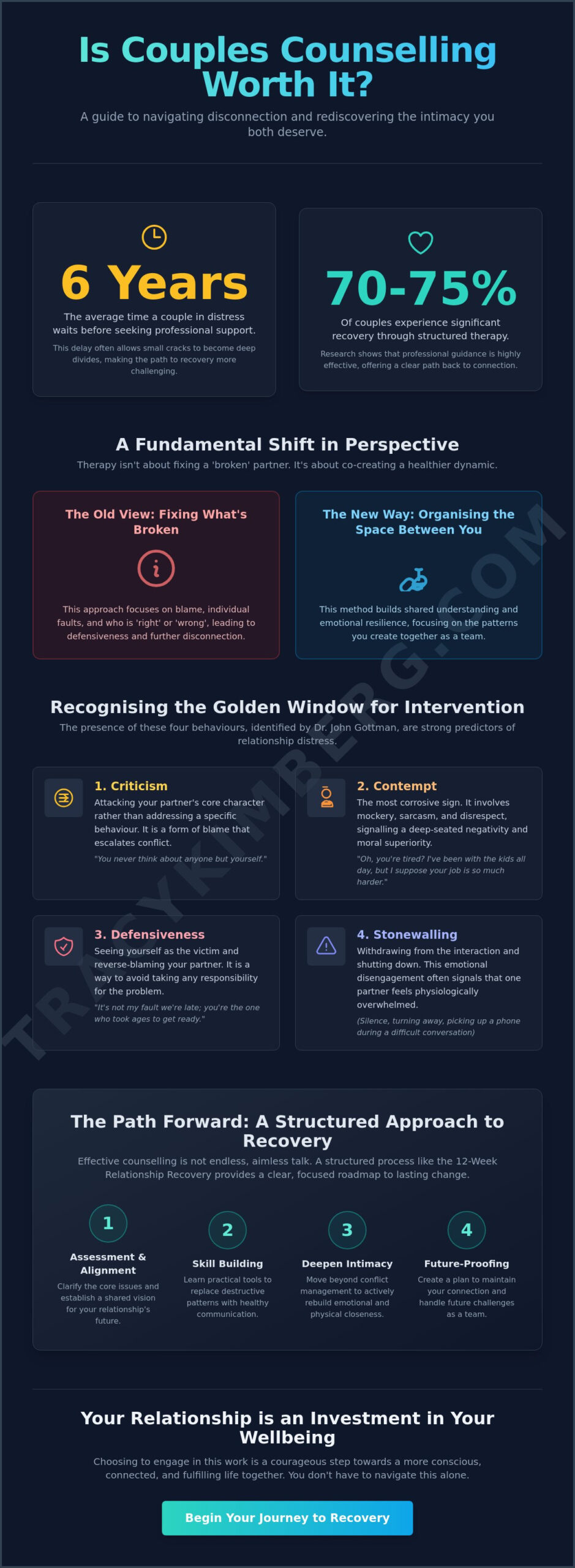
You sit on opposite ends of the sofa, the silence between you heavy with the weight of things unsaid. Perhaps you have spent the evening rehearsing the same circular argument, or maybe you simply feel like strangers sharing a postcode. In these moments of deep disconnection, it is natural to ask: is couples counselling worth it? You might fear that the bond is already beyond repair, or that opening up will only make the cracks wider. It is a vulnerable position to be in, especially when you consider that the average couple waits six years after problems start before reaching out for professional support.
I understand that the decision to invite a therapist into your private world feels like a significant leap. You deserve to know whether this investment of time and emotion will actually lead to the restored intimacy you crave. In this article, we will explore the psychological and practical value of professional guidance, drawing on research that shows 70 to 75 per cent of couples find their way from distress to recovery through therapy. We will look at how to move past perpetual conflicts and provide you with the clarity needed to decide whether to stay or go, ensuring you have the tools to build a future grounded in conscious connection.
Key Takeaways
- Shift your perspective from fixing a partner to organising the emotional space between you, viewing therapy as a proactive investment in your long-term resilience.
- Utilise research-backed insights from the Gottman Method to identify the specific behaviours that erode trust and learn how to replace them with deeper intimacy.
- Evaluate the practical and emotional ROI of professional support to determine if couples counselling is worth it for your health, career, and family stability.
- Recognise the critical indicators that signal your relationship has reached its golden window for intervention before circular arguments lead to permanent detachment.
- Discover why a structured 12-Week Relationship Recovery Process offers a more effective path to lasting change than traditional, open-ended talk therapy alone.
Is Couples Counselling Worth It? Redefining Relationship Success
When we ask if something is “worth it”, our minds often drift to financial spreadsheets or time spent. In the context of love, worth is measured by the texture of your daily life. Is the air in your home light or heavy? Couples therapy is frequently misunderstood as a last-ditch effort to stop a sinking ship. In reality, it is a sophisticated method of organising the emotional space between two people. Instead of trying to “fix” a partner, we look at the dance you do together. By shifting the focus from individual faults to the shared dynamic, we create a relationship that doesn’t just survive but thrives. This shift from crisis intervention to proactive emotional health is the cornerstone of modern partnership.
Moving Beyond the ‘Roommate Phase’
In 2026, the most common catalyst for seeking professional support isn’t a dramatic betrayal. It is the slow, quiet drift into the “Roommate Phase”. You manage the calendar, the children, and the kitchen with clinical efficiency, yet you haven’t truly seen each other in months. This platonic co-existence feels safe, but it lacks the “erotic” spark that experts like Esther Perel identify as essential for long-term desire. You become masters of the domestic whilst the romantic self withers. Many couples fear arguments, but silence is often the more dangerous signal. It suggests a withdrawal of energy and a loss of curiosity. Counselling helps you rebalance these two worlds, ensuring your home is a sanctuary for intimacy rather than just a logistics centre.
The Myth of the ‘Broken’ Relationship
There is a lingering stigma that only failing couples attend therapy. This perspective is outdated and prevents many from accessing the support they need. To determine if is couples counselling worth it, you must view it as proactive maintenance rather than a repair shop for the broken. Waiting until you are at breaking point makes the work harder because resentment has likely calcified. By engaging early, you take individual responsibility for the collective healing process. This involves looking at your own behaviours and triggers with compassion. It is not about admitting defeat; it’s about choosing a higher quality of connection.
- Prevention over cure: Addressing small misalignments before they become structural cracks.
- Skill building: Learning how to speak so your partner actually listens, and vice versa.
- Emotional ROI: The psychological difference between simply staying together and actually feeling known and cherished.
Ultimately, the investment is in your future self. When you choose to explore your dynamics with a professional, you are deciding that your happiness and your partner’s well-being are priorities. It is a courageous step toward a more conscious way of living together.
The Science of Worth: Research-Backed Methods That Deliver Results
For many, the question of whether is couples counselling worth it depends on the evidence. You aren’t just looking for a friendly chat; you are looking for a methodology that works. Modern relationship therapy is built upon decades of rigorous clinical research that demystifies why some couples flourish whilst others flounder. By leaning on the work of pioneers like Dr John Gottman, who has spent over 40 years studying the “mathematics of love”, we can move away from guesswork and toward predictable, positive outcomes. This scientific foundation ensures that your investment of time and energy is rooted in proven human behaviour rather than fleeting trends.
One of the most profound markers of success in this field is the ability to identify the “Four Horsemen”: criticism, contempt, defensiveness, and stonewalling. According to The Gottman Institute on when to seek therapy, the presence of these behaviours is a primary indicator that a relationship needs professional intervention. Identifying these patterns early makes therapy immensely valuable, as it allows us to replace destructive habits with healthy communication before the bond is permanently eroded. Whilst Gottman provides the structural blueprint, experts like Esther Perel challenge us to look at the neurobiology of desire, helping us understand why we often feel a tension between the need for security and the need for mystery.
The Gottman Method: A Scientific Benchmark
At the heart of a successful intervention is the Sound Relationship House theory, which provides a framework for building trust and commitment. We look closely at “Bids for Connection”—those small, everyday moments where one partner reaches out for attention or support. The way you respond to these bids determines the long-term ROI of your sessions. By identifying specific patterns of conflict, Dr John Gottman developed the ability to predict the future of a relationship with a staggering 94 per cent accuracy rate. This level of precision allows couples to move forward with confidence, knowing that the tools they are learning are grounded in hard data.
Attachment Styles and the Space Between
We don’t enter partnerships as blank slates; we bring our histories with us. Gabor Maté’s insights into childhood trauma remind us that our adult dynamics are often echoes of our earliest experiences. By adopting a trauma-informed lens, we can move from a culture of blame to one of deep understanding. Recognising whether you or your partner has an anxious, avoidant, or secure attachment style changes the entire conversation. It allows for better emotional regulation and creates a safe harbour where healing can occur. Understanding these patterns is the first step toward a Relationship Recovery Process that feels both safe and transformative.
Calculating the Real ROI: Emotional and Practical Outcomes
When we evaluate a financial investment, we look at the return. In a relationship, the return on investment (ROI) is often measured in the absence of tension and the presence of joy. Many people ask, is couples counselling worth it, by comparing the cost of a session to the price of a dinner out. However, the real calculation must include the “hidden costs” of staying stuck. Relational stagnation isn’t a neutral state; it’s an active drain on your physical health, your career performance, and the emotional well-being of your family. Chronic stress within a partnership triggers elevated cortisol levels, which, over time, can lead to significant physical health challenges.
The Cost of Inaction
Living in a high-conflict or emotionally distant home environment creates a “biological weather” that everyone in the house breathes. For children and teenagers, this atmosphere can shape their developing nervous systems and future relationship patterns. Addressing these dynamics isn’t just about the two of you; it’s about the emotional legacy you are building. Sometimes, the path to healing starts with one person deciding to change the rhythm. If your partner isn’t ready to attend, exploring Individual Relationship Counselling can be a powerful way to transform the partnership from the inside out.
Transformational Outcomes You Can Measure
The skills you acquire in therapy often transcend the four walls of the consulting room. You aren’t just learning to argue less; you are developing a higher level of emotional intelligence. This capacity to regulate your emotions and understand another’s perspective is a profound life skill that often leads to better outcomes in the workplace and amongst your wider social circle. Harvard Health on the effectiveness of couples therapy highlights that professional support provides a structured environment to tackle complex issues like rebuilding trust after infidelity. This is a path that is incredibly difficult to walk alone.
Having a neutral, professional centre for your disputes offers immense psychological relief. It removes the need for friends or family to take sides and ensures that the conversation remains productive. Whilst many hope for reconciliation, sometimes the most successful outcome is a Conscious Approach to Divorce or separation. Deciding to part ways with respect and clarity is a far better investment in your future than years of resentment. Ultimately, determining if is couples counselling worth it comes down to the value you place on your own peace of mind and the health of your future connections.
Identifying the ‘Golden Window’: When is Therapy Most Effective?
Timing often dictates the success of any therapeutic intervention. Research suggests that most couples wait an average of six years after their problems begin before they decide to reach out for professional support. During this long interval, small misunderstandings can harden into rigid patterns of resentment. To determine if is couples counselling worth it, you must consider the current state of your emotional landscape. The “Golden Window” occurs when there is still a shared desire to understand one another, even if that desire is currently buried under layers of frustration. Waiting until the final hour makes the climb back to intimacy steeper, but it is rarely impossible if the underlying commitment remains.
Readiness is the silent engine of change. It is not enough to simply sit in the therapist’s chair; both partners must be “in the room” emotionally. This involves a willingness to look at your own contributions to the dynamic with radical honesty. When both individuals move from a “me versus you” stance to an “us versus the problem” perspective, the investment in therapy becomes incredibly powerful. Even if you have already decided that separation is the healthiest path, professional support is worth it to facilitate a conscious transition, ensuring you part with clarity rather than lingering bitterness.
Signs It’s Time to Book a Session
Recognising the signals before they become catastrophic is essential for a positive outcome. You might notice repetitive cycles where every conversation ends in the same defensive posture or a total lack of physical intimacy. This state of “skin hunger”, where the biological need for touch and closeness has been neglected, is a significant indicator of relational distress. Major life transitions also place unique pressures on a partnership. Career shifts, the arrival of children, or moving into retirement can all disrupt your established rhythm, requiring a neutral space to reorganise your roles and expectations.
Is It Ever Too Late?
Clients often wonder if they have left it too long to seek help. Whilst contempt is the most significant predictor of relationship failure, it does not have to be the final word. If you are currently questioning Can Your Relationship Be Saved?, the answer often lies in the structure of the support you choose. Years of neglect or silence can be reversed through a dedicated 12-Week Relationship Recovery Process. This approach provides a clear map through the fog of disconnection, helping you rebuild trust from the ground up. If you are ready to explore the possibility of a renewed connection, you can schedule a session with a specialist here to begin your journey toward healing.
The Path Forward: A Structured Approach to Recovery
Many approach therapy as a space to simply air grievances. Whilst venting provides temporary relief, it rarely shifts the underlying architecture of the relationship. To truly determine if is couples counselling worth it, we must move beyond the “venting session” model and toward a framework of intentional growth. A structured approach ensures that you aren’t just talking about your problems; you are actively dismantling the patterns that created them in the first place. This transition from passive observation to active participation is what transforms a partnership.
This is where the 12-Week Relationship Recovery Process becomes invaluable. Instead of an indefinite commitment that feels like treading water, this time-bound journey offers a clear beginning, middle, and end. It provides a safe environment where difficult truths can be explored without the fear of the conversation spiralling out of control. Whether you choose Online Therapy for its convenience amongst a busy schedule or Face-to-Face Therapy for the physical presence of a neutral third party, the methodology remains the same: strategic, compassionate, and result-oriented.
Why Structure Beats Endless Venting
Moving from weekly complaints to strategic growth requires a fundamental shift in mindset. In a structured programme, we set clear milestones and goals from the outset. This isn’t about who did what on Tuesday; it’s about how we communicate every day. Homework and specific exercises allow you to practice new behaviours in the “real world” outside of our sessions. By engaging in these proactive adventures together, you build the “muscle memory” of healthy connection. This ensures that the insights gained in the consulting room translate into lasting changes in your living room.
Finding Your ‘Wise Guide’
The efficacy of your recovery depends heavily on the person sitting across from you. You need a “Wise Guide”, someone who possesses the clinical qualifications to navigate complex emotional landscapes and the human warmth to make you feel truly seen. A compassionate, non-judgemental expert acts as a structural anchor, holding space for both of you whilst you navigate the vulnerability of change. They help you see the “unseen” dynamics that Gabor Maté and Esther Perel often highlight. Taking that first step requires immense courage, but it is the most significant move you can make toward a healthier, more conscious future. When you invest in a guide who understands the intricacies of the human heart, you aren’t just buying time; you are buying a new way of being together.
Choosing a Future of Conscious Connection
Deciding to bridge the gap between you is more than a clinical necessity; it is a profound commitment to your shared well-being. We have explored how moving beyond the “Roommate Phase” and addressing the “Four Horsemen” can transform a high-conflict home into a sanctuary of understanding. Determining if is couples counselling worth it is ultimately an act of courage that prioritises your emotional health and the legacy you leave for your family. By choosing a structured path over endless cycles of venting, you ensure that every conversation becomes a stepping stone toward measurable growth.
With over 15 years of experience in relational health, I specialise in the Gottman Method and Perel-inspired coaching to help you navigate these complex emotional landscapes. My structured 12-week programmes are designed to provide the clarity and tools you need to thrive together or part with respect. You don’t have to carry the weight of disconnection alone. Book your 12-Week Relationship Recovery consultation with Tracy Kimberg today and begin your proactive adventure toward healing. There is always a possibility for a new, more vibrant chapter to begin.
Frequently Asked Questions
How long does couples counselling usually take to see results?
On average, it takes about 11 sessions of marriage or relationship counselling to see a positive, lasting change. Whilst some couples notice a shift in their communication after just a few meetings, others require a more structured approach to dismantle years of ingrained habits. A 12-week programme is often the ideal timeframe to move from initial distress to a place of stable, renewed connection.
What if my partner refuses to go to counselling with me?
You can still transform your relationship by attending individual relationship counselling on your own. When one person in a partnership changes their behaviour and emotional responses, it inevitably forces the entire system to reorganise. Often, a reluctant partner becomes more open to the process once they observe the positive shifts and increased emotional regulation in their spouse.
Is online couples therapy as effective as face-to-face sessions?
Clinical research and modern practice confirm that online therapy is just as effective as traditional face-to-face sessions. Many couples actually prefer the virtual format because it allows them to remain in the comfort and privacy of their own home. This familiar environment can lower defences, making it easier to discuss sensitive topics whilst removing the logistical stress of travel.
Can couples counselling help after an affair has been discovered?
Professional support is a vital tool for navigating the profound trauma and shattered trust that follows an affair. We focus on creating a safe harbour where the betrayed partner can express their pain whilst exploring the systemic factors that led to the breach. It is a challenging journey, but many find that the process of rebuilding trust leads to a more transparent and resilient bond.
How much does couples therapy cost in the UK on average?
The cost of therapy in the UK varies significantly depending on the practitioner’s level of specialist training and their location. When people ask if is couples counselling worth it, they are often weighing the session fee against the “hidden costs” of relational distress, such as poor physical health and career stagnation. It is helpful to view the fee as an investment in your long-term emotional stability and family well-being.
Will the therapist tell us if we should break up?
A therapist’s role is not to dictate the future of your relationship, but to provide the clarity you need to decide for yourselves. We act as a neutral guide, helping you identify whether the partnership can be repaired or if a conscious approach to divorce is the healthiest path. The goal is to ensure your decision is based on deep insight rather than reactive anger.
How do I know if my therapist is the right fit for us?
The right therapist should make both of you feel equally seen, heard, and respected without a hint of judgement. You should feel a sense of confidence in their clinical expertise, particularly their knowledge of research-based methods like the Gottman Method. If you don’t feel a sense of safety and rapport within the first two sessions, it is important to discuss this openly or seek a different practitioner.
What happens if we both feel like we’ve already given up?
Feeling as though you have given up is often a sign of emotional exhaustion rather than a definitive end to the love between you. Even in cases of significant distress, research into Emotionally Focused Therapy shows that 70 to 75 per cent of couples move from a state of despair to full recovery. Professional intervention can help you determine if that spark is still there, buried under layers of protective silence.

Article by
Tracy Kimberg
Tracy Kimberg is a Relationship Expert, Couples Therapist and Coach with a dedicated focus on helping couples and individuals rebuild connection, trust and emotional safety in their relationships. Drawing on the research of John and Julie Gottman, the relational insights of Esther Perel, and years of hands-on therapeutic experience, Tracy offers a warm, non-judgemental and deeply compassionate approach to modern relationships. Based in Dorset, Tracy works with couples navigating communication breakdowns, betrayal, intimacy challenges, separation, family dynamics and life transitions. Known for creating a safe and grounded therapeutic space, she combines practical tools with emotional depth to help clients move beyond survival patterns and towards meaningful, lasting change. With a reputation for empathy, professionalism and dedication to her clients’ growth, Tracy is passionate about helping people feel seen, understood and empowered — both within their relationships and within themselves.
Disclaimer
Disclaimer: The information shared in this article is intended for educational and informational purposes only and should not be considered a substitute for professional therapeutic, psychological, medical or legal advice. Every individual and relationship is unique, and the perspectives offered are based on general therapeutic principles, research and professional experience. Reading this article does not establish a therapist-client relationship with Tracy Kimberg. If you are experiencing significant emotional distress, relationship crisis, trauma, or mental health concerns, it is important to seek support from a qualified professional appropriate to your individual circumstances. All content remains the intellectual property of Tracy Kimberg and may not be reproduced or distributed without permission.