

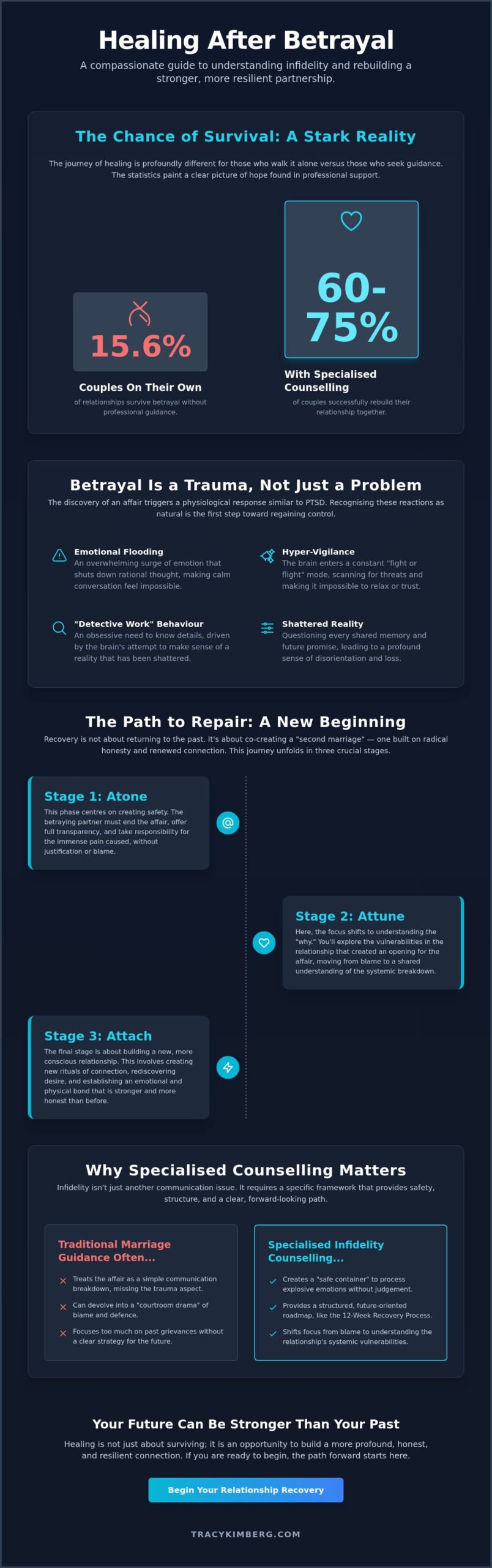
Did you know that whilst only 15.6% of relationships survive betrayal on their own, between 60% and 75% of couples who seek professional help manage to rebuild their lives together? It’s a staggering statistic that offers a glimmer of light during what feels like an endless night of emotional flooding and exhausting detective work behaviour. You’re likely feeling that the ground beneath you has vanished, leaving behind a heavy fog of shame and a terrifying uncertainty about whether your home will ever feel safe again. This is where couples counselling for infidelity becomes more than just a crisis intervention. It serves as a structured, compassionate path to transform this trauma into a catalyst for a deeper, more resilient intimacy.
We understand that you aren’t looking for excuses, but for a way to breathe again. In this guide, we’ll explore how you can stop the immediate cycle of pain and uncover the complex “why” behind the betrayal whilst maintaining clear boundaries. You’ll discover a roadmap for moving from the wreckage of the past toward a new, stronger version of your partnership. Healing is a proactive adventure, and it begins with the decision to turn toward one another, even when the path ahead feels uncertain.
Key Takeaways
- Understand why specialised couples counselling for infidelity is essential for creating a safe container to process trauma rather than just managing surface-level conflict.
- Reframe the affair not as a simple lack of love, but as a crisis of longing that signals the end of your old relationship and the potential for a new, resilient one.
- Discover the research-based framework of Atone, Attune, and Attach to move from the pain of disclosure toward genuine emotional reconnection.
- Learn to recognise the signs of emotional flooding and how to manage the physiological responses that often derail your attempts at honest conversation.
- Explore how a structured 12-Week Relationship Recovery Process provides the necessary safety and clear timeline to guide your partnership back to health.
Beyond the Crisis: What is Couples Counselling for Infidelity?
When betrayal enters a relationship, it doesn’t just bring anger; it brings a profound sense of disorientation. You might feel as though the map you’ve been using to navigate your life has suddenly been wiped clean. Traditional marriage guidance often stumbles here because it treats the affair as just another communication breakdown. However, couples counselling for infidelity is different. It acts as a specialised, safe container designed to hold the explosive emotions of betrayal trauma whilst providing a structured path toward clarity. Instead of simply “moving on,” this process allows you to process the pain without the conversation collapsing into a cycle of endless recrimination.
In this space, we shift the focus from a courtroom drama of “prosecutor and defendant” to a systemic exploration of the relationship’s architecture. We aren’t here to justify the betrayal or to suggest that “both sides are equally at fault.” Instead, professional neutrality ensures a non-judgemental environment where we can look at the mechanics of what happened. Before we can rebuild, we must understand the landscape. To truly grasp the complexity of the situation, one might ask, what is infidelity? It is rarely just about a physical act; it is a profound breach of the emotional and psychological contract that defines your partnership.
The Difference Between Coaching and Clinical Therapy
Recognising Betrayal as a Relationship Trauma
The Anatomy of Betrayal: Why Infidelity Occurs
To understand why an affair happens, we must first dismantle the myth that it is always a symptom of a loveless marriage. Often, infidelity is not a rejection of the partner, but a crisis of longing for a lost version of oneself. It frequently emerges from the “roommate phase,” where the vibrant connection of early years has been replaced by the domestic efficiency of managing a household. In couples counselling for infidelity, we look at these systemic breakdowns not as excuses, but as the context in which the betrayal occurred. Understanding the psychological impact of infidelity requires us to look beyond the act itself and into the emotional void it was meant to fill.
One of the most profound realisations in this process is the “Second Marriage” concept. Your first marriage, the one you had before the betrayal, is over. It cannot be recovered because the foundation of trust has been irrevocably altered. The question we explore together is whether you are both willing to build a second, more honest relationship with the same person. This shift from mourning the past to architecting the future is a cornerstone of recovery. If you find yourself at this crossroads, engaging in specialised relationship coaching can help you decide if a new chapter is possible.
The Esther Perel Perspective: Desire vs. Security
Renowned therapist Esther Perel suggests that we all live with a fundamental tension between our need for security and our quest for novelty. We want our partner to be our best friend and our anchor, yet desire often thrives on the unknown and the adventurous. An affair is frequently an attempt to reclaim a sense of vitality or autonomy that has been buried under the weight of responsibilities. By framing the affair as a symptom of this internal conflict, we can conduct a deep, compassionate investigation into what was missing, without stripping the unfaithful partner of their accountability.
Emotional Affairs: The Digital Boundary
In our modern age, the “slippery slope” of digital intimacy has made betrayal more accessible than ever. The sting of an emotional affair can be just as sharp as a physical one, primarily because it involves the redirection of the heart’s deepest confidences. The line between a close Emotional Affair vs Friendship has become increasingly blurred by constant connectivity. We typically identify three pillars that transform a friendship into an emotional affair:
- Secrecy: Keeping the interaction hidden from your partner.
- Emotional Intimacy: Sharing parts of yourself that belong within the primary relationship.
- Sexual Alchemy: A shared chemistry that, even if not acted upon, changes the nature of the bond.
The Path to Repair: How the Recovery Process Works
Healing from betrayal isn’t a straight line, but it does require a reliable map. In the context of couples counselling for infidelity, we often utilise the Gottman Method’s “Atone, Attune, Attach” framework. This research-based approach isn’t just about apologies; it’s about rebuilding the “Sound Relationship House” from the floor up. Success depends on the unfaithful partner’s willingness to “bear witness” to the hurt partner’s pain. This means listening to the anger and grief without becoming defensive or shutting down. Current research on therapy outcomes for infidelity suggests that when this structured process is followed, the possibility of long-term recovery and deeper intimacy increases significantly.
A non-negotiable prerequisite for this journey is full disclosure. Many couples try to protect the relationship by withholding painful details, but this “trickle-truth” approach acts like a slow-release poison. It destroys the foundation of transparency. Rebuilding trust requires a complete, honest account of what occurred. This isn’t about voyeurism; it’s about ensuring the betrayed partner isn’t left trying to solve a puzzle with missing pieces whilst the other partner holds all the cards.
Phase 1: Atonement and De-escalation
The first priority is stopping the bleeding. This requires the immediate and total cessation of the affair, with no “goodbye” calls or lingering contact. Transparency must be radical. This might mean shared passwords or open calendars for a period. These aren’t punishments; they are “prosthetics” for broken trust. The unfaithful partner must take full accountability, acknowledging that their choices caused this trauma. There is no room for “I did this because you did that” in the atonement phase.
Phase 2: Attunement and Understanding
Once the crisis has stabilised, we move into understanding the systemic vulnerabilities. This isn’t about justifying the betrayal. Instead, we look at when communication breaks down to identify the gaps where the relationship became susceptible. We learn to “attune” to each other’s emotional needs, creating a new language of intimacy. This phase allows you to explore the “why” together, ensuring that the second version of your marriage is built on a foundation that can actually hold you both.
Navigating Flooding: Managing the Emotional Fallout
When you’re in the thick of betrayal recovery, a single word or a familiar song can trigger a sudden, overwhelming wave of distress. John Gottman calls this “Emotional Flooding.” It isn’t just a mood; it’s a physiological state where your heart rate exceeds 100 beats per minute, and your nervous system enters a “fight or flight” mode. In this state, the creative, problem-solving part of your brain shuts down. You can’t have a productive conversation about your future whilst your body is screaming that you’re under attack. Recognising this biological reality is a vital part of couples counselling for infidelity, as it allows you to stop pathologising your reactions and start managing them with compassion.
The most effective tool for managing this fallout is the productive time-out. When you feel the heat rising in your chest, you must learn to pause. This isn’t about avoiding the issue; it’s about self-soothing so you can return to the table with a regulated heart. We also encourage couples to organise “affair-free zones.” These are specific times or physical spaces where the betrayal is not discussed. Protecting these small sanctuaries of normalcy is essential for preserving the threads of your connection whilst you do the heavy lifting of repair. If you need immediate support in managing these volatile moments, you can book a specialised consultation to learn regulation strategies tailored to your dynamic.
Managing Triggers and “Detective Work”
It’s common for the hurt partner to fall into “detective work” behaviour, compulsively checking phones or social media. We view this not as a lack of self-control, but as a trauma response. Your brain is desperately seeking evidence of safety. To heal, the unfaithful partner must proactively offer reassurance before being asked. This might look like sending a check-in text during the day or being radically transparent about your whereabouts. Over time, the goal is to transform “interrogation,” which is driven by fear, into “vulnerable enquiry,” which is driven by a desire for connection.
The Role of Individual Therapy
Whilst working together is crucial, the hurt partner often needs a separate, private space to process the sheer scale of their trauma. Betrayal shatters your sense of reality, and untangling that mess requires focused attention. Engaging in individual relationship counselling provides a sanctuary where you can express anger and grief without the immediate pressure of maintaining the partnership. This individual work is a powerful adjunct to couples counselling for infidelity because it prevents your joint sessions from becoming a “blame cycle,” allowing the couple’s work to stay focused on the architecture of the new relationship.
Reclaiming Your Future: The 12-Week Relationship Recovery
By the time most couples reach this stage, they are emotionally exhausted. The initial shock has passed, but the heavy lifting of rebuilding remains. This is where the shift from frantic crisis management to intentional partnership begins. Tracy Kimberg’s signature 12-Week Relationship Recovery Process is designed to provide the safety and containment you crave during this volatile time. It isn’t just about surviving the day; it’s about architecting a relationship that is fundamentally more honest and intimate than the one that existed before the affair. When you commit to couples counselling for infidelity within this structured framework, you aren’t just talking about your problems; you’re actively building a new foundation.
We view this recovery as a proactive and positive adventure rather than a clinical necessity. The programme moves you through the layers of betrayal, addressing the physiological trauma we discussed earlier whilst teaching you the specific skills needed for long-term health. The aim is to reach a place where the betrayal is no longer the central character in your story, but a catalyst that forced a necessary, albeit painful, evolution of your bond. This structured approach ensures that you don’t just “get over it,” but that you truly grow through it.
Why Structure Matters in Chaos
In the aftermath of an affair, your world feels like a jumble of broken pieces. A structured timeline offers the psychological benefit of a “map” when you feel most lost. It provides a sense of order when your internal world is in disarray. Our programme addresses both the “whys” of the systemic breakdown and the practical “how-tos” of daily repair, ensuring that no stone is left unturned. To see how this structured approach transforms lives, you can explore the 12-Week Relationship Recovery Case Study, which offers real-world evidence of how deep connection can be reclaimed from the wreckage.
Taking the First Step Toward Healing
The journey toward recovery begins with a shift in perspective. You must move from the uncertain question of “can we?” to the more empowered enquiry of “how will we?”. Healing is never a passive event that happens with the passage of time; it is a proactive choice made every single day. It requires the courage to be vulnerable and the willingness to do the work. If you’re ready to begin this chapter, we invite you to reach out for an initial consultation. Whether you choose online therapy or face-to-face support, we’re here to act as your Wise Guide, helping you navigate the complex emotional landscape toward a stronger, more resilient future.
Choosing a New Chapter Together
The journey from the wreckage of betrayal to a restored partnership is rarely a straight line, but it’s a path that leads toward a far more resilient version of love. By moving beyond the immediate crisis and exploring the systemic vulnerabilities that allowed the affair to occur, you’ve already taken the first steps toward reclamation. We’ve discussed how the “Second Marriage” concept allows you to grieve the past whilst architecting a future built on radical transparency and the research-based Gottman Method. Healing isn’t about forgetting; it’s about integrating this trauma into a new, more honest narrative of your lives together.
You don’t have to navigate this complex emotional landscape without a map. Through specialised couples counselling for infidelity, we provide compassionate, non-judgemental support for both partners, ensuring that the process feels both powerful and manageable. This work is a proactive and positive adventure that transforms the weight of betrayal into a catalyst for deeper interpersonal closeness. There is a way to feel safe again, and that journey starts with a single, intentional choice to turn toward one another.
Begin your path to healing with a 12-Week Relationship Recovery Process and discover how to rebuild a partnership that is stronger than ever before. There is hope on the other side of this pain, and we’re here to help you find it.
Frequently Asked Questions
Is couples counselling for infidelity effective if the trust is completely gone?
Trust isn’t a static object that breaks; it’s a living dynamic that can be regrown from scratch. Specialised couples counselling for infidelity focuses on creating a “second marriage” rather than patching up the old one. even when the foundation feels like dust, we use structured frameworks to help you build a new, more resilient contract. This process requires patience, but starting from zero often allows for a level of honesty you’ve never experienced before.
How long does it typically take to recover from an affair in therapy?
Recovery is a process rather than an event, but our 12-week programme provides a specific timeline for stabilising the immediate crisis. Research suggests that the most intense phase of betrayal trauma often requires several months of focused work to move from “fight or flight” into a state of attunement. Total recovery, where the affair is no longer the primary focus of your daily life, typically evolves over a year of consistent effort.
What if my partner refuses to go to counselling after cheating?
You can still begin individual therapy to process your own betrayal trauma and gain clarity on your future. Working on yourself isn’t a sign of giving up on the relationship; it’s a proactive way to find your own footing amongst the chaos. Often, when one partner begins to heal and set clear boundaries, it changes the systemic dance of the relationship, which may eventually invite the unfaithful partner to engage in the repair process.
Can we do couples therapy for infidelity online or is face-to-face better?
Online and face-to-face sessions are both clinically effective for managing relationship trauma. The best option is whichever environment allows you to feel most safe and present. Online therapy can be particularly helpful for couples who feel overwhelmed by the intensity of an office setting, whilst face-to-face sessions offer a physical “container” that some find more grounding. We offer both to ensure our support is as accessible as possible for your needs.
What is the “Atone, Attune, Attach” model in infidelity recovery?
This model is a research-based roadmap developed by the Gottman Institute to guide couples through the recovery journey. “Atone” involves the unfaithful partner taking full accountability without defensiveness. “Attune” explores the systemic vulnerabilities that allowed the relationship to drift over time. Finally, “Attach” focuses on rebuilding a secure emotional bond. This structure ensures that you aren’t just “moving on,” but are actually fixing the underlying architecture of your partnership.
How do we handle the “trickle-truth” problem during our counselling sessions?
We handle this by establishing radical transparency as a non-negotiable foundation for couples counselling for infidelity. “Trickle-truth,” or the slow release of painful details, is a trauma response that acts as a secondary betrayal and resets the clock on healing. We create a safe environment where the unfaithful partner can provide a full, honest account from the start, ensuring that the recovery process isn’t constantly derailed by new, unexpected disclosures.
Should we tell our children or family about the infidelity?
This is a delicate decision that requires a balance between your need for support and the protection of your family’s boundaries. We generally advise against involving children in the adult details of infidelity, as it can cause significant emotional distress. However, acknowledging that the relationship is “going through a difficult time” can provide them with a sense of reality. We’ll help you navigate these conversations to ensure your support network is helpful rather than intrusive.
Is it possible to have a better marriage after an affair?
It’s absolutely possible to build a relationship that is more intimate and honest than the one you had before. The process of recovery forces you to address deep-seated issues and communication gaps that may have been ignored for decades. By doing the hard work of repair, you move beyond surface-level harmony into a profound, trauma-informed connection that is built on a foundation of genuine choice and radical honesty.

Article by
Tracy Kimberg
Tracy Kimberg is a Relationship Expert, Couples Therapist and Coach with a dedicated focus on helping couples and individuals rebuild connection, trust and emotional safety in their relationships. Drawing on the research of John and Julie Gottman, the relational insights of Esther Perel, and years of hands-on therapeutic experience, Tracy offers a warm, non-judgemental and deeply compassionate approach to modern relationships.
Based in Dorset, Tracy works with couples navigating communication breakdowns, betrayal, intimacy challenges, separation, family dynamics and life transitions. Known for creating a safe and grounded therapeutic space, she combines practical tools with emotional depth to help clients move beyond survival patterns and towards meaningful, lasting change.
With a reputation for empathy, professionalism and dedication to her clients’ growth, Tracy is passionate about helping people feel seen, understood and empowered — both within their relationships and within themselves.
Disclaimer
Disclaimer:
The information shared in this article is intended for educational and informational purposes only and should not be considered a substitute for professional therapeutic, psychological, medical or legal advice. Every individual and relationship is unique, and the perspectives offered are based on general therapeutic principles, research and professional experience.
Reading this article does not establish a therapist-client relationship with Tracy Kimberg. If you are experiencing significant emotional distress, relationship crisis, trauma, or mental health concerns, it is important to seek support from a qualified professional appropriate to your individual circumstances.
All content remains the intellectual property of Tracy Kimberg and may not be reproduced or distributed without permission.