

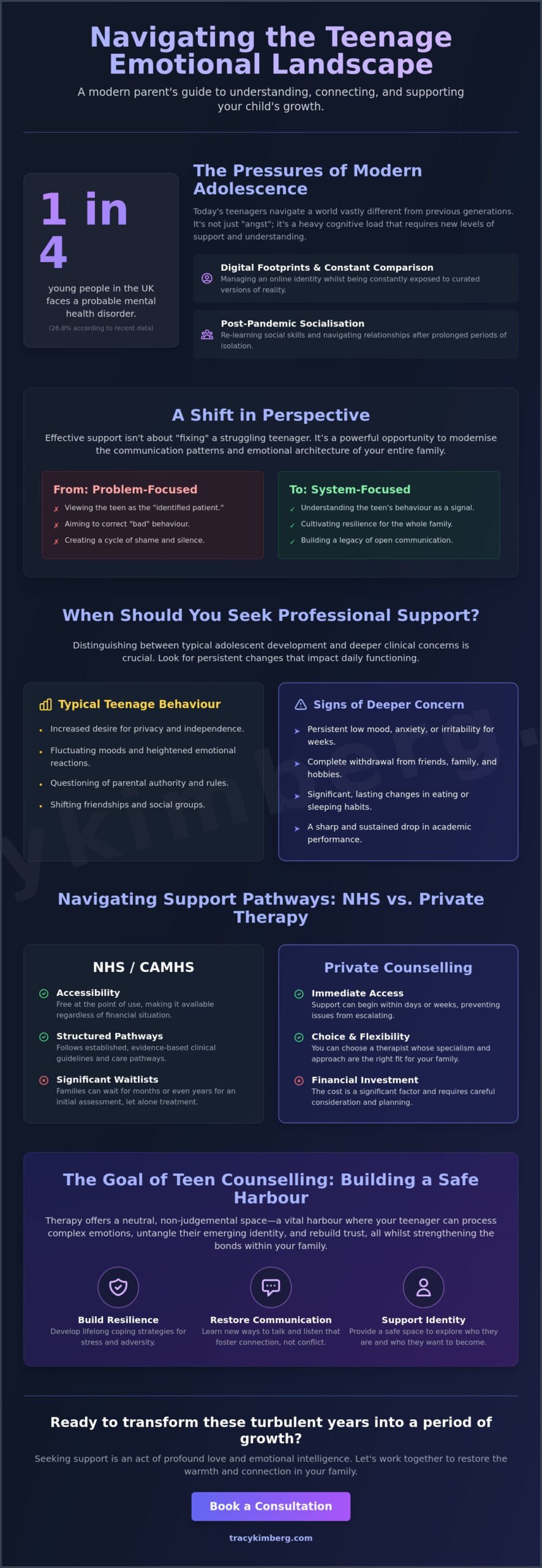
What if your teenager’s sudden silence or explosive outbursts aren’t a sign that you’ve failed as a parent, but a signal that the emotional architecture of your home is ready for an upgrade? It’s incredibly painful to feel shut out by the child who used to tell you everything. You might be watching them struggle with anxiety or low mood, feeling the weight of a two-year NHS waitlist pressing down on your family’s hope. Seeking professional counselling for teenagers isn’t just about addressing a crisis; it’s about modernising how you connect during this vital transition. You aren’t alone in this worry. With 26.8% of young people in the UK now facing a probable mental health disorder, the pressure on parents has never been higher.
I promise that therapeutic support can help your child build resilience whilst restoring the warmth and communication you thought was lost. We’ll explore how therapeutic insight can transform these turbulent years into a period of profound growth. You will discover how to manage these emotional challenges with empathy, gaining practical tools to handle outbursts and strengthen the vital bonds within your family.
Key Takeaways
- Learn why the adolescent brain’s unique neuroplasticity makes this stage a powerful window for lasting emotional healing and identity formation.
- Discover how professional counselling for teenagers can shift the focus from “fixing” a child to modernising the communication patterns within your entire family unit.
- Gain clarity on the practical differences between NHS pathways and private therapy to help you navigate your child’s support options with confidence.
- Identify the subtle behavioural shifts that distinguish typical teenage angst from deeper clinical concerns requiring specialised intervention.
- Understand how a warm, non-judgemental therapeutic environment can provide a safe harbour for your teenager to process complex emotions whilst rebuilding trust at home.
What is Counselling for Teenagers and Why Does it Matter Now?
Adolescence is a profound period of transformation that requires more than just parental patience; it requires a specialised environment where a young person can safely untangle their emerging identity. When we talk about counselling for teenagers, we aren’t describing a clinical “fix” for a broken child. Instead, we’re talking about providing a dedicated space where they can explore complex emotions without the fear of hurting or disappointing their parents. It’s a sanctuary for the “unspoken,” where the messy transition from childhood to adulthood is met with professional insight rather than just discipline.
The urgency for this support has never been greater. In 2026, our teenagers are living through a unique set of pressures that previous generations simply didn’t face. They manage permanent digital footprints and constant social comparison whilst trying to master post-pandemic socialisation. This isn’t just “angst”; it’s a heavy cognitive load. When exploring various psychotherapy approaches for adolescents, it becomes clear that this work is less about correcting a person and more about supporting their natural evolution. Their brains are currently in a state of remarkable neuroplasticity. This means that while they are vulnerable to stress, they are also at a peak window of opportunity for healing and building lifelong resilience.
Choosing to seek help isn’t a confession of parenting failure. In fact, it’s an act of high emotional intelligence. It shows you recognise that your child is becoming their own person and might need a different kind of mirror to see themselves clearly. By facilitating counselling for teenagers, you’re giving them the gift of a neutral territory to process the world.
The Evolving Adolescent Landscape
Breaking the Stigma Around Young People’s Mental Health
We often hear the phrase “they’ll grow out of it,” but “toughing it out” often leads to deeper relational fractures that persist well into adulthood. Normalising the conversation about therapy at the dinner table removes the shame that keeps many young people silent. A therapist acts as a neutral “third space,” allowing the teen to speak the unspeakable without the emotional baggage of the family dynamic interfering with their progress. It’s about creating a healthier legacy for their future relationships.
The Relational Shift: Why Teenager Counselling Involves the Whole Family
When a teenager starts to struggle, they often become the “identified patient” within the family system. It’s as if the collective stress, unspoken tensions, and transitional anxieties of the whole household are being expressed through their specific outbursts or withdrawals. This is why effective counselling for teenagers doesn’t treat the adolescent in a vacuum. Families are delicate ecosystems; when one part shifts, the entire system feels the ripple. According to global adolescent mental health facts, the emotional well-being of young people is deeply intertwined with their social environment, making the home the primary site for both conflict and healing.
Esther Perel often discusses the fundamental human tension between the need for autonomy and the need for belonging. For a teenager, this internal tug-of-war is at its most intense. They still crave the safety of the family fold, yet they are desperate to differentiate themselves and prove they can stand alone. When they pull away or “shut you out,” it isn’t necessarily an act of hostility. Often, it’s a misguided attempt to protect their developing self from being overwhelmed by parental expectations. By choosing to engage in this process, you can improve parent-child relationship dynamics by learning to honour their need for space whilst maintaining your presence.
Connection Over Correction
Gabor Maté reminds us that attachment remains the primary need of the teenager, even when they act like it’s the last thing they want. When behaviour becomes challenging, our parental instinct is often to correct, punish, or tighten control. However, this usually creates more distance. Counselling for teenagers helps parents move away from punitive measures and toward curious engagement. The goal is to remain a “secure base.” This allows your teen to explore their world and test boundaries, knowing they have a safe, non-judgemental harbour to return to when they inevitably falter.
Understanding the Language of Behaviour
We have to learn to translate the signals. Often, “acting out” is actually a favour the teenager does for the family; they are flagging hidden tensions or systemic stresses that the adults might be ignoring. Anger, silence, and defiance are frequently just underlying requests for help that they don’t yet have the vocabulary to express. A teen’s behaviour is their most honest, albeit messy, form of communication. If you’re struggling to decode what’s happening in your home, exploring professional therapeutic support can help you find the words that have been missing.
Choosing the Right Support: NHS vs. Private Therapy vs. Online Platforms
Deciding how to access support is often the first hurdle for parents. In the UK, the landscape of counselling for teenagers is diverse, ranging from state-funded services to private practices and digital platforms. Each route offers a different rhythm and level of intensity. Whilst the NHS provides a vital safety net, the current demand is unprecedented. As of April 2026, over 90,000 under-18s in England have been waiting for more than two years for their first contact with specialist community mental health services. For a family in the middle of a crisis, these timelines can feel like an eternity.
Private therapy offers an alternative defined by immediacy and consistency. It allows for a deeper “therapeutic alliance,” which is the professional term for the chemistry and trust between the teen and their therapist. This connection is the single most significant predictor of a positive outcome. Online counselling for teens UK has also become a popular choice, offering a sense of safety for digital natives who might find a physical consulting room intimidating. However, for many, the physical presence of a therapist provides a grounding “holding environment” that a screen cannot fully replicate. The right choice depends on your child’s temperament and the urgency of their needs.
The Reality of CAMHS and NHS Waitlists
The pressure on state services means that many young people only receive help once they reach a point of acute crisis. Between December 2025 and February 2026, approximately 70% of children with mental health needs waited longer than four weeks for care. This “wait and see” approach can be detrimental to a teenager’s development, as emotional patterns can become more entrenched over time. Early intervention is the most effective way to prevent these challenges from evolving into more complex adult issues. It’s about catching the spark before it becomes a forest fire.
The Private Practice Advantage
In a private setting, the work isn’t restricted by clinical protocols or limited session numbers. We can create bespoke programmes that evolve as your teenager grows. This flexibility also allows us to support the parents. Often, the most profound shifts happen when parents engage in individual relationship counselling alongside their child’s sessions. This dual approach ensures that the “safe harbour” of the therapeutic space extends back into the home, providing a consistent environment for healing. Choosing counselling for teenagers through a private practice means you are investing in a dedicated, long-term partner for your family’s emotional health.
Recognising the Signs: When to Seek Professional Support
Parenting a teenager is a profound lesson in the art of letting go, but knowing when the distance they’re creating is a healthy step toward independence or a silent cry for help is difficult. It is a delicate balance. You don’t want to pathologise every mood swing, yet you cannot afford to miss the quiet signals of distress. Statistics show that over 30% of teenage girls and 18% of teenage boys in the UK now report clinically significant symptoms of anxiety, depression, or eating disorders. These aren’t just abstract figures; they represent children struggling to carry the weight of their world. Recognising when to seek counselling for teenagers starts with observing the persistence of their behaviour rather than just the intensity of a single moment.
Normal “teenage angst” is often loud, reactive, and fleeting. It is the slammed door that opens an hour later because they’re hungry. Clinical anxiety or depression feels different; it has a heavy, stagnant quality. Academic pressure in 2026 often acts as a catalyst, especially with the constant digital comparison young people face. Whilst nearly six million children in England can now access mental health support in schools, the pressure to perform remains a significant burden. If your child seems “stuck” in their sadness or fear, it is a signal that the architecture of their internal world needs professional support to rebuild.
The Checklist for Parents: What to Look For
Look for shifts that feel out of character and, crucially, seem to last. This isn’t about a bad weekend; it is about a change in their fundamental vitality. Key indicators include:
- Persistent withdrawal: This goes beyond wanting privacy. It is a loss of interest in their favourite hobbies or a refusal to engage with friends they once adored.
- Biological disruptions: Significant changes in sleep patterns, a sudden loss of appetite, or a noticeable decline in personal hygiene.
- Emotional flatness: A “muted” quality to their personality where they seem neither happy nor sad, but simply disconnected.
- Academic decline: A sudden, sustained drop in performance that suggests they’ve given up on the things that used to matter.
Starting the Conversation with Your Teen
The way you approach this conversation determines whether they see therapy as a lifeline or a punishment. Avoid suggesting they are “broken” or “crazy.” Instead, use “I” statements to express your observations with warmth. You might say: “I’ve noticed you haven’t seemed yourself lately, and I’m worried that you’re carrying a lot on your own. I’d love to help you find a space where you can talk about that without feeling judged.” By positioning the therapist as a neutral ally, you remove the pressure of them having to “protect” you from their pain. If you feel the communication in your home has reached a standstill, you can book a consultation to explore how we can bridge that gap together. Starting counselling for teenagers is a proactive step that honours their growth whilst securing their future well-being.
The Tracy Kimberg Approach: A Safe Harbour for Young Minds
My philosophy is built on the belief that therapy shouldn’t feel like a clinical transaction; it should feel like a collaborative adventure into the self. When providing counselling for teenagers, I strike a delicate balance between rigorous clinical expertise and a warm, non-judgemental environment that demystifies the therapeutic process. By integrating the research-based insights of the Gottmans with the systemic wisdom of Esther Perel, I help young people manage the tension between their need for individual autonomy and their desire for family belonging. Whether we meet through online therapy or face-to-face sessions, the goal remains the same: a more resilient teenager and a more connected, harmonious home.
Transformational Programmes for Adolescents
Adolescence is often the stage where the cracks in the family foundation become most visible. I work extensively with teenagers processing the fallout of conscious separation, helping them manage the complex grief and loyalty conflicts that often arise when parents part ways. My programmes are tailored to address the roots of anxiety and depression, providing young people with “emotional toolkits” that serve them long into adulthood. By honouring the teen’s unique voice, we create a path to recovery that feels authentic to them, rather than a one-size-fits-all clinical protocol.
Your Next Steps Toward Healing
The first step is often the hardest, but I aim to make it as simple and supportive as possible. Our initial connection is an invitation to a supportive conversation where we can explore the challenges your family is facing without judgement. In our first session, we’ll discuss what your teenager needs to feel safe and what you, as a parent, hope to see change. This is the beginning of a proactive journey toward emotional health. I invite you to book a consultation to begin your teenager’s journey to emotional well-being. Together, we can transform this turbulent time into a period of profound growth and restored connection.
Building a Bridge to Your Teenager’s Future
The transition from childhood to adulthood doesn’t have to be a period of permanent fracture within your home. By reframing these challenging years as a window for profound emotional growth, you can move away from the frustration of silence and toward a deeper, more resilient connection. We’ve explored how counselling for teenagers serves as a vital “third space” where identity is forged and family bonds are modernised rather than broken. Whether you are navigating the complexities of academic pressure or the emotional fallout of a family transition, remember that seeking help is an act of courage that honours your child’s emerging self.
As a specialist in relationship and teenager dynamics, I utilise research-based methods from the Gottman Institute and Esther Perel to create a safe, non-judgemental environment for your family. This work is a proactive adventure into emotional well-being that provides your child with tools for a lifetime. I invite you to book a consultation with Tracy Kimberg to support your teenager’s mental health. There is hope for a calmer, more communicative home; let’s begin that journey together today.
Frequently Asked Questions
How do I know if my teenager actually needs counselling or if it is just a phase?
Distinguishing between developmental shifts and clinical needs depends on whether the behaviour is persistent and disruptive to their daily life. If your child has struggled to maintain friendships, attend school, or find joy in any activities for over two weeks, it is likely more than a phase. Counselling for teenagers provides a safe space to explore these patterns before they become more deeply ingrained in their personality.
What happens if my teenager refuses to attend the counselling sessions?
If your child refuses to attend, you can still begin the process by attending a session yourself to explore the family dynamic. Often, when parents change how they interact with their teen, the adolescent eventually feels safe enough to join the conversation. Forcing them usually creates more resistance; instead, we focus on lowering the emotional temperature in the home first to invite their participation.
Is teenager counselling confidential, or will the therapist tell me what they say?
Confidentiality is the cornerstone of the therapeutic relationship, meaning what your child says stays in the room unless there is a risk of harm to themselves or others. I will provide you with general themes and progress updates, but I won’t share specific details without their consent. This privacy is essential for them to develop the trust needed to speak their truth openly.
How long does the therapeutic process usually take for a young person?
The length of the process depends entirely on the complexity of the challenges, but most families notice a positive shift within six to twelve sessions. Some young people benefit from short-term support to navigate a specific transition, whilst others require a longer-term engagement to process deeper trauma or persistent anxiety. We regularly review our progress to ensure the work remains purposeful and effective.
Can online counselling be as effective as face-to-face therapy for teens?
Online sessions are often highly effective for teenagers because they are “digital natives” who feel naturally comfortable communicating through a screen. It can lower the barrier to entry for those who feel anxious about entering a formal office. Whilst face-to-face therapy offers a specific physical presence, online counselling for teenagers provides flexibility and a sense of safety in their own familiar environment.
How can I support my teenager whilst they are going through the therapy process?
You support your teenager best by becoming a “secure base” who listens with curiosity rather than jumping to “fix” their problems. Allow them the space to process their sessions without interrogation or pressure to share what happened. Your role is to provide the warmth and stability they need to return to after doing the difficult emotional work of therapy.
Will the therapist judge my parenting or blame me for my child’s struggles?
Therapy is a non-judgemental space where we look at the family as a system rather than assigning blame to any individual. My role is to act as a wise guide, helping you understand the “why” behind the behaviour so we can work together toward a solution. We focus on progress and healing rather than dwelling on past parenting choices.
What is the difference between a school counsellor and a private therapist like Tracy Kimberg?
School counsellors are wonderful resources but are often limited by short-term contracts and very high student volumes. A private therapist offers a bespoke, consistent relationship that isn’t tied to the school environment or academic records. This allows for deeper systemic work, including sessions that involve parents and a focus on long-term relational health that extends far beyond the classroom.

Article by
Tracy Kimberg
Tracy Kimberg is a Relationship Expert, Couples Therapist and Coach with a dedicated focus on helping couples and individuals rebuild connection, trust and emotional safety in their relationships. Drawing on the research of John and Julie Gottman, the relational insights of Esther Perel, and years of hands-on therapeutic experience, Tracy offers a warm, non-judgemental and deeply compassionate approach to modern relationships. Based in Dorset, Tracy works with couples navigating communication breakdowns, betrayal, intimacy challenges, separation, family dynamics and life transitions. Known for creating a safe and grounded therapeutic space, she combines practical tools with emotional depth to help clients move beyond survival patterns and towards meaningful, lasting change. With a reputation for empathy, professionalism and dedication to her clients’ growth, Tracy is passionate about helping people feel seen, understood and empowered — both within their relationships and within themselves.
Disclaimer
Disclaimer: The information shared in this article is intended for educational and informational purposes only and should not be considered a substitute for professional therapeutic, psychological, medical or legal advice. Every individual and relationship is unique, and the perspectives offered are based on general therapeutic principles, research and professional experience. Reading this article does not establish a therapist-client relationship with Tracy Kimberg. If you are experiencing significant emotional distress, relationship crisis, trauma, or mental health concerns, it is important to seek support from a qualified professional appropriate to your individual circumstances. All content remains the intellectual property of Tracy Kimberg and may not be reproduced or distributed without permission.