

Couples therapy is not a repair shop where you drop off a “broken” partner for fixing; it is a laboratory for relational literacy that requires your active, individual accountability. It’s a common experience to feel a sense of trepidation before your first session, perhaps worrying about being “ganged up on” or fearing that you’ll simply reopen old wounds without finding a way to heal them. If you’re wondering how to make the most of couples therapy, you’re already taking the first step toward a more conscious and connected partnership. It’s perfectly normal to feel anxious about the process, especially when the stakes for your heart and home feel so high.
This guide will help you navigate that uncertainty by providing a clear roadmap for engagement. You’ll discover how to transform your relationship by mastering the specific mindset and preparation required to move beyond conflict and toward restored emotional intimacy. We will explore the practical ways you can show up for each other, ensuring that your time in therapy becomes a proactive adventure in healing rather than just a clinical necessity. By the end of this article, you will have the tools to turn your sessions into a foundation for lasting, positive change.
Key Takeaways
- Shift your focus from “fixing” your partner to healing the relationship system, allowing for a collaborative rather than confrontational approach to growth.
- Discover how to make the most of couples therapy by identifying your repetitive cycles and shared goals before you even step into the consulting room.
- Learn why the time between sessions is your real “performance” and how to use micro-connections to bridge the gap in your daily life.
- Apply research-based methods to neutralise contempt and foster erotic intelligence, keeping your connection vibrant amidst the routines of domesticity.
- Understand the value of a structured journey, such as a 12-Week Relationship Recovery Process, to ensure your progress is both measurable and sustainable.
Understanding the Mindset: Shifting from ‘Fixing’ to Healing
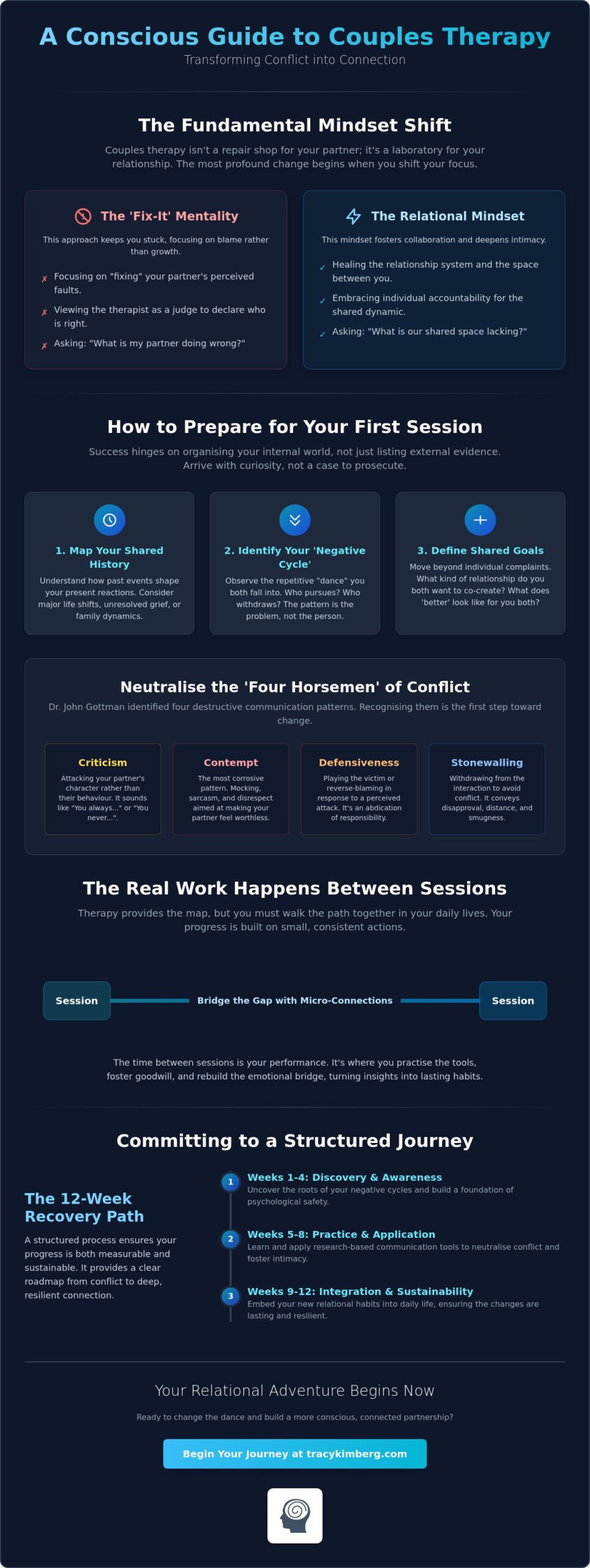
Many couples arrive at their first session with a secret hope; they want the therapist to finally tell their partner why they are wrong. This “fix-it” mentality is often the biggest hurdle to genuine progress. To understand how to make the most of couples therapy, you must first realise that you aren’t there to change your partner. You’re there to change the dance you’ve both been doing. Couples therapy is a collaborative process where the relationship itself, rather than either individual, is the primary client in the room.
When you shift your focus from individual faults to the relationship system, you begin to see that your conflicts aren’t just about who forgot to do the washing or a tone of voice used during breakfast. They are often symptoms of a fractured connection. Focusing on your own behaviour is the most powerful lever for change whilst in therapy. It’s the only part of the dynamic you have total control over. By changing your steps, you force the entire dance to evolve.
Adopting a Relational Mindset
In a relational mindset, the question shifts from “What is my partner doing wrong?” to “What is the space between us lacking?” We often become so consumed by our partner’s perceived failures that we lose sight of our own contribution to the cycle. Relational literacy is the ability to see one’s own role in a conflict loop. When you stop acting as a prosecutor and start acting as a co-creator of your shared environment, the atmosphere in the room changes from one of defence to one of discovery.
The Myth of the Neutral Judge
It’s common to view the therapist as a “judge and jury” who will eventually declare a winner. However, a skilled therapist isn’t there to validate your side or shame your partner. They are there to facilitate a deeper connection. If you spend your time seeking validation for your perspective, you might win the argument but lose the intimacy. You must be open to hearing difficult truths about your own relational patterns. This can feel exposing, yet this vulnerability is exactly where healing begins.
Discomfort is often a sign of progress, not a reason to retreat. When things feel “messy” or emotionally taxing, it usually means you’re touching on the raw, honest material that needs to be processed. Learning how to make the most of couples therapy involves staying in that discomfort long enough to understand what it’s trying to teach you about your needs and your partner’s fears. Growth doesn’t happen in the comfort zone; it happens when we’re brave enough to look at ourselves with compassion and a willingness to do things differently.
How to Organise Your Thoughts Before Your First Session
Entering the therapy room for the first time can feel like walking onto a stage without a script. You might feel a frantic need to document every grievance or every “he said, she said” moment from the last few years. However, if you want to know how to make the most of couples therapy, the secret lies in organising your internal landscape rather than your external evidence. Scientific reviews on the effectiveness of couple therapy suggest that success often hinges on the couple’s ability to engage with the process early and with clear, shared intentions.
Gathering your history is about more than just listing dates. It’s about understanding how significant life transitions or past traumas inform your current behaviour. As experts like Gabor Maté suggest, our past isn’t just behind us; it’s often living within our present reactions. Consider these areas before your session:
- Major life shifts like career changes, relocations, or the transition to parenthood.
- Unresolved grief or family-of-origin dynamics that still trigger a response.
- Significant health challenges that have altered the relationship balance.
Identifying Your ‘Negative Cycle’
Most couples are trapped in a repetitive “dance” where one person pursues and the other withdraws. When you prepare for your first session, try to observe this cycle with curiosity. Do you notice your heart racing or your jaw tightening during an argument? These physical cues are indicators of the “Four Horsemen” identified by John Gottman: criticism, contempt, defensiveness, or stonewalling. By identifying these patterns beforehand, you move the conversation away from “what happened” to “how we react,” which is the true territory of healing.
Establishing Shared Intentions
It’s vital to reflect on what a successful outcome looks like for the partnership. Success isn’t simply the absence of conflict; it’s the presence of connection and safety. Whilst you work on shared goals, don’t ignore the personal triggers that you bring to the table. Sometimes, individual relationship counselling can be a powerful adjunct to couples work. It allows you to unpack your own history without your partner feeling the need to defend themselves. When both partners feel they have agency in the decision to attend, the therapy room becomes a space of mutual growth. If you feel ready to explore these dynamics, reaching out for professional relationship coaching can provide the structure you need to begin.
The real transformation doesn’t happen on the therapist’s sofa. It happens in the kitchen, the car, and the quiet moments before sleep. If the 50-minute session is the rehearsal, then the week in between is the performance. Understanding how to make the most of couples therapy requires a shift in perspective. You aren’t just attending an appointment; you’re engaging in a continuous process of neurological rewiring. Every time you choose a “micro-connection”—a six-second kiss or a genuine “how was your day?”—you are building new pathways for intimacy.
Therapeutic homework isn’t a set of chores. It’s a structured way to practice the skills you’ve discussed in a safe, familiar environment. These rituals of affection act as emotional deposits, creating a buffer for the moments when things inevitably get difficult. By intentionally choosing connection, you’re telling your partner that the relationship is worth the effort.
The Importance of Integration
The transition from the therapist’s office back into daily life can be jarring. Many couples find it helpful to take brief notes during or immediately after a session to reflect on throughout the week. This keeps the insights fresh and actionable. Implementing a “24-hour rule” is also vital. Agree not to discuss sensitive or heavy topics raised in the room for at least a day. This allows the nervous system to settle and prevents a “therapy hangover.” Use the session as a safe container to fix communication in a relationship, rather than trying to force a resolution the moment you get home.
Navigating Conflict Between Sessions
Conflict will still happen whilst you’re in treatment. The goal isn’t to eliminate it immediately, but to handle it without “re-breaking” the bond. When reactivity feels too high to manage alone, implement a formal “time-out.” This isn’t a withdrawal; it’s a mutual agreement to pause for at least twenty minutes to let your heart rates return to baseline. When your physiology is calm, you can think clearly again.
When you do re-engage, practice a “softened start-up.” This involves stating your feelings and a positive need without blame. Instead of saying “You always ignore me,” try “I’m feeling a bit lonely and I’d love to spend some time together.” This subtle shift from criticism to curiosity is a hallmark of the Gottman Method. It keeps the dialogue open and prevents the defensive walls from rising. By focusing on the “we” instead of the “me,” you turn every disagreement into an opportunity for deeper understanding.
Deepening the Connection: Using Research-Based Methods
To truly understand how to make the most of couples therapy, one must look beyond the immediate arguments to the scientific frameworks that govern our hearts. We often feel lost in a forest of resentment, but research-based methods like the Gottman Method provide a compass. John Gottman’s work highlights that contempt is the greatest predictor of relationship failure. In therapy, we don’t just stop the eye-rolling; we neutralise the underlying belief that one partner is superior to the other.
Similarly, Gabor Maté’s insights remind us that our adult dynamics are often echoes of our earliest attachments. When your partner reacts with what seems like disproportionate intensity, it’s rarely just about the current moment, whilst it may feel that way. It’s often a trauma-informed response to a historical wound. Recognising this allows you to see your partner’s struggle with compassion rather than as a personal attack. This shift in perspective is essential for anyone learning how to make the most of couples therapy.
Embracing Vulnerability and Insight
Most of us lead with “hard” emotions like anger or blame because they feel protective. However, these emotions act as a wall, preventing the very connection we crave. To move forward, you must learn to share “vulnerable” feelings. Instead of saying “You’re always late and it’s disrespectful,” try expressing the loneliness or fear that sits beneath the surface. When you share the understated need, the desire to feel prioritised or safe, you give your partner a chance to step toward you rather than away.
Reclaiming Intimacy and Desire
As Esther Perel eloquently argues, the very things that provide security in a relationship, predictability and closeness, can sometimes stifle desire. We find ourselves in the “roommate phase,” where the passion of the early days has been traded for domestic stability. Reclaiming your connection involves balancing the need for safety with the need for mystery and autonomy. You must consciously reintroduce playfulness and recognise that your partner is a separate person with their own internal world.
This process becomes even more critical when trust has been shattered. For those navigating couples therapy for infidelity, the path to rebuilding involves both radical honesty and a commitment to creating a “second” relationship that is stronger than the first. If you’re ready to move from survival to thriving, you can book a consultation for relationship counselling to start your recovery journey today.
Committing to the Journey: The 12-Week Recovery Path
Healing a relationship is rarely a linear process; it’s a series of intentional shifts. Whilst many couples fear that therapy will become a permanent fixture in their diaries, the most effective work often happens within a structured framework. If you’re looking for how to make the most of couples therapy, moving away from open-ended “chat” therapy toward a goal-oriented programme is often the turning point. This structure prevents the sessions from devolving into a weekly venting of grievances, instead focusing on deep, transformational change.
The 12 week relationship recovery process is designed to guide you through specific phases of repair. It begins with immediate crisis stabilisation, moves into intensive skill-building, and concludes with future-proofing your connection. This roadmap ensures that you aren’t just managing symptoms but are fundamentally altering the way you relate to one another. Knowing there is a clear beginning, middle, and end to the “intensive” phase can provide immense psychological relief for partners who feel they’ve been treading water for years.
Why Structure Matters in Crisis
When a relationship is in high conflict, the world feels chaotic. A 12-week framework provides a necessary sense of safety and containment. It acts as a vessel for the intense emotions that have likely been overflowing. By committing to a time-bound process, you and your partner agree to stay in the room even when things get difficult. This commitment allows you to move beyond surface-level repairs and tackle the systemic issues that keep you stuck in repetitive loops. It’s about transformational programmes rather than just symptom management.
From Crisis to Conscious Growth
Transitioning from “repair” to “maintenance” is a significant milestone. You’ll know you’re ready when the tools you’ve learned—like the softened start-up or micro-connections—become your default behaviour rather than a forced exercise. This is the point where you begin building a “Relationship House” that can withstand future life stressors. It’s no longer about putting out fires; it’s about designing a shared life that feels vibrant and secure.
Even after formal therapy concludes, the journey continues. Regular “check-ins” are essential to ensure that old habits don’t quietly resurface amongst the busyness of life. View your relationship health as an ongoing adventure rather than a clinical necessity. By treating your partnership as a proactive investment, you ensure that your connection with your favourite person remains a source of strength. Ultimately, how to make the most of couples therapy is about taking the insights from the room and weaving them into the very fabric of your daily life.
Your Relational Adventure Begins Now
Relationships don’t thrive on autopilot; they require the conscious tending of two people willing to look inward. By shifting your focus from individual blame to the health of your shared system, you’ve already begun the work of transformation. Remember that the insights gained in our sessions are merely the seeds. The real growth happens when you water them through daily micro-connections and rituals of affection whilst navigating the complexities of domestic life. Embracing a structured approach allows you to move past the weight of old patterns and into a future defined by emotional safety and renewed desire.
Learning how to make the most of couples therapy is an investment in your favourite person and your future self. As a UK-based expert with a global online reach, I specialise in Gottman and Perel methodologies to help you navigate these complex emotional landscapes. Whether you are in the midst of a crisis or simply want to deepen your bond, there is always a path forward.
For readers seeking professional support in California, you can find out more about the mental health services offered by Hope Therapy Center.
If you’re ready to move from repair to a vibrant, conscious partnership, I invite you to book a consultation for the 12-Week Relationship Recovery Process. Your journey toward lasting relational change is not just a clinical necessity; it’s a proactive and positive adventure that starts today.
Frequently Asked Questions
How long does couples therapy typically take to show results?
Most couples start to notice tangible shifts in their communication patterns within 8 to 12 sessions. Research into Emotionally Focused Therapy suggests that approximately 70-73% of couples move from distress to recovery within this timeframe. However; deeper relational healing often requires a longer commitment to integrate these new behaviours into your daily life. The pace depends entirely on your willingness to engage with the process outside the room.
What if my partner is reluctant or refuses to attend sessions?
You can still begin the journey by attending individual relationship counselling to explore your own role in the relational system. Often, when one partner changes their “dance steps” and starts responding with more curiosity and less reactivity, the other partner becomes more open to joining the process. Change in one person inevitably forces the entire relationship dynamic to shift, creating a new opening for collaborative healing.
Is it normal to feel worse after the first few sessions of therapy?
It’s entirely normal to feel a temporary increase in tension after the first few sessions of therapy. This “therapeutic dip” occurs because you’re finally speaking the unspoken and bringing hidden resentments into the light. Whilst it feels challenging, this discomfort is often a sign of progress. It indicates that you’re finally touching on the raw material that needs to be healed to create lasting change.
Can couples therapy work if there has been infidelity or a total loss of trust?
Relational healing is possible even after a major breach of trust, provided both partners are committed to a trauma-informed recovery process. Rebuilding involves radical honesty from the partner who strayed and a willingness to explore the “why” behind the breach. Many couples find that their “second relationship”, the one built after the crisis, is far stronger and more transparent than the one they had before.
What is the difference between relationship coaching and traditional counselling?
Relationship coaching is typically more future-focused and goal-oriented, whereas traditional counselling often dives deeper into past traumas and family-of-origin dynamics. Coaching provides a structured roadmap for how to make the most of couples therapy by giving you practical tools to use immediately in your daily interactions. Both approaches are valuable and frequently overlap in a holistic recovery process, ensuring you have both insight and action.
How do we choose the right therapist for our specific relationship challenges?
Choose a therapist who specialises in evidence-based models like the Gottman Method and whose personality feels like a secure “fit” for both partners. It’s essential that neither of you feels judged or misunderstood during the process. Most specialists offer an initial consultation to ensure their expertise aligns with your specific challenges, such as navigating significant life transitions or entrenched high-conflict cycles that feel impossible to break alone.
Will the therapist tell us if we should just get a divorce?
A therapist’s role is not to tell you whether to stay or go but to provide the clarity you need to make that choice yourselves. They act as a compassionate mirror, reflecting the health of your dynamic and helping you decide if you both have the capacity to do the work. If a separation is chosen, a therapist can facilitate a conscious approach to ensure the transition is handled with dignity.
How much ‘homework’ should we expect to do between sessions?
You should expect to spend about 15 to 30 minutes each day practising specific communication exercises or micro-connections. This consistent, active engagement is a key part of how to make the most of couples therapy and ensures your new skills become second nature. The most significant growth happens in these quiet, daily moments where you intentionally choose to lean toward your partner instead of pulling away.

Article by
Tracy Kimberg
Tracy Kimberg is a Relationship Expert, Couples Therapist and Coach with a dedicated focus on helping couples and individuals rebuild connection, trust and emotional safety in their relationships. Drawing on the research of John and Julie Gottman, the relational insights of Esther Perel, and years of hands-on therapeutic experience, Tracy offers a warm, non-judgemental and deeply compassionate approach to modern relationships.Based in Dorset, Tracy works with couples navigating communication breakdowns, betrayal, intimacy challenges, separation, family dynamics and life transitions. Known for creating a safe and grounded therapeutic space, she combines practical tools with emotional depth to help clients move beyond survival patterns and towards meaningful, lasting change.With a reputation for empathy, professionalism and dedication to her clients’ growth, Tracy is passionate about helping people feel seen, understood and empowered — both within their relationships and within themselves.
Disclaimer
Disclaimer:The information shared in this article is intended for educational and informational purposes only and should not be considered a substitute for professional therapeutic, psychological, medical or legal advice. Every individual and relationship is unique, and the perspectives offered are based on general therapeutic principles, research and professional experience.Reading this article does not establish a therapist-client relationship with Tracy Kimberg. If you are experiencing significant emotional distress, relationship crisis, trauma, or mental health concerns, it is important to seek support from a qualified professional appropriate to your individual circumstances.All content remains the intellectual property of Tracy Kimberg and may not be reproduced or distributed without permission.