

What if suggesting therapy wasn’t an admission of failure, but a brave invitation to build a more resilient bond? You might be feeling exhausted by circular arguments that leave you drained, or perhaps you’re quietly grieving the loss of closeness whilst sitting right next to your partner. It’s deeply painful to feel like the only one trying to save the relationship. If you’re wondering how to convince my partner to go to therapy, you aren’t alone in your anxiety; it’s a vulnerable request that requires immense care and a shift in perspective.
We agree that the fear of a defensive reaction or a partner feeling blamed often keeps us silent, yet staying silent only allows the distance to grow. This guide promises to help you navigate this delicate conversation using research-backed methods that foster connection rather than conflict. We’ll explore how to reframe therapy as a shared project and an investment in your future, moving away from the idea of fixing a broken person and toward a clear, compassionate path for healing your partnership together.
Key Takeaways
- Understand that your partner’s resistance is often a mask for a deep-seated fear of inadequacy or being cast as the “bad guy” in the room.
- Learn how to convince my partner to go to therapy using a “Softened Start-up,” which focuses on your own feelings and positive needs rather than their perceived failings.
- Discover why a structured, time-limited coaching programme can feel significantly less threatening than open-ended clinical treatment for a reluctant partner.
- Identify how to navigate the “Pursuer-Distancer” trap and maintain your own emotional well-being whilst respecting your partner’s current boundaries.
- Explore how a 12-Week Relationship Recovery Process offers the safety and predictability needed to turn a difficult conversation into a shared investment in your future.
The Silent Barrier: Why Partners Often Resist the Idea of Therapy
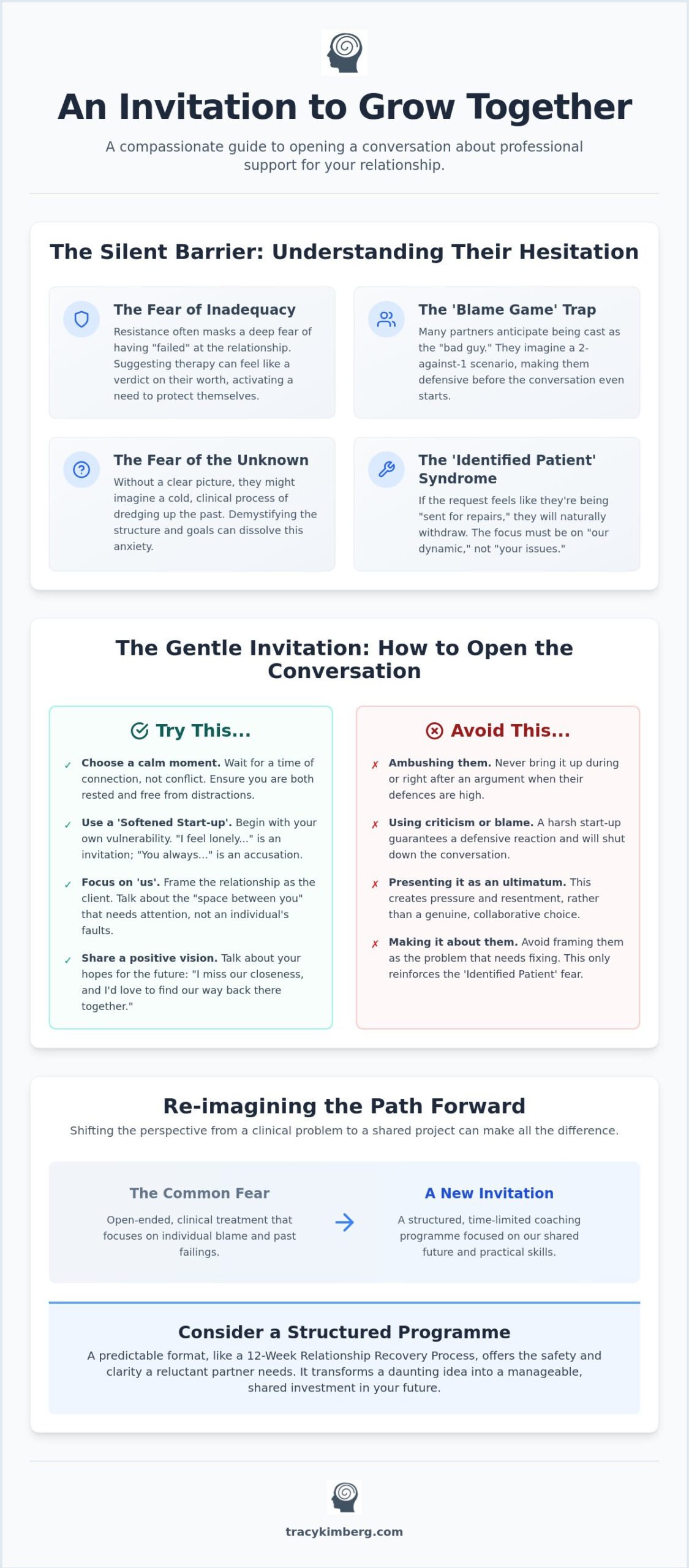
When you suggest professional support, you might be met with a wall of silence or a sharp retort. It’s easy to feel rejected. However, resistance is rarely about a lack of love. It’s often a secondary behaviour masking a primary fear of inadequacy. Your partner isn’t necessarily rejecting the relationship; they’re likely protecting themselves from the perceived shame of “failing” at it. In our culture, the traditional British “keep calm and carry on” mentality still lingers. We’re taught to handle our problems behind closed doors. For a partner raised with this ethos, opening up to a stranger feels like a betrayal of privacy. They see therapy as a clinical necessity for a broken bond, rather than a proactive adventure for a growing one.
The “Blame Game” is another significant hurdle. Most people who resist therapy expect to be cast as the “bad guy” in the room. They imagine a scenario where you and the therapist team up to list their flaws. This fear of being judged makes them defensive before the conversation even begins. By understanding these psychological undercurrents, you can begin to see why your initial attempts at discussing how to convince my partner to go to therapy might have stalled. It isn’t just about the session; it’s about the safety of their identity within the relationship.
The Fear of the Unknown
Much of the resistance stems from a simple lack of clarity. Your partner might imagine a cold, sterile environment where they’re forced to dredge up childhood traumas without a clear purpose. It’s helpful to clarify What is couples therapy? in a modern context. Modern relationship work isn’t about individual “venting” or finding fault. It’s a systemic approach that looks at the space between you. Demystifying the process by explaining that it’s a structured, forward-facing programme can lower the stakes significantly. When the process feels manageable and transparent, the anxiety of the unknown starts to dissolve.
The ‘Identified Patient’ Syndrome
Sometimes, the way we ask for help reinforces the very wall we’re trying to climb. If your partner feels they’re being “sent for repairs” like a faulty appliance, they will naturally withdraw. This is known as the “Identified Patient” syndrome, where one person is framed as the problem that needs fixing. To change this, you must recognise when your own delivery is reinforcing their defensiveness. Shifting the focus from “your issues” to “our dynamic” is essential. You aren’t asking them to go to therapy to be “fixed”; you’re inviting them to collaborate on a shared project in a non-judgemental space. When the invitation is about “us” rather than “you,” the door to how to convince my partner to go to therapy begins to open.
Softening the Start-up: How to Prepare for the Conversation
The way you open a dialogue often determines how it will close. John Gottman’s research suggests that the first three minutes of a conversation are predictive of its entire outcome. If you start with a “harsh start-up,” which is often characterised by criticism or sarcasm, it is highly likely the door will slam shut before you’ve even made your point. When considering how to convince my partner to go to therapy, you must focus on “how to be” just as much as “what to say.” This involves a shift from pointing out their shortcomings to sharing your own vulnerability. By expressing your own loneliness rather than their failures, you lower the emotional stakes and invite them into a space of mutual care.
A vital part of this process is choosing the right “container.” You should never bring up the idea of professional support during or immediately after an argument. At those moments, your partner’s nervous system is likely in a state of “fight or flight,” making them physiologically incapable of processing a complex emotional request. Instead, wait for a moment of connection and calm. When you frame the relationship as the “client,” rather than either individual person, it removes the weight of blame. You aren’t asking them to change; you’re asking to work together on the dynamic that exists between you.
Setting the Stage for Success
Success begins with intentionality. Identify a neutral time when stress levels are low and you are both well-rested; perhaps a quiet Sunday morning or a walk in the park. Physical proximity and eye contact are essential, so ensure phones are away and distractions are minimised. Before you speak, organise your thoughts and identify your “why.” Is it a desire for more intimacy? A hope to end the exhaustion of circular arguments? Having a clear, loving purpose helps you stay grounded if the conversation feels difficult. If you feel you need a more structured environment for these talks, exploring Relationship Counselling and Coaching for Couples can provide the professional guidance needed to keep these discussions productive.
The Language of Connection
The vocabulary you choose can either build a bridge or a wall. Replace accusatory phrases like “You need to change” or “You always do this” with “I miss our closeness” or “I want to find our way back to each other.” Use words like “support,” “growth,” and “teamwork” instead of “problems” or “issues.” It’s also incredibly powerful to express your own willingness to look at your own contributions to the dynamic. When you say, “I want to learn how I can be a better partner to you,” it signals that you are in this together. This collaborative spirit is the most effective way to help a reluctant partner see therapy as a proactive adventure rather than a clinical punishment.
Reframing the Request: Coaching vs. Traditional Therapy
For many, the word “therapy” carries a heavy, clinical weight. It suggests an open-ended journey into the past that can feel daunting for someone already feeling overwhelmed. When you’re exploring how to convince my partner to go to therapy, it’s often more effective to reframe the request as “relationship coaching.” Unlike traditional models that might focus on diagnosing dysfunction, coaching is inherently proactive. It’s about building a toolkit for the future. By positioning the professional as a guide or a coach for the partnership, you transform the experience from a medical necessity into a strategic investment in your shared happiness.
A structured, time-limited programme often feels significantly less threatening to a partner wary of a lifelong commitment. Knowing there’s a clear beginning, middle, and end provides a sense of safety and predictability. It moves the conversation away from “what’s wrong with us” and toward “how do we get where we want to be.” This shift in focus can be the turning point for a partner who values efficiency and tangible results over abstract emotional exploration. It frames the work as a project with a deadline, making it feel manageable rather than infinite.
The Appeal of Structure
A clear roadmap reduces the anxiety of the unknown. When a partner understands that there is a Step A to Step B progression, they feel less like they’re being interrogated and more like they’re participating in a joint venture. This results-driven approach appeals to the logical mind, making the invitation to connect feel like a productive use of time rather than an emotional chore. Coaching typically involves:
- Practical exercises and “homework” that make progress feel tangible.
- A focus on the “how” of communication rather than just the “why” of past conflicts.
- Defined goals that allow both of you to track your growth as a team.
Individual Relationship Counselling as a First Step
If your partner isn’t ready to join you yet, don’t lose heart. You can begin the process alone. Engaging in Individual relationship counselling allows you to work on your part of the relational dance. Relationships are systems; when one person changes their steps, the other is naturally forced to adjust theirs. Often, as you become more grounded and less reactive, your partner will notice the shift. This change in your behaviour can pique their curiosity and desire to join the process. It demonstrates that the work is about growth and connection, not blame, making the question of how to convince my partner to go to therapy a much softer one to answer over time.
What to Do When the Answer is ‘No’
Hearing a “no” can feel like the final thread of the relationship is snapping. However, respecting that boundary is the first step in rebuilding trust. If you try to force compliance through ultimatums, you might get them in the room, but you won’t get their heart or their presence. This often triggers the “Pursuer-Distancer” trap; the more you chase them for emotional engagement, the further they retreat into their shell. Instead of focusing solely on how to convince my partner to go to therapy, consider adopting a “conscious” approach. This means acknowledging their right to refuse whilst being honest about your own needs. You might say, “I respect that you aren’t ready, but I need to look at how I can support myself whilst we are in this difficult patch.”
The Power of the ‘Soft No’
It’s vital to distinguish between “not ever” and “not right now.” Often, a partner says no because they feel unsafe or overwhelmed. Ask them what would make the process feel more secure. Perhaps they would be open to a “trial session” or a fixed three-week period rather than an indefinite commitment. Giving them agency is crucial; invite them to help choose the professional or the format. Lower-barrier entry points, such as attending a masterclass or reading a specific relationship book together, can also act as a bridge. These smaller steps help you learn how to convince my partner to go to therapy by demonstrating that growth doesn’t have to be painful or punitive.
Focusing on Your Own Growth
Relationships are governed by circular causality. When one person in a system changes their behaviour, the whole system is forced to recalibrate. If your partner remains resistant, investing in Therapy for Adults can be transformative for the relationship even if you attend alone. By working on your own triggers and communication styles, you stop the old, painful patterns from repeating. This isn’t about “fixing” yourself for them. It’s about reclaiming your own wellbeing. Maintaining your own social circles and favourite hobbies ensures the relationship isn’t your only source of emotional oxygen. This often reduces the pressure on your partner and makes them more likely to step toward you.
A Path to Healing: The 12-Week Relationship Recovery Process
Once you have navigated the delicate initial conversations, the question shifts from “if” to “what.” For a partner who has been hesitant, the idea of an open-ended clinical commitment can still feel like a heavy burden. This is where Tracy Kimberg’s signature 12-Week Relationship Recovery Process offers a refreshing and manageable alternative. By framing the work as a structured three-month project rather than a lifelong treatment, you provide the predictability and safety that a resistant partner often craves. It transforms the experience into a shared investment in your future, with a clear beginning, middle, and end.
This programme isn’t just about “talking through problems.” It is a sophisticated synthesis of research-backed methods, incorporating the pioneering work of John Gottman and Esther Perel. When you are exploring how to convince my partner to go to therapy, presenting a programme with a defined roadmap can be the ultimate game-changer. It signals that there is a proven method to the work, moving beyond the fear of aimless “venting” and toward the active building of a more resilient bond. It is an invitation to a proactive adventure where the goal is a thriving partnership, not just the absence of conflict.
What to Expect from the Journey
The 12-week structure is designed to move couples through a logical and supportive progression. We begin by identifying the specific patterns of disconnect that have left you both feeling lonely or exhausted. From there, the focus shifts to rebuilding the foundation of intimacy and friendship. A central pillar of this work is the creation of a safe, non-judgemental environment where both voices carry equal weight. This ensures that neither partner feels like the “identified patient” or the “bad guy” in the room. To accommodate busy British lifestyles, sessions are available both online and face-to-face, providing the flexibility needed to prioritise your emotional health without added stress.
This flexibility is a core component of modern Mental Health Counseling and Corporate Wellbeing Programs, which are designed to support individuals and couples regardless of their location or professional commitments.
Taking the First Step Together
The chemistry between a couple and their therapist is one of the most significant predictors of a positive outcome. This is why the process typically begins with an initial conversation to ensure the fit feels right for both of you. Think of this as meeting your “Wise Guide”; this is someone who understands the complex emotional landscape of adult transitions and can navigate the path for you when you feel lost. It is a low-pressure way to demystify the experience and see if this collaborative approach resonates with your shared goals. If you are ready to move from circular arguments toward a clear path of healing, you can Discover the 12-Week Relationship Recovery Process and begin the journey of restoring your bond today.
Reclaiming Your Connection Together
Approaching the delicate terrain of inviting a partner into a therapeutic space requires patience and a shift from blame to vulnerability. You’ve learned that resistance is often a mask for fear and that by using a softened start-up, you can invite your partner into a shared project rather than a clinical trial. Whether you are reframing the request as relationship coaching or starting your own growth journey first, the goal remains the same: a stronger, more resilient bond.
If you’ve been struggling with how to convince my partner to go to therapy, remember that a structured, research-based approach offers the safety you both need. Tracy Kimberg provides a safe, non-judgemental environment inspired by the work of Gottman and Perel. With expertise in managing infidelity, anxiety, and deep emotional disconnect, she helps you move beyond circular arguments toward lasting recovery. Book a consultation for the 12-Week Relationship Recovery Process and take that first step toward a thriving partnership. Healing is possible when you choose to walk the path together.
Frequently Asked Questions
What if my partner thinks therapy is only for couples about to divorce?
Therapy is most effective when used as a proactive tool for growth rather than an emergency exit. Many couples seek support to deepen their intimacy or refine their communication whilst their bond is still strong. You can explain to your partner that professional guidance is about upgrading your shared “operating system” to prevent the very cracks that lead to separation in the first place.
Is it worth going to couples therapy if only one person wants to go?
Yes, because relationships are systems where one person’s change inevitably shifts the entire dynamic. When you learn to manage your own triggers and communicate with more clarity, the “dance” between you and your partner changes. This often creates a safer emotional climate that naturally piques your partner’s curiosity and invites them to join the process later on.
How do I respond if my partner says ‘I’m not the one with the problem’?
Gently remind them that the relationship is the client, not either individual person. When considering how to convince my partner to go to therapy, it’s vital to focus on the “space between” you. Frame the request as a desire to work on the shared dynamic and your collective happiness rather than fixing a specific person’s perceived flaws or mistakes.
Can online couples therapy be as effective as face-to-face sessions?
Online therapy is proven to be just as effective as face-to-face sessions for building connection and resolving conflict. Many couples find that being in their own comfortable environment allows them to be more vulnerable and honest. It also removes the stress of travel, making it much easier to fit into a busy British lifestyle whilst maintaining the necessary consistency.
How long does it usually take to see progress in relationship counselling?
While every couple is unique, structured programmes like the 12-Week Relationship Recovery Process are designed to show tangible progress within a specific timeframe. Many couples report a significant shift in their communication and a reduction in daily tension within the first four to six weeks. Consistency and a willingness to practice new skills between sessions are the primary drivers of success.
What should I do if my partner agrees to go but won’t talk during the session?
Trust that a skilled professional is trained to navigate silence and will never force a partner into a defensive corner. Silence is often a form of protection or a sign of feeling emotionally overwhelmed. The therapist will focus on creating a safe environment where your partner feels heard without being interrogated, allowing them to open up at their own pace.
How do we choose the right therapist together so neither of us feels ganged up on?
The best way to ensure balance is to choose a therapist who uses a research-based approach, such as the Gottman Method, which focuses on the dynamic rather than taking sides. Booking an initial consultation together allows both of you to assess the “chemistry.” This ensures the professional feels like a neutral, wise guide for the partnership rather than an ally for one person.
What are the signs that we’ve waited too long to seek professional help?
It is rarely too late if both partners retain a spark of willingness to try, but persistent contempt or total emotional withdrawal are signs that help is urgently needed. If you’ve been trapped in the same circular argument for years or feel like “roommates” rather than lovers, it is time to act. Learning how to convince my partner to go to therapy now can prevent the final erosion of your bond.

Article by
Tracy Kimberg
Tracy Kimberg is a Relationship Expert, Couples Therapist and Coach with a dedicated focus on helping couples and individuals rebuild connection, trust and emotional safety in their relationships. Drawing on the research of John and Julie Gottman, the relational insights of Esther Perel, and years of hands-on therapeutic experience, Tracy offers a warm, non-judgemental and deeply compassionate approach to modern relationships.Based in Dorset, Tracy works with couples navigating communication breakdowns, betrayal, intimacy challenges, separation, family dynamics and life transitions. Known for creating a safe and grounded therapeutic space, she combines practical tools with emotional depth to help clients move beyond survival patterns and towards meaningful, lasting change.With a reputation for empathy, professionalism and dedication to her clients’ growth, Tracy is passionate about helping people feel seen, understood and empowered — both within their relationships and within themselves.
Disclaimer
Disclaimer:The information shared in this article is intended for educational and informational purposes only and should not be considered a substitute for professional therapeutic, psychological, medical or legal advice. Every individual and relationship is unique, and the perspectives offered are based on general therapeutic principles, research and professional experience.Reading this article does not establish a therapist-client relationship with Tracy Kimberg. If you are experiencing significant emotional distress, relationship crisis, trauma, or mental health concerns, it is important to seek support from a qualified professional appropriate to your individual circumstances.All content remains the intellectual property of Tracy Kimberg and may not be reproduced or distributed without permission.