

Have you ever sat on the sofa right next to your spouse and felt as though there were an ocean between you? It’s a heavy, quiet kind of loneliness that often grows amongst the piles of laundry and the silent score-keeping of parenting duties. When every disagreement feels like a battle to be won, learning how to feel like a team in your marriage becomes the only way to stop the drift. It’s exhausting to live in a “me versus you” world whilst your heart is actually longing for deep connection.
I recognise how draining it is to feel like housemates instead of partners, constantly braced for the next conflict. You aren’t alone in this, and healing is entirely possible. This article will help you dismantle resentment and rebuild a shared “Us” identity through expert-led psychological insights. We’ll explore practical connection rituals that bring back mutual support and laughter; giving you a clear framework to handle life’s stresses as a united front. Together, we can shift the dynamic from individual survival to a partnership that feels safe, supportive, and genuinely joyful once again.
Key Takeaways
- Understand why modern stress naturally pulls couples into adversarial survival modes and how to transition back to a state of emotional attunement.
- Discover how to feel like a team in your marriage by dismantling the “scoreboard” mentality and replacing silent resentment with mutual support.
- Explore the psychology of “Shared Meaning” to build a solid foundation where both partners feel seen, heard, and deeply valued.
- Learn to implement small, daily “Rituals of Connection” that rebuild trust and intimacy more effectively than grand, infrequent romantic gestures.
- Identify when to move beyond self-help and utilise structured professional guidance, such as a 12-Week Relationship Recovery Process, to break stubborn, deep-seated patterns.
Why Marriage Often Shifts from Partnership to Adversarial Behaviour
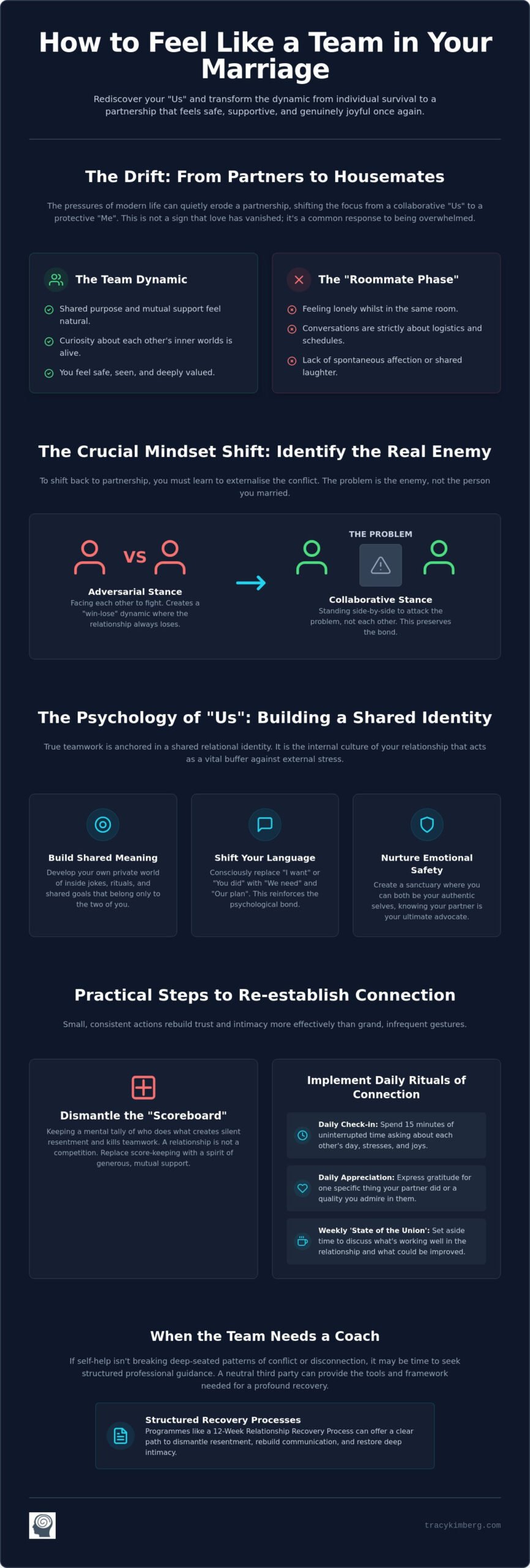
A team marriage is far more than a tidy division of labour. It’s a profound state of emotional attunement where both people feel a deep, shared sense of purpose. When you’re in sync, you move through the world with the quiet confidence that you aren’t alone. However, the pressures of daily life have a sneaky way of eroding this “Us” identity. Understanding the psychology of interpersonal relationships reveals that under stress, our brains often default to a “me-centric” survival mode. If you’re wondering how to feel like a team in your marriage again, it starts with understanding that this isn’t a sign your love has vanished; it’s a physiological response to being overwhelmed.
The “Roommate Phase” and Emotional Drift
Many couples find themselves sliding into what’s known as the “Roommate Phase”. This is where you’ve transitioned from being lovers to being co-managers of a household. You’re efficient at discussing the school run or the grocery list, but you’ve stopped being curious about each other’s inner worlds. When curiosity dies, emotional drift sets in. Common signs of this drift include:
- Feeling lonely whilst sitting in the same room.
- Conversations that revolve strictly around logistics and schedules.
- A lack of spontaneous affection or shared laughter.
External pressures like demanding careers or parenting force a shift from a collaborative “us” to a protective “me”. You start to see your partner’s needs as obstacles to your own peace, rather than shared priorities. Learning how to feel like a team in your marriage requires recognising that this drift is a common stage, not a final destination. It is a signal that your relationship needs a new set of tools, not that it’s over.
Identifying the Enemy: The Problem vs. The Partner
In the heat of a disagreement, it’s easy to view your spouse as the adversary. You keep score of who did the washing up or who stayed up late with the baby. This creates a “win-lose” dynamic where the relationship always loses. To shift back to partnership, you must learn to externalise the conflict. In a team marriage, you stand side-by-side to face the problem, rather than face-to-face to fight each other.
Whether the issue is financial strain, a difficult relative, or a lack of intimacy, the problem is the enemy, not the person you married. By standing together against the challenge, you preserve the bond and foster emotional safety. This mental shift allows you to stop attacking each other and start attacking the issues that are making life difficult. It’s the cornerstone of moving from adversaries back to partners.
The Psychology of “Us”: Building a Shared Relational Identity
To truly understand how to feel like a team in your marriage, we have to look past the chore list and the calendar. True partnership is anchored in what Dr John Gottman calls “Shared Meaning”. This is the internal culture of your relationship; the unique language, rituals, and values that belong only to the two of you. When you have a solid relational identity, your marriage becomes a sanctuary. This shared “Us” acts as a vital psychological buffer, protecting the bond when external crises, like career stress or family illness, try to pull you apart.
Esther Perel often highlights the delicate tension between our need for security and our desire for autonomy. Teamwork isn’t about losing your individuality or becoming a blurred version of your partner. Instead, it’s about creating enough emotional safety that you can both be your authentic selves whilst knowing the other person is your ultimate advocate. When you drop your guard, you stop viewing your partner’s needs as a threat to your own. You begin to realise that a win for them is a win for the relationship, and by extension, a win for you.
Moving Beyond “I” and “You” to a Conscious “Us”
Shifting your perspective requires a conscious move from individual goals to a shared relational vision. This often starts with the language you use. Replacing “I want” or “You did” with “We” and “Our” reinforces the psychological bond in subtle but powerful ways. It signals to your brain that you are no longer operating in a vacuum. When you adopt a conscious “Us” mentality, you start to recognise that your partner’s struggles are something you face together, rather than a burden they are imposing on you.
The Role of Emotional Attunement in Teamwork
Attunement is the ability to stay aware of and responsive to your partner’s inner world. It’s built through what experts call “bids for connection”. A bid can be as small as a sigh, a touch on the shoulder, or a comment about a news story. These are the building blocks of the team. When you consistently turn towards these bids, you build a massive reservoir of trust. Research into Developing Teamwork in Marriage suggests that these small, everyday interactions are actually more significant than grand romantic gestures.
If you find that the “Us” has been replaced by a persistent sense of “Me”, engaging in a structured Relationship Recovery Process can help you reclaim that lost territory and learn how to feel like a team in your marriage once again. By prioritising attunement, you ensure that neither of you has to face life’s challenges in isolation.
Dismantling the Scoreboard: Why Resentment Kills Teamwork
We’re taught from a young age that fairness is the gold standard for healthy interaction. In a marriage, however, the pursuit of “fairness” often becomes a trap that breeds deep resentment. When you find yourself mentally tallying who did the morning school run or who initiated the last three date nights, you’ve stopped being partners and started being accountants. This internal scoreboard is a clear symptom of low trust and high anxiety. It suggests a fear that you are being exploited or that your contributions aren’t being seen. If you want to know how to feel like a team in your marriage, you must first be willing to put down the ledger.
Resentment thrives in the gap between what we expect and what we experience. When one partner feels “one-up” because they’ve done more chores, they often use that perceived moral high ground as a weapon. This creates a transactional mindset where every act of service is a debt to be repaid. To move toward a transformational relationship, you have to stop asking “What have you done for me lately?” and start asking “How are we doing as a unit?”. As noted in the discussion on Building Teamwork in Marriage, shifting from a mindset of “helping” to one of “conquering together” is essential for long-term health.
The Trap of Transactional Love and Mental Tallies
Counting chores leads to an emotional deficit because it ignores the reality of invisible labour. One partner might handle the physical cleaning, whilst the other carries the mental load of school schedules and family birthdays. True teamwork isn’t about being “equal” in every task; it’s about being “equitable”. This means recognising that capacity fluctuates. Some days you give 80% and your partner gives 20%; other days, the roles are reversed. Recognising these unspoken contributions prevents the feeling of being “short-changed” and fosters a sense of mutual appreciation.
Shifting from Criticism to Vulnerable Requests
When the scoreboard feels lopsided, our instinct is to criticise. We say things like, “You never help with the kids,” which immediately puts our partner on the defensive. Dr John Gottman suggests using a “softened start-up” instead. This involves expressing a need without attacking your partner’s character. Instead of a complaint, try a vulnerable request: “I’m feeling quite overwhelmed with the evening routine, and I’d really love your support with the bedtime stories tonight.” Vulnerability is the ultimate team-building tool because it replaces the armour of defence with an invitation for connection. By showing your partner your need rather than your anger, you make it safe for them to step up as your teammate. This is a fundamental shift in how to feel like a team in your marriage, moving you from adversaries to allies.
Practical Rituals to Re-establish Connection and Shared Meaning
If you’re searching for how to feel like a team in your marriage, the answer rarely lies in a once-a-year holiday or an expensive anniversary gift. Instead, it’s found in the small, seemingly mundane “Rituals of Connection” that anchor your daily life. These rituals create a culture of appreciation, turning your home into a sanctuary rather than a battlefield. By setting firm boundaries with the outside world, you protect this “team space” from the encroachment of work emails and social obligations. It’s about prioritising the “Us” above the noise of the “Me”.
The Power of the 15-Minute Daily Connection
The most powerful ritual you can adopt is the 15-minute stress-reducing conversation. This isn’t the time to discuss the broken dishwasher or the school trip fees. To ensure this stays a positive experience, follow these specific rules:
- No Logistics: Ban all talk of chores, schedules, or “to-do” lists.
- No Fixing: Resist the urge to solve your partner’s problems. Just listen.
- Active Validation: Use phrases like “That sounds incredibly frustrating” or “I can see why you’d feel that way.”
When you listen without trying to “fix” the problem immediately, you provide the emotional support that builds massive trust. This practice ensures that even on the most hectic days, you remain attuned to each other’s inner worlds. It is a foundational step in learning how to feel like a team in your marriage by proving that you are each other’s safest harbour.
Creating Shared Goals and a Family Vision
Every successful team has a mission statement. Without one, you’re just two people living parallel lives under the same roof. Sit down together and identify your core values. Are you driven by adventure, financial security, or perhaps a commitment to community? Identifying these shared values allows you to plan for the future as a joint venture rather than separate paths. This alignment ensures that when life’s stresses hit, you aren’t pulled in opposite directions; you’re moving toward a destination you both chose.
Rebuilding these rituals can feel daunting if you’ve been in the “Roommate Phase” for a long time. If you find yourselves struggling to start, my Relationship Counselling and Coaching for Couples provides the expert, structured guidance needed to turn these concepts into lasting habits that save your partnership.
When the Team Needs a Coach: Professional Support for Your Marriage
Even with the best intentions, some relational patterns are too deeply ingrained to untangle alone. You might understand the theory of how to feel like a team in your marriage, yet find yourselves falling back into the same adversarial rhythms the moment stress peaks. This isn’t a failure of your love; it’s a sign that your team needs a coach. A professional coach acts as a neutral referee, helping you see the blind spots in your communication and providing a new, research-based playbook to replace the one that’s no longer working. Unlike traditional talk therapy, which can sometimes feel like a circular exploration of the past, specialised coaching is profoundly goal-oriented. It focuses on where you are now and where you want to be as a unit.
Furthermore, it is worth considering whether individual factors like neurodiversity are impacting your dynamic. For instance, Collins Psychology offers targeted support for adults with ADHD, addressing the specific behavioural patterns that can sometimes be mistaken for a lack of commitment to the relationship.
The 12-Week Relationship Recovery Process
For couples facing significant rifts, a structured intervention is often more effective than occasional, ad-hoc sessions. My signature 12-Week Relationship Recovery Process is designed as the ultimate team-building exercise for marriage. It provides a clear, step-by-step path from emotional disconnect back to deep reconnection. This programme is specifically built to address the most challenging hurdles, including:
- Healing from the trauma of infidelity and rebuilding shattered trust.
- Managing individual and relational anxiety that fuels conflict.
- Reversing years of emotional drift and relational breakdown.
The focus here isn’t on a temporary “quick fix” that fades after a few weeks. Instead, we work on building long-term resilience. We dismantle the old, adversarial habits and replace them with the psychological tools needed to sustain a partnership for a lifetime.
Moving from Relational Breakdown to Lasting Resilience
The ultimate goal of this work is a marriage that can weather any storm together. When you have a solid “Us” identity, external pressures no longer feel like threats that might pull you apart; they become challenges that you face side-by-side. You learn how to feel like a team in your marriage not just when things are easy, but when life is at its most demanding. This shift from individual survival to collective thriving is where true intimacy lives.
Healing is possible, even amongst the deepest rifts and most painful histories. If you’re ready to stop the score-keeping and start rebuilding your partnership, you can book a session to begin your transformation. It’s time to stop fighting each other and start fighting for the beautiful, supportive connection you both deserve. Your journey back to “Us” is a proactive and positive adventure, and I am here to guide you every step of the way.
Reclaiming the Partnership You Deserve
Shifting from a state of silent score-keeping to a truly collaborative partnership doesn’t happen by accident. It requires a conscious decision to put down the ledger and prioritise the “Us” identity we’ve explored. By externalising your challenges and committing to small, daily rituals of connection, you begin to understand how to feel like a team in your marriage once again. Remember, your spouse is your ally; not the adversary you must defeat to win the day. When you stop fighting each other and start fighting for the relationship, everything changes.
If the drift feels too wide to bridge on your own, you don’t have to navigate this complex landscape without a map. My work provides a safe, non-judgemental environment where we utilise a research-based approach inspired by the insights of Gottman and Perel. We can work together to replace old, defensive patterns with lasting resilience and mutual joy. Begin your journey back to “Us” with Tracy’s 12-Week Relationship Recovery Process. Healing is a proactive adventure, and it’s entirely within your reach. You’ve already taken the bravest step by acknowledging the need for change; now, let’s build that shared future together.
Frequently Asked Questions
How can I stop keeping score in my marriage when I feel I do everything?
Stopping the scoreboard starts with a vulnerable conversation about your capacity rather than a list of your partner’s failures. When you feel you’re doing everything, you’re likely carrying a heavy mental load that your spouse hasn’t yet recognised. Learning how to feel like a team in your marriage involves shifting from “equal” tasks to “equitable” support. Express your need for help as a request for connection, making it safe for your partner to step into their role.
Can a marriage survive if only one person wants to work as a team?
Whilst it’s difficult, a relationship can often begin to heal through the determined effort of one partner. By changing your own reactions and initiating new rituals, you shift the entire relational system. However, for long-term resilience, both individuals eventually need to commit to the “Us” identity. If you’re the only one trying, professional coaching can help you navigate whether the partnership has the foundation to become a team once more.
What are the first signs that we are no longer acting as a team?
The most common signs include feeling lonely whilst sitting next to each other and conversations that revolve strictly around household logistics. You might notice you’ve entered the “Roommate Phase”, where curiosity about each other’s inner worlds has been replaced by silent score-keeping. If disagreements feel like a “me versus you” battle rather than a shared problem to solve, it’s a clear signal that your emotional attunement has drifted.
How do we handle disagreements about parenting whilst staying on the same team?
Handling parenting disagreements requires you to externalise the challenge and return to your shared family vision. Instead of fighting face-to-face over discipline or schedules, stand side-by-side and ask, “What values do we want to instil in our children?”. By identifying a common goal, you stop viewing your partner’s perspective as an obstacle. This mental shift allows you to treat parenting as a joint venture where both voices are essential to the team’s success.
Is it possible to rebuild teamwork after infidelity has broken our trust?
Rebuilding a team after infidelity is a complex process, but it is entirely possible with the right structured support. The focus must move beyond the betrayal and toward understanding the relational breakdown that preceded it. Through a specialised 12-Week Relationship Recovery Process, couples can dismantle resentment and slowly rebuild a safe, non-judgemental environment. It requires a deep commitment to transparency and a new playbook for emotional safety and trust.
What is the difference between relationship coaching and traditional marriage counselling?
Relationship coaching differs from traditional counselling by being more goal-oriented and proactive. Whilst counselling often explores past traumas, coaching focuses on providing a clear framework for handling life’s current stresses together. Think of it as having a neutral referee who helps you identify your blind spots and teaches you specific connection rituals. It’s about movement and progress, helping you build a resilient partnership that feels powerful and manageable.
How often should we have a relationship check-up to ensure we are still aligned?
You should ideally practice small rituals of connection daily, such as a 15-minute stress-reducing conversation. On a broader level, a deeper “state of the union” check-up once a month helps ensure your shared goals remain aligned. These check-ins aren’t for listing grievances; they are for expressing appreciation and adjusting your team playbook. Regular alignment prevents small drifts from turning into the deep emotional rifts that lead to the “Roommate Phase”.
Can online therapy really help us feel more like a team?
Online therapy is an incredibly effective way to learn how to feel like a team in your marriage from the comfort of your own home. It removes the stress of travel and allows you to practice new behaviours in the environment where you actually live. Many couples find that the screen provides a safe distance that makes vulnerability feel more manageable. It is a modern, accessible way to access specialised care and start your journey back to “Us”.

Article by
Tracy Kimberg
Tracy Kimberg is a Relationship Expert, Couples Therapist and Coach with a dedicated focus on helping couples and individuals rebuild connection, trust and emotional safety in their relationships. Drawing on the research of John and Julie Gottman, the relational insights of Esther Perel, and years of hands-on therapeutic experience, Tracy offers a warm, non-judgemental and deeply compassionate approach to modern relationships.
Based in Dorset, Tracy works with couples navigating communication breakdowns, betrayal, intimacy challenges, separation, family dynamics and life transitions. Known for creating a safe and grounded therapeutic space, she combines practical tools with emotional depth to help clients move beyond survival patterns and towards meaningful, lasting change.
With a reputation for empathy, professionalism and dedication to her clients’ growth, Tracy is passionate about helping people feel seen, understood and empowered — both within their relationships and within themselves.
Disclaimer
Disclaimer:
The information shared in this article is intended for educational and informational purposes only and should not be considered a substitute for professional therapeutic, psychological, medical or legal advice. Every individual and relationship is unique, and the perspectives offered are based on general therapeutic principles, research and professional experience.
Reading this article does not establish a therapist-client relationship with Tracy Kimberg. If you are experiencing significant emotional distress, relationship crisis, trauma, or mental health concerns, it is important to seek support from a qualified professional appropriate to your individual circumstances.
All content remains the intellectual property of Tracy Kimberg and may not be reproduced or distributed without permission.