

You are sitting on the sofa, just inches away from your partner, yet the silence between you feels like a vast, unbridgeable canyon. It isn’t that you are fighting; in fact, the absence of conflict is often more unsettling than a loud argument would be. You find yourself wondering if these are the subtle signs you are growing apart from your partner, or if this is simply the natural ebb and flow of a long-term commitment. That quiet ache of loneliness whilst in the same room is a heavy burden to carry, especially when you fear the vibrant joy that once defined your relationship has been replaced by a polite, hollow routine.
It is deeply painful to realise that the “magic” feels distant, but acknowledging this drift is actually the first step toward a more conscious way of relating. We understand that growing apart is rarely a sudden event but rather a slow, insidious drift. In this guide, you will discover the psychological indicators of emotional distance and gain a framework to understand why this space has formed between you. We will explore how to navigate this transition with compassion and clarity, providing you with actionable steps to either breathe new life into your connection or decide on your next chapter with grace.
Key Takeaways
- Distinguish between a temporary “dry spell” and the chronic emotional drift that characterises a deeper loss of shared intimacy.
- Identify the subtle signs you are growing apart from your partner, including the transition to “logistics only” talk and the neglect of vital micro-bids for connection.
- Explore how psychological concepts like the “Four Horsemen” and the “Distance and Isolation Cascade” create invisible walls between you and your loved one.
- Learn actionable strategies like radical honesty and “turning towards” to re-engage with your partner and rebuild a sense of shared vulnerability.
- Understand how to recognise if your relationship is ready for a restorative journey or if it is time to choose a path of conscious separation with grace.
The Silent Distancing: What Does it Mean to Grow Apart?
Growing apart isn’t usually a dramatic event marked by shouting or betrayal. Instead, it’s a quiet, gradual loss of emotional intimacy and shared vulnerability. You might find that the person who once knew your every thought now feels like a stranger whose schedule you merely coordinate with. Relational drift is the slow erosion of the “we-space” through passive neglect. Whilst every couple experiences seasons of distance, chronic drift is different from a temporary “dry spell.” A dry spell is often a short-term reaction to external stress or exhaustion, whilst the signs you are growing apart from your partner suggest a more permanent shift in how you view the shared life you’ve built together.
This often manifests as “roommate syndrome.” Your conversations shift from dreams, fears, and curiosities to the dull logistics of the bins, the kids’ school runs, or the weekly food shop. You are co-existing, but you aren’t connecting. This passive neglect is often more dangerous than active conflict because it doesn’t demand attention; it simply settles in like a thick fog until you can no longer see the person standing right in front of you.
Normal Phases vs. Relational Breakdown
Relationships naturally move through cycles. The high-intensity honeymoon period eventually transitions into a more stable, albeit quieter, integration phase. However, when this “cool down” becomes a permanent state of indifference, it signals a breakdown rather than a natural phase. Life transitions, such as becoming parents, navigating career shifts, or dealing with bereavement, often act as catalysts for this drift. If you aren’t actively tending to the bond during these high-pressure moments, the gap can widen quickly. Understanding Knapp’s relational development model can help you see where your partnership sits on the spectrum of “coming together” versus “coming apart.” In 2026, research indicates that lack of commitment accounts for 73% of relationship dissolutions, often starting with this very sense of passive disconnection.
The Emotional Cost of Loneliness in Partnership
There is a particular kind of grief found in being “alone together.” Feeling lonely whilst in a partnership is often more psychologically damaging than being physically alone. This emotional neglect can lead to increased anxiety, a sense of worthlessness, and persistent low mood. It’s a heavy weight to carry, but you don’t have to navigate it without support. Often, engaging in individual Therapy for Adults can provide the clarity needed to understand your own needs and attachment patterns before you attempt to bridge the gap with your partner. Acknowledging the pain of this distance is the first step toward deciding whether to rebuild the bridge or find a new path forward.
5 Subtle Signs You Are Growing Apart from Your Partner
Whilst open conflict is loud and demanding, the most concerning signs you are growing apart from your partner are often the quietest. It’s the slow fading of colour from your daily interactions, where indifference replaces both passion and anger. Indifference is the true opposite of love, not hate. When you stop caring enough to even argue, the drift has likely become significant.
- The “Logistics Only” Conversation: You’ve become an efficient administrative team. You talk about the bins, the school run, or the weekend calendar, but you no longer discuss your inner worlds.
- The Loss of the “Micro-Bid”: John Gottman’s research highlights the importance of “bids” for connection, a joke, a touch, or a shared look. When you start ignoring these small attempts to reconnect with your partner, you are effectively turning away from the relationship.
- Preferring Digital Distractions: You find yourself scrolling through your phone in bed rather than talking. The screen acts as a convenient wall, protecting you from the vulnerability of real interaction.
- Emotional Compartmentalisation: When something big happens, good or bad, your partner isn’t the first person you want to tell. You’ve started sharing your emotional life with friends or colleagues first, leaving your partner with the “leftovers.”
- A Quiet House is No Longer Peaceful: Silence used to be a sanctuary you shared. Now, it feels heavy, awkward, or even suffocating. You might even find yourself making noise or leaving the room just to break the tension.
If these patterns feel familiar, it’s a signal that your “we-space” needs intentional care. Exploring these dynamics through a structured Relationship Counselling and Coaching programme can help you understand if the bridge can still be rebuilt.
The Vanishing of Shared Future-Thinking
In a healthy partnership, the future is a shared favourite destination. When you are drifting, “forever” starts to feel like a heavy sentence rather than a choice. You might find yourself making major life plans, such as career moves or financial investments, without truly considering how they impact your partner. This “exit strategy” mindset often develops subconsciously long before a physical separation occurs.
The Decline of Physical and Erotic Intimacy
We must look beyond just sex frequency. The real red flag is the loss of non-sexual affection, the hand-holding whilst walking or the intentional kiss hello. Esther Perel often notes that the security of domesticity can sometimes kill the mystery required for desire. When physical touch becomes a chore or feels “obligatory,” it signals that the emotional eroticism that fuels a partnership has been dampened by the drift.
The Psychology of Disconnection: Why Do Couples Drift?
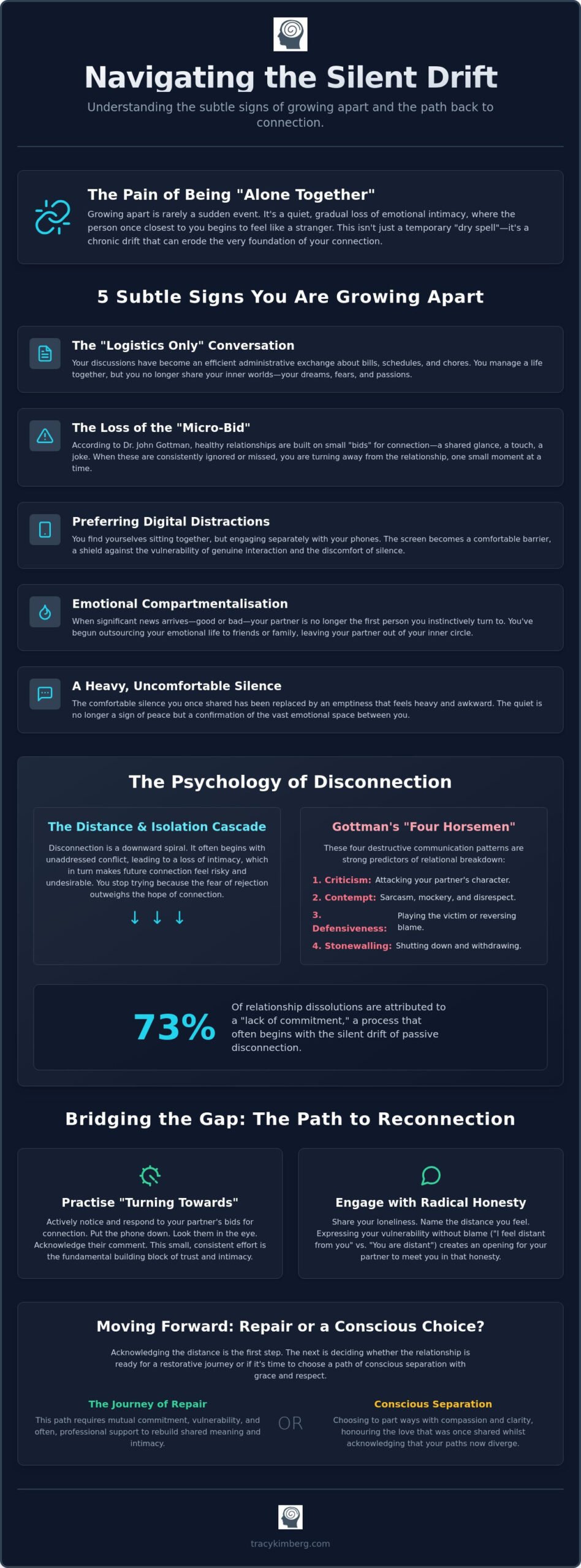
Understanding why we drift requires looking beneath the surface of daily habits. It isn’t just bad luck or a lack of compatibility. Often, it is the result of predictable psychological patterns that remain unaddressed. John Gottman, a pioneer in relationship research, identified four specific behaviours he calls the “Four Horsemen”: criticism, contempt, defensiveness, and stonewalling. When these enter the “we-space,” they act as a corrosive force. They trigger what is known as the “Distance and Isolation Cascade.” This is a process where small, unrecorded hurts lead to massive emotional walls. You stop seeing your partner as your sanctuary and start seeing them as a source of stress. Over time, the brain naturally begins to disengage to protect itself from further disappointment.
Gabor Maté offers another profound lens through which to view this drift. He suggests that our adult relationship patterns are often echoes of our earliest experiences of safety and trauma. When we feel emotionally unsafe or misunderstood, we might instinctively withdraw. This isn’t necessarily a lack of love; it’s a survival mechanism. If your partner feels like they are “growing away,” it might be that they are retreating into a shell of self-protection. To counter this, we look to the “Sound Relationship House” theory. This framework emphasizes building deep “love maps” of your partner’s inner world and maintaining a culture of fondness and admiration. Without these foundations, the signs you are growing apart from your partner become more than just warnings; they become your daily reality.
Contempt and the Erosion of Respect
Contempt is the single greatest predictor of relationship breakdown. It goes beyond simple anger; it is the belief that you are superior to your partner. It manifests in biting sarcasm, mocking, or the subtle eye-roll during a conversation. These behaviours signal that the fundamental respect required for intimacy has vanished. If you recognise these patterns, engaging in Relationship Counselling and Coaching for Couples can provide the tools to deconstruct these harmful habits before they become permanent barriers.
The Tension Between Security and Adventure
Esther Perel often speaks about the paradox of intimacy. We crave the security of a stable home, yet we also need the mystery of adventure to sustain desire. Sometimes, we push away the person who provides our greatest safety because the relationship feels too domestic or predictable. Balancing “togetherness” with individual growth is vital. When you maintain your own identity, hobbies, and friendships, you remain a distinct individual. This autonomy actually makes you more attractive to your partner, keeping the spark of curiosity alive whilst preventing the “smothering” that can lead to emotional withdrawal.
Bridging the Gap: How to Re-engage and Reconnect
Rebuilding a connection isn’t about a single grand gesture or a luxury holiday. True reconnection is an active, evolving process that happens in the quiet, mundane moments of your daily life. If you’ve recognised the signs you are growing apart from your partner, the instinct might be to pull further away to protect yourself from the sting of rejection. However, moving from passive neglect to conscious engagement requires a brave shift in perspective. It involves moving from a “me versus you” mentality to a “we versus the distance” approach.
- Radical Honesty: This begins with a courageous conversation. It isn’t about listing grievances; it’s about sharing the vulnerability of your own loneliness. Use “I” statements to express how you feel without triggering your partner’s defensiveness.
- Turning Towards Bids: Revisit the concept of “bids” for connection. When your partner makes a small joke or shares a thought, make a conscious effort to acknowledge it. These small wins rebuild the emotional safety required for deeper intimacy.
- Creating Shared Meaning: Rediscover rituals that belong only to your partnership. Whether it’s a specific way you brew morning coffee or a dedicated Sunday walk, these rituals act as anchors amongst the chaos of life.
- Scheduling Intimacy: Spontaneity is often a myth in long-term relationships. Waiting for “the right mood” can lead to weeks of distance. Scheduling time for closeness ensures that your erotic and emotional bond remains a priority.
- Seeking Professional Guidance: Sometimes the drift has become a canyon that feels too wide to bridge alone. There is no shame in seeking help, and Coach-spot can connect you with a Wise Guide to help you navigate the terrain.
Exercises for Daily Connection
Small habits can effectively regulate your collective nervous system. The “6-second kiss” is a simple Gottman-inspired tool that encourages a physical connection long enough to release oxytocin. Combine this with a daily “stress-reducing conversation” where each person speaks for fifteen minutes whilst the other listens without trying to fix or solve. This practice helps you update your “Love Maps,” ensuring you stay intimately acquainted with your partner’s current inner world.
When Communication Breaks Down
Many couples fall into a “pursuer-distancer” dynamic. One partner pushes for connection whilst the other, feeling overwhelmed, retreats into silence. Recognising this cycle is the first step toward stopping it. De-escalate conflict by calling a “time-out” when emotions run too high, agreeing to return to the conversation when you both feel calmer. If you find yourselves stuck in these repetitive cycles, our 12-Week Relationship Recovery Process provides a structured, research-based path to help you find your way back to one another.
Moving Forward: Is it Time for Repair or a Conscious Choice?
There comes a point in every drifting relationship where you must stop and look at the landscape you’ve created. Sometimes, the signs you are growing apart from your partner culminate in a realisation that the divide has become a permanent feature of your shared life. It’s a heavy moment. However, it doesn’t have to be framed as a failure. There is a profound difference between “giving up” and “letting go” with grace. Letting go involves a compassionate acknowledgement that the partnership, in its current form, no longer serves the emotional health or growth of either person. It’s about honouring the history you shared whilst being honest about the present.
If you aren’t ready to close the book, a structured approach is often more effective than the repetitive, circular arguments many couples fall into. The 12-Week Relationship Recovery Process provides the clinical framework and research-based tools needed for a final, concerted effort at reconnection. This programme is designed to help you see if the bridge can be rebuilt or if the foundations have shifted too far. For those who decide that the drift is too great, we provide support through a Conscious Approached Divorce and separation. This path focuses on uncoupling with awareness, dignity, and a commitment to future well-being.
The Power of Professional Intervention
Relationship coaching differs from traditional therapy by maintaining a sharp focus on the future. Whilst we acknowledge the past, our work is primarily about creating actionable change. You can expect a structured recovery programme to offer more than just a place to vent; it provides a roadmap for transformation. Often, relational healing begins with individual growth. By engaging in Therapy for Adults, you can process your own attachment styles and traumas, which is frequently the first step to changing the dynamic of the partnership itself.
Choosing a Path of Compassion
Prioritising emotional health is vital, particularly when children are involved in the transition. They don’t just need a house with two parents; they need an environment where the adults are emotionally regulated and present. A non-judgemental space allows you to make these heavy decisions with clarity rather than guilt. Whether you choose to embark on a journey of deep repair or decide to walk separate paths, the goal is to do so with awareness and kindness. Every relationship transition is an opportunity to move toward a more authentic version of yourself and your life.
Reclaiming Your Connection or Choosing a New Path
Recognising the signs you are growing apart from your partner is a heavy realisation, but it’s also a powerful invitation to stop living on autopilot. We’ve explored how silence and logistics can replace intimacy, and why our psychological histories often drive us to withdraw. Whether you choose to bridge the gap through intentional rituals or decide to uncouple with grace, the key is to move forward with clarity and compassion. You don’t have to navigate this complex emotional terrain alone.
I invite you to book a discovery call to explore the 12-Week Relationship Recovery Process. This research-based Gottman Method approach offers a safe, non-judgemental environment for both couples and individuals. It provides a structured 12-week path to clarity, helping you decide whether to reinvest in your bond or move forward separately with dignity. Healing is always an active, evolving process. Your long-term emotional health is worth the courage it takes to seek support today.
Frequently Asked Questions
Is it normal for couples to grow apart after having children?
Yes, it is very common for the romantic bond to be sidelined during the transition to parenthood. When you move into “caregiver mode,” your focus often shifts entirely to the needs of the child, leaving the “we-space” neglected. Whilst this phase is natural, it becomes a risk if the couple-self is permanently replaced by the parent-self. Reclaiming your partnership requires an intentional effort to move beyond daily logistics and back into shared intimacy.
Can a relationship be saved if only one person wants to try?
One person can certainly initiate a significant change in the relationship’s temperature. By shifting your own behaviours and reactions, you effectively change the “dance” you are both doing, which can invite your partner back into the space. However, for deep and sustainable repair, both individuals eventually need to be invested in the work. Individual therapy is often a powerful catalyst for this systemic shift, providing the clarity needed to lead by example.
How do I tell my partner I feel like we are growing apart without causing a fight?
The most effective way to approach this is by sharing your own internal experience rather than pointing out their flaws. You might say, “I’ve been feeling a bit lonely lately and I miss our connection,” rather than accusing them of being distant. Using “I” statements invites them into a conversation about your needs and vulnerabilities instead of triggering their defensiveness. This creates a safe environment for a courageous conversation about your future together.
What is the difference between growing apart and just being in a “boring” phase?
A “boring” phase is often just a temporary lack of external excitement or novelty, whilst the signs you are growing apart from your partner involve a deeper emotional withdrawal. Boredom can often be fixed with a new hobby or a holiday; growing apart requires deconstructing the invisible walls that have replaced your shared vulnerability. If you find you no longer want to share your inner world with them, it is likely more than just boredom.
How long does it typically take to reconnect using relationship coaching?
Meaningful reconnection usually takes a few months to settle into new, healthy habits. Our 12-Week Relationship Recovery Process is specifically designed to provide a clear, structured timeframe for this transformative work. Whilst some shifts in perspective can happen quickly, true relational healing often requires three to four months of consistent, research-based practice to ensure the new connection is resilient and lasting.
What if I feel more like myself when my partner isn’t around?
Feeling more authentic in your partner’s absence often indicates that you are suppressing parts of yourself to maintain the peace or fit into the relationship. This is a significant indicator of emotional distance and self-protection. A healthy partnership should be a sanctuary where you feel most like your true self. If the relationship has become a place of self-suppression, it is a sign that the “we-space” needs urgent attention and honest exploration.
Can the Gottman Method help even if we have been distant for years?
Yes, the Gottman Method is highly effective for long-standing distance because it focuses on concrete, research-based behaviours. It provides tools to identify the signs you are growing apart from your partner and replaces them with positive “bids” for connection. By building new “love maps” and fostering a culture of appreciation, you can deconstruct old walls of indifference regardless of how many years the emotional gap has existed.
What happens if we decide that conscious separation is the best path?
Conscious separation is a path focused on uncoupling with dignity, awareness, and mutual respect. It moves away from adversarial models of divorce and instead prioritises the emotional health of everyone involved. This process ensures that any children are protected from high-conflict dynamics and that both adults can move forward into their next chapters with clarity. It is about ending the partnership with the same kindness with which it began.

Article by
Tracy Kimberg
Tracy Kimberg is a Relationship Expert, Couples Therapist and Coach with a dedicated focus on helping couples and individuals rebuild connection, trust and emotional safety in their relationships. Drawing on the research of John and Julie Gottman, the relational insights of Esther Perel, and years of hands-on therapeutic experience, Tracy offers a warm, non-judgemental and deeply compassionate approach to modern relationships.
Based in Dorset, Tracy works with couples navigating communication breakdowns, betrayal, intimacy challenges, separation, family dynamics and life transitions. Known for creating a safe and grounded therapeutic space, she combines practical tools with emotional depth to help clients move beyond survival patterns and towards meaningful, lasting change.
With a reputation for empathy, professionalism and dedication to her clients’ growth, Tracy is passionate about helping people feel seen, understood and empowered — both within their relationships and within themselves.
Disclaimer
Disclaimer:
The information shared in this article is intended for educational and informational purposes only and should not be considered a substitute for professional therapeutic, psychological, medical or legal advice. Every individual and relationship is unique, and the perspectives offered are based on general therapeutic principles, research and professional experience.
Reading this article does not establish a therapist-client relationship with Tracy Kimberg. If you are experiencing significant emotional distress, relationship crisis, trauma, or mental health concerns, it is important to seek support from a qualified professional appropriate to your individual circumstances.
All content remains the intellectual property of Tracy Kimberg and may not be reproduced or distributed without permission.