

What if the chronic anxiety you feel isn’t a sign of your own oversensitivity, but rather your body’s most honest response to a partner who has stopped being a safe harbour? It’s a heavy question to carry, especially when you’ve spent months or years trying to organise your life around someone else’s unpredictable reactions. You likely feel as though you’re losing your identity, caught in a cycle where you’re constantly questioning your own reality. Knowing exactly when to walk away from a toxic relationship is rarely about a single explosive moment. Instead, it’s often a quiet, persistent realisation that the relational cost has exceeded your capacity for growth.
You aren’t alone in feeling this way, and your desire for clarity is a courageous act of self-preservation. This guide will help you discover the psychological markers and research-backed indicators that signal when a connection has moved beyond repair. We will explore how to identify the subtle behaviours that erode your self-worth and provide a clear framework for reclaiming your emotional health. By looking at these patterns through a compassionate, clinical lens, you can find the path back to your own centre and decide what your future should look like.
Key Takeaways
- Identify the crucial boundary between repairable conflict and systemic toxicity where staying requires the abandonment of your identity.
- Recognise the “Four Horsemen” of relational breakdown, with a specific focus on why contempt is the most reliable indicator that a bond has moved beyond repair.
- Learn the three non-negotiable signs of when to walk away from a toxic relationship, particularly when a partner consistently refuses to take accountability for their behaviour.
- Utilise objective tools like the “Relationship Check-Up” to determine if healing is possible or if your emotional health demands a different path.
- Discover the framework for a Conscious Separation, allowing you to transition out of the partnership with clarity, safety, and psychological integrity.
Understanding the Difference: High-Conflict vs Toxic Dynamics
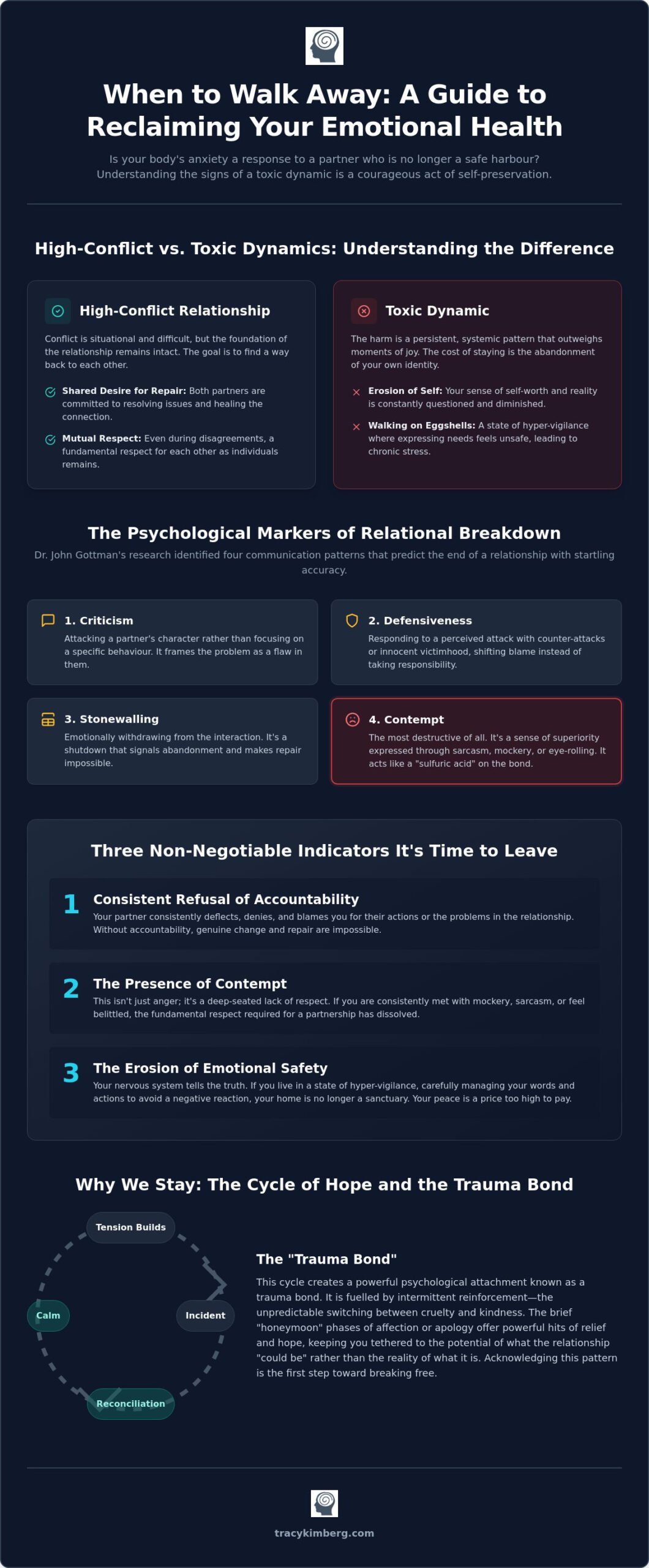
Relationships are naturally messy. We all have moments of poor communication or heated arguments, but there’s a profound difference between a partnership experiencing high conflict and one that has become fundamentally toxic. In a healthy, albeit difficult, relationship, there’s a shared desire for repair and a mutual respect that remains intact even during disagreements. In a toxic one, the conflict is systemic rather than situational. Toxic relational behaviour is a persistent pattern of emotional harm that outweighs the joy. When you are trying to decide when to walk away from a toxic relationship, the most telling indicator is often the cost of staying. If the price of the partnership is the slow erosion of your sense of self, the cost is simply too high.
Many people find themselves trapped in a “cycle of hope.” This is a psychological loop where a period of tension is followed by a “honeymoon” phase of intense affection or apologies. This often mirrors the cycle of abuse, where the brief glimpses of the person you fell in love with keep you tethered to the connection. You wait for the person they “could be” rather than accepting the reality of who they are today. This cycle creates a powerful fog that makes it difficult to see the exit even when the door is right in front of you.
The Role of Emotional Safety
Emotional safety is the bedrock of any sustainable intimacy. It’s the quiet confidence that you can express your deepest needs or vulnerabilities without fear of mockery, punishment, or retaliation. When this safety vanishes, you begin “walking on eggshells.” This isn’t just a metaphor; it’s a state of hyper-vigilance. Your nervous system remains in a chronic state of “fight or flight,” which can lead to exhaustion, digestive issues, and long-term physiological stress. If your home feels like a minefield rather than a sanctuary, you’re living in a toxic environment that prioritises the partner’s reactions over your peace.
Why We Stay: The Trauma Bond
It’s often confusing why we struggle to leave situations that cause us deep pain. This is frequently due to a trauma bond, fuelled by intermittent reinforcement. Like a gambler at a slot machine, you’re hooked on the occasional “win” of a kind word or a peaceful evening. Gabor Maté often points out that our adult tolerance for relational pain is frequently rooted in our earliest childhood attachments. We might mistake intensity for intimacy or chaos for passion because it feels familiar. Knowing when to walk away from a toxic relationship requires acknowledging that your survival strategies from the past might be keeping you stuck in the present. Choosing yourself is a necessity, even if it feels like a betrayal of the bond.
The Psychological Markers: Contempt and the Four Horsemen
John Gottman’s decades of research identified four specific communication patterns that predict the end of a relationship with startling accuracy. Known as The Four Horsemen, these behaviours include criticism, defensiveness, stonewalling, and contempt. Whilst criticism attacks a partner’s character and defensiveness shifts blame to avoid responsibility, stonewalling represents a profound emotional withdrawal. It acts as a form of abandonment where one partner physically or mentally shuts down during conflict, leaving the other to navigate the crisis alone. This silence isn’t just a lack of words; it’s a structural wall that prevents any possibility of reconciliation. When these patterns become your daily reality, the question of when to walk away from a toxic relationship becomes a matter of psychological survival.
Contempt: The Poison of Connection
Contempt is widely considered the most destructive of the horsemen, acting as a “sulfuric acid” that dissolves the bond of respect. Unlike anger, which can be a healthy expression of a crossed boundary, contempt is rooted in a sense of superiority. It manifests through mockery, biting sarcasm, or even a simple eye-roll, all intended to make the other person feel inferior. The physical toll of this is significant. Studies have shown that people in relationships characterised by contempt have higher rates of infectious illness, as the chronic stress of being belittled actively weakens the immune system. If you are questioning if Overcoming Contempt in a Relationship is possible, you must look for a genuine, sustained effort from your partner to change these patterns. Without that shift, the relationship often becomes a “death by a thousand cuts” for your self-esteem.
Gaslighting and the Loss of Perspective
Gaslighting is a specific psychological tactic used to make you doubt your own memory and perception. It’s an insidious form of control that erodes your perspective until you no longer trust your own mind. You might hear common phrases like “You’re imagining things” or “You’re being oversensitive” whenever you try to address a legitimate concern. This constant invalidation causes your “internal compass” to fail, leaving you feeling lost and dependent on your partner’s version of the truth. Reclaiming your perspective often requires the specialised support found in Therapy for Adults, where you can safely unpack these experiences and begin the process of trusting your own intuition again. Recognising these markers is the first step toward reclaiming the person you were before the relationship began to dim your light.
When to Walk Away: Three Non-Negotiable Indicators
Deciding exactly when to walk away from a toxic relationship is one of the most taxing emotional journeys you’ll ever undertake. It’s rarely a single, explosive event that provides the answer; rather, it’s a cumulative weight that eventually becomes too heavy to carry. Whilst every partnership has its unique challenges, there are specific, non-negotiable indicators that suggest the relationship has moved from a difficult patch into a territory of systemic harm. When the “will to repair” is only present in one partner, the relationship effectively ceases to be a partnership and becomes a burden borne by one person alone. If you find your physical or mental health in a state of chronic decline, your body is likely telling you what your mind isn’t yet ready to accept.
The Accountability Test
There’s a vital distinction between a partner who is “willing but unskilled” and one who is “unwilling and toxic.” An unskilled partner might fumble their words or struggle with emotional intimacy, but they show a genuine desire to learn and grow. In contrast, a toxic dynamic is defined by a persistent refusal to take accountability for harmful behaviour. You might receive “empty apologies” that are quickly followed by the same hurtful actions, or perhaps your partner blames you for their own reactions. A relationship cannot heal if one partner refuses to acknowledge the wound they are creating. Without this shared reality, there’s no foundation upon which to build a healthier future. Recognising the signs of a toxic relationship often starts with noticing this lack of ownership.
The Cost of Self-Abandonment
Esther Perel often speaks about the delicate balance of maintaining a sense of “self” within the “we.” In a healthy connection, your partnership should be a space where you feel expanded, not diminished. However, a primary indicator of when to walk away from a toxic relationship is the realisation that you’ve shrunk your personality to fit the narrow confines of your partner’s expectations. You might notice that your “favourite” parts of yourself—your spontaneous laughter, your ambition, or your social nature—have slowly disappeared to keep the peace. This self-abandonment is a high price to pay for a connection. If you’ve traded your integrity and core values for a temporary sense of security, you aren’t just losing a partner; you’re losing yourself. Reclaiming your identity requires acknowledging that a relationship that requires you to be “less than” is never the right fit for your “more than.”
The Decision-Making Process: Can Your Relationship Be Saved?
The decision to stay or leave isn’t usually a lightning bolt of clarity. Instead, it’s a slow gathering of evidence, a quiet weighing of the “here and now” against the hope of what could be. Many people find themselves paralysed by the fear of future regret, asking, “What if I leave too soon?” However, a more grounded approach is to look at the current reality of your partnership. An objective assessment, often referred to as a “Relationship Check-Up,” can help you move past the emotional fog. This involves examining whether the foundation of friendship and mutual respect still exists beneath the layers of conflict. If you’re struggling to find your footing, engaging in Individual Relationship Counselling can provide the necessary space to explore your feelings without the immediate pressure of the “we.”
Professional intervention serves as a vital mirror in this process. Whilst coaching focuses on future-oriented strategies and communication skills, therapy often digs deeper into the systemic patterns that keep you stuck. Knowing when to walk away from a toxic relationship often involves testing whether these professional tools actually lead to a shift in the dynamic. If you’ve reached a point where you’re no longer fighting for the relationship but are simply fighting with your partner, the energy required to sustain the connection may be better spent on your own healing.
The 12-Week Recovery Window
For couples who feel there is still a spark worth saving, a structured 12-Week Relationship Recovery Process can offer a final, intensive path toward change. This timeframe is purposeful. It allows enough time for new behaviours to take root whilst ensuring you aren’t trapped in an endless cycle of “trying” without results. If no measurable change in emotional safety or accountability occurs within this period of dedicated work, the answer regarding the future of the partnership often becomes clear. It’s a way to ensure you’ve truly exhausted all avenues before making the final move.
Establishing Boundaries as a Final Test
Boundaries are the ultimate litmus test for relational health. Try setting a “hard boundary” regarding a specific behaviour, such as a refusal to accept name-calling or a requirement for transparency. A healthy partner, even if they find the boundary challenging, will see it as a guide for how to love you better. In contrast, toxic partners often view boundaries as threats to their control or personal attacks. Observing this reaction tells you everything you need to know. If the boundary is met with increased volatility or gaslighting, it acts as the catalyst for your exit. If you’re ready to explore these dynamics with expert guidance, you can book a session for Relationship Counselling to begin your journey toward clarity.
Navigating the Exit: Towards Conscious Separation
Once you have identified when to walk away from a toxic relationship, the focus shifts from the “why” to the “how.” Navigating an exit doesn’t have to be an act of mutual destruction. Conscious Separation is a framework that allows you to end the partnership with your integrity and dignity intact. It requires a shift in perspective, viewing the ending not as a failure of character, but as a necessary boundary for your long-term emotional health. This process is about untangling your life with as much grace as the situation allows, whilst remaining rooted in the reality of the harm you’ve experienced.
If the dynamic has been volatile, your first priority is the creation of a Safety Plan. This is a clinical necessity that involves organising your practical resources, secure communication, and physical safety before the conversation takes place. When you are ready to speak, communicate your decision with absolute clarity and firmness. Toxic dynamics often thrive on ambiguity or the “maybe” of a future change. By stating your decision as a completed fact rather than a negotiation, you avoid the trap of circular arguments and reclaim the power over your own narrative.
The Gentle Art of Letting Go
Moving from a state of enmeshment to one of detachment is a slow, often painful process. You aren’t just leaving a person; you’re often grieving the “dream” of who you thought they were and what the relationship might have become. It’s essential to acknowledge this loss without letting it pull you back into the cycle. Seeking support for Conscious Divorce and Separation can provide a structured way to handle the logistical and emotional complexities of the transition. This professional guidance ensures that the ending serves as a bridge to your future rather than a weight from your past.
Reclaiming Your Future
The post-separation period is a time for deep, trauma-informed healing. Gabor Maté often emphasises that healing is the process of becoming whole again, and after a toxic partnership, your sense of self may feel fragmented. Focus on radical self-compassion whilst you rebuild your internal compass. Professional support is vital here, but finding strength in a community like Be Broken and Beautiful can also help you cultivate the resilience needed for this journey. This isn’t about blame; it’s about the proactive adventure of self-discovery. By choosing to leave, you’re making a profound statement that your life is worth more than the shadow of a relationship. You’re choosing health, peace, and the possibility of a connection that actually feels like home.
Choosing Your Path to Emotional Freedom
Recognising the persistent patterns of contempt and the profound lack of accountability in a partnership is a vital step toward reclaiming your reality. Your emotional health is the most precious resource you possess; it’s the foundation for everything you build in this life. Deciding when to walk away from a toxic relationship is never a decision made lightly, yet it’s often the most courageous act of self-preservation you will ever undertake. Whether you choose to try one final intensive recovery process or begin the journey toward conscious separation, you don’t have to navigate this complex emotional landscape alone.
As a specialist in Gottman and Perel research-based methods, Tracy Kimberg provides a safe harbour for those seeking clarity. With over 5 years of transformational relationship coaching, she offers compassionate, non-judgemental UK-based support tailored to your unique needs. You deserve a life defined by safety, respect, and genuine connection rather than chronic anxiety and self-doubt. Book a Discovery Call with Tracy Kimberg to find your path to clarity and healing. Your future is waiting for you to step into it with confidence and peace.
Frequently Asked Questions
How do I know if I am the toxic one in the relationship?
If you are asking this question, it is a sign of self-awareness that systemically toxic individuals often lack. Toxicity is frequently a cycle of reactive behaviours rather than a fixed personality trait. You might be using “protest behaviours” to get your needs met because you don’t feel emotionally safe. Working with a professional can help you distinguish between a temporary lapse in character and a pattern that requires deep, individual healing.
Can a toxic relationship ever become healthy again?
A relationship can return to health only if both partners commit to radical accountability and sustained behavioural change. It requires moving beyond “empty apologies” into a structured process of repair and professional intervention. However, if the “will to repair” is only present in one person, the dynamic remains systemic. Real change is measured in months of consistent safety, not just a few days of peace after a heated argument.
What is the difference between a narcissist and someone who is just toxic?
Narcissism is a specific clinical personality structure characterised by a lack of empathy and a profound need for admiration, whilst toxicity is a broader set of harmful behaviours. Someone can be toxic due to unhealed trauma or poor communication skills without being a narcissist. The distinction matters less than the impact on your well-being. If the behaviour is consistently harmful, the label is secondary to your need for safety.
How do I leave a toxic relationship when we have children together?
Leaving when children are involved requires a focus on physical safety and emotional stability above all else. You must prioritise a calm environment, as children are highly sensitive to the chronic stress of a toxic home. Utilising “parallel parenting” rather than “co-parenting” can help minimise contact with a volatile partner. This framework allows you to protect your children’s well-being whilst you navigate the complexities of when to walk away from a toxic relationship.
Is it possible to have a conscious separation from a toxic partner?
Conscious separation is possible if both parties can maintain a level of respect, but it may be unrealistic if your partner is highly volatile. In cases of severe toxicity, a “clean break” approach is often the only way to preserve your mental health. You cannot have a conscious ending with someone who is committed to misunderstanding you or using the separation as a tool for further emotional control.
Why do I feel guilty for wanting to leave someone who treats me badly?
Guilt is a common symptom of a trauma bond, where you feel responsible for your partner’s emotions or their “potential.” You may have been conditioned to believe that your needs are less important than the survival of the relationship. This is often a “fawn” response, a survival strategy where you try to appease a partner to avoid conflict. Recognising that your guilt is a product of the dynamic is essential for your healing.
How long does it take to recover from the emotional damage of a toxic partnership?
Recovery is not a linear process, but many people report a significant shift after 6 to 18 months of dedicated professional support. Your nervous system needs time to move out of a state of chronic hyper-vigilance and back into a state of rest. Healing involves reclaiming your identity and learning to trust your intuition again. Knowing when to walk away from a toxic relationship is simply the first step in a long-term adventure toward health.

Article by
Tracy Kimberg
Tracy Kimberg is a Relationship Expert, Couples Therapist and Coach with a dedicated focus on helping couples and individuals rebuild connection, trust and emotional safety in their relationships. Drawing on the research of John and Julie Gottman, the relational insights of Esther Perel, and years of hands-on therapeutic experience, Tracy offers a warm, non-judgemental and deeply compassionate approach to modern relationships.
Based in Dorset, Tracy works with couples navigating communication breakdowns, betrayal, intimacy challenges, separation, family dynamics and life transitions. Known for creating a safe and grounded therapeutic space, she combines practical tools with emotional depth to help clients move beyond survival patterns and towards meaningful, lasting change.
With a reputation for empathy, professionalism and dedication to her clients’ growth, Tracy is passionate about helping people feel seen, understood and empowered — both within their relationships and within themselves.
Disclaimer
Disclaimer:
The information shared in this article is intended for educational and informational purposes only and should not be considered a substitute for professional therapeutic, psychological, medical or legal advice. Every individual and relationship is unique, and the perspectives offered are based on general therapeutic principles, research and professional experience.
Reading this article does not establish a therapist-client relationship with Tracy Kimberg. If you are experiencing significant emotional distress, relationship crisis, trauma, or mental health concerns, it is important to seek support from a qualified professional appropriate to your individual circumstances.
All content remains the intellectual property of Tracy Kimberg and may not be reproduced or distributed without permission.