

Your partner is ten minutes late coming home, and instead of assuming they’re simply stuck in traffic, your mind starts crafting a painful narrative where they’ve finally realised you aren’t enough. This constant hyper-vigilance isn’t just a personality trait; it’s the exhausting reality of living with a fear of abandonment in relationships. You likely find yourself scanning for subtle shifts in their tone or “testing” their commitment to see if they’ll stay, only to end the day feeling emotionally depleted and fundamentally unlovable. It’s a heavy cycle that drains the very intimacy you’re trying so hard to protect.
We recognise how draining this state of high alert is for both you and your partnership. You deserve to feel settled and secure without the need for constant reassurance. This article will help you uncover the psychological roots of your anxiety and provide research-based strategies to transform fear into a resilient, lasting connection. We’ll explore how your attachment style influences your behaviour and guide you through the process of rewiring your nervous system for emotional stability and genuine trust.
Key Takeaways
- Learn how early childhood environments wire the nervous system for hyper-vigilance and influence your capacity for adult intimacy.
- Identify the counterintuitive behaviours, such as “testing” or clinging, that often emerge from a deep-seated fear of abandonment in relationships.
- Uncover the dynamics of the anxious-avoidant trap to help you and your partner stop the painful, repetitive cycle of pursuit and withdrawal.
- Gain practical tools for self-soothing and co-regulation to transform your internal alarm system into a sustainable sense of secure calm.
- Explore how a structured, professional approach to healing can bridge the gap between understanding your trauma and actually living a life of trust.
The Anatomy of Abandonment: Why We Fear Being Left
To understand the fear of abandonment in relationships, we must look beneath the surface of the present moment. This isn’t just a case of “relationship nerves” or a simple worry about a breakup. It’s a complex emotional state, often rooted in deep-seated attachment trauma. When you experience this fear, your body isn’t reacting to what is happening today; it’s reacting to what happened long ago. It’s a bone-deep dread that the person you rely on for safety will suddenly disappear, leaving you adrift.
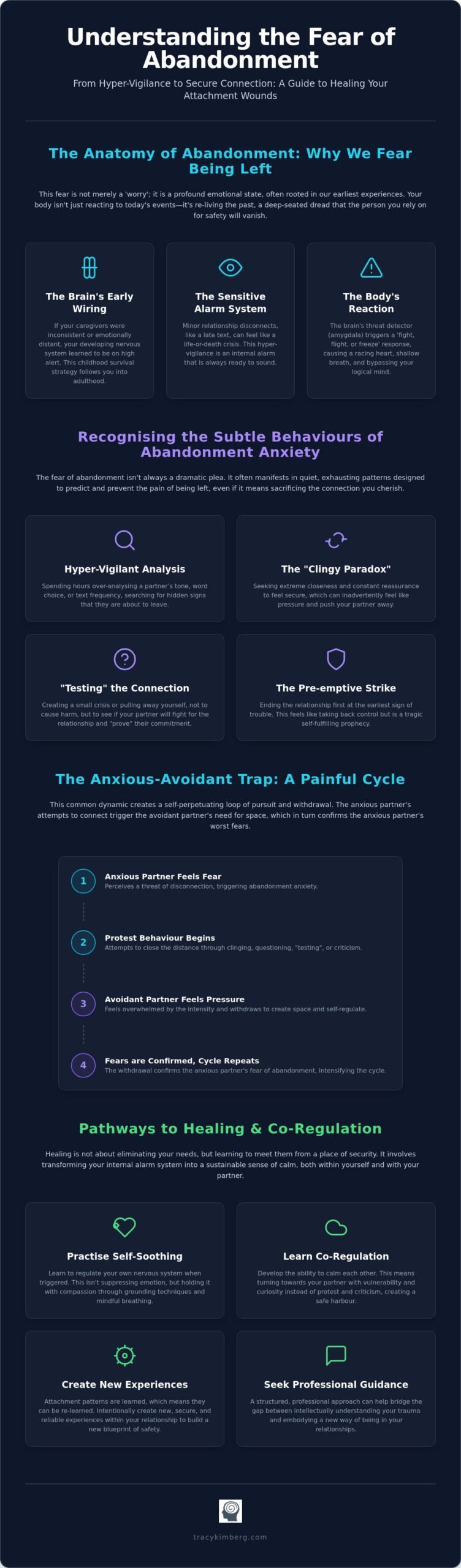
Dr Gabor Maté often explores how our early environment literally “wires” the brain. If your primary caregivers were inconsistent, emotionally distant, or physically absent, your developing nervous system learned to stay on high alert. You became an expert at scanning for signs of trouble because, for a child, staying connected to a caregiver is a matter of survival. This hyper-vigilance doesn’t just go away as you grow up. Instead, it follows you into your adult partnerships, acting as a silent, sensitive alarm system that’s always ready to go off.
This internal alarm often triggers during minor relational disconnects. Whilst a healthy concern for a relationship involves wanting to resolve a conflict, pathological abandonment anxiety feels like a life-or-death crisis. It’s the difference between thinking, “I hope we can talk this through,” and feeling a primal terror that the end is imminent. This state of emotional abandonment can be so overwhelming that it clouds your ability to see the reality of your partner’s commitment.
The Role of Insecure Attachment Styles
Your attachment style acts as a fundamental blueprint for how you experience adult intimacy. Those with an anxious-preoccupied style often seek “fusion” with their partner, trying to bridge the gap of fear through constant closeness. In contrast, those with a fearful-avoidant pattern live in a painful contradiction. They deeply desire connection but simultaneously fear being trapped or hurt, leading them to push people away before they can be left. These patterns aren’t choices; they’re the strategies your younger self developed to find safety in an unpredictable world.
Abandonment as a Physiological Response
When you feel your partner pulling away, your amygdala, the brain’s smoke detector, takes over. It doesn’t distinguish between a physical predator and a late text message; it simply registers a threat to your survival. This triggers a “fight, flight, or freeze” response that bypasses your logical mind. You might find yourself in the grip of an emotional flashback, where the current situation triggers the exact same terror you felt as a neglected child. Your heart races, your breath becomes shallow, and your body prepares for a battle that isn’t actually happening in the room.
Identifying the Subtle Behaviours of Abandonment Anxiety
Recognising the fear of abandonment in relationships often requires us to look at our smallest, most private reactions. It isn’t always a dramatic plea for attention. Frequently, it manifests as a quiet, exhausting hyper-vigilance. You might spend hours over-analysing a partner’s tone of voice or the sudden drop in text frequency, searching for signs and symptoms of abandonment issues that haven’t even occurred yet. This mental tax is a survival strategy; it’s an attempt to predict the “inevitable” exit before it happens.
When this anxiety peaks, it often leads to what we call the “Clingy Paradox.” In an attempt to secure the bond, you might seek a level of fusion that inadvertently pushes your partner away. The intensity of the need for reassurance can feel like pressure to the other person, causing them to withdraw. This withdrawal then confirms your deepest fears, creating a painful loop. Some individuals take a different route, engaging in “testing” behaviours. They might create a crisis or pull away themselves to see if their partner will chase them. Others prefer the “pre-emptive strike,” choosing to end the relationship first. It feels like taking back control, but in reality, it’s a tragic sacrifice of a potentially healthy connection to avoid the perceived pain of being left.
The Self-Fulfilling Prophecy of Sabotage
These fear-driven actions often create the very distance you dread. In the heat of an abandonment-triggered conflict, it’s easy to fall into John Gottman’s “Four Horsemen”: criticism, contempt, defensiveness, and stonewalling. This cycle of protest behaviour is usually followed by a wave of intense guilt once the panic subsides. If you find yourself trapped in these repetitive patterns, professional relationship coaching can offer the tools to communicate your needs without the weight of sabotage.
Fusion vs. Autonomy: The Esther Perel Perspective
Esther Perel often reminds us that intimacy requires a bridge, and you cannot have a bridge without two distinct shores. The fear of abandonment in relationships often drives a desire for total fusion, where any sign of a partner’s autonomy is seen as a threat. You might feel that your partner’s need for an evening with friends or a solo hobby is a sign they are drifting away. However, security isn’t found in the absence of space. True intimacy thrives when we balance a “secure base” with the freedom for individual growth, allowing the relationship to breathe and the erotic spark to remain alive.
The Impact on the Partnership: Navigating the Anxious-Avoidant Trap
The dynamic between partners often shifts into a repetitive, painful loop known as the “Anxious-Avoidant Dance.” It’s a cruel irony that those struggling with a fear of abandonment in relationships frequently find themselves drawn to partners who value independence above all else. Whilst the anxious partner seeks safety through proximity, the avoidant partner seeks safety through distance. This creates a chase where nobody wins; the harder one pursues, the faster the other retreats. When you are in this state of “attachment threat,” your brain perceives your partner’s need for space as a literal threat to your survival, making it almost impossible to respond with logic or calm.
For the partner on the receiving end of abandonment anxiety, the experience can be deeply confusing and draining. They may feel smothered, controlled, or as though they are constantly “on trial” for crimes they haven’t committed. When every late arrival or missed call is interpreted as a sign of impending betrayal, the partner can eventually experience “compassion fatigue.” They might stop trying to provide reassurance altogether, not out of malice, but out of sheer emotional exhaustion. Breaking this cycle often requires individual relationship counselling, which allows each person to own their internal triggers rather than projecting them onto their loved one.
When Communication Becomes a Battlefield
In the heat of a conflict, abandonment fear makes it remarkably difficult to listen or empathise. Your prefrontal cortex effectively shuts down, and your survival brain takes over, turning a simple discussion into a fight for your life. There is a vital difference between “complaining” about a specific behaviour and “criticising” your partner’s entire character from a place of panic. Learning how to fix communication in a relationship involves recognising these physiological shifts and choosing to pause before the words become weapons.
The Toll on Intimacy and Trust
The weight of constant reassurance-seeking can slowly erode the foundation of even the most loving partnership. If one person is always waiting for the “other shoe to drop,” true relaxation and playfulness become impossible to sustain. Trust isn’t a grand, one-time declaration; it’s a fragile ecosystem that requires daily nurturing. Trust is built in small, consistent moments of “turning toward.” Without these moments, the relationship becomes a series of tense negotiations rather than a shared journey of intimacy and mutual growth.
Practical Strategies for Healing and Co-Regulation
Healing from the fear of abandonment in relationships is rarely a solo endeavour. While the initial alarm sounds within your own nervous system, the resolution often happens in the shared space between you and your partner. This process requires a move from isolation to connection, transforming the “threat” of intimacy into a sanctuary of safety. To begin this transformation, we can follow a structured path toward relational security:
- Step 1: Self-Soothing and Emotional Regulation. Before you can engage with your partner, you must learn to calm your own physiological storm. Techniques like box breathing or grounding exercises help signal to your amygdala that you are safe in the present moment.
- Step 2: Identifying Triggers and Glimmers. Recognise the specific behaviours that set off your internal alarm. Conversely, look for “glimmers”—micro-moments of safety and connection that remind you of your partner’s presence and care.
- Step 3: Radical Transparency. Learn to express your fear without casting your partner as the villain. Saying, “I’m feeling a bit vulnerable right now and need a moment of connection,” is far more effective than an accusatory “You never make time for me.”
- Step 4: Building a Secure Base. Incorporate Gottman-inspired rituals of connection, such as a focused daily check-in or a lingering hug before leaving the house. These small acts build a reservoir of trust.
- Step 5: Challenging the Narrative. Actively identify the “unlovable” script written in your childhood. Replace it with the adult truth: you are a person worthy of consistent, reliable love.
The Power of Co-Regulation
A vital part of healing is learning how to use the relationship as a tool for regulation. Partners can provide “containment” for these fears by remaining steady whilst you are in distress. By using softened start-ups—beginning a conversation with “I feel” rather than “You did”—you prevent your partner’s defences from rising. Simple physical touch, like holding hands or sustained eye contact, can do more to de-escalate abandonment anxiety than an hour of logical debate. If you’re ready to move beyond self-help and build these skills together, our relationship counselling for couples provides the guided support needed to anchor your partnership.
Healing the Inner Child
At the heart of abandonment anxiety is a wounded child who was once left to handle overwhelming emotions alone. Reparenting involves your “Adult Self” stepping in to provide the validation and protection that was missing in your early years. When a trigger occurs, pause to distinguish between the child’s panic and the adult’s reality. Mindfulness allows you to stay present in your body, observing the urge to “cling” or “flee” without being forced to act upon it. You are no longer that helpless child; you have the agency to choose a different outcome.
For those seeking to deepen this healing, working with a specialist in subconscious reprogramming like Salarah K Starre can provide the necessary tools to shift these deep-seated emotional patterns and reclaim a sense of internal safety.
Transforming Your Relationship with Professional Guidance
Understanding the fear of abandonment in relationships is a powerful first step, but insight alone rarely settles a dysregulated nervous system. You might know exactly why you feel the urge to check your partner’s phone or why you withdraw when they seek independence, yet the primal impulse remains. This is because attachment trauma isn’t just a thought; it’s a physiological state. Whilst self-help books offer valuable frameworks, they cannot provide the real-time co-regulation that a therapeutic relationship offers. To move from a state of constant survival to one of genuine thriving, you need a safe container where you can practice new ways of being.
Deep-seated fears require more than just intellectual understanding. They require a felt sense of safety that is built through consistent, guided interaction. Professional support allows you to slow down the “threat response” long enough to see your partner—and yourself—with clarity. By working with a specialist, you move away from the “Anxious-Avoidant Dance” and toward a partnership where both individuals feel seen, respected, and fundamentally secure.
The 12-Week Relationship Recovery Process
Many couples find that unstructured talk therapy feels like circling the same drain without reaching a resolution. This is why a structured path, such as the 12-week relationship recovery, is often more effective for those dealing with abandonment issues. This time-bound, goal-oriented programme focuses on rebuilding the foundations of trust and emotional safety through practical, research-based tools. We know that focused interventions can significantly improve secure attachment, and our process is designed to deliver those transformative results. It isn’t just about surviving the next week; it’s about equipping you with a toolkit for a lifetime of connection.
Start Your Journey to Security Today
If you’ve spent years feeling like you’re on the verge of being left, it’s time to choose a different narrative. Professional relationship coaching for couples provides the neutral ground necessary to explore these deep-seated fears without the conversation devolving into blame or conflict. Whether you prefer the convenience of online therapy or the presence of face-to-face sessions, taking the first step is an act of profound self-care. Healing isn’t a clinical chore or a sign of failure; it is a proactive and positive adventure that allows you to finally rest in the arms of a secure partnership. You don’t have to carry the weight of the past alone anymore.
Step Into a Future of Relational Security
Living with the fear of abandonment in relationships can feel like navigating a storm without a compass, but your history doesn’t have to be your destiny. We have explored how your nervous system’s early wiring creates hyper-vigilance and how the anxious-avoidant dance often keeps you trapped in survival mode. Healing is about moving from these reactive patterns into a space of co-regulation and conscious connection. It’s about learning that you are fundamentally worthy of a love that stays.
I invite you to transform this cycle through a research-based, empathetic approach. Whether you choose online therapy or face-to-face sessions, we provide a non-judgemental environment grounded in the insights of Gottman and Perel. Begin your journey to a secure partnership with the 12-Week Relationship Recovery Process. You deserve a relationship where trust is the foundation rather than the exception. This is your proactive adventure toward lasting emotional health, and you don’t have to walk it alone.
Frequently Asked Questions
Is fear of abandonment a mental illness?
Fear of abandonment is not a formal mental illness on its own. Clinically, it is recognised as a symptom or feature of other conditions, such as Borderline Personality Disorder (BPD) or Separation Anxiety Disorder. For many, it is simply a manifestation of an anxious attachment style rather than a clinical diagnosis. Understanding this distinction helps demystify the experience; it is a nervous system response to a perceived threat rather than a sign of being “broken.”
Can a relationship survive if one partner has a severe fear of abandonment?
A relationship can certainly survive and even thrive if one partner struggles with this fear. Success depends on both partners’ willingness to move beyond the “Anxious-Avoidant Dance” and commit to a structured healing process. When the anxious partner learns self-soothing and the other provides consistent containment, the relationship moves from a state of constant survival to one of enduring security and mutual trust.
How do I tell my partner about my fear of abandonment without sounding “crazy”?
The key to discussing your fear of abandonment in relationships without feeling “crazy” is to frame it as a physiological experience. Instead of making it about your partner’s actions, talk about your “alarm system.” You might say, “My nervous system sometimes interprets small disconnects as a survival threat.” This takes the blame off them and invites them to be your ally in finding safety rather than your opponent in an argument.
What is the difference between jealousy and fear of abandonment?
Jealousy and abandonment fear are often confused, but they have different emotional roots. Jealousy typically involves a perceived threat from a third party, whilst fear of abandonment is a primal dread regarding the loss of the connection itself. You can feel a fear of abandonment even when there is no “rival” present; it is a worry that you are fundamentally unlovable and will eventually be left alone.
Can you ever truly “cure” a fear of abandonment?
Whilst you may not “cure” the fear in a medical sense, you can absolutely achieve what psychologists call “earned secure attachment.” This means that through therapy and consistent relational work, your nervous system learns to trust. The old triggers may still flicker occasionally, but they no longer control your behaviour or dictate the quality of your intimacy. Healing is an active, evolving experience of building resilience over time.
How can I support a partner who is constantly afraid I will leave them?
Supporting a partner with this fear requires radical consistency and patience. You can help by “turning toward” their bids for connection and offering reassurance before they feel the need to “test” you. It’s about creating a predictable environment where they feel safe. However, it’s equally important to maintain your own boundaries so you don’t experience compassion fatigue; supporting them shouldn’t mean losing your own sense of autonomy.
What should I do if my fear of abandonment is causing me to be controlling?
If your fear of abandonment in relationships is leading to controlling behaviour, it is vital to recognise this as a misguided attempt to create safety. Control is a shadow version of connection; it provides a temporary sense of relief but ultimately erodes the trust you crave. Acknowledging this pattern is the first step toward change. Seeking professional guidance can help you find healthier ways to manage your anxiety without stifling your partner’s freedom.
Does fear of abandonment always stem from childhood?
Most abandonment fears are rooted in early childhood experiences and attachment trauma, but they don’t always stem from the distant past. Significant adult trauma, such as a sudden divorce or a betrayal in a previous long-term partnership, can also wire the brain for hyper-vigilance. Whether the root is in your first years of life or a recent heartbreak, the path to healing involves the same work of nervous system regulation and building secure bonds.

Article by
Tracy Kimberg
Tracy Kimberg is a Relationship Expert, Couples Therapist and Coach with a dedicated focus on helping couples and individuals rebuild connection, trust and emotional safety in their relationships. Drawing on the research of John and Julie Gottman, the relational insights of Esther Perel, and years of hands-on therapeutic experience, Tracy offers a warm, non-judgemental and deeply compassionate approach to modern relationships.
Based in Dorset, Tracy works with couples navigating communication breakdowns, betrayal, intimacy challenges, separation, family dynamics and life transitions. Known for creating a safe and grounded therapeutic space, she combines practical tools with emotional depth to help clients move beyond survival patterns and towards meaningful, lasting change.
With a reputation for empathy, professionalism and dedication to her clients’ growth, Tracy is passionate about helping people feel seen, understood and empowered — both within their relationships and within themselves.
Disclaimer
Disclaimer:
The information shared in this article is intended for educational and informational purposes only and should not be considered a substitute for professional therapeutic, psychological, medical or legal advice. Every individual and relationship is unique, and the perspectives offered are based on general therapeutic principles, research and professional experience.
Reading this article does not establish a therapist-client relationship with Tracy Kimberg. If you are experiencing significant emotional distress, relationship crisis, trauma, or mental health concerns, it is important to seek support from a qualified professional appropriate to your individual circumstances.
All content remains the intellectual property of Tracy Kimberg and may not be reproduced or distributed without permission.