

What if the sharp, familiar sting of jealousy isn’t a sign that your relationship is failing, but a misplaced signal from your nervous system trying to keep you safe? It’s incredibly exhausting to live with the constant anxiety of a partner being away or the heavy shame that follows a late-night phone check. You likely want to feel secure and grounded, yet you find yourself trapped in frequent arguments and a nagging sense that you are not enough. We understand that overcoming jealousy and insecurity in a relationship is not about willpower alone; it’s about understanding the deep-seated attachment needs hidden beneath the surface of your distress.
In this guide, you’ll discover how to transform the “green-eyed monster” into a catalyst for deeper intimacy and emotional security through research-based therapeutic insights. We’ll explore how to soothe your nervous system and move past the “pursue-withdraw” dynamic, which research suggests affects 74% of couples in distress. You’ll learn to foster trust that feels organic and develop the tools for clearer, calmer communication. By shifting your perspective and recognising these patterns, you can move from a place of fear towards a connection that feels truly safe and restorative.
Key Takeaways
- Reframe jealousy as a “smoke alarm” for your bond, allowing you to address unmet needs for connection without the weight of shame or judgement.
- Uncover how early attachment styles and past trauma shape your current behaviours, providing the insight needed to respond with calm rather than reactiveness.
- Learn actionable tools for overcoming jealousy and insecurity in a relationship, including the “vulnerability first” rule to transform accusations into opportunities for intimacy.
- Balance the paradox of belonging and separateness, ensuring your partnership has the space to breathe whilst remaining deeply anchored in mutual trust.
- Identify a structured path toward long-term emotional safety through a recovery process that integrates both individual growth and collaborative healing.
The Anatomy of Jealousy: Why Insecurity Isn’t Always a Warning Sign
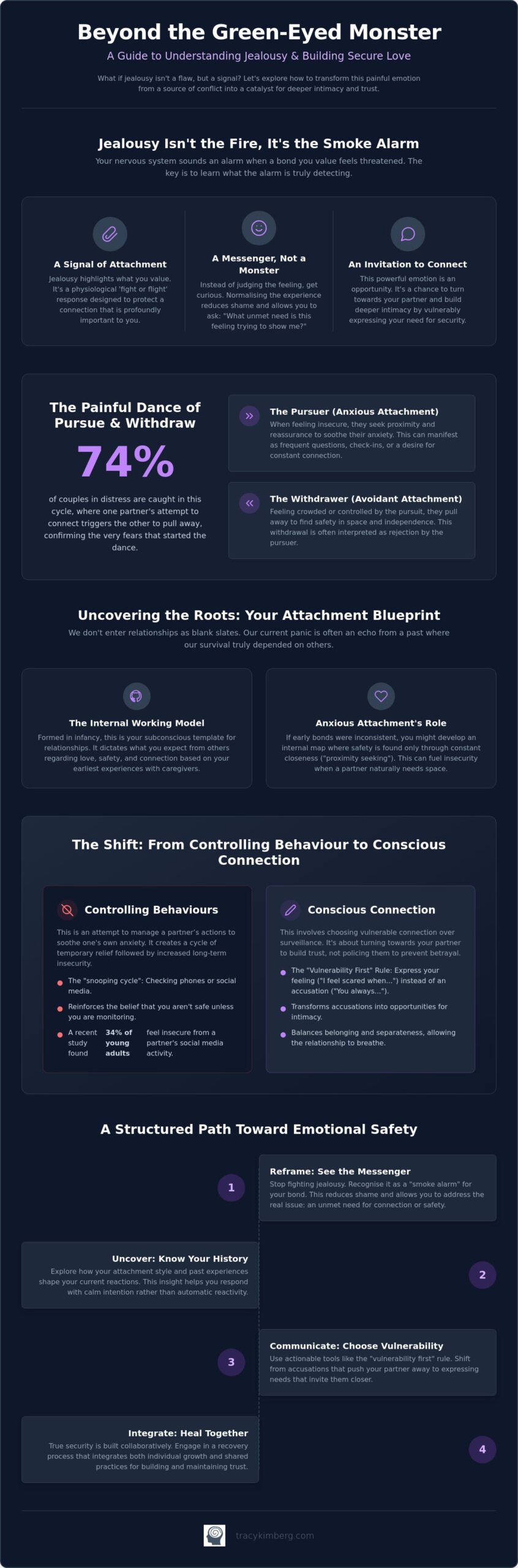
Jealousy is rarely a single emotion. Instead, it’s a complex, often painful blend of fear, anger, and humiliation that can feel like a tidal wave. When we look at The Anatomy of Jealousy, we see that it functions much like a smoke alarm in a home. The alarm is loud and irritating, but its purpose isn’t to annoy you; it’s to alert you to a potential fire. In a relationship, this “smoke” might be a perceived threat to your bond. The challenge is that smoke alarms don’t always distinguish between a burnt piece of toast and a house fire. They simply react to the presence of heat.
Developing relational self-awareness is the first step toward overcoming jealousy and insecurity in a relationship. This involves learning to pause and ask what the alarm is actually detecting. Is it a “rational” concern based on a partner crossing a clear boundary, or is it an “irrational” insecurity fuelled by internal scripts and past hurts? By understanding the mechanics of these feelings, you can stop being a victim of your own reactions and start responding with intention.
Jealousy as a Messenger, Not a Monster
We often feel a secondary layer of shame when we feel insecure. We tell ourselves we’re being “possessive” or “toxic,” which only adds to the distress. However, jealousy highlights what we value most. You don’t feel jealous about someone you don’t care for. When you feel that familiar pang, your body often enters a “fight or flight” mode. Your heart rate increases, your breath becomes shallow, and your focus narrows. This physiological response is designed to protect your attachment. Normalising this experience helps reduce the shame, allowing you to view the emotion as a messenger rather than a monster to be suppressed.
Distinguishing Between Healthy Concern and Controlling Behaviour
There’s a delicate line where care ends and control begins. Healthy concern involves expressing a need for reassurance, whilst controlling behaviour attempts to manage a partner’s actions to soothe one’s own anxiety. Many people fall into the “snooping cycle,” checking phones or social media accounts. This behaviour provides a fleeting sense of relief, but it actually increases long-term anxiety because it reinforces the idea that you aren’t safe unless you’re monitoring. In our digital age, digital jealousy is rampant. A 2026 study found that 34% of young adults report feeling insecure due to their partner’s social media interactions. Recognising these patterns is vital for overcoming jealousy and insecurity in a relationship, as it allows you to choose vulnerable connection over surveillance.
Uncovering the Roots: Attachment Styles and the Shadow of the Past
We don’t enter our adult partnerships as blank slates. Instead, we bring with us a complex internal map of how love and safety should look. Gabor Maté often emphasises that our early environment, particularly our interactions with primary caregivers, shapes our adult emotional landscape. This “Internal Working Model” is formed in infancy, acting as a subconscious template for what we expect from others. If those early bonds were inconsistent, we may grow up with a nervous system that is perpetually scanning for signs for rejection. To address these deep-seated subconscious patterns and help rewire your nervous system, you can check out Christina L. Woods for specialised hypnotherapy sessions designed to facilitate deep personal transformation.
Attachment styles are the blueprints of the heart that dictate our emotional reactions. By understanding Attachment Styles and the Shadow of the Past, we can begin the process of overcoming jealousy and insecurity in a relationship. It allows us to see that our current panic is often an echo of a time when we truly were dependent on others for our survival. Recognising this history is a powerful step toward reclaiming your sense of self and your peace of mind.
The Role of Anxious Attachment in Relationship Insecurity
For those with an anxious-preoccupied attachment style, safety is often found through “proximity seeking.” This might manifest as a need for frequent check-ins or constant verbal reassurance. When these needs aren’t met, it often triggers the “Pursuer-Distancer” dynamic. One partner pursues connection to soothe their anxiety, whilst the other feels crowded and pulls away. This withdrawal then confirms the pursuer’s worst fears, creating a painful loop that can feel impossible to break. Data from over 41,000 assessments shows this is the dominant pattern in 74% of couples in distress.
How Past Infidelity Shapes Present Fears
Sometimes the shadow isn’t from childhood, but from a “Betrayal Trauma” experienced in a previous adult relationship. These experiences leave deep scars that can haunt even the healthiest new connections. It becomes difficult to differentiate between your partner’s current behaviour and the “ghosts of relationships past” that warn you of impending pain. If you’re navigating the aftermath of a breach in trust, exploring Couples Therapy for Infidelity can help you process these old wounds rather than letting them dictate your future. If you feel stuck in these patterns, Relationship Counselling and Coaching for Couples offers a compassionate space to start your healing journey.
Navigating the Shadow Behaviours: From Control to Conscious Connection
A common objection often surfaces when we discuss letting go of monitoring: “If I don’t check, I won’t know if they are lying.” It is a powerful, protective thought. We tell ourselves that surveillance is the only way to stay safe. However, when a relationship shifts from a sanctuary to a culture of surveillance, the cost to your mental health is immense. Hyper-monitoring keeps your nervous system in a state of high alert, perpetually scanning for evidence of betrayal. This doesn’t create safety; it creates a prison. The goal of overcoming jealousy and insecurity in a relationship is to move away from being a detective and toward being a partner once again.
Esther Perel often speaks of the fundamental paradox in our partnerships. We have a deep need for belonging and security, yet we also require separateness and autonomy to maintain desire. Jealousy is often an attempt to collapse that distance entirely, to know everything and control every moment. Yet, intimacy requires a bridge, and you cannot have a bridge without two distinct shores. By trying to monitor every move, you destroy the very space where trust and attraction live. True connection thrives in a culture of transparency, where honesty is offered freely rather than extracted through force.
The Futility of Constant Reassurance Seeking
Reassurance can feel like a drug. When your partner tells you they love you or shows you their messages, you feel a brief “high” of relief. But this relief is fleeting. Within minutes or hours, the doubt often returns, louder than before. This is because reassurance is like drinking salt water to quench thirst; it only makes you crave more. To find lasting peace, we must learn to tolerate the “uncertainty of love.” This involves shifting your language. Instead of asking “Who were you talking to?”, try leading with your internal state: “I am feeling a bit disconnected today and I’m struggling with some old fears. I could really use a moment of closeness with you.”
Building Transparency Without Losing Autonomy
Establishing healthy boundaries is about respecting both your partner’s privacy and the relationship’s need for safety. An “Open Book” policy can be a helpful tool for some, but only if it is grounded in mutual care rather than a demand for control. If transparency feels like a chore or a punishment, it will eventually breed resentment. Understanding When Communication Breaks Down helps us see that arguments about passwords or social media are rarely about the technology itself. They are about the subtext of safety and whether we can trust our partner to hold our heart with care whilst we navigate our own vulnerabilities.
Practical Strategies for Overcoming Jealousy as a Couple
Transforming the way you communicate during moments of distress is the cornerstone of healing. When you’re in the grip of insecurity, the natural impulse is often to protect yourself through accusation or withdrawal. However, overcoming jealousy and insecurity in a relationship requires a shift toward radical honesty. One of the most effective tools for this is the “Vulnerability First” rule. Instead of leading with a question about your partner’s behaviour, lead with the raw emotion beneath it. Saying “I’m feeling quite small and anxious today, and I’m struggling with a fear that I’m not enough” invites your partner to step toward you with compassion, rather than away from you in defensiveness.
Establishing proactive “Check-in Rituals” is another vital strategy. These are scheduled times to take the “emotional temperature” of your partnership before a crisis occurs. By creating a safe container for these conversations, you ensure that fears don’t have to leak out in the middle of a dinner or a social event. If you find that these patterns feel too ingrained to shift on your own, engaging in Relationship Counselling and Coaching for Couples can provide the structured support needed to implement these changes effectively.
The Gottman Method: Building the Sound Relationship House
John Gottman’s research emphasises that trust is built in the small, “sliding door” moments of everyday life. By consistently “turning towards” your partner’s bids for connection, you build a reservoir of emotional credit that makes insecurity less likely to take root. Utilising a “Softened Start-up” is particularly helpful when raising concerns. This involves using “I” statements and describing what is happening without casting blame. Many couples find success with a weekly “State of the Union” meeting, where they discuss what went well and where they felt a bit disconnected, ensuring that triggers are addressed whilst both partners are calm and receptive.
Emotional Regulation Techniques for the Activated Partner
When you feel the “neurological hijack” of jealousy, your prefrontal cortex, the part of your brain responsible for logic, essentially goes offline. In these moments, you need a “Self-Soothing Toolkit.” The “Pause and Breathe” method is a simple but profound way to interrupt the panic. Try journaling the “Story I’m Telling Myself.” This exercise helps you separate the facts of a situation from the fearful interpretations your brain is generating. It allows you to distinguish between a “feeling” of being excluded and the actual “fact” of the situation, giving you the space to respond from a place of groundedness rather than reaction.
Transforming Your Bond: The Path to Secure Attachment
Healing a relationship strained by insecurity isn’t about reaching a destination where fear never exists. Instead, it’s about building a partnership resilient enough to hold that fear without breaking. The ultimate goal of overcoming jealousy and insecurity in a relationship is the development of an “Earned Secure Attachment.” This is a state where, regardless of your past “shadows” or attachment wounds, you and your partner have co-created a bond defined by reliability, responsiveness, and deep emotional safety. It’s a profound transformation that turns a previous source of pain into a foundation of lasting strength.
Many couples find that whilst they have the desire to change, they lack the specific roadmap to do so. This is why a structured approach is so effective. Relationships can actually become stronger because of the intentional work done to navigate these challenges; the process of repair often creates a level of intimacy that “easy” relationships never quite reach. You aren’t just returning to how things were. You are building something entirely new.
A Structured Approach to Healing
The 12-Week Relationship Recovery Process provides the necessary container for this deep emotional work. A time-bound framework offers a sense of containment and visible progress that open-ended talk often lacks. This structured path is designed specifically for overcoming jealousy and insecurity in a relationship by replacing reactive cycles with conscious connection. Having a “Wise Guide” to navigate these complex dynamics is essential for trust repair. Professional coaching differs significantly from just talking about problems at home because it introduces new perspectives and interrupts the circular arguments that keep you stuck. It’s an active, evolving experience that moves you toward a collaborative solution.
When Individual Therapy is Necessary Alongside Couples Coaching
Sometimes, the roots of our insecurity are so deeply buried in our own history that the relationship cannot fix them on its own. Addressing these personal wounds is an act of love for both yourself and your partner. I often recommend Individual Relationship Counselling as a vital companion to couples work. It allows you to focus on your own growth and healing without the immediate pressure of the relational dynamic. By working on yourself, you transform what you bring to the partnership. If you’re ready to move from a place of anxiety to one of calm optimism, book a consultation with Tracy Kimberg to begin your journey toward a secure and favourite partnership.
Reclaiming Your Peace and Partnership
You’ve explored how jealousy is often a cry for safety rather than a sign of a broken bond. By understanding your unique attachment history and learning to lead with vulnerability rather than accusation, you can begin the vital work of overcoming jealousy and insecurity in a relationship. This shift from surveillance to conscious connection isn’t just about stopping a behaviour; it’s about building a foundation where trust can finally grow and flourish. It’s a journey from fear to a place of earned security.
If these patterns feel too heavy to carry alone, there is a structured way forward. Within a safe, non-judgemental environment, you can access a research-based approach inspired by the profound insights of Gottman and Perel. Start your journey to a secure connection with Tracy’s 12-Week Relationship Recovery Process. This structured, transformational programme provides the clinical tools and compassionate guidance needed to soothe your nervous system and co-create a partnership that feels truly safe. Remember that your relationship can emerge from this struggle more resilient and deeply connected than ever before. You have the power to transform your bond into a sanctuary of mutual trust.
Frequently Asked Questions
Is it normal to feel jealous even when my partner has done nothing wrong?
Yes, it is entirely normal because jealousy is often an internal signal rather than a reflection of your partner’s current actions. This “smoke alarm” response frequently stems from your own attachment history or past experiences of betrayal. Your nervous system is simply trying to protect a bond you value deeply, even if there is no immediate threat present in your current reality.
How can I stop being insecure in my relationship without bothering my partner?
You can begin by developing relational self-awareness and practicing individual emotional regulation techniques. Focus on identifying the “story you are telling yourself” and use grounding exercises to soothe your nervous system when you feel triggered. Whilst your partner can offer support, the work of calming your internal alarm is something you can start independently through journaling and mindful breathing.
Can a relationship survive extreme jealousy and lack of trust?
A relationship can certainly survive and even flourish if both partners are committed to a structured recovery process. Success depends on moving away from surveillance and toward a culture of transparency and mutual care. Research into Emotionally Focused Therapy shows a 70-75% success rate in moving couples from distress to recovery, proving that even deep-seated trust issues can be healed with the right guidance.
What is the difference between “healthy” jealousy and “toxic” insecurity?
Healthy jealousy is a fleeting emotion that reminds you how much you value your partner, whilst toxic insecurity involves controlling behaviours and constant surveillance. The difference lies in the reaction; healthy jealousy leads to a desire for closer connection, whereas toxic patterns lead to hyper-monitoring and the pursue-withdraw dynamic. The goal is always to move from a place of control back to conscious connection.
How do I tell my partner I am feeling jealous without starting an argument?
The best approach is to lead with your own vulnerability rather than an accusation by using “I” statements. Instead of asking “Who were you talking to?”, try saying “I’m feeling a bit anxious and disconnected today, and I’m struggling with some old fears.” By sharing the raw emotion beneath the jealousy, you invite your partner to offer comfort rather than triggering their natural defensiveness.
What should I do if my partner’s behaviour is actually causing my insecurity?
If your partner is crossing established boundaries, it is vital to have a calm conversation about relationship safety. When overcoming jealousy and insecurity in a relationship, you must address whether the behaviour is a breach of trust that requires a formal repair process. Distinguish between your internal triggers and their concrete actions to determine if you need to re-negotiate your boundaries as a couple.
How does childhood trauma affect my ability to trust my partner today?
Can therapy really help someone overcome lifelong jealousy issues?
Professional therapy is highly effective for overcoming jealousy and insecurity in a relationship, especially when using research-based frameworks. For instance, Cognitive-Behavioural Therapy can lead to a 35-45% reduction in jealous thoughts and behaviours within 12 weeks. A structured programme helps you rewire your neurological responses, moving you from a state of constant alarm to a place of earned secure attachment.

Article by
Tracy Kimberg
Tracy Kimberg is a Relationship Expert, Couples Therapist and Coach with a dedicated focus on helping couples and individuals rebuild connection, trust and emotional safety in their relationships. Drawing on the research of John and Julie Gottman, the relational insights of Esther Perel, and years of hands-on therapeutic experience, Tracy offers a warm, non-judgemental and deeply compassionate approach to modern relationships.
Based in Dorset, Tracy works with couples navigating communication breakdowns, betrayal, intimacy challenges, separation, family dynamics and life transitions. Known for creating a safe and grounded therapeutic space, she combines practical tools with emotional depth to help clients move beyond survival patterns and towards meaningful, lasting change.
With a reputation for empathy, professionalism and dedication to her clients’ growth, Tracy is passionate about helping people feel seen, understood and empowered — both within their relationships and within themselves.
Disclaimer
Disclaimer:
The information shared in this article is intended for educational and informational purposes only and should not be considered a substitute for professional therapeutic, psychological, medical or legal advice. Every individual and relationship is unique, and the perspectives offered are based on general therapeutic principles, research and professional experience.
Reading this article does not establish a therapist-client relationship with Tracy Kimberg. If you are experiencing significant emotional distress, relationship crisis, trauma, or mental health concerns, it is important to seek support from a qualified professional appropriate to your individual circumstances.
All content remains the intellectual property of Tracy Kimberg and may not be reproduced or distributed without permission.