

What if the distance you feel today isn’t the end of your story, but the beginning of a more conscious “second marriage” with the same person? When you’re searching for how to save my relationship, it’s often because the silence at the dinner table has become deafening or every conversation feels like a recurring script of old grievances. You aren’t alone in feeling like roommates who have lost their way amongst the heavy demands of daily life. It’s exhausting to live in a state of constant hyper-vigilance, wondering if the emotional safety you once cherished is gone for good.
I recognise that you’re likely feeling a mixture of hope and profound fatigue. This guide offers a psychologically grounded, expert-led framework designed to help you repair that emotional disconnect and rebuild a resilient, loving partnership. We’ll explore a clear roadmap to de-escalate conflict and restore the spark that initially drew you together. By focusing on these evidence-based strategies, you’ll discover how to ensure both of you feel truly seen and heard again, transforming your current struggle into a foundation for lasting intimacy.
Key Takeaways
- Recognise the subtle signs of the “Roommate Phase” and learn how to transition from simply managing logistics to nurturing genuine curiosity about one another.
- Gain a clear understanding of how to save my relationship by mastering the Gottman Method to neutralise destructive communication patterns like contempt and stonewalling.
- Reframe your approach to intimacy by balancing the essential need for emotional safety with the vital, transformative spark of erotic discovery.
- Uncover how personal history and childhood wounds shape your current behaviours, allowing for deeper empathy and a more compassionate inquiry into your reactions.
- Discover the benefits of a structured 12-Week Relationship Recovery Process for moving beyond ad-hoc fixes toward an intentionally co-created and resilient future.
Recognising the Signs of Relational Breakdown
Relational breakdown is rarely a loud, sudden explosion. It’s usually a quiet, persistent erosion of the curiosity and trust you once held for each other. You might feel a heavy sense of dread as you realise your partner has become a stranger who happens to share your kitchen. This drift often happens whilst you’re busy with the demands of work or family, leaving you wondering how to save my relationship before the distance becomes permanent. Acknowledging this erosion isn’t a sign of failure; it’s a necessary step toward understanding interpersonal relationships and how they can be restored.
Many couples find themselves trapped in a cycle of silence that feels safer than conflict. However, this silence is often more dangerous than a heated argument. Arguments, though painful, suggest there’s still enough energy left to fight for the connection. Silence, on the other hand, often signals that one or both partners have begun to detach emotionally. It’s a state of “functional freeze” where you coexist without truly connecting, and it’s here that the work of conscious reconnection must begin.
The “Roommate Phase” and Emotional Disconnect
The “Roommate Phase” occurs when the logistics of life eclipse the romantic partnership. You might find yourselves discussing the school run, the mortgage, or the weekly food shop, but you’ve stopped asking about each other’s inner worlds. This shift from “we” language to individualised living is a significant marker of disconnect. You might notice you’ve stopped being curious about your partner’s dreams or fears, or perhaps you’ve started making plans without considering their emotional involvement. When daily chores become the only thing you share, the romantic bond begins to starve.
Why We Drift: The Science of Emotional Safety
Our nervous systems are hardwired to scan for safety. When a relationship feels tense or unpredictable, we often retreat into self-protection. This is where John Gottman’s concept of “bids for connection” becomes vital. A bid can be as simple as a look, a touch, or a comment about a news story. When these bids are consistently ignored or “turned away” from, the rejected partner stops making them. These missed opportunities create micro-resentments that act like grit in a machine, eventually causing the entire relationship to seize. If you’re looking for how to save my relationship, you must first learn to recognise these small, missed moments and understand how they contribute to your current sense of isolation.
Whilst this feeling of drifting apart is deeply painful, it’s also a powerful catalyst for change. By recognising these signs early, you can begin to move from a place of reactive anxiety toward a structured, intentional path of healing.
Mastering the Art of Productive Communication
When you’re searching for how to save my relationship, the way you speak to each other is often the first thing that needs a radical shift. It isn’t just about “talking more”; it’s about changing the biological and emotional impact of your words. Dr John Gottman’s research offers a scientific framework that moves beyond vague advice, identifying specific patterns that either build a bridge or burn it down. By understanding these dynamics, you can begin to de-escalate the tension that has likely become a permanent guest in your home.
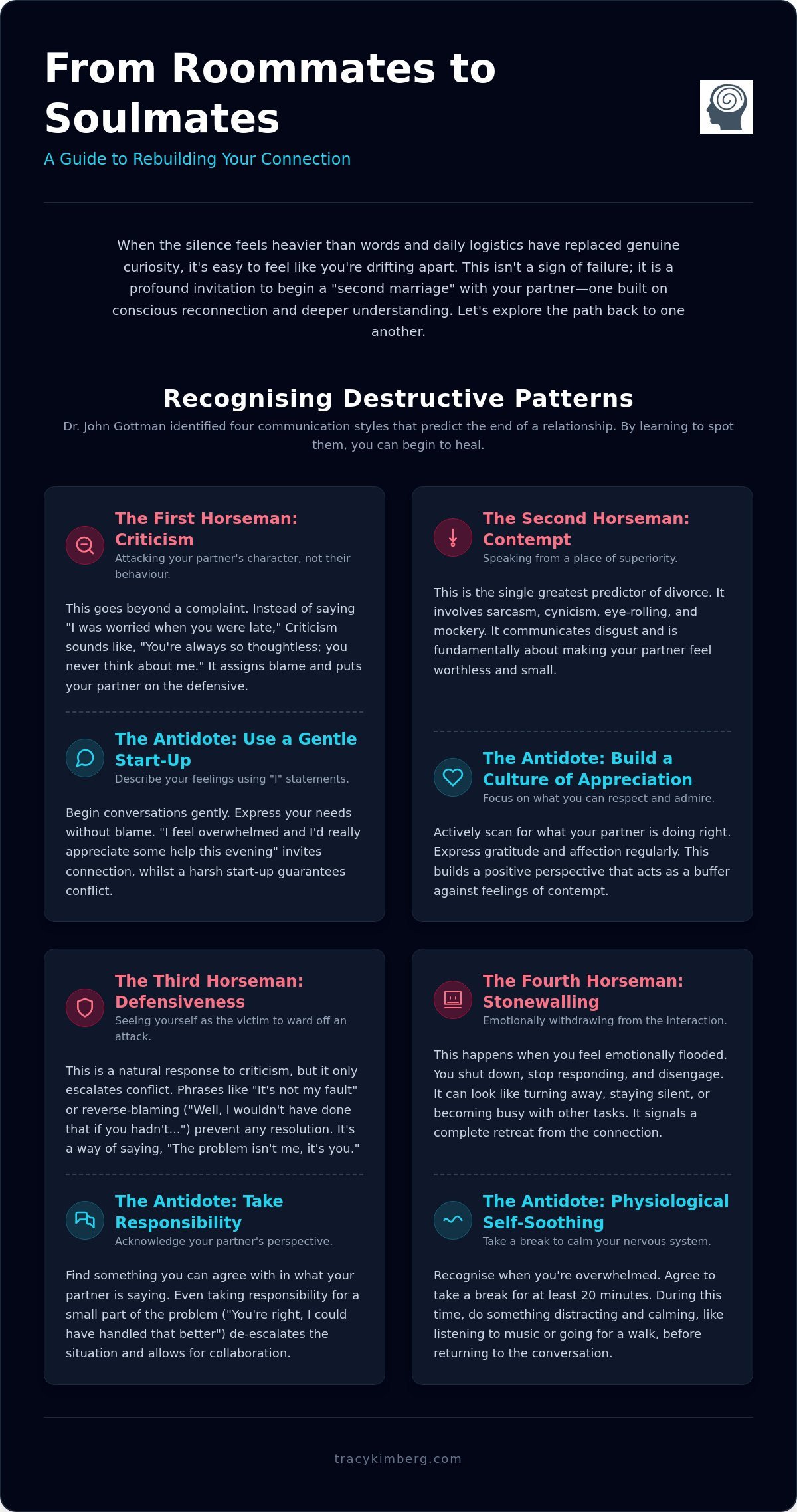
Counteracting the Four Horsemen
Gottman identified four destructive behaviours he calls the “Four Horsemen”: Criticism, Contempt, Defensiveness, and Stonewalling. Whilst Criticism attacks a partner’s character, Contempt is far more lethal. It is the single greatest predictor of divorce because it involves speaking from a place of superiority, often using sarcasm or eye-rolling to make a partner feel small. To heal, you must replace Contempt with a culture of appreciation, focusing on what your partner is doing right. The antidote to Defensiveness is simply taking responsibility for even a small part of the problem. If you feel overwhelmed and find yourself Stonewalling, or shutting down, the necessary step is physiological self-soothing. Take a 20-minute break to calm your heart rate before returning to the conversation.
The Power of the Softened Start-up
How a conversation begins almost always determines how it ends. A “harsh start-up” immediately triggers the other person’s fight-or-flight response, making productive dialogue impossible. Instead, try a softened start-up. This involves using “I” statements to describe your own feelings and needs without blaming your partner. For example, instead of saying “You never help,” try “I feel overwhelmed and I’d really appreciate some help this evening.” This approach invites connection rather than defensiveness. You might find expert advice on reconnecting helpful for understanding the broader context of these interactions.
Research shows that stable relationships maintain a 5:1 ratio, meaning for every negative interaction, there are five positive ones. This doesn’t mean you ignore problems; it means you build a “buffer” of kindness that makes the difficult conversations manageable. If you find these patterns are deeply ingrained, a structured Relationship Counselling and Coaching for Couples programme can provide the safe space needed to practice these new skills. Relearning how to talk to the person you love is a courageous act of hope.
Rebuilding Intimacy and Erotic Intelligence
Many couples believe that saving a relationship is solely about ending the fighting. Whilst resolving conflict is essential, you can be perfectly safe and yet perfectly bored. If you’re searching for how to save my relationship, you must look beyond the absence of war and toward the presence of vitality. Esther Perel’s philosophy teaches us that erotic intelligence is the ability to maintain a sense of mystery whilst enjoying the comforts of commitment. We often collapse into each other, thinking that total transparency is the goal, but this level of closeness can sometimes stifle the very attraction you’re trying to save.
Desire requires a bridge to cross. If there’s no distance between you, there’s no space for longing. This is the systemic “dance” of partnership: the constant tension between our need for security and our need for adventure. To move forward, you must honour both. This involves shifting your focus from “fixing” your partner to rediscovering the person they’ve become today, separate from your expectations or the roles they play in your household. Acknowledging that you are two separate individuals is the first step in restoring the erotic space between you.
Rituals of Connection
Reclaiming your bond requires structured habits that protect your time together. John Gottman’s research highlights “Rituals of Connection” as the scaffolding of a resilient marriage. These aren’t grand gestures, but small, daily choices that signal your partner is still your favourite person. Consider implementing the following:
- The 6-second kiss: A simple yet profound physical “bid” that is long enough to feel romantic and physiologically calming.
- State of the Union meetings: A weekly 20-minute check-in where you discuss the relationship itself, rather than the logistics of the house or the children.
- Shared play: Engaging in activities that spark joy and laughter, reminding you both that you are more than just co-parents or co-habitators.
Cultivating Curiosity and Mystery
The greatest enemy of desire is the belief that you already know everything about your partner. You’ve likely written a “fixed story” about them that leaves no room for surprise. To save the relationship, you must cultivate a fresh lens. This means creating space for autonomy and individual identities. When you see your partner in their own element, pursuing a hobby or excelling at work, you see them as a separate, attractive individual rather than just an extension of yourself. This distance creates the “erotic space” where curiosity can flourish, allowing you to navigate the delicate balance between the safety you crave and the adventure you need.
Individual Growth as a Catalyst for Change
It’s a common human impulse to look across the dinner table and see a list of things our partner needs to change. Whilst you are searching for how to save my relationship, the most profound shift often begins within your own internal landscape. Gabor Maté frequently observes that our adult conflicts are rarely about the present moment; they are echoes of childhood wounds that haven’t yet healed. When your partner forgets a chore or uses a certain tone, it doesn’t just annoy you; it might trigger a deep-seated fear of being unimportant or abandoned. Recognising this is the first step toward true healing.
Breaking Trauma Cycles in Partnership
Identifying your attachment style, whether it’s anxious, avoidant, or disorganised, can be a revelation. It helps you understand that your partner’s sudden withdrawal or intense need for reassurance is often a self-protection mechanism rather than a personal attack. When you realise their triggers are often not about you, it becomes easier to respond with empathy instead of defensiveness. Our early experiences of love create a blueprint that unconsciously directs how we navigate intimacy and conflict in our adult lives. Breaking these cycles requires a conscious effort to respond to the present reality rather than the past pain.
The Myth of the “Perfect Partner”
We often fall in love with a fantasy and then spend years being disappointed by the reality. To save the relationship, you must move from “fixing” to “witnessing” each other’s growth. Accepting that both you and your favourite person are flawed, evolving humans allows for a more authentic connection. This doesn’t mean accepting poor behaviour, but it does mean acknowledging that your partner cannot be the sole source of your happiness or self-worth. If you find that your past is consistently interfering with your present, engaging in Therapy for Adults can provide the clarity needed to show up more fully in your relationship.
Taking the Next Step: Structured Relationship Recovery
When you’re caught in the cycle of circular arguments, it’s easy to feel like you’ve tried everything. You might have read every book on how to save my relationship or watched countless videos, yet the distance remains. This is where the transition from self-help to structured professional guidance becomes essential. Whilst some seek initial perspective through Breeve, a professional Wise Guide provides a mirror and a map, helping you navigate the complex emotional terrain that feels so overwhelming when you’re in the thick of it. It’s about moving from a place of reactive anxiety toward a calm, optimistic future.
Choosing a structured approach over ad-hoc advice means you aren’t just putting out fires; you’re rebuilding the foundation. Ad-hoc fixes often address the symptoms of a breakdown without touching the root cause. By engaging in a research-based programme, you move from reactive survival into a proactive and positive adventure of rediscovery. It’s a commitment to a process that values clinical accuracy whilst never losing sight of the deeply human connection at the heart of your partnership. This structured work makes the daunting task of healing feel both powerful and manageable.
The 12-Week Relationship Recovery Process
The 12-Week Relationship Recovery Process is designed for couples who are ready for deep, lasting change. This isn’t a quick fix or a series of casual chats. It’s a transformational path that addresses the most challenging issues, including infidelity recovery and chronic emotional disconnect. Throughout these twelve weeks, you’ll work through a specific framework to rebuild trust, improve communication, and co-create a resilient future. The goal is to move beyond the “Roommate Phase” discussed earlier and into a conscious, thriving partnership where both of you feel safe to be your authentic selves.
Choosing Between Online and Face-to-Face Therapy
Deciding how to access support is a personal choice that depends on your lifestyle and comfort levels. Online Therapy offers incredible flexibility for busy couples, allowing you to engage in sessions from the comfort and safety of your own home. It removes the stress of travel and can often feel less intimidating for those new to the therapeutic process. However, Face-to-Face Therapy remains a powerful option for many who prefer the physical presence and direct connection of an in-person setting. Both formats provide a safe, non-judgemental environment where you can discuss difficult topics openly.
The first step is often the hardest, but it’s also the most courageous. Whether you choose to meet online or in person, the invitation is the same: to stop drifting and start connecting. You don’t have to navigate this landscape alone. By booking an initial consultation for Relationship Counselling and Coaching for Couples, you’re choosing to invest in the long-term emotional health of your partnership. This is your opportunity to transform your current struggle into a foundation for a more resilient, loving future.
Choosing a Conscious Path Forward Together
We’ve explored how moving from reactive silence to intentional communication can bridge the gap between you. By balancing the need for emotional safety with the thrill of discovery, you can transform the “Roommate Phase” into a vibrant second marriage. Real progress requires looking inward at our own wounds whilst showing up with curiosity for our partner’s evolution. Learning how to save my relationship isn’t about erasing the past, but about using it as a foundation for a more resilient future.
If you’re ready to move beyond ad-hoc fixes, I invite you to book your initial consultation for the 12-Week Relationship Recovery Process with Tracy Kimberg. As a UK-based specialist inspired by Gottman and Perel methodologies, I provide a safe, non-judgemental environment to help you navigate these complexities, whether you prefer face-to-face sessions or my global online reach. You don’t have to navigate this landscape alone; professional guidance can turn a period of crisis into a proactive adventure of healing.
Your relationship is an evolving story, and with the right tools and commitment, the next chapter can be your most profound and connected one yet.
Frequently Asked Questions
How do I know if my relationship is actually worth saving?
A relationship is worth saving if there is still a shared commitment to growth and a foundation of mutual respect, even if it’s currently buried under layers of resentment. If both partners are willing to look at their own contributions to the disconnect, there is a clear path forward. It’s less about your current state of happiness and more about the presence of goodwill and a genuine desire to co-create a new, more conscious version of your partnership.
Can a relationship survive infidelity or an emotional affair?
Yes, a relationship can survive infidelity if both partners are committed to a process of radical honesty and structured healing. Whilst the pain is profound, many couples find that working through an affair leads to a deeper, more authentic connection than they had before. It requires the partner who strayed to take full accountability whilst the betrayed partner eventually allows for the possibility of a new, more transparent bond built on repaired trust.
What if my partner refuses to go to relationship coaching or therapy?
If your partner refuses to join you, starting individual therapy is still a powerful way to influence the relationship dynamic. When one person changes their patterns of reaction and behaviour, the other is often forced to shift in response. You can focus on your own self-regulation and boundaries, which frequently creates the emotional safety your partner needs to eventually consider joining the process as they see the positive changes in you.
How long does it typically take to see progress in a relationship?
You can often begin to see shifts in your communication within the first few weeks of a structured programme. However, rebuilding deep trust and emotional safety typically requires a more sustained commitment, such as a 12-week process. Progress isn’t linear; it involves small, daily “bids for connection” that eventually accumulate into a significant shift in the relationship’s overall climate and resilience. Consistency is far more important than speed when healing a bond.
Is it possible to save a relationship when we have lost all intimacy?
It is absolutely possible to restore intimacy, but it involves moving beyond just “fixing” problems and toward rediscovering each other with fresh curiosity. When searching for how to save my relationship after intimacy has faded, the focus must shift to rebuilding emotional safety first. Physical closeness often follows naturally once the “erotic space” is cleared of micro-resentments and both partners feel seen and heard in their vulnerability without fear of judgement.
How do I bring up the idea of relationship counselling to my partner?
Approach the conversation during a calm, connected moment using “I” statements rather than during an argument. Focus on your own desire for a better connection rather than your partner’s failings. You might say, “I value our relationship so much that I want us to have the best tools to navigate our challenges.” Framing it as a proactive adventure for the health of the partnership is often more effective than presenting it as a last resort or a punishment.
What is the difference between relationship coaching and traditional therapy?
Relationship coaching tends to be more goal-oriented and focused on the “how” of moving forward, whilst traditional therapy often delves deeper into the “why” of past behaviours. In my practice, I blend these approaches to provide both clinical insight and actionable strategies. This dual focus ensures you understand your history and childhood wounds whilst gaining the practical, research-based skills needed to change your daily interactions and improve your long-term emotional trajectory.
How can I stop the same circular arguments from happening every day?
To break the cycle of circular arguments, you must learn to recognise the physiological signs of “flooding” and call for a productive time-out. When your heart rate exceeds 100 beats per minute, your brain’s logic centre effectively shuts down. By pausing for at least 20 minutes to self-soothe, you can return to the conversation in a state where you can actually hear each other, rather than just waiting for your turn to defend yourself or attack back.

Article by
Tracy Kimberg
Tracy Kimberg is a Relationship Expert, Couples Therapist and Coach with a dedicated focus on helping couples and individuals rebuild connection, trust and emotional safety in their relationships. Drawing on the research of John and Julie Gottman, the relational insights of Esther Perel, and years of hands-on therapeutic experience, Tracy offers a warm, non-judgemental and deeply compassionate approach to modern relationships.
Based in Dorset, Tracy works with couples navigating communication breakdowns, betrayal, intimacy challenges, separation, family dynamics and life transitions. Known for creating a safe and grounded therapeutic space, she combines practical tools with emotional depth to help clients move beyond survival patterns and towards meaningful, lasting change.
With a reputation for empathy, professionalism and dedication to her clients’ growth, Tracy is passionate about helping people feel seen, understood and empowered — both within their relationships and within themselves.
Disclaimer
Disclaimer:
The information shared in this article is intended for educational and informational purposes only and should not be considered a substitute for professional therapeutic, psychological, medical or legal advice. Every individual and relationship is unique, and the perspectives offered are based on general therapeutic principles, research and professional experience.
Reading this article does not establish a therapist-client relationship with Tracy Kimberg. If you are experiencing significant emotional distress, relationship crisis, trauma, or mental health concerns, it is important to seek support from a qualified professional appropriate to your individual circumstances.
All content remains the intellectual property of Tracy Kimberg and may not be reproduced or distributed without permission.