

You walk through the front door and the silence does not just greet you; it echoes. The kettle whistles in an empty kitchen, and the sofa where you once shared laughter now feels like a lonely island in a vast, quiet sea. It’s a heavy, physical ache that makes you wonder if you’ll ever feel truly seen or “lovable” again. You aren’t alone in feeling this way. Many people find that the sudden loss of a shared social circle and the quiet of a formerly bustling home are the most confronting parts of a relationship ending. Learning how to cope with loneliness after separation is not about simply distracting yourself until the day ends or “staying busy” to avoid the pain.
It is a process of navigating the emotional void to transform your solitude into a path of self-discovery and renewed connection. I want to show you that this period of transition, though painful, can be the foundation for a more authentic version of yourself. In this guide, we will explore practical ways to regulate your emotions, fill your hours with meaningful activity, and build a sense of hope for a future where you feel whole once more. You’ll find that the silence is not something to fear, but a space where your new identity can finally begin to breathe.
Key Takeaways
- Understand the physiological nature of your grief and why separation often feels like a physical withdrawal from a shared life.
- Discover practical, grounding techniques for how to cope with loneliness after separation, specifically during the quietest hours of the day.
- Learn how to re-author your living space and your personal narrative to transition from a shared identity to a reclaimed sense of self.
- Identify the vital difference between “distraction friends” and a conscious support system that truly honours your emotional healing.
- Recognise the signs that you may need a structured therapeutic path, such as a 12-week recovery programme, to navigate the complexities of relational breakdown.
Understanding the Biology of Loneliness After Separation
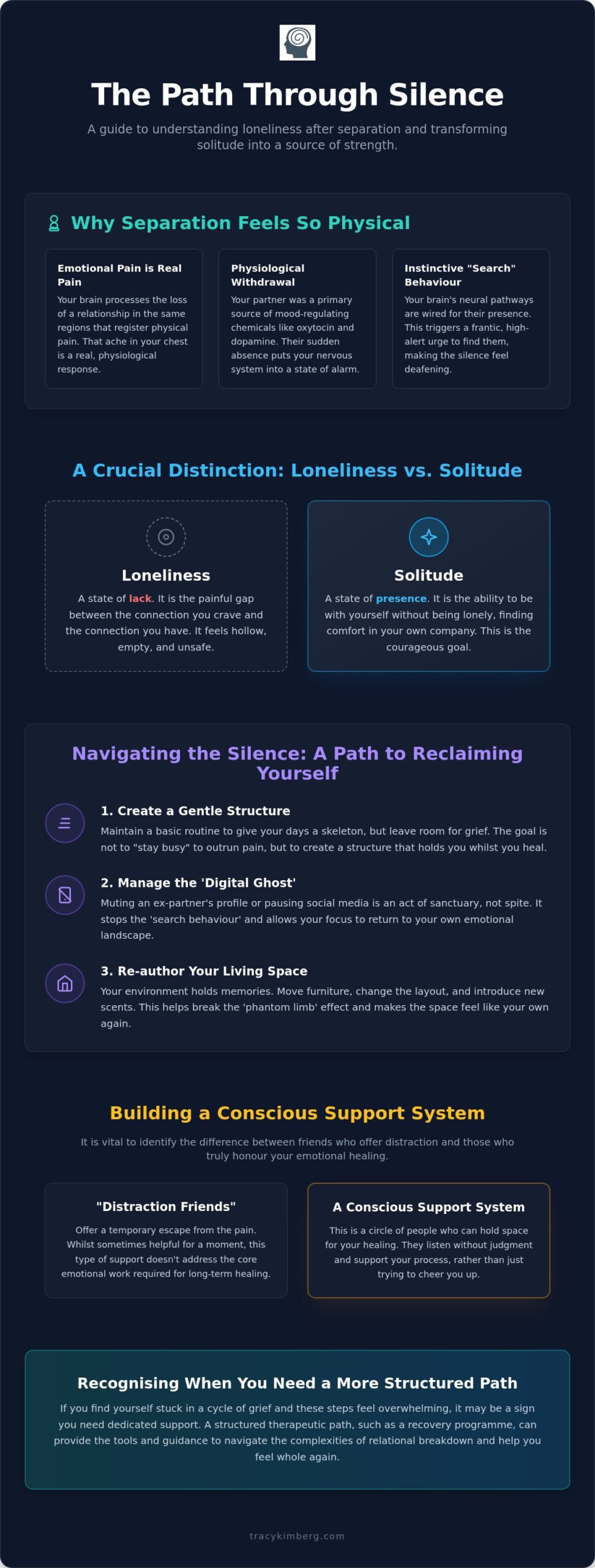
When a relationship ends, the pain often feels surprisingly physical. You might feel a literal ache in your chest or a hollowness in your stomach that no amount of logic can soothe. This isn’t just “in your head.” To understand how to cope with loneliness after separation, you must first recognise that your body is experiencing a form of physiological withdrawal. For years, your partner was a primary source of oxytocin and dopamine; the “feel-good” chemicals that regulate your mood and sense of safety. When that source is abruptly removed, your nervous system enters a state of alarm.
Research into the biology of loneliness shows that our brains process relational loss in the same regions that register physical pain. This is why the “phantom limb” effect is so common amongst the newly separated. You might instinctively turn to share a joke with an empty chair or feel a jolt of panic when you realise their keys aren’t on the hook. Your brain has spent years building neural pathways around this person’s presence. Those paths don’t disappear overnight; they continue to fire, searching for the person who is no longer there. Your distress is not a sign of weakness; it is a natural, healthy response to a broken attachment bond.
The Attachment Bond and the “Search” Behaviour
Human beings are biological mirrors. In a long-term partnership, our nervous systems actually co-regulate; our heart rates, sleep patterns, and cortisol levels often synchronise with our partner’s. When they leave, your system loses its “regulatory anchor.” This triggers what psychologists call “search behaviour.” It’s the frantic urge to check your phone, scroll through their social media, or listen for their car in the driveway. Gabor Maté often speaks about how the pain of disconnection is rooted in our fundamental need for belonging. When that connection snaps, your body treats it as a survival threat, keeping you in a state of high-alert anxiety that makes the silence of the house feel deafening.
Loneliness vs. Solitude: A Crucial Distinction
It helps to distinguish between the “hollow” of loneliness and the “fullness” of solitude. Loneliness is a state of lack; it is the painful gap between the connection you want and the connection you have. This feeling is often intensified by childhood attachment patterns that tell us we are only safe when someone else is watching over us. Solitude, however, is a state of presence. It is the ability to be alone without being lonely, finding comfort in your own company rather than fearing the quiet. Solitude is the courageous act of turning toward yourself as the first step toward true emotional healing.
Navigating the Silence: Practical Strategies for the Immediate Aftermath
The silence of a home that was once shared is loudest on a Friday evening. It is the time when the “we” was most active, and its absence feels like a physical weight. When you are learning how to cope with loneliness after separation, you quickly realise that the hardest battles aren’t fought in a solicitor’s office; they are fought in the quiet hours of a Sunday afternoon. It’s vital to maintain a basic routine to give your days a skeleton, yet you must also leave room for the sudden, sharp waves of grief that don’t follow a schedule. Don’t try to fill every second with “busyness” as a way to outrun the pain; instead, create a structure that holds you whilst you heal.
Managing the “digital ghost” of your former partner is another modern hurdle that requires firm boundaries. Every time you see their name pop up or check their “active” status, you are feeding the search behaviour that keeps your nervous system on high alert. Muting their profile or taking a break from social media isn’t an act of spite. It’s an act of sanctuary. By clearing these digital triggers, you begin the essential work of reclaiming your identity after separation, allowing your focus to return to your own emotional landscape rather than their highlights reel.
Creating a Sanctuary at Home
Your physical environment holds memories in its very layout. To break the “phantom limb” effect, you need to re-author your space so it reflects your personality rather than the partnership. Move the furniture to change the flow of a room. If you always sat on the left side of the sofa, move to the right. Introduce new scents through candles or diffusers that don’t carry the emotional weight of the past. Sensory comfort is a powerful tool for soothing an anxious nervous system. By organising your external world, you provide a sense of order for your internal chaos.
The “First Aid” Kit for Loneliness Attacks
There will be moments when the silence feels suffocating. In these times, you need a “first aid” kit of grounding techniques. Try the 20-minute rule: when the urge to reach out to your ex or scroll through old photos becomes overwhelming, commit to waiting just twenty minutes. Usually, the peak of the emotional wave will pass. Choose high-quality connection, like calling a trusted friend, over the low-quality dopamine hit of a phone screen. If you find yourself stuck in a loop of despair, engaging in a structured Relationship Recovery Process can offer the professional guidance needed to bridge the gap between “we” and “me”.
Reclaiming Your Identity: Moving from “We” to “Me”
In a long-term relationship, the boundaries of the self often blur. This “identity fusion” means that your preferences, your social schedule, and even your sense of future purpose were likely negotiated through the lens of a partnership. When that partnership dissolves, the resulting loneliness is often an existential crisis in disguise. You aren’t just missing a person; you are missing the version of yourself that existed alongside them. Understanding how to cope with loneliness after separation requires a fundamental shift in how you perceive your own reflection. It is a painful, yet profound, opportunity for self-actualisation.
Esther Perel often suggests that in every relationship, we mute certain parts of ourselves to make room for the “we.” Perhaps you stopped travelling, suppressed a specific ambition, or quietened a hobby that didn’t fit into your shared life. Now is the time to listen to those muted parts. The goal is to move from seeking external validation to becoming your own “primary attachment figure.” This means learning to provide yourself with the safety, reassurance, and consistency you once looked for in a partner. It is about building an internal sanctuary that remains standing even when the external structure of your life has changed.
The Narrative of the Break-up
The story you tell yourself about why the relationship ended dictates the quality of your solitude. If your internal narrative is one of abandonment or being “unlovable,” your loneliness will feel like a prison sentence. However, if you shift toward a growth narrative, the quiet becomes a workshop for your new life. Conscious separation is the intentional process of uncoupling with mutual respect and emotional clarity, allowing both individuals to transition into their new lives without the weight of unresolved resentment. By choosing this path, you transform the end of a relationship into a dignified beginning for your new identity.
Rediscovering Personal Desire and Eroticism
We often equate eroticism solely with sexual intimacy, but in the context of healing, eroticism is about vitality. It is the “spark” that makes you feel alive and connected to the world around you. After a separation, that spark can feel extinguished by the heavy blanket of grief. Reclaiming your identity involves reconnecting with the things that make you feel vibrant, whether that’s the tactile joy of gardening, the rhythm of a morning walk, or the intellectual thrill of a new book. Curiosity is the most powerful antidote to the stagnation of loneliness. By following your own desires, you begin to fill the hours with a sense of presence rather than a sense of lack.
Building a Conscious Support System
There is a specific kind of ache that occurs when you are sitting in a crowded room, surrounded by laughter, yet feeling utterly invisible. This “lonely in a crowd” sensation often happens because your social life is still built for the person you were, not the person you are becoming. When exploring how to cope with loneliness after separation, it is tempting to say “yes” to every invitation just to keep the silence at bay. However, using people as a human shield against your own grief is rarely effective. True healing requires moving away from “distraction friends”—those who help you numb the pain with noise—and toward “support friends” who can sit with you in the quiet.
Communicating your needs to your existing circle is a vital step in this transition. You might need to tell people, “I want to come out, but I might need to leave early if I feel overwhelmed,” or “I’m not ready to talk about the separation yet, I just need to feel part of the group.” By being explicit about your boundaries, you prevent the exhaustion that comes from performing “fine” when you are actually struggling. Be wary of rebound socialising or jumping into the dating world too soon. Whilst a new connection offers a temporary dopamine hit, it often masks the underlying work of building a solid, independent identity. You are looking to build a village that honours your growth, not just a crowd to fill your calendar.
Audit Your Social Circle
Take a moment to reflect on your current connections. Who makes you feel seen and energised, and who leaves you feeling emotionally depleted? Separation often acts as a natural filter for friendships. You may find that mutual friends of your former partner bring up feelings of divided loyalty or awkwardness; it is perfectly acceptable to set boundaries or take a temporary step back from these dynamics. Vulnerability is the bridge to deeper connection. By sharing your authentic experience with a few trusted individuals, you transform surface-level acquaintances into a genuine support network.
Seeking Community Amongst Strangers
Sometimes, the most profound support comes from those who haven’t known you as part of a couple. Support groups for the separated provide a unique therapeutic value because they offer a mirror to your own experience without the baggage of your past. Volunteering is another powerful way to reconnect with a sense of purpose, shifting your focus from your own lack to the contribution you can make to others. Attending events “solo” for the first time will feel awkward, but it is a necessary rite of passage in reclaiming your autonomy. If you find the social transition particularly daunting, engaging in Relationship Counselling and Coaching can provide a safe space to practice these new interpersonal skills.
When to Seek Professional Support: The Path to Recovery
Loneliness is a spectrum, and it is vital to recognise where your experience sits. Normal “grief-loneliness” often arrives in waves; it is heavy and painful, but it allows for brief moments of respite where you can still see a future, however distant. Clinical depression, by contrast, feels like a static, unchanging fog that strips away your ability to feel pleasure or hope. If you find that the practical strategies for how to cope with loneliness after separation aren’t providing relief after several months, or if you feel consistently stuck in a “loneliness loop,” professional intervention can provide the scaffolding you need to stand again.
Therapy acts as a safe container for the emotions that often feel too raw or complex to share with friends or family. Whilst your social circle provides comfort, a professional therapeutic environment offers a non-judgemental space to explore the deeper mechanics of your attachment and the trauma of the disconnect. It is the difference between having someone hold your hand and having a guide show you the way out of the woods. Moving from surviving the day to thriving in your new life requires more than just time; it requires the intentional processing of your relational history.
The 12-Week Relationship Recovery Process
When your world feels like it has no floor, a structured, time-bound framework can be incredibly grounding. The 12-Week Relationship Recovery Process is designed to move you through the layers of emotional breakdown in a manageable, research-based way. Rather than wandering through your grief without a map, this programme provides a clear path toward healing. It involves deep work on your own identity, helping you address the underlying patterns that may have influenced your partnership dynamics. Engaging in individual therapy for adults during this time is the best investment you can make for your future relationships. By understanding your own emotional triggers and attachment needs, you ensure that your next connection is built on a foundation of health rather than a reaction to your past pain.
Taking the First Step Towards Connection
Admitting that the path ahead is too steep to climb alone is not a sign of failure; it is an act of profound strength and agency. In the context of separation, many people find clarity by combining different types of support. Counselling often focuses on the “why” of your past experiences, whilst coaching is more concerned with the “how” of your future goals. Both are essential components of a holistic recovery. If you are ready to stop merely enduring the silence and start building a life of renewed connection, you can book a discovery call to begin your journey of recovery. This is the first step in a proactive adventure toward reclaiming your vitality and emotional health.
Embracing the Journey Towards Reconnection
The path through the quiet of an empty home is rarely linear, but it is deeply transformative. You’ve discovered that the physical ache of separation is a natural biological response, and that by re-authoring your space and setting digital boundaries, you can begin to quiet the alarm of your nervous system. Reclaiming your identity means listening to the muted parts of yourself and moving from a shared “we” to a vibrant, independent “me.” Understanding how to cope with loneliness after separation isn’t about rushing to fill the void with noise; it’s about building an internal sanctuary of self-compassion and curiosity.
If you feel ready to move beyond merely surviving the silence, I offer a safe, non-judgemental environment for both online and face-to-face sessions. My work is grounded in the research-based approaches of experts like Gottman and Perel, providing transformational support for those navigating the weight of relational breakdown. You don’t have to navigate this landscape alone. Begin your 12-Week Relationship Recovery journey today to transform this period of loss into a proactive adventure of healing. Remember, the end of a partnership is not the end of your story; it is the beginning of a deeper connection with yourself.
Frequently Asked Questions
Is it normal to feel lonely even when I wanted the separation?
It is absolutely normal to feel a deep sense of loss even if you were the one who initiated the split. You are mourning the death of a “we” and the loss of a predictable future. Even a chosen change requires a physiological adjustment as your body resets its attachment expectations. Allow yourself the grace to grieve the companionship whilst still knowing the decision to separate was the right one for your long-term health.
How long does the loneliness usually last after a break-up?
There is no universal timeline for healing because every relationship and attachment history is unique. Many people find the first six months to be the most challenging as they navigate “first” milestones and holidays alone. The intensity usually begins to fade as you build new routines and neural pathways. If you feel stuck in a static state of despair after several months, seeking structured support can help you move through the process more effectively.
Should I stay in touch with my ex to feel less lonely?
Whilst it feels like a temporary relief, staying in touch often hinders your ability to learn how to cope with loneliness after separation. Every text or call resets the “attachment clock” and prevents your brain from forming new, independent neural pathways. A period of intentional distance allows your nervous system to find its own baseline. This creates the necessary space for true emotional healing to take root without the interference of old triggers.
What if I feel like I will never find anyone else?
This is a common cognitive distortion triggered by the “alarm” state of your nervous system after a break-up. When you are in the midst of relational trauma, your brain struggles to imagine a future that looks different from your current pain. This thought is a reflection of your current grief, not a factual prediction of your future. Focus on becoming your own primary attachment figure; as you heal, your capacity for new, healthy connections will naturally return.
How can I tell the difference between loneliness and depression?
Loneliness is typically situational and tends to come in waves that are triggered by specific memories or quiet moments. Depression, however, is a persistent state of low mood that often strips away your ability to feel pleasure in anything at all. If you find that your sleep, appetite, and basic ability to function are severely disrupted for more than a few weeks, it is important to speak with a professional to explore a clinical path to recovery.
Can individual therapy help if my partner was the one who left?
Individual therapy is incredibly effective for those who didn’t choose the separation because it provides a safe space to process the trauma of rejection. It allows you to examine your attachment patterns and rebuild your self-esteem outside of the context of the relationship. Therapy helps you move from a narrative of being “left” to a narrative of reclaiming your own life. It is an investment in your future resilience and emotional health.
Is it a good idea to get a pet to cope with the silence at home?
Introducing a pet can be a wonderful way to provide sensory comfort and a sense of routine during a difficult transition. The presence of an animal can lower cortisol levels and provide a non-judgemental form of companionship that soothes the nervous system. However, a pet should be seen as a complement to your healing process rather than a substitute for human connection or the professional work required to process the end of your relationship.
How do I explain my loneliness to my children without upsetting them?
You can be honest with your children by using age-appropriate language that focuses on emotional regulation. You might say, “I am feeling a bit quiet today because I am adjusting to our new changes, but I have friends and tools that help me feel better.” This approach validates that feelings are okay whilst reassuring them that you are still the stable, capable adult in their lives. It models a healthy way to handle complex emotions without making them responsible for your happiness.

Article by
Tracy Kimberg
Tracy Kimberg is a Relationship Expert, Couples Therapist and Coach with a dedicated focus on helping couples and individuals rebuild connection, trust and emotional safety in their relationships. Drawing on the research of John and Julie Gottman, the relational insights of Esther Perel, and years of hands-on therapeutic experience, Tracy offers a warm, non-judgemental and deeply compassionate approach to modern relationships.Based in Dorset, Tracy works with couples navigating communication breakdowns, betrayal, intimacy challenges, separation, family dynamics and life transitions. Known for creating a safe and grounded therapeutic space, she combines practical tools with emotional depth to help clients move beyond survival patterns and towards meaningful, lasting change.With a reputation for empathy, professionalism and dedication to her clients’ growth, Tracy is passionate about helping people feel seen, understood and empowered — both within their relationships and within themselves.
Disclaimer
Disclaimer:The information shared in this article is intended for educational and informational purposes only and should not be considered a substitute for professional therapeutic, psychological, medical or legal advice. Every individual and relationship is unique, and the perspectives offered are based on general therapeutic principles, research and professional experience.Reading this article does not establish a therapist-client relationship with Tracy Kimberg. If you are experiencing significant emotional distress, relationship crisis, trauma, or mental health concerns, it is important to seek support from a qualified professional appropriate to your individual circumstances.All content remains the intellectual property of Tracy Kimberg and may not be reproduced or distributed without permission.