

Criticism is rarely the sign of a failing heart; more often, it is a poorly phrased protest of an unmet longing. It is exhausting to feel like you can never do anything right, especially when that feedback comes from the person you love most. That familiar knot of anxiety in your stomach before you walk through the front door, wondering which version of your partner you will meet, is a heavy and lonely place to be. You have likely felt the growing emotional distance where every conversation feels like a minefield and the person who was once your favourite seems more like a judge.
The good news is that overcoming criticism in a relationship is entirely possible when you have the right tools. It is not about ignoring problems; it is about translating those sharp attacks back into vulnerable requests for intimacy. This guide uses research-based psychological insights to help you dismantle destructive communication patterns and rebuild trust. We will explore how to stop the cycle of personal attacks and return to a partnership where you both feel seen, valued, and truly understood.
Key Takeaways
- Learn to distinguish between a specific complaint about behaviour and a character attack, which is the first step in protecting your emotional bond.
- Discover how overcoming criticism in a relationship involves uncovering the hidden longings and unmet needs that often fuel verbal sharpness.
- Master the “Softened Startup” technique to express your feelings and needs effectively without triggering your partner’s defensiveness.
- Understand the physical signs of emotional “flooding” and how to use the “Kernel of Truth” method to stay calm and receptive during difficult conversations.
- Explore how a structured 12-week recovery process can provide the neutral centre needed to unlearn destructive habits and restore lasting intimacy.
What is Criticism in a Relationship and Why Does it Hurt So Much?
When you are in the thick of a heated moment, it is easy to mistake a sharp tongue for simple honesty. However, there is a profound difference between expressing a grievance and attacking the very soul of the person you love. Criticism is not merely a list of things your partner did wrong; it is a global strike on their character. It moves the focus from a specific action to a permanent flaw in their personality. This shift is why overcoming criticism in a relationship feels so urgent for couples who have lost their way. When your partner becomes a judge rather than a teammate, the safety of the relationship begins to dissolve.
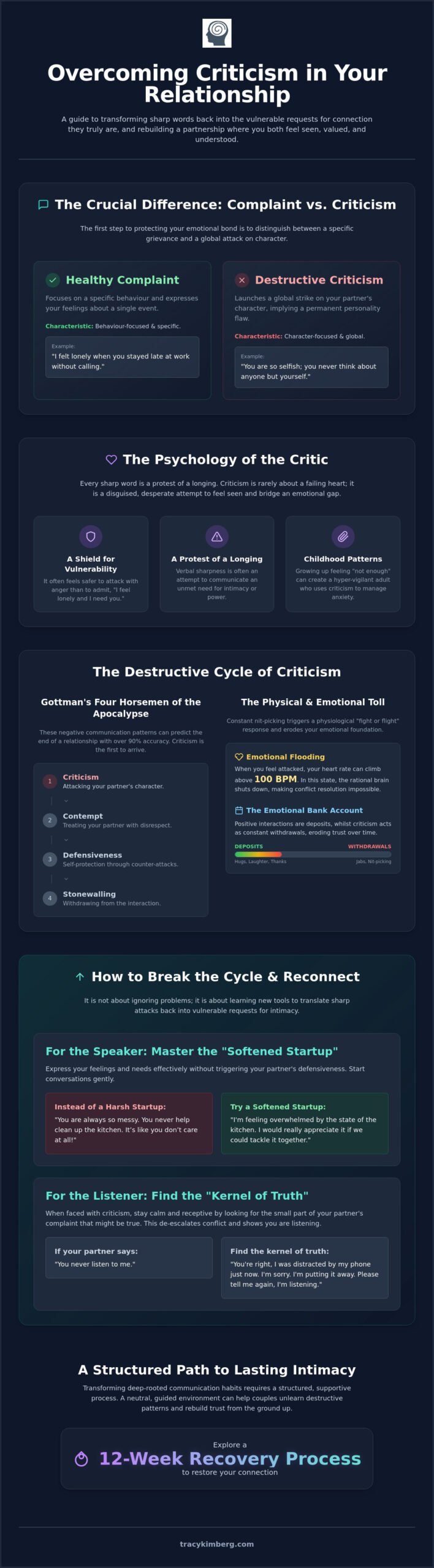
Dr John Gottman, a leading figure in relationship research, identifies criticism as one of the “Four Horsemen of the Apocalypse.” His studies suggest that these negative communication patterns can predict the end of a relationship with over 90% accuracy. Criticism is often the first horseman to arrive, opening the gates for contempt, defensiveness, and eventually, stonewalling. It hurts so deeply because it triggers a physiological “fight or flight” response. When you feel attacked, your heart rate can climb above 100 beats per minute, a state known as flooding. In this state, the rational part of your brain shuts down, making it nearly impossible to resolve the actual issue at hand.
Complaint vs. Criticism: Knowing the Difference
The path to overcoming criticism in a relationship begins with learning to speak the language of complaints. A complaint is behaviour-focused and specific. For example, saying, “I felt lonely when you stayed late at work without calling,” is a healthy expression of a need. It addresses a single event and how it made you feel.
Criticism, conversely, is character-focused and global. It sounds like, “You are so selfish; you never think about anyone but yourself.” Notice the red-flag phrases “you always” or “you never.” These are rarely true and serve only to put your partner on the absolute defensive. By attacking their essence, you invite them to protect themselves rather than to hear your pain.
The Emotional Toll of Constant Nit-picking
Every relationship has what we call an “Emotional Bank Account.” Positive interactions like a warm hug, a shared laugh, or a genuine “thank you” act as deposits. Subtle, daily criticisms are like constant, small withdrawals. Over time, these jabs erode the foundation of trust. You might find yourselves transitioning from being each other’s “favourite person” to feeling like frustrated roommates or, worse, adversaries.
We take criticism more personally from a partner than from a boss or a friend because our partner holds the mirror to our most vulnerable selves. When that mirror only reflects our failures, the emotional distance grows. This creates a “criticism-defensiveness” loop: one person attacks, the other protects themselves by counter-attacking or withdrawing, and the cycle of resentment continues until the connection feels entirely severed.
The Psychology of the Critic: Understanding the Unmet Longing
Every sharp word is a disguised desire. When we understand that criticism is often a “protest of a longing,” we begin to see the person behind the attack. Esther Perel suggests that when intimacy or power feels out of reach, we often resort to verbal sharpness to bridge the gap. It is a desperate, albeit destructive, attempt to feel seen. Gabor Maté’s work highlights how childhood patterns of “not being enough” can create a hyper-vigilant adult. If you grew up in an environment where your worth was conditional, you might now use criticism as a way to manage the anxiety of your own perceived imperfections.
Common triggers like exhaustion, chronic stress, or feeling invisible within the partnership can turn a simple request into a stinging rebuke. Recognising these triggers is a vital part of overcoming criticism in a relationship. It requires us to look beneath the surface of the argument to the emotional hunger driving it. When we feel unheard, our voice often gets louder and sharper, hoping to finally pierce through the silence.
Criticism as a Shield for Vulnerability
It often feels safer to attack than to admit, “I feel lonely and I need your help.” Vulnerability is a risk; anger is a shield. This is why many conversations begin with “harsh startups,” where the first few minutes are laced with blame. Research from The Gottman Institute shows that The ‘Softened Startup’ and Other Tools are essential for turning these attacks back into constructive dialogue. The critic is often someone who feels fundamentally out of control in their own life, using verbal control as a way to find stability amongst the chaos.
Attachment Styles and the Critical Voice
Your attachment style dictates your “attachment cry.” For those with an anxious attachment, criticism is often “protest behaviour.” It is a loud, urgent way to get a partner’s attention when they feel the connection is slipping. Conversely, an avoidant partner might use criticism to create distance when things feel uncomfortably intimate. They find a flaw to justify pulling away. Recognising your own attachment cry behind the words you choose is a profound step toward healing.
If these patterns feel deeply ingrained, you don’t have to unlearn them alone. Working with a specialist through Relationship Counselling and Coaching can provide the safe space needed to explore these hidden longings. Overcoming criticism in a relationship starts with the courage to be vulnerable instead of being right.
Breaking the Cycle: The ‘Softened Startup’ and Other Tools
One of the most effective ways to prevent a descent into resentment is by organising a weekly “State of the Union” meeting. This is a dedicated twenty-minute space where you both feel safe to air complaints before they ferment into character-assassinating criticism. It provides a neutral centre for the relationship, ensuring that grievances are handled with care rather than hurled in the heat of the moment. By making this a ritual, you move from a state of hyper-vigilance to one of collaborative problem-solving.
How to Master the Softened Startup
The “Softened Startup” is perhaps the most vital skill for any couple. Research indicates that 96% of the time, the outcome of a conversation can be predicted by how it begins. If you start with a character attack, your partner will naturally retreat into defensiveness. To shift this dynamic, follow these three steps:
- Step 1: Share how you feel. Use “I” statements to own your emotion. Instead of saying “You make me so stressed,” try “I feel overwhelmed and anxious.”
- Step 2: About what specific situation. Pinpoint the behaviour, not the person. For example, “…about the state of the kitchen,” rather than “because you are a slob who never cleans.”
- Step 3: State a positive need. Give your partner a clear map to success. “Could you please help me with the washing up tonight?” This turns a potential argument into a request for support.
The Power of Repair Attempts
Even when a conversation begins to spiral, you can still save the connection through “Repair Attempts.” These are the small olive branches, such as a self-deprecating joke, a gentle touch on the shoulder, or a simple “I’m sorry, I said that poorly”; they act as an emergency brake on escalation. The secret to long-term stability is not the absence of conflict, but the presence of repair.
This process also requires “accepting influence.” When your partner makes a repair attempt, you have a choice: you can stay “right” and keep the wall up, or you can choose the relationship and let the wall down. Learning to make your own repair attempts whilst you are still feeling frustrated is an act of profound emotional courage. It signals to your partner that the relationship is more important than the dispute, which is a fundamental step in overcoming criticism in a relationship.
How to Receive Criticism Without Spiralling into Defensiveness
Being on the receiving end of a character attack feels like a physical blow. Your heart races, your palms sweat, and your mind begins to sharpen its own weapons for a counter-strike. This is “flooding,” a physiological state where your heart rate exceeds 100 beats per minute. When this happens, your rational brain effectively goes offline, making the goal of overcoming criticism in a relationship feel impossible. You aren’t being stubborn; your nervous system is simply in survival mode.
Moving from defensiveness to taking responsibility is the essential antidote to this dynamic. It requires a conscious shift from protecting your ego to protecting your connection. By learning to regulate your internal state, you can hear the message beneath the “nagg” and find a path back to intimacy.
Managing Your Nervous System During Conflict
The most important tool in your kit is the “20-Minute Rule.” If you feel your pulse quickening and your thoughts racing, you must call a timeout. However, this isn’t an excuse to stonewall or ignore your partner. You must walk away respectfully, saying something like, “I want to hear you, but I’m feeling flooded. I need twenty minutes to calm down so I can listen properly.”
- Self-Soothing: Use this time to signal safety to your brain. Focus on deep, diaphragmatic breathing or a simple physical task like walking. Do not spend the time rehearsing your counter-argument.
- The Re-do: Once you return, you can ask for a “re-do.” Try saying, “I want to hear your concern, but the way you said that made me feel defensive. Can we try again with a softened approach?”
Listening for the Need, Not the Nagg
To truly master overcoming criticism in a relationship, you must develop “emotional ears.” This means hearing the hidden longing behind the sharp words. When a partner says, “You’re always late,” they are often actually saying, “I miss you and I feel unimportant when you aren’t here.”
The “Kernel of Truth” method is a powerful way to disarm an attack. Even if you disagree with 90% of what your partner is saying, find the 10% you can agree with. Validation is not the same as agreement. You don’t have to agree that you “always” do something to validate that your partner’s feelings are real and important. Simply saying, “I can see why you’d feel that way, and I’m sorry my actions caused that,” can instantly lower the temperature of the room.
If you find that your relationship has become a constant cycle of attack and defence, it might be time for professional intervention. You can book a Relationship Counselling session to learn these regulation techniques in a safe, guided environment where both voices are heard without judgement.
Transforming Your Dynamic with Tracy Kimberg’s 12-Week Recovery
Breaking a cycle of criticism isn’t just about learning a few new phrases; it’s about shifting the tectonic plates of your relational dynamic. For many couples, overcoming criticism in a relationship requires more than a weekend workshop or a self-help book. It demands a structured, safe environment where both partners can unlearn defensive habits and rebuild trust from the ground up. This is where professional guidance becomes the bridge between wanting change and actually living it.
These principles of communication are universal; just as leaders look to Intact Academy for expertise in executive coaching and organisational change, couples also benefit from structured guidance to navigate complex relational dynamics.
The 12-Week Relationship Recovery Process provides a neutral centre for couples who feel they have lost their way. Inspired by the research-based methods of John Gottman and the systemic insights of Esther Perel, this programme moves beyond surface-level fixes. It addresses the emotional disconnect and relational breakdown at their source. By working through a clear framework, you move from “Conscious Conflict,” where you are painfully aware of your arguments, to “Conscious Connection,” where intimacy and understanding become your new baseline.
Why a Structured Programme Works Better Than ‘Trying Harder’
Willpower is often the first casualty of a high-conflict relationship. When you are exhausted and feeling invisible, “trying harder” usually leads to more of the same frustration. Breaking deeply ingrained habits requires a new blueprint rather than just more effort. The 12-week framework is designed to guide you through the crisis phase with a clear beginning, middle, and end. It provides the steady hand needed to navigate the most difficult emotional landscapes.
Weekly accountability ensures that the tools we’ve discussed, such as the Softened Startup and repair attempts, don’t just stay on the page. They become a permanent part of your vocabulary. Amongst the chaos of daily life, having a dedicated time to focus solely on the health of your partnership ensures that progress is consistent and measurable. You aren’t just stopping the criticism; you are actively cultivating a relationship where you both feel seen and valued.
Taking the First Step Toward a Criticism-Free Home
Couples coaching differs from individual therapy because the “client” is the relationship itself. Whilst individual work is valuable, relational breakdown requires a focus on the space between two people. My approach provides a compassionate, non-judgemental lens that helps you see the “protest of a longing” behind your partner’s words. Online sessions make this professional support accessible for those with a busy British lifestyle, allowing you to engage in deep work from the comfort of your own home.
You don’t have to wait for a total collapse to seek help. In fact, overcoming criticism in a relationship is most effective when you catch the patterns before they become permanent. If you are ready to return to being each other’s “favourite person,” it is time to invest in the recovery of your bond. Book your initial consultation with Tracy Kimberg today and begin your journey back to intimacy.
Reclaiming Your Partnership Through Conscious Connection
The journey of overcoming criticism in a relationship isn’t about achieving a state of perfect silence; it’s about learning to speak the language of longing rather than the language of blame. By mastering the Softened Startup and recognising the physiological signs of flooding, you can transform your home from a place of hyper-vigilance into a sanctuary of safety. Every sharp word often hides a vulnerable wish to be seen, valued, and truly understood by your favourite person.
When willpower alone isn’t enough to break these deeply ingrained habits, a structured approach provides the necessary blueprint for lasting change. My 12-Week Relationship Recovery Process offers a safe, non-judgemental environment where you can unlearn destructive behaviours whilst rebuilding trust. Inspired by the research-based methods of Gottman and Perel, this programme helps you move beyond the cycle of resentment and return to the intimacy you once shared. If you’re ready to do the work, I’m here to guide you through this transformative process.
Start your 12-Week Relationship Recovery Process with Tracy Kimberg and begin the proactive adventure of healing your bond today. There is profound hope for your relationship, and the first step is simply deciding that your connection is worth the effort.
Frequently Asked Questions
Is criticism a sign that my relationship is over?
Criticism is not a death sentence for your partnership; rather, it is an urgent signal that your communication system is in distress. Whilst it is one of the “Four Horsemen” that can predict relational breakdown, it is also a reversible habit. Many couples find that identifying the “protest of a longing” behind the sharp words allows them to rebuild a foundation that is stronger and more resilient than before.
How do I tell my partner their criticism is hurting me without starting a fight?
The key is to use a “softened startup” by focusing on your own feelings rather than your partner’s flaws. Instead of saying, “You are always so mean,” try saying, “I feel hurt and defensive when I hear feedback about my character, and I find it hard to listen to what you need.” This keeps the focus on the emotional impact and invites your partner to join you in problem-solving rather than defending themselves.
What is the ‘antidote’ to criticism according to the Gottman Method?
According to the Gottman Method, the direct antidote to criticism is the “softened startup.” This involves expressing your feelings using “I” statements, describing the specific situation neutrally, and then stating a positive need. By shifting from a character attack to a clear request for help, you bypass your partner’s “fight or flight” response and create a space where they can actually hear your request.
Can one person change the dynamic if the other partner isn’t ready for therapy?
Yes, you can begin the process of overcoming criticism in a relationship even if your partner is initially hesitant to join you in therapy. Relationships are systemic; when one person changes their “move” in the dance, the other is often forced to adjust. By mastering self-soothing and using softened startups yourself, you can lower the overall temperature of the relationship enough that your partner eventually feels safe enough to engage.
Why do I feel like I’m walking on eggshells around my partner?
Feeling like you are walking on eggshells is a sign of hyper-vigilance, usually caused by an unpredictable cycle of criticism and defensiveness. Your nervous system is constantly scanning for threats to avoid the pain of being “wrong” or attacked. This emotional state often leads to a “flooding” response, where you become so overwhelmed by the fear of conflict that you lose your ability to connect authentically with your partner.
How can I distinguish between ‘constructive feedback’ and ‘destructive criticism’?
Constructive feedback focuses on a specific behaviour and a desired outcome, such as, “It would help me if the dishes were done before bed.” Destructive criticism, conversely, attacks the person’s essence, such as, “You are so lazy and never help out.” If the statement includes global labels or the words “always” and “never,” it has crossed the line from a helpful request into a character attack.
How long does it take to break the habit of being critical?
Breaking deeply ingrained communication habits typically takes conscious effort over several months. Whilst small changes can be felt immediately, it often takes about 12 weeks of consistent practice for “softened startups” and “repair attempts” to become your new default setting. A structured programme helps by providing the weekly accountability needed to ensure these new behaviours stick even during moments of high stress.
What should I do if my partner refuses to stop criticising me?
If your partner continues to use criticism despite your requests, it’s important to set clear boundaries regarding how you are spoken to. You might say, “I want to hear your concerns, but I cannot stay in this conversation if I am being attacked personally.” Seeking professional support through a 12-Week Relationship Recovery Process can provide a neutral centre to address these patterns safely and determine the best path forward for your long-term emotional health.

Article by
Tracy Kimberg
Tracy Kimberg is a Relationship Expert, Couples Therapist and Coach with a dedicated focus on helping couples and individuals rebuild connection, trust and emotional safety in their relationships. Drawing on the research of John and Julie Gottman, the relational insights of Esther Perel, and years of hands-on therapeutic experience, Tracy offers a warm, non-judgemental and deeply compassionate approach to modern relationships.
Based in Dorset, Tracy works with couples navigating communication breakdowns, betrayal, intimacy challenges, separation, family dynamics and life transitions. Known for creating a safe and grounded therapeutic space, she combines practical tools with emotional depth to help clients move beyond survival patterns and towards meaningful, lasting change.
With a reputation for empathy, professionalism and dedication to her clients’ growth, Tracy is passionate about helping people feel seen, understood and empowered — both within their relationships and within themselves.
Disclaimer
Disclaimer:
The information shared in this article is intended for educational and informational purposes only and should not be considered a substitute for professional therapeutic, psychological, medical or legal advice. Every individual and relationship is unique, and the perspectives offered are based on general therapeutic principles, research and professional experience.
Reading this article does not establish a therapist-client relationship with Tracy Kimberg. If you are experiencing significant emotional distress, relationship crisis, trauma, or mental health concerns, it is important to seek support from a qualified professional appropriate to your individual circumstances.
All content remains the intellectual property of Tracy Kimberg and may not be reproduced or distributed without permission.