

If your partnership is weathering a storm, you might feel you have to choose between looking back at the wreckage or simply steering forward. But what if the most effective path involves doing both at once? Choosing the wrong type of support can feel like a costly gamble, especially when you’re already exhausted by the weight of unspoken words or recurring arguments. It’s understandable to feel confused when weighing up a BACP registered relationship counsellor vs coach, particularly when you’re worried about wasting money on unregulated advice or getting stuck in a therapy process that feels too clinical and light on practical solutions.
You deserve to feel safe and understood whilst also gaining the tools to change your daily reality. In this article, you’ll discover the professional differences between counselling and coaching to choose the most effective support for your relationship’s unique journey. We will look at how accredited standards provide a safety net for your emotional well-being and provide a roadmap for both deep healing and decisive action. By the end, you’ll have a clear sense of which professional can help you fix your specific issues and move towards a more vibrant, connected future together.
Key Takeaways
- Distinguish between the reparative nature of counselling for healing emotional wounds and the generative, action-oriented focus of relationship coaching.
- Understand why choosing a BACP registered relationship counsellor vs coach ensures your partnership is supported by rigorous ethical standards and professional accountability.
- Identify your relationship’s current “season” to determine if you need to mend foundations from the past or architect a new strategy for the future.
- Discover how a hybrid approach, such as a 12-Week Relationship Recovery Process, integrates clinical insight with practical tools for a more efficient path to connection.
The Essential Distinction: Relationship Counselling vs Coaching
When you’re standing at a crossroads in your partnership, the terminology can often feel like a barrier rather than a bridge. You might be wondering about the specific merits of a BACP registered relationship counsellor vs coach, but the answer depends entirely on the current “weather” of your connection. It is helpful to view these two paths not as competing services, but as different tools in a specialist’s kit. One looks at the soil and the roots to understand why the plant is wilting, whilst the other focuses on the pruning and the sunlight needed for the next season’s growth. Both are essential for a relationship to truly thrive.
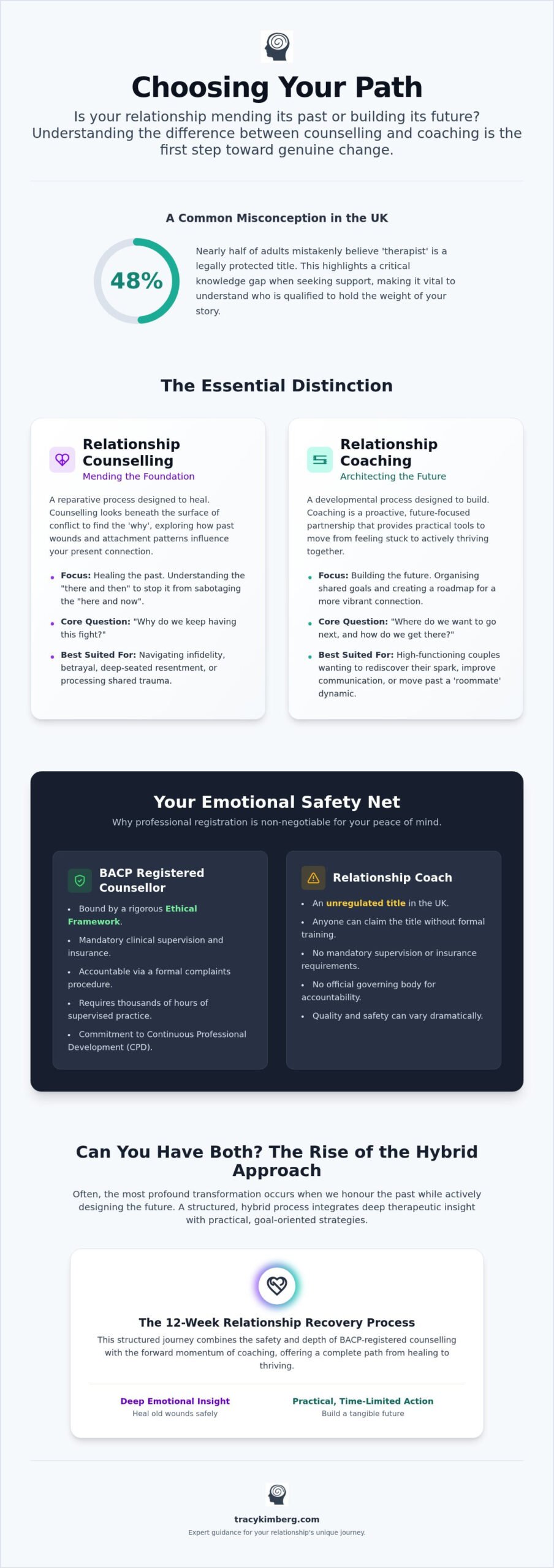
Relationship counselling is fundamentally a reparative process. It is about looking back to understand how you arrived at this point of pain, silence, or disconnect. In contrast, relationship coaching is developmental. It is a strategic, forward-facing alliance designed to help you reach specific milestones and improve your daily interactions. Choosing between them isn’t always an “either/or” decision; quite often, it is a matter of “which first?” You cannot easily architect a beautiful new future if the foundation is currently cracking under the weight of unresolved history.
Relationship Counselling: Mending the Foundation
Couples therapy, or relationship counselling, dives into the “why” behind your repetitive arguments and emotional distance. It provides a safe container to explore the invisible scripts you both brought into the partnership. By examining attachment styles and how childhood patterns influence your adult behaviour, a counsellor helps you deconstruct the cycles that keep you stuck. This path is particularly vital for:
- Processing deep-seated issues such as infidelity, betrayal, or long-term resentment.
- Understanding the trauma-informed reasons why certain triggers cause you to shut down or lash out.
- Healing the emotional wounds that make vulnerability feel like a risk you’re no longer willing to take.
Relationship Coaching: Architecting the Future
Relationship coaching assumes a baseline of emotional safety and asks, “Where do we go from here?” It is about the “how”—the practical mechanics of a shared life. If you feel like you have become “efficient roommates” who have lost your spark, coaching provides the proactive roadmap to rediscover intimacy. It is a generative process that focuses on:
- Mastering communication strategies to ensure both partners feel heard and respected.
- Organising your life around shared goals, from financial planning to parenting styles.
- Rediscovering passion and playfulness through intentional, action-oriented exercises.
Whether you need to heal the past or organise the future, the goal remains the same: a partnership that feels like a safe harbour rather than a source of stress.
Why BACP Registration Matters for Your Emotional Safety
Opening up the most private corners of your partnership to a stranger is a radical act of trust. When you’re weighing the choice between a BACP registered relationship counsellor vs coach, that trust needs a foundation firmer than a well-designed website or a charismatic social media presence. In the UK, the title of “coach” is currently unregulated. This means anyone can claim the title without formal training or clinical oversight. Whilst many coaches are well-meaning, they often lack the psychological depth required to hold the weight of a relationship in crisis.
The British Association for Counselling and Psychotherapy (BACP) acts as a vital sanctuary for your emotional well-being. By choosing a registered professional, you’re ensuring that your guide is bound by a strict Ethical Framework. This framework isn’t just a list of rules; it’s a safety net. It ensures that your most vulnerable secrets are held with confidentiality, competence, and a deep respect for your autonomy. If something goes wrong, a registered professional is accountable to a formal complaints procedure, something an independent coach simply cannot offer.
The Rigour of the BACP Register
Earning a place on the BACP register requires a commitment that spans years. It involves thousands of hours of supervised practice and academic study before a professional can even apply. This process ensures that a therapist isn’t just “good at listening” but understands the complex neurobiology of trauma and the systemic patterns of human behaviour. BACP registration is the gold standard for therapeutic safety in the UK. Furthermore, members must engage in regular Continuing Professional Development (CPD) to ensure their skills remain sharp and their methods stay current with the latest research in relationship health.
Ethics in the Coaching Space
The danger of working with a coach who lacks psychological depth is that they may offer “quick fixes” or communication “hacks” that inadvertently trigger deeper, unresolved traumas. A BACP professional is trained to spot the difference between a simple communication breakdown and a deep-seated attachment wound. They can integrate goal-oriented coaching techniques whilst maintaining a trauma-informed lens. This balance allows you to move forward without the fear of being pushed too fast or ignored in your pain. It provides the peace of mind that your guide knows exactly when to lean into action and when to pause for healing.
If you’re seeking a professional who balances this clinical safety with a proactive, action-oriented approach, my Relationship Counselling and Coaching for Couples offers a structured path to lasting change. You don’t have to choose between feeling safe and seeing progress; you can have both.
Healing the Past vs Organising the Future: Which Do You Need?
Identifying the “season” of your partnership is the first step toward finding the right support. If you feel like you are constantly treading water just to keep your head above the surface, your needs differ significantly from a couple who has a steady ship but lacks a clear destination. The debate over a BACP registered relationship counsellor vs coach often misses a fundamental truth: both roles are deeply transformative, but they operate on different timelines of the human experience. One seeks to resolve the echoes of the past, whilst the other seeks to harness the potential of your future.
As noted in the BACP’s official explanation of coaching, counselling is reparative in nature whilst coaching has a developmental focus. This distinction is vital for your emotional safety. There is a common misconception that coaching is “light” and counselling is “heavy.” In reality, both require a profound commitment to growth. Coaching can be incredibly challenging as it demands immediate accountability and action. Counselling can be equally intense as it asks you to sit with discomfort and vulnerability to heal old wounds. The question isn’t about which is harder, but about which focus your partnership requires today.
When Counselling is the Priority
Counselling should be your first port of call if your relationship is currently defined by what John Gottman calls “The Four Horsemen”: contempt, criticism, defensiveness, and stonewalling. These behaviours act as emotional toxins that erode the foundation of trust. You likely need a clinical approach if you are dealing with:
- The painful aftermath of an affair or a significant breach of trust that feels impossible to move past.
- Individual mental health challenges, such as depression or anxiety, that are bleeding into your shared dynamic and causing friction.
- A sense of “stuckness” where every conversation turns into the same circular argument regardless of the topic.
When Coaching Takes the Lead
Coaching is most effective when the emotional foundation is stable enough to support active building. It is about strategy and vision. You might choose this path when you are:
- Walking through a major life transition, such as becoming parents, moving house, or entering the “empty nest” phase.
- Feeling a sense of stagnation or boredom, where you love each other but have lost the ability to play, dream, or connect deeply.
- Seeking a Conscious Approach to separation or divorce, where the goal is to uncouple with dignity and respect rather than through conflict.
Whether you are mending or building, the process is an active, evolving experience. Both paths offer a way out of the fog and toward a relationship that feels intentional and authentic.
The Rise of the Hybrid: Can You Have Both?
For many high-functioning couples, the traditional binary choice between healing the past and architecting the future feels insufficient. You might find yourself in a position where you recognise the patterns of your history, yet you lack the practical tools to change your behaviour in the heat of the moment. This is where the concept of “Therapeutic Coaching” becomes a powerful alternative. It bridges the gap between the profound insights of therapy and the strategic momentum of coaching. By understanding the “there and then” of your childhood attachments, you gain the clarity needed to transform the “here and now” of your daily interactions.
When you are weighing up the merits of a BACP registered relationship counsellor vs coach, you might discover that the most potent results come from a practitioner who refuses to see these as separate silos. A BACP registered professional is uniquely qualified to hold this hybrid space. They possess the clinical depth to safely explore trauma whilst having the tactical skill to drive you toward specific relational goals. This integrated approach prevents you from getting “stuck” in the past, ensuring that every piece of psychological insight is immediately tethered to a new way of being together.
The Integrated Approach to Intimacy
In my practice, I blend the rigorous, research-based conflict management strategies of John Gottman with the evocative, systemic insights of Esther Perel. This allows us to look at the “soil” of your relationship whilst also planning the “architecture” of your future. Having one professional who can pivot between deep emotional healing and strategic action provides a seamless experience that respects the complexity of your bond. It is about moving beyond simple awareness; for instance, integrating mindset support from Mindy Ling Coaching can provide the neuroscience-based tools needed to turn insight into action. Awareness without action is a hollow victory in relationships; it leaves you knowing why you are unhappy without the map to find your way back to joy.
Identifying a ‘Conscious’ Relationship
A hybrid model shifts the focus from merely “fixing” a broken dynamic to “transforming” it into something entirely new. This is what it means to build a conscious relationship. It is a process that often ripples out beyond the couple, supporting individual Therapy for Teenagers and adults within the family unit. When the parents change their dance, the entire family system begins to move differently. Unlike open-ended, “chat-based” therapy that can sometimes feel aimless, a structured process provides a clear sense of movement. It offers the safety of clinical expertise combined with the invigorating energy of a proactive adventure.
If you are ready to move beyond the cycle of repetitive arguments and start building a partnership based on intentional connection, my Relationship Counselling and Coaching for Couples provides the integrated support your partnership deserves.
Choosing between a BACP registered relationship counsellor vs coach doesn’t have to be a source of stress if you have a clear roadmap to follow. Relationships don’t always have the luxury of “as long as it takes,” and when your partnership is in distress, the ambiguity of open-ended therapy can sometimes add to the anxiety you’re already feeling. This is why a structured, time-limited approach is so effective for modern couples. The 12-Week Relationship Recovery Process serves as the ultimate integration of depth and direction, providing a clear beginning, middle, and end to your journey of reconnection.
By blending the clinical safety of a BACP registered relationship counsellor vs coach with the momentum of a goal-oriented programme, we can address multiple layers of your experience simultaneously. It’s rare for relationship friction to exist in a vacuum; often, it’s intertwined with individual struggles like anxiety or depression. A structured path ensures these clinical nuances aren’t ignored whilst we work on the relational disconnect. It’s the logical choice if you’re seeking the “why” of counselling and the “how” of coaching in one cohesive, manageable package.
What to Expect from a Structured Programme
Moving through this 12-week journey involves three distinct phases designed to move you from crisis to clarity. We begin with Phase 1, where we assess your “Sound Relationship House” to identify where the leaks are occurring. This isn’t about finger-pointing; it’s about understanding the current state of your shared home and the foundation you’ve built together.
Phase 2 focuses on deconstructing old, reflexive behaviours that no longer serve you. We work on healing emotional triggers and addressing the “there and then” that interrupts your “here and now.” Finally, Phase 3 is about architecture. We build new rituals of connection and future-proof the partnership, ensuring you have the practical tools to maintain your progress long after our sessions conclude.
Online vs Face-to-Face: Accessibility for Modern Couples
Accessibility is key for busy couples, and the beauty of a structured process is that it translates perfectly to a digital environment. Whether you prefer face-to-face therapy or the flexibility of online therapy, the quality of professional intimacy remains the same. Global clients often find that online sessions remove the stress of travel, allowing them to enter the therapeutic space from the comfort of their own home whilst still receiving specialized care.
This flexibility ensures that distance is never a barrier to healing your bond. If you’re ready to stop the cycle of disconnect and start a proactive adventure toward a more conscious partnership, now is the time to act. Discover how the 12-Week Relationship Recovery Process can transform your bond and provide the lasting, positive change your relationship deserves.
Embarking on Your Journey to Lasting Connection
Your relationship is a living entity that deserves specialised care. Whether you need to heal the echoes of the past or architect a vibrant future, understanding the role of a BACP registered relationship counsellor vs coach ensures you don’t have to settle for unregulated advice. By prioritising clinical safety alongside proactive action, you create a space where both partners can feel truly seen. Real transformation happens when you bridge the gap between reparative healing and developmental growth.
As a BACP Registered Member, I offer a research-based approach that blends the insights of Gottman and Perel with practical, global support. Whether we meet face-to-face or through online sessions, the goal remains the same: moving your partnership from a place of disconnect to one of intentional joy. You don’t have to navigate this complex emotional landscape alone. A structured path is waiting to guide you home.
If you’re ready to turn your challenges into a proactive adventure, I invite you to connect. Book a Discovery Call for the 12-Week Relationship Recovery Process to see how we can transform your bond. Healing is possible, and a more vibrant future is well within your reach.
Frequently Asked Questions
Is a relationship coach as good as a BACP registered counsellor?
The answer depends on the depth of your needs. A coach provides excellent action-oriented support for future goals, but they lack the clinical regulation and rigour of a BACP registered professional. For relationships weathering deep trauma or attachment wounds, the extensive training and supervised practice of a counsellor ensure a level of emotional safety that an unregulated coach simply cannot guarantee.
Can a BACP registered counsellor also provide relationship coaching?
Yes, many therapists are dually trained to offer both clinical healing and strategic coaching. This hybrid approach is often the most effective path for modern couples. It allows the professional to pivot between deep reparative work and proactive goal-setting, ensuring that your partnership has both the psychological foundation and the practical tools needed to thrive in the long term.
How do I know if we need couples therapy or just a relationship coach?
Identify the “season” of your struggle. If you’re navigating the aftermath of an affair or feel stuck in toxic, repetitive cycles, you likely need the reparative focus of therapy. If your foundation is stable but you feel stagnant or are facing a major life transition, coaching might be the better fit. Often, a BACP registered relationship counsellor vs coach comparison shows that healing must happen before building can begin.
What are the risks of hiring an unregistered relationship coach in the UK?
The primary risk is a lack of professional accountability and clinical depth. Unregistered coaches are not bound by the BACP Ethical Framework, which means there is no formal complaints procedure or oversight if things go wrong. They may also lack the psychological training to identify when a partner is experiencing a mental health crisis that requires clinical intervention rather than just strategic advice.
Does insurance cover relationship coaching or only BACP registered counselling?
Most UK private healthcare providers only reimburse fees for sessions with registered professionals. Because coaching is an unregulated and developmental service, it rarely meets the clinical criteria for insurance coverage. It’s always best to check your specific policy, but you’ll usually find that accreditation with a body like the BACP is a mandatory requirement for any successful claim.
What is the 12-Week Relationship Recovery Process and how does it differ from traditional therapy?
This process is a structured, time-bound integration of counselling and coaching. Unlike traditional therapy, which can sometimes feel open-ended or aimless, this programme follows a clear 12-week roadmap. It moves purposefully from assessing the “Sound Relationship House” to deconstructing old behaviours and finally building new rituals of connection, providing a sense of momentum that busy couples often find invigorating.
Can we switch from counselling to coaching halfway through our sessions?
You can certainly transition as your relationship evolves. Many couples start with the “heavy lifting” of counselling to resolve past hurts and then move into a coaching phase to design their future together. If your practitioner is dually trained, this shift happens naturally, allowing you to maintain the trust you’ve built whilst changing the focus of your work as you heal.
How much does a BACP registered relationship expert cost compared to a coach?
Fees vary significantly based on location, experience, and the specific level of accreditation. Registered professionals often have fee structures that reflect their extensive academic training and ongoing clinical supervision costs. When weighing up a BACP registered relationship counsellor vs coach, it’s helpful to consider the value of professional accountability and ethical safety alongside the session rate to ensure you’re making a sustainable investment.

Article by
Tracy Kimberg
Tracy Kimberg is a Relationship Expert, Couples Therapist and Coach with a dedicated focus on helping couples and individuals rebuild connection, trust and emotional safety in their relationships. Drawing on the research of John and Julie Gottman, the relational insights of Esther Perel, and years of hands-on therapeutic experience, Tracy offers a warm, non-judgemental and deeply compassionate approach to modern relationships.
Based in Dorset, Tracy works with couples navigating communication breakdowns, betrayal, intimacy challenges, separation, family dynamics and life transitions. Known for creating a safe and grounded therapeutic space, she combines practical tools with emotional depth to help clients move beyond survival patterns and towards meaningful, lasting change.
With a reputation for empathy, professionalism and dedication to her clients’ growth, Tracy is passionate about helping people feel seen, understood and empowered — both within their relationships and within themselves.
Disclaimer
Disclaimer:
The information shared in this article is intended for educational and informational purposes only and should not be considered a substitute for professional therapeutic, psychological, medical or legal advice. Every individual and relationship is unique, and the perspectives offered are based on general therapeutic principles, research and professional experience.
Reading this article does not establish a therapist-client relationship with Tracy Kimberg. If you are experiencing significant emotional distress, relationship crisis, trauma, or mental health concerns, it is important to seek support from a qualified professional appropriate to your individual circumstances.
All content remains the intellectual property of Tracy Kimberg and may not be reproduced or distributed without permission.