

What if the discovery of an affair, as devastating as it is, could actually be the catalyst for the most honest relationship you’ve ever had? Right now, that probably feels impossible. You’re likely exhausted by intrusive thoughts and the “pain shopping” that keeps you awake, wondering if you’ll ever feel truly safe in your own home again. It’s a heavy burden to carry, especially when you lack the communication exercises after infidelity needed to address the hurt whilst avoiding defensive behaviour or a fresh wave of conflict.
I understand that the road back to each other feels obscured by fog. However, research indicates that 60 to 75 per cent of marriages not only survive but can actually improve with the right therapeutic intervention. By using structured tools, you can move past the immediate trauma and begin to co-author a “second marriage” with the same partner. In this guide, we’ll explore research-backed techniques that help reduce daily friction and ensure you both feel heard. We’ll look at how to transform your dialogue from a source of pain into a tool for genuine, lasting recovery.
Key Takeaways
- Understand why betrayal triggers a physiological “fight-or-flight” response and how to navigate this profound rupture in your attachment bond.
- Discover research-backed communication exercises after infidelity designed to foster radical transparency and restore a sense of safety in your home.
- Learn the art of attunement to validate your partner’s pain without triggering the cycle of defensiveness that often stalls recovery.
- Rebuild your emotional connection by co-authoring a “Third Story” that honours both of your experiences whilst paving the way for a new kind of intimacy.
- Identify the benefits of a structured 12-Week Relationship Recovery Process to move beyond temporary fixes and towards a resilient, “second marriage” to the same person.
The Anatomy of Betrayal: Why Standard Communication Often Fails
To understand why your conversations keep ending in tears or stony silence, we must first look at The Anatomy of Betrayal. It isn’t merely a broken promise or a secret kept; it’s a profound rupture in your attachment bond. For most couples, the instinct is to talk it out immediately. However, standard communication often fails because you’re attempting to build a house on shifting sand whilst the ground is still shaking. You have to accept a difficult truth: the relationship you had before the discovery is over. Healing isn’t about fixing that old version. It’s about co-authoring something entirely new from the remains, a process that requires a different set of tools than your average chat over dinner.
Understanding the Betrayal Trauma Response
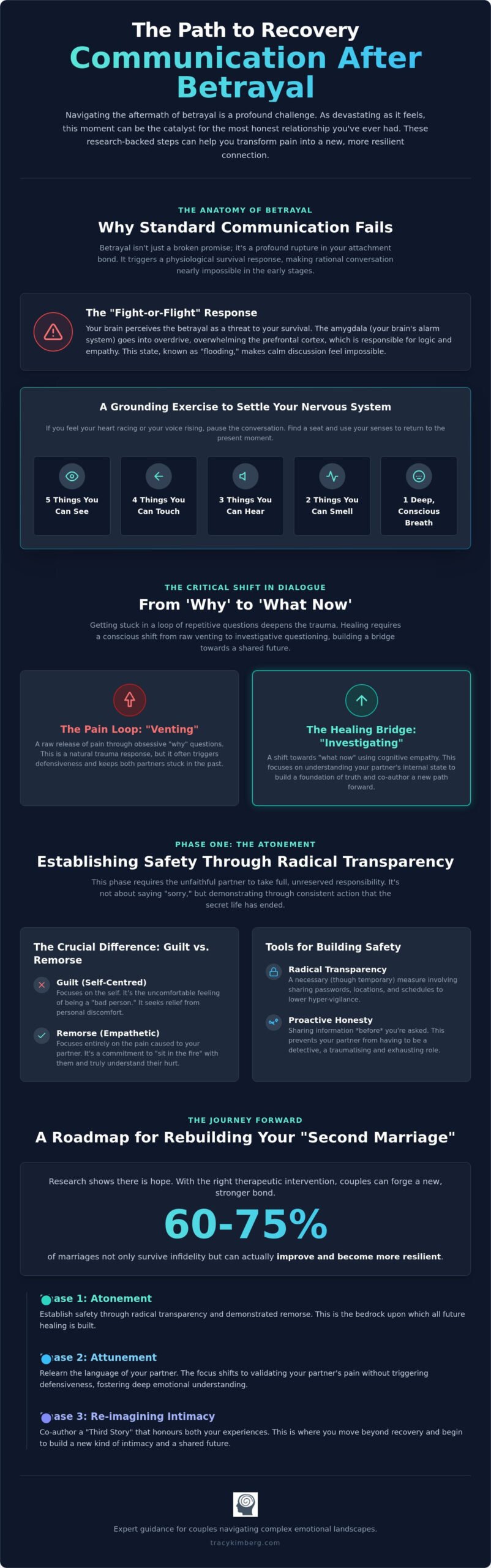
When betrayal occurs, the brain doesn’t just feel sad. It perceives a threat to survival. This triggers a “fight-or-flight” response that makes rational conversation nearly impossible in the early stages. You might experience “flooding,” a state where the prefrontal cortex, the part of your brain responsible for logic and empathy, is overwhelmed by the amygdala’s alarm bells. In this state, communication exercises after infidelity can feel like trying to solve a complex puzzle during a hurricane. Your body is screaming for safety, not for a debate on the timeline of events.
If you feel your heart racing or your voice rising, try this simple grounding exercise to settle your nervous system before continuing:
- Stop the conversation immediately and find a seat where your feet touch the floor.
- Identify five things you can see in the room.
- Acknowledge four things you can physically touch.
- Notice three things you can hear.
- Identify two things you can smell.
- Take one deep, conscious breath, exhaling longer than you inhale.
The Shift from ‘Why’ to ‘What Now’
Many couples get stuck in a loop of “obsessive” questioning. You ask the same questions over and over, hoping for a different answer that will finally make the pain stop. Whilst this is a natural part of processing trauma, it often leads to “venting,” a raw release of pain that can trigger more defensiveness. To move forward, you need to shift towards “investigative” questioning. This requires cognitive empathy, which is the ability to understand your partner’s perspective and internal state without necessarily agreeing with their actions. By focusing on the “what now” rather than just the repetitive “why,” you begin to use communication exercises after infidelity to bridge the gap between your two separate realities and establish a foundation of truth.
The Atonement Phase: Establishing Safety Through Radical Transparency
After the initial shock of discovery, you enter a period that requires a complete restructuring of how you share information. In the context of Gottman’s Trust Revival Method, this is known as the Atonement phase. It’s the foundation of recovery where the partner who was unfaithful takes full, unreserved responsibility for their actions. This isn’t just about saying “I’m sorry.” It’s about demonstrating through consistent action that the secret life has ended. The Atonement phase often requires the most intensive communication exercises after infidelity because you’re working to lower the betrayed partner’s hyper-vigilance, a physiological state where they are constantly scanning for signs of further danger.
Transparency is your primary tool for creating safety. Whilst it may feel intrusive, sharing passwords, locations, and schedules is a necessary temporary measure. It provides a “proof of life” for the relationship. However, the real shift happens through Proactive Honesty. This means sharing information before you’re asked. If you’re running late or a colleague you previously mentioned contacts you, say so immediately. This prevents your partner from having to play the role of a detective, which is an exhausting and traumatising position to hold.
It’s also vital to distinguish between remorse and guilt. Guilt is often self-centred; it’s the uncomfortable feeling of being a “bad person.” Remorse, however, is empathetic. It focuses entirely on the pain caused to the other person. When you communicate from a place of remorse, you aren’t looking for a “get out of jail free” card. You’re looking to sit in the fire with your partner until the flames begin to die down.
The Exercise of ‘Controlled Disclosure’
To avoid the “trickle-truth” effect that destroys trust, schedule a structured 20-minute session for difficult questions. The unfaithful partner should use a template of genuine remorse: “I recognise that my choice to [action] caused you to feel [emotion]. I am here to answer your questions because your need for clarity is more important than my desire to avoid discomfort.” Be careful with “TMI” (Too Much Information). Focus on the “who, what, and where” rather than graphic details that can create intrusive mental images and lead to further trauma.
Building an Accountability Framework
Create a formal Transparency Agreement. This isn’t a legal document, but a shared understanding of what information will be shared and how. This framework helps manage expectations and reduces daily conflict. Remember the concept of “Sliding Door Moments.” Every time you choose to be open instead of defensive, you’re turning towards your partner. Consistent behaviour over weeks and months is the only way to prove that the change is real. If you find these sessions are consistently spiralling, seeking professional guidance can provide the structure needed to keep the conversation safe.
Attunement Exercises: Relearning the Language of Your Partner
Once you’ve navigated the immediate crisis of Atonement, the focus must shift to Attunement. This is the delicate process of tuning in to each other’s emotional frequencies. It isn’t about fixing a problem; it’s about understanding a state of being. Whilst active listening is a common suggestion, it’s often ineffective after betrayal unless it’s paired with deep emotional validation. You aren’t just reflecting words; you’re acknowledging the reality of your partner’s pain. To do this, you must master the “softened start-up.” This involves bringing up difficult feelings without the harsh edge of criticism. Instead of saying, “You’re acting suspicious again,” you might say, “I’m feeling a bit of anxiety about the schedule today, and I’d love some reassurance.”
The Speaker-Listener Technique for High-Stakes Emotions
This exercise is a cornerstone of communication exercises after infidelity. It uses the “Floor” rule to ensure both partners feel heard without the conversation devolving into a match of defensiveness. One person holds a physical object, representing the Floor, and speaks in brief sentences about their experience. The listener’s only job is to paraphrase what they heard, focusing on the underlying emotion. For example, if the speaker says, “I feel invisible when you’re on your phone all evening,” the listener reflects back, “I hear that you’re feeling lonely and disconnected when I’m distracted.” This identifies the “feeling” behind the words, moving the dialogue from “You are never here” to the much more vulnerable “I feel lonely.”
The ‘Daily Ritual of Connection’ Exercise
Recovery is exhausting. You need spaces where the affair isn’t the guest of honour. Commit to a 10-minute daily check-in that is strictly NOT about the betrayal. Use this time for a “Positive Perspective” exercise, where you each identify one small thing you appreciated about the other that day. This could be as simple as, “I appreciated that you made the coffee this morning.” These moments are “emotional bids,” which are small requests for connection that help repair the damaged bond. Over time, these daily rituals of connection create a buffer of positive sentiment that makes the harder work of communication exercises after infidelity more manageable. By consistently turning towards these bids, you begin to rebuild the friendship that serves as the bedrock for all future intimacy.
Re-imagining Intimacy: Exercises to Rebuild the Emotional Bond
Re-imagining intimacy requires us to move beyond the clinical details of the betrayal and into the messy, beautiful work of rediscovery. You’re no longer the same people you were before the crisis, and that’s okay. In fact, it’s necessary. Whilst the foundation of trust is being repaired through the communication exercises after infidelity we’ve already explored, you must also begin updating your “Love Maps.” This involves a conscious effort to learn who your partner is today, their new fears, their shifting dreams, and the vulnerabilities they’ve uncovered amongst the wreckage. Emotional intimacy isn’t just a precursor to physical closeness; it’s the very environment in which desire can safely return. You’re essentially learning to speak a new language together, one that honours the past but isn’t held hostage by it.
The ‘State of the Union’ Meeting
Commit to a weekly 30-minute “State of the Union” meeting. This is a dedicated space to discuss the relationship’s health without the pressure of an active crisis. Start by sharing five things you appreciated about your partner this week. Use specific prompts to discuss your progress: “I felt particularly seen when you shared your location proactively,” or “I struggled when our conversation became defensive on Tuesday.” If the tension rises, employ a “repair attempt” exercise. This could be a pre-agreed phrase or a gentle touch that signals a need to pause and de-escalate before the nervous system becomes flooded again. These meetings ensure that communication exercises after infidelity become a consistent practice rather than a reactive one.
Esther Perel’s ‘The Third Story’ Exercise
Esther Perel often suggests that your first marriage is over; the question is, would you like to build a second one together? This involves writing “The Third Story.” It isn’t just the victim’s story or the perpetrator’s story. It’s a shared narrative that explores the “Shadow” side of the relationship that existed before the infidelity. What parts of yourselves were stifled? What longings were ignored? This isn’t about excusing the betrayal, but about understanding the systemic context in which it occurred. By exploring what each of you discovered about yourselves through this crisis, you transform a tragedy into a catalyst for growth. If you’re finding it difficult to find the words for this new narrative, you can book a session for relationship counselling to help guide your journey towards a more resilient connection.
Navigating the 12-Week Recovery: Professional Support for Lasting Change
Whilst self-guided communication exercises after infidelity are a vital starting point, many couples eventually reach a plateau. You might find that despite your best intentions, certain topics remain too “hot” to handle alone, or the same circular arguments keep resurfacing. This is where professional facilitation becomes essential. Research suggests that only about 15.6 per cent of relationships survive infidelity when couples attempt to navigate the aftermath without professional help. In contrast, those who engage in structured therapy see recovery rates between 60 and 75 per cent. Tracy Kimberg’s 12-Week Relationship Recovery Process provides this necessary structure, offering a roadmap that moves you from the chaos of discovery to the clarity of a renewed commitment.
By utilising a trauma-informed approach inspired by the work of John Gottman, Esther Perel, and Gabor Maté, this process addresses the physiological and psychological roots of betrayal. It isn’t just about talking; it’s about reorganising the way you relate to one another. Viewing this work as an investment in a “Second Marriage” to the same partner allows you to shed the dysfunctional patterns of the past. You aren’t trying to go back to the way things were. Instead, you’re building a more resilient, transparent, and consciously chosen partnership.
To further support this journey, you may also explore Therapeutic Counselling and Immersive Retreats options with The Project Of You, which provide a dedicated, trauma-informed space for couples to heal and reconnect.
When Exercises Aren’t Enough: Identifying the ‘Stuck’ Points
There are moments when even the best communication exercises after infidelity hit a wall. This often happens when “gaslighting” behaviours persist or when the betrayal triggers unaddressed childhood trauma in either partner. In these instances, a therapist acts as a “secure base,” providing the emotional containment needed to explore high-conflict topics without the conversation collapsing. If you find yourself unable to move past your own internal blocks, seeking Individual Relationship Counselling can be a transformative step in your personal healing journey, ensuring you can show up fully for the shared work of the couple.
Building Your ‘Second Marriage’ Strategy
A “Conscious Partnership” is one where both individuals are awake to their own needs and the needs of the relationship. As you conclude the initial intensive phase of recovery, long-term maintenance becomes the priority. This involves a commitment to the rituals you’ve established and a refusal to return to a state of emotional complacency. Use this checklist to keep your connection healthy:
- Maintain the “State of the Union” weekly meetings to address small issues before they escalate.
- Continue the “Daily Rituals of Connection” to keep the emotional bank account full.
- Practice proactive honesty regarding all schedules, finances, and social interactions.
- Acknowledge and validate emotional triggers without defensiveness.
- Prioritise emotional intimacy as the foundation for physical closeness.
The journey of healing from betrayal is a marathon, not a sprint. Whilst the initial 12 weeks provide the foundation, the growth continues for years. If you are ready to move beyond the pain and start co-authoring a new chapter, I invite you to Explore the 12-Week Relationship Recovery Process with Tracy Kimberg and discover the possibility of a deeper, more authentic connection.
Co-Authoring Your Second Marriage
Rebuilding after betrayal isn’t about returning to what you’ve lost. It’s about using communication exercises after infidelity to build a foundation that’s stronger and more transparent than before. You’ve learned that recovery requires moving through the raw Atonement phase into a deeper state of Attunement, where validation replaces defensiveness. By co-authoring a “Third Story,” you allow the crisis to become a catalyst for a more conscious partnership. You’re not just fixing a rupture; you’re creating a relationship that is fundamentally more honest and resilient.
I specialise in betrayal trauma and infidelity recovery, utilising a research-based approach inspired by the work of Gottman, Perel, and Maté. My signature 12-Week Relationship Recovery Process is designed to guide you through this complex emotional landscape with expert care and a clear, manageable roadmap. If you’re ready to move beyond the pain and explore the possibility of a resilient future, I invite you to Book a Discovery Call for the 12-Week Relationship Recovery Process. You don’t have to navigate this journey alone. Healing is an active, evolving experience, and a more profound connection is truly within your reach.
Frequently Asked Questions
How often should we do these communication exercises after an affair?
You should aim for a daily ritual of connection, such as a ten-minute check-in, whilst reserving more intensive sessions for once a week. Over-practising can lead to emotional burnout. It’s better to have brief, consistent moments of attunement than a three-hour marathon that leaves both of you exhausted. Consistency builds the predictability your partner needs to feel safe again.
Can communication exercises really fix the trust that was broken?
Trust isn’t fixed so much as it’s rebuilt through new, reliable patterns of behaviour. These communication exercises after infidelity provide the structure for that rebuilding process. By consistently choosing transparency and vulnerability over defensiveness, you demonstrate that you’re now a safe person to lean on. Research shows that 60 to 75 per cent of couples who engage in this structured work successfully recover.
What if my partner refuses to participate in these exercises?
You cannot force a partner to participate, but you can choose to work on your own emotional resilience and boundaries. If your partner is hesitant, try starting with low-pressure exercises that focus on general connection rather than the betrayal itself. However, if the refusal is absolute, it may be time to seek individual support to determine what your own path forward looks like, regardless of their choices.
Should we talk about the affair every day, or is that too much?
Talking about the betrayal every day often leads to emotional flooding and prevents the relationship from having any breathing room. It’s more effective to schedule specific times for these difficult conversations. This allows the betrayed partner to feel heard whilst preventing the unfaithful partner from feeling constantly ambushed. Creating a sanctuary space where the affair is not discussed helps preserve the friendship that remains.
How do we handle ‘triggers’ that happen in the middle of a conversation?
When a trigger occurs, the most effective response is to call a formal “Time-Out” to settle your nervous systems. Stop the conversation immediately and engage in a grounding exercise, such as focusing on your breathing or naming objects in the room. Once both of you have moved out of the “fight-or-flight” state, you can return to the dialogue with more clarity and less reactivity.
Is it better to do these exercises alone or with a relationship coach?
Whilst self-guided work is a great start, a relationship coach provides the secure base needed to navigate high-conflict topics safely. A professional can identify the subtle patterns of defensiveness or gaslighting that you might miss. If you find yourselves reaching a plateau or spiralling into the same arguments, the structured guidance of a specialist ensures your communication exercises after infidelity lead to actual progress rather than more pain.
What are the most common mistakes couples make when trying to communicate after infidelity?
The most common errors include “trickle-truth” disclosure, which destroys trust further, and responding to pain with defensiveness. Many couples also make the mistake of trying to rush back to normal before the emotional foundation is repaired. True recovery requires sitting with the discomfort and acknowledging the depth of the betrayal trauma without trying to find a quick fix or an easy exit from the conversation.
Can these exercises help if we are currently in a ‘conscious separation’ phase?
These exercises are incredibly valuable during a conscious separation as they help clarify whether a second marriage is possible. Even if you are living apart, practising structured dialogue can reduce the daily conflict and help you both process the trauma more effectively. It provides a framework for transparency and honesty that is essential, whether you eventually choose to reconcile or move toward a conscious divorce.

Article by
Tracy Kimberg
Tracy Kimberg is a Relationship Expert, Couples Therapist and Coach with a dedicated focus on helping couples and individuals rebuild connection, trust and emotional safety in their relationships. Drawing on the research of John and Julie Gottman, the relational insights of Esther Perel, and years of hands-on therapeutic experience, Tracy offers a warm, non-judgemental and deeply compassionate approach to modern relationships.
Based in Dorset, Tracy works with couples navigating communication breakdowns, betrayal, intimacy challenges, separation, family dynamics and life transitions. Known for creating a safe and grounded therapeutic space, she combines practical tools with emotional depth to help clients move beyond survival patterns and towards meaningful, lasting change.
With a reputation for empathy, professionalism and dedication to her clients’ growth, Tracy is passionate about helping people feel seen, understood and empowered — both within their relationships and within themselves.
Disclaimer
Disclaimer:
The information shared in this article is intended for educational and informational purposes only and should not be considered a substitute for professional therapeutic, psychological, medical or legal advice. Every individual and relationship is unique, and the perspectives offered are based on general therapeutic principles, research and professional experience.
Reading this article does not establish a therapist-client relationship with Tracy Kimberg. If you are experiencing significant emotional distress, relationship crisis, trauma, or mental health concerns, it is important to seek support from a qualified professional appropriate to your individual circumstances.
All content remains the intellectual property of Tracy Kimberg and may not be reproduced or distributed without permission.