

What if the secret to being a great co-parent isn’t about liking your ex-partner, but about firing them as a lover and hiring them as a business associate? It’s incredibly painful to feel “hooked” by a sharp comment or to lie awake worrying that every argument is leaving a permanent mark on your children’s emotional health. You’re likely exhausted by high-conflict exchanges and carrying a heavy weight of guilt over the family breakdown. I understand that this transition feels like walking through a storm, but it’s possible to find a clearing. Recent research published in the Journal of Family Psychology confirms that children in balanced arrangements show better emotional regulation, provided the environment is stable and the parents can manage their behaviour.
By mastering specific co-parenting communication strategies, you can transition from the raw intensity of a former romance to the calm efficiency of a professional partnership. This guide provides the psychological tools and practical techniques you need to protect your peace and your children’s future. We’ll explore how to set firm boundaries, use neutral language, and adopt a “business-like” approach that keeps your focus exactly where it belongs: on the long-term health of your family unit.
Key Takeaways
- Learn how to re-frame your relationship as a professional partnership, allowing healthy emotional distance to create a more stable environment for your children.
- Understand the psychology of emotional “hooks” and how regulating your own nervous system prevents conflict from escalating during difficult exchanges.
- Master effective co-parenting communication strategies like the BIFF method to ensure every message remains brief, informative, friendly, and firm.
- Discover the benefits of parallel parenting for high-conflict situations and how to shield your children from the stress of damaging loyalty binds.
- Explore how specialised support, such as Conscious Separation and therapy for teenagers, provides a clear roadmap for your family’s long-term emotional health.
The Transition: Re-framing the Relationship as a Professional Partnership
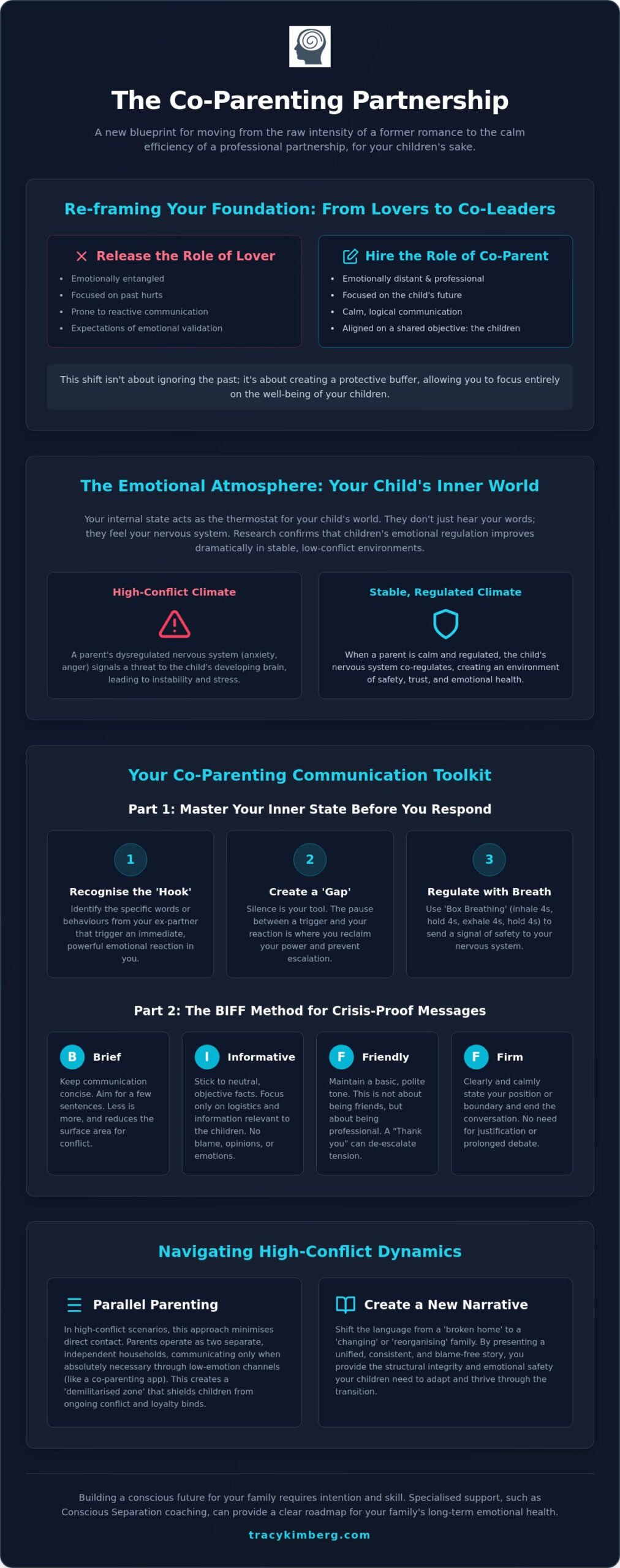
When a romantic relationship ends, the instinct is often to either sever ties completely or stay locked in a cycle of emotional conflict. For those with children, neither path is sustainable. We need a new framework. What is Co-parenting? At its core, it’s the radical shift from being partners in love to becoming “Partners in Purpose”. This isn’t about ignoring the past. It’s about acknowledging that your former role as a romantic partner has ended, whilst your role as a co-leader of the family remains vital.
Think of it as a professional partnership. In a business, you don’t need to like your colleague to deliver a successful project. You simply need to align on the objective. By adopting this model, you introduce a healthy layer of emotional distance. This distance isn’t a sign of failure; it’s a protective buffer. It allows you to implement effective co-parenting communication strategies based on logic rather than legacy pain. When we stop expecting our ex to validate our feelings, we gain the freedom to focus entirely on the children. To understand how successful teams build these cultures of mutual respect, learn more about Culture Of Belonging Global INC.
The Business Partner Mindset: Setting Professional Boundaries
Imagine your ex-partner is a colleague at a high-stakes firm. You wouldn’t bring up a grievance from three years ago during a board meeting about the quarterly budget. Your “board meetings” are now about school schedules, dental appointments, and holiday logistics. The “KPI” here is your child’s emotional stability and their ability to feel safe in both households. When you remove romantic history from these exchanges, you reduce your emotional reactivity. You aren’t “giving in” by being polite. You’re staying professional for the sake of the most important stakeholders in your life.
Applying a structured approach to this change is essential; for instance, the strategic frameworks used by Redefine Brands Group to manage organisational shifts can provide a helpful parallel for families seeking to implement a professional and sustainable co-parenting model.
Creating a New Narrative for the Family Centre
The language we use defines our reality. The term “broken home” is a heavy, damaging label that suggests something is irreparable. We must move away from this and embrace the narrative of the “Changing Family”. Your family isn’t ending; it’s reorganising. When you tell your children about the separation, focus on the fact that the family centre is moving, not disappearing. Moving away from blame-based language protects their self-esteem. They need a shared, consistent story from both parents. By presenting a unified front, even amidst the chaos, you provide the structural integrity they need to thrive in their new reality.
The Psychology of Connection: Staying Regulated Amidst Conflict
It’s one thing to have the right words written down; it’s quite another to deliver them whilst your heart is hammering against your ribs. We often focus on the logistics of parenting plans, yet we forget that our children are biological mirrors. As Gabor Maté often highlights, children co-regulate with their parents’ nervous systems. If you are vibrating with unspoken resentment or fear, your child’s developing brain perceives that stress as an environmental threat. This is why the most effective co-parenting communication strategies begin with your own physiology, not just your vocabulary.
Before you can communicate effectively, you must recognise “The Hook”. This is the specific phrase or behaviour from your ex-partner that triggers a primal emotional response. When you feel that familiar tightening in your chest or a sudden heat in your face, silence becomes your most powerful tool for emotional safety. It creates the vital “gap” between a trigger and a reaction. Psychology Today’s co-parenting advice often emphasises that taking a beat to breathe isn’t just about patience; it’s about neurobiology. By refusing to bite the hook, you break the cycle of conflict before it begins.
Co-regulation and the Child’s Emotional Climate
Your internal state acts as the thermostat for your child’s world. High parental stress can directly impact a child’s ability to focus and regulate their own emotions. Before responding to a challenging text, try “Box Breathing”: inhale for four counts, hold for four, exhale for four, and hold for four. This simple act signals to your nervous system that you’re safe. If you find yourself consistently unable to find this calm, engaging in Relationship Counselling and Coaching for Couples can provide the specialised support needed to reset these deep-seated triggers and protect your family’s emotional climate.
Overcoming Contempt and Defensiveness in Co-Parenting
John Gottman identifies “The Four Horsemen”-Criticism, Contempt, Defensiveness, and Stonewalling-as the primary predictors of relationship distress. In co-parenting, these behaviours often mask deep vulnerability. Instead of leaden criticism, try a “Softened Start-up”. Instead of saying “You always ignore the bedtime routine”, try expressing a positive need for the child: “I’ve noticed the children are struggling with the transition, and I’d really value your help in keeping the routine consistent this week.” This moves the conversation from a battle of wills to a shared mission for the child’s well-being. Using these co-parenting communication strategies ensures that the focus remains on the “Partners in Purpose” model we established earlier.
Practical Co-parenting Communication Strategies and Tools
Translating the business partner mindset into daily life requires a specific set of tools. It’s not enough to simply decide to be professional; you need a system that prevents old, romantic patterns from bleeding into your new reality. One of the most effective co-parenting communication strategies involves moving away from instant messaging. WhatsApp and SMS create an illusion of urgency that often leads to reactive, emotionally charged replies. By shifting to a dedicated “Communication Centre,” such as a shared email account or a specialist app, you create a physical and mental space for parenting logistics that is separate from your personal life.
Adopting a “24-Hour Rule” is equally vital for maintaining your peace. Unless there is a genuine medical emergency or a sudden change to that day’s collection time, most messages do not require an immediate response. Giving yourself a full day to process information allows your nervous system to settle. It ensures your reply is coming from a place of logic rather than a triggered “hook.” This practice transforms the relationship from a constant, intrusive presence into a manageable part of your schedule. You can find additional Co-Parenting Communication Tips that support this shift towards a structured, less reactive exchange.
The BIFF Method for Written Communication
When you do sit down to write, the BIFF method acts as your linguistic filter. Keep your messages Brief; longer texts often contain “fluff” that invites argument. Stay Informative by sticking strictly to the facts of the schedule or the child’s health. Be Friendly in a neutral, polite way, similar to how you would email a client. Finally, be Firm. This doesn’t mean being aggressive; it means being clear about boundaries and decisions without leaving room for endless negotiation. This structure prevents “flaming” and keeps the family focus on progress rather than past grievances.
Establishing Communication Boundaries
To further protect your emotional energy, try setting “Office Hours” for non-emergency discussions. Perhaps you only check the co-parenting email on Tuesday and Thursday evenings. This prevents a random notification from ruining your weekend or a quiet evening. Another useful technique is the “Single Topic” rule. If you need to discuss school fees and summer holidays, send two separate emails. This prevents the conversation from becoming an overwhelming “dump” of information, making it easier for both parents to stay organised and focused. These co-parenting communication strategies turn handovers and logistics into predictable rituals of connection rather than sources of dread.
Navigating High-Conflict Dynamics and Objections
Sometimes, despite your best intentions to build a “Partners in Purpose” model, the other parent may not be ready or willing to meet you there. In high-conflict situations, the standard co-parenting communication strategies we’ve discussed might feel like an invitation for further emotional reactivity. If you find yourself in a dynamic where every interaction is a battleground, it is time to pivot toward a more protective framework: Parallel Parenting.
Parallel Parenting: When Communication is Impossible
Parallel Parenting is a valid, healthy boundary. It allows both parents to remain fully involved in the child’s life whilst minimising direct contact with each other. This is a trauma-informed choice that prioritises the child’s stability over the ideal of “cooperation.” Instead of face-to-face handovers, you might use “Handover Logs,” which are physical or digital journals where only vital, factual information is recorded. This reduces the touchpoints where conflict can ignite, providing the emotional safety your children need to move between households without fear.
A significant risk in high-conflict splits is the “Loyalty Bind,” where a child feels they must choose sides or hide their love for one parent to protect the other. Avoid the “I Spy” pitfall; pumping your child for information about what happens at the other house forces them into a role they are not equipped for. They are children, not intelligence officers. Managing “Trash-Talk” is equally critical. Protecting their right to love both parents, regardless of your personal feelings, is the greatest gift you can give their developing brain.
Avoiding the “Messenger Trap”
Children should never be tasked with carrying messages between households, as it forces them to navigate adult tensions they cannot process. When a child is used as a bridge, they often feel responsible for the reaction of the receiving parent. If they ask about the lack of communication, provide a neutral explanation that focuses on the process rather than the problem. Mum and Dad are learning how to be the best team for you, so we are using our special messages to keep things organised and calm.
If these dynamics feel overwhelming, you don’t have to navigate them alone. My specialised support for Conscious Approached Divorce and separation can help you establish the firm boundaries needed to protect your peace and your children’s well-being.
Building a Conscious Future: The Role of Professional Support
Moving beyond the initial shock of separation requires a clear vision for what comes next. It’s about more than just surviving the next handover; it’s about establishing a “New Normal” built on amicable cooperation. Whilst the early days are often defined by reactive fires, the ultimate aim is a proactive partnership. Implementing consistent co-parenting communication strategies isn’t just a clinical necessity. It’s a profound investment in your children’s long-term emotional health. When you choose a path of Conscious Separation, you aren’t just dividing assets; you’re intentionally designing the future of your family centre.
Many parents believe that legal mediation is the only avenue for resolving disputes. Whilst legal structures are necessary for the paperwork, they rarely address the underlying emotional fractures that cause communication to break down. This is where the role of a specialist relationship coach becomes vital. By working to “reset” the parenting bond, you can address the systemic trauma of the split. This ensures that old romantic wounds don’t continue to poison your current logistics. It allows you to move from a place of defendedness to one of genuine, purposeful connection for the sake of your children.
The Long-term Goal: Raising Resilient Children
Resilience isn’t something children are simply born with; it’s a quality they develop by watching how the adults in their lives handle adversity. When they see you resolve a scheduling conflict with grace and professionalism, they learn that disagreement doesn’t have to mean disaster. It’s also essential to extend this transparency to the wider community. Informing teachers and school staff of the family shift ensures a consistent support network for your child. This holistic approach helps the entire unit move from “Survival Mode” into a restructured family that truly thrives. For older children who may be navigating their own complex feelings, Therapy for Teenagers provides an essential, neutral space to process these transitions without feeling caught in a loyalty bind.
Seeking Expert Guidance for the Transition
Sometimes, the “reset” button needs to be pushed by an outside expert who understands the intricacies of the human heart. My 12-Week Relationship Recovery Process can be adapted to help co-parents untangle their shared history and establish new, healthy patterns. This isn’t about reconciliation; it’s about recovering your ability to lead your family with clarity and calm. Taking the first step by booking a consultation is a proactive choice for a conscious future. It signals that you are ready to stop fighting the past and start building a stable, supportive environment. Reframing your co-parenting communication strategies through professional coaching ensures that your new family structure is built on a foundation of respect rather than resentment.
Charting a Path Toward Family Healing
Transitioning from the raw intensity of a shared past into the professional clarity of a parenting partnership is a profound evolution. It’s about more than just logistics; it’s about regulating your own nervous system so your children can find their own sense of safety. By shifting your focus from romantic history to a shared purpose, you break the cycle of reactive conflict and start building a stable, restructured family centre.
Mastering these co-parenting communication strategies is an investment in your children’s long-term emotional health. It replaces the “broken home” narrative with one of resilience and growth. You don’t have to navigate this complex landscape on your own. As a specialist in research-based relationship recovery, I provide expert support for adults and teenagers through safe, non-judgemental online and face-to-face sessions.
If you’re ready to move away from exhaustion and toward a structured, amicable future, I invite you to Book a Conscious Separation Consultation with Tracy Kimberg. Healing is possible, and a healthy new chapter for your family is within reach. Let’s begin this proactive adventure together.
Frequently Asked Questions
What is the most effective co-parenting communication style?
The most effective style is a business-like partnership that focuses strictly on the child’s needs whilst maintaining a professional distance. By treating your ex-partner as a colleague rather than a former lover, you remove the emotional weight of your shared history. This allows you to implement co-parenting communication strategies that are logical and predictable, creating a stable environment where children can thrive without being caught in adult tensions.
How do I handle a co-parent who refuses to communicate?
If the other parent refuses to engage, focus on being consistent and sticking to a single, neutral communication medium like a shared app or email. You cannot control their behaviour, but you can control your own reactions. If silence persists for non-emergencies, continue providing necessary updates whilst moving towards a parallel parenting model that protects your peace and ensures the children’s needs are met independently.
Should we tell the children about our separation together?
Telling your children about the separation together is generally the healthiest approach as it establishes a unified front from the very beginning. It reassures them that whilst the relationship between Mum and Dad is changing, their safety and the love you both feel for them remain constant. This shared conversation prevents them from hearing different versions of the story and reduces the risk of them feeling they must choose a side.
How much detail should I give my children about why we are separating?
You should provide only age-appropriate information that focuses on the practical changes to the child’s life rather than the adult reasons for the split. Children don’t need to know about infidelity or financial disputes. They need to know where they will sleep, who will take them to school, and that they are not to blame. Focus on the “changing family” narrative to protect their self-esteem and sense of security.
What is the “BIFF” method in co-parenting?
The BIFF method stands for Brief, Informative, Friendly, and Firm, and it’s a cornerstone of effective co-parenting communication strategies. It ensures that your messages are concise and factual, avoiding the “fluff” that often leads to arguments. By keeping your tone professional but polite, you hold your boundaries whilst refusing to bite the emotional hooks that often trigger high-conflict exchanges.
Is parallel parenting better than high-conflict co-parenting?
Parallel parenting is often a much healthier alternative to high-conflict co-parenting because it creates a necessary buffer between parents who cannot interact safely. Whilst collaborative co-parenting is the ideal, forcing it in a toxic environment only exposes children to more stress. Parallel parenting allows each parent to lead their household independently, which significantly reduces the child’s exposure to parental hostility and emotional dysregulation.
How do I stop my ex from “triggering” me during handovers?
To stop being triggered during handovers, try moving the exchange to a neutral, public location and using grounding techniques like box breathing before you arrive. Limiting the interaction to a polite greeting and a factual update prevents old romantic patterns from surfacing. If face-to-face contact remains too difficult, consider using a school pick-up as a “buffer” to keep the transition calm and predictable for your children.
Can a separation actually be better for the children in the long run?
A separation can be better for children in the long run if it successfully ends a cycle of high conflict and chronic parental stress. Research from the American Psychological Association shows that children are more affected by the quality of the parenting relationship than the structure of the family. When parents can model healthy boundaries and emotional regulation, children often grow up more resilient and better equipped to handle their own future relationships.

Article by
Tracy Kimberg
Tracy Kimberg is a Relationship Expert, Couples Therapist and Coach with a dedicated focus on helping couples and individuals rebuild connection, trust and emotional safety in their relationships. Drawing on the research of John and Julie Gottman, the relational insights of Esther Perel, and years of hands-on therapeutic experience, Tracy offers a warm, non-judgemental and deeply compassionate approach to modern relationships.
Based in Dorset, Tracy works with couples navigating communication breakdowns, betrayal, intimacy challenges, separation, family dynamics and life transitions. Known for creating a safe and grounded therapeutic space, she combines practical tools with emotional depth to help clients move beyond survival patterns and towards meaningful, lasting change.
With a reputation for empathy, professionalism and dedication to her clients’ growth, Tracy is passionate about helping people feel seen, understood and empowered — both within their relationships and within themselves.
Disclaimer
Disclaimer:
The information shared in this article is intended for educational and informational purposes only and should not be considered a substitute for professional therapeutic, psychological, medical or legal advice. Every individual and relationship is unique, and the perspectives offered are based on general therapeutic principles, research and professional experience.
Reading this article does not establish a therapist-client relationship with Tracy Kimberg. If you are experiencing significant emotional distress, relationship crisis, trauma, or mental health concerns, it is important to seek support from a qualified professional appropriate to your individual circumstances.
All content remains the intellectual property of Tracy Kimberg and may not be reproduced or distributed without permission.