

You’re sitting on the same sofa, scrolling through your phones in a silence that feels heavy, wondering when you stopped being lovers and started being just roommates. It’s a common, painful realisation that many couples face as the years pass. You might find yourselves stuck in a loop of surface-level logistics, discussing the school run or the grocery list whilst the deeper parts of your hearts remain tucked away. If you’re wondering how to build emotional intimacy when the spark feels like it’s fading, you aren’t alone; the fear that being truly vulnerable might spark a conflict often keeps partners in this safe, yet lonely, holding pattern.
I understand how isolating it feels to be physically close yet emotionally miles apart. This guide offers you research-based strategies and soulful practices designed to bridge that gap and rediscover true closeness with your partner. We’ll explore how to transform your daily communication, move beyond the “roommate phase,” and create a secure environment where even the most difficult conversations lead to feeling truly seen and understood.
Key Takeaways
- Learn to distinguish between mere physical closeness and the deep emotional resonance of being truly seen and understood by your partner.
- Discover how to build emotional intimacy by identifying your attachment styles and learning to turn towards your partner’s subtle bids for connection.
- Embrace the ‘Vulnerability Paradox’ to move past conversations about chores and logistics into a space of genuine, heartfelt sharing.
- Utilise five research-based exercises designed to lower emotional defences and foster a renewed sense of curiosity within your relationship.
- Recognise when professional support is needed to navigate complex emotional landscapes and break the cycle of superficial communication.
What is Emotional Intimacy? Understanding the Heart of Connection
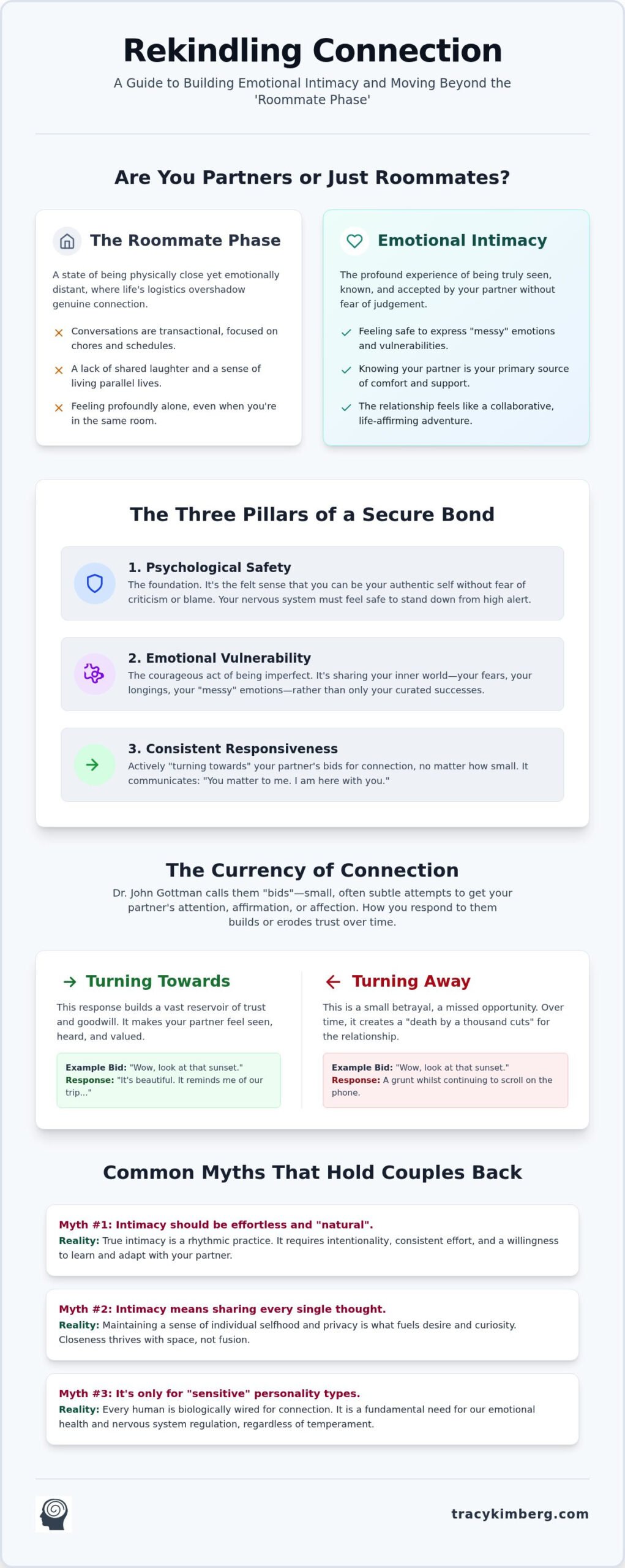
At its core, Emotional intimacy is the profound experience of being truly seen, known, and accepted by another person without the fear of judgement. It isn’t merely about sharing a home or a bed; it’s about emotional resonance. You can be physically close to someone whilst feeling entirely alone, a state often described as “roommate syndrome.” This occurs when the logistics of life, such as the mortgage, the school run, and the weekly shop, take centre stage, leaving your inner worlds to drift apart. When you understand how to build emotional intimacy, you’re essentially learning how to bridge that gap and rediscover the person behind the partner.
This connection serves as the vital “glue” that holds a relationship together during periods of high stress. When life throws challenges your way, whether it’s a career change or a family crisis, a deep emotional bond provides a safe harbour. Without it, couples often find themselves trapped in a cycle of superficial communication, where conversations are transactional rather than transformational. Signs of a healthy bond include feeling safe to express “messy” emotions and knowing your partner is your primary source of comfort, whereas roommate syndrome is marked by a lack of shared laughter and a sense of living parallel, rather than shared, lives.
The Three Pillars: Safety, Vulnerability, and Responsiveness
Creating closeness requires a foundation of psychological safety. If your nervous system feels it must remain on guard to avoid criticism, you won’t feel safe enough to open up. Vulnerability is the next step; it is the “courage to be imperfect” in front of your partner, sharing your fears and longings rather than just your successes. Finally, responsiveness is about “turning towards” your partner’s bids for connection. These are the small moments where one partner reaches out for attention or support. Consistently responding with warmth and curiosity builds a reservoir of trust over time, making the relationship feel like a collaborative adventure rather than a clinical necessity.
Common Myths About Intimacy That Hold Couples Back
Many couples mistakenly believe that intimacy should be effortless and “natural.” In reality, it’s a rhythmic practice that requires intentionality and consistent effort. Another common myth is that intimacy requires sharing every single thought. However, maintaining a sense of privacy and individual selfhood is actually what fuels desire and curiosity. Lastly, don’t fall into the trap of thinking emotional depth is only for “sensitive” personality types. Every human being is biologically wired for connection; it is a fundamental need for our emotional health and nervous system regulation, regardless of your temperament.
The Psychology of Disconnect: Why We Drift Apart
Disconnect rarely arrives with a bang; it’s a slow, quiet drift that happens whilst you’re busy living. This “Death by a Thousand Cuts” is often the result of hundreds of tiny, missed opportunities for connection. When one partner reaches out and the other is too distracted by a smartphone or the mental load of the household, a brick is added to the wall between them. Understanding how to build emotional intimacy requires us to look beneath the surface at the psychological blueprints we bring into our adult partnerships.
Our attachment styles, often forged in the crucible of childhood, dictate our “intimacy dance.” If you grew up in an environment where emotions were unpredictable, you might develop an anxious attachment, constantly seeking reassurance. Conversely, those from homes where vulnerability was met with dismissal often become avoidant, retreating into themselves when things feel too intense. This push-pull dynamic can leave both partners feeling exhausted and misunderstood. If you find yourself stuck in these patterns, engaging in relationship counselling and coaching can provide the necessary framework to rewire these responses for a healthier future.
Bids for Connection: The Gottman Perspective
John Gottman’s research highlights the importance of “bids,” which are those small, often subtle requests for attention, affirmation, or empathy. It could be a sigh, a comment about a news story, or a simple touch on the shoulder. Successful couples “turn towards” these bids significantly more often than those who eventually part ways. When you ignore or “turn away” from these moments, you inadvertently signal that your partner’s needs aren’t a priority. Over time, this leads to a profound sense of isolation, even whilst sharing the same dinner table.
The Roommate Phase: A Survival Mechanism, Not a Choice
Falling into the “roommate phase” is often a subconscious survival mechanism. When the pain of disconnect becomes too much to bear, couples often retreat into the safety of logistics. Discussing the mortgage or the children’s schedules feels safer than addressing the void where passion used to be. Gabor Maté suggests that our physiological response to stress and past trauma can block our ability to feel relationally safe. Resentment then acts as a secondary barrier, clogging the emotional pathways and making it even harder to learn how to build emotional intimacy again. It’s a heavy weight to carry, especially when research shows the average couple waits about six years after problems begin before seeking professional guidance.
Moving Beyond Logistics: Vulnerability as a Daily Practice
Moving beyond the ‘roommate’ logistics requires a conscious shift in how you inhabit your shared space. We often fall into the trap of asking “How was your day?” as a placeholder for real conversation. It’s a safe, scripted exchange that rarely touches the heart. To truly understand how to build emotional intimacy, you must replace these functional queries with feeling-based ones. Try asking, “What felt heavy today?” or “What made you smile whilst you were at work?”. This transition invites your partner to share their internal landscape rather than just their itinerary.
This leads us to the “Vulnerability Paradox.” We often mask our anxieties or failures, fearing they make us less lovable. However, it is your willingness to be seen in your messiness that actually deepens the bond. When you show your partner your true, unpolished self, you give them permission to do the same. This reciprocal openness is the bedrock of a resilient partnership. Esther Perel suggests that whilst we crave this closeness, we also need a sense of “otherness” to maintain desire. You aren’t just a co-parent or a co-habitant; you are two distinct individuals on a shared journey, and maintaining a spark of mystery is just as vital as fostering closeness.
The Art of Active Listening and Validation
Listening is an act of love. Most of us listen to defend ourselves or to fix the problem, but true active listening involves setting aside your own perspective to fully grasp your partner’s reality. You aren’t there to fix their problem or defend your own actions. The goal is validation. A simple phrase like, “I can see why that felt so frustrating for you,” can de-escalate a conflict instantly. Your body language also speaks volumes; uncrossing your arms and maintaining soft eye contact signals that you are emotionally available and present.
Rituals of Connection: Small Habits with Big Impact
Intimacy isn’t built in a day; it’s built in a thousand small moments. These rituals are essential for how to build emotional intimacy in a way that feels manageable amidst a busy British lifestyle. Consider these practices:
- The 6-Second Kiss: John Gottman recommends a kiss that lasts at least six seconds. It’s long enough to be a moment of genuine somatic connection that signals safety to your nervous system.
- State of the Union: A weekly meeting to discuss what is working and what needs adjustment. This prevents small grievances from turning into deep-seated resentment.
- Tech-Free Zones: Reclaiming the dinner table or the bedroom from digital distractions ensures your attention is focused entirely on your partner.
By prioritising these somatic and emotional habits, you move from merely co-existing to truly connecting. These rituals provide the structure needed to keep your bond vibrant, even amongst the competing demands of work and family life.
Five Research-Based Exercises to Rebuild Your Bond
Learning how to build emotional intimacy is less about grand gestures and more about the quiet, daily commitment to curiosity. Moving from the “roommate phase” into a deeply connected partnership requires you to shift from theory into lived experience. It’s normal for these exercises to feel slightly forced or awkward at first. If a practice triggers conflict, take a breath and remember that the goal isn’t perfection; it’s presence. Consistency will always trump intensity when it comes to rewiring your relational habits.
Exercise 1: The ‘Love Map’ Update
John Gottman’s research emphasises that the most resilient couples have a detailed “Love Map” of their partner’s inner world. This isn’t a static document but an evolving understanding of who your partner is today. People change, and assuming you already know everything about your spouse is a common barrier to closeness. Dedicate ten minutes this week to asking open-ended questions. What are your current stressors at work? What is your secret dream for next year? By staying curious, you build a foundation of being truly known, which is the heart of emotional resonance.
Exercise 2: The ‘Stress-Reducing Conversation’
This exercise is designed to foster co-regulation and build an “us against the world” mentality. The rules are simple but strict: the speaker shares an external stressor, whilst the listener provides empathy without falling into the “Fix-it” trap. Avoid offering solutions unless specifically asked. Instead, use validating phrases such as, “That sounds incredibly draining,” or “I can see why you’d feel that way.” Focusing on stressors outside the relationship creates a safe space where both partners feel supported rather than attacked.
Exercise 3: Shared Meaning and Legacy
Intimacy flourishes when you align your emotional paths through shared values. Discuss the “culture” of your relationship. What do you want your home to feel like? What legacy do you want to leave for your children? Creating a joint vision for the future fosters a sense of belonging and permanence. It moves the relationship beyond the immediate logistics of survival and into the realm of shared purpose. If you find these exercises difficult to navigate on your own, our 12-Week Relationship Recovery Process offers a structured, expert-led path to rediscovering your connection.
Whilst these three exercises provide a powerful start, remember that the journey of repair is often non-linear. Some days will feel easier than others. The key is to keep showing up for one another, even in the moments of awkwardness. By prioritising these research-based practices, you are actively choosing to bridge the emotional gap and rediscover the true closeness you both deserve.
When to Seek Professional Support: The Path to Lasting Recovery
Sometimes, despite your best intentions, the ‘DIY’ approach to healing reaches its limit. You might have read the books, listened to the podcasts, and tried the exercises, yet find yourselves circling the same drain of resentment. This is where professional support becomes essential. A neutral, expert third party doesn’t just mediate; they provide the ‘scaffolding’ necessary for those deeply vulnerable conversations that might otherwise feel too dangerous to have at home. When you’re lost in a thick fog of disconnect, a guide can help you see the terrain clearly again. Knowing how to build emotional intimacy is a skill that can be taught, but applying it when the foundation is cracked requires a specialised level of care.
Therapy offers a container for the ‘unspoken’ things that have been festering in the silence. It allows you to slow down the communication rhythm, moving away from the reactive ‘attack-defend’ cycle and towards a collaborative solution. By framing the work as both powerful and manageable, we demystify the therapeutic process and focus on the optimistic possibility of healing. It’s about rediscovering the person you fell in love with amongst the wreckage of life’s transitions and stressors, turning the process into a proactive adventure rather than a clinical necessity.
Signs That Professional Intervention is Needed
It’s time to look beyond self-help if you recognise the presence of what John Gottman calls the ‘Four Horsemen’: Criticism, Contempt, Defensiveness, and Stonewalling. These patterns act as emotional toxins that erode the bond over time. Similarly, if you are recovering from a major betrayal or infidelity, the path back to closeness is rarely one you can navigate alone; the weight of shattered trust often requires professional guidance to rebuild. A persistent feeling of ‘walking on eggshells’ is another clear indicator. It suggests that the psychological safety required for intimacy has been compromised, leaving you stuck in a state of hyper-vigilance that blocks genuine connection.
The 12-Week Relationship Recovery Process
For couples seeking a structured, research-led transformation, the 12-Week Relationship Recovery Process offers a clear path out of the woods. This signature programme is based on the proven methodologies of experts like Gottman and Perel, providing you with the tools to move from crisis to connection. We create a safe, non-judgemental environment where you can explore your interpersonal challenges without the fear of being blamed or shamed. This is an active, evolving experience designed to help you execute the strategies we’ve discussed in a way that lasts. You don’t have to stay stuck in the ‘roommate phase’ forever. If you’re ready to rediscover true closeness, you can book a consultation with Tracy Kimberg to start your recovery journey and begin the work of lasting repair.
Taking the First Step Towards Rediscovery
Rebuilding a bond that has drifted into the “roommate phase” is a courageous act of hope. It requires a fundamental shift from survival-based logistics to a rhythmic practice of vulnerability and responsiveness. By understanding your attachment styles and intentionally “turning towards” your partner’s subtle bids, you transform your relationship from a static arrangement into an evolving, shared adventure. You have the power to move beyond surface-level silence and rediscover the spark that first brought you together.
Throughout this guide, we’ve explored the essential pillars of how to build emotional intimacy, whilst emphasising that consistency in small moments often outweighs grand gestures. If you find that the weight of past hurts or chronic disconnect feels too heavy to carry alone, professional guidance offers a safe, non-judgemental space for transformational change. Utilising the research-based methods of Gottman and Perel, my goal is to help you bridge the gap and rediscover the deep resonance you once shared.
Take the first step towards reconnection: Explore the 12-Week Relationship Recovery Process. Healing is not just a clinical necessity; it’s an invitation to a deeper, more meaningful life together. You deserve to feel truly seen and understood by the person you love, and that journey starts today.
Frequently Asked Questions
How do I build emotional intimacy if my partner is avoidant?
Building closeness with an avoidant partner starts by creating a low-pressure environment where vulnerability is invited rather than demanded. Avoidant individuals often feel overwhelmed by intense emotional expectations; therefore, small, consistent “bids” for connection are far more effective than grand, emotional confrontations. By using “I” statements to express your own feelings whilst acknowledging their need for autonomy, you can bridge the gap without triggering their instinctive flight response.
Can emotional intimacy be restored after infidelity?
Yes, emotional intimacy can be restored, though it requires a structured and transparent healing process that prioritises safety. Rebuilding trust involves the “Atone, Attune, and Attach” phases, which allow both partners to process the trauma of the breach. It is essential to have a non-judgemental space to understand the underlying dynamics that led to the infidelity, as this understanding is what eventually allows a new, more resilient bond to form.
How long does it typically take to feel close again?
The timeline for reconnection varies for every couple, but many begin to feel a significant shift within three to six months of consistent practice. Given that the average couple waits six years after problems begin before seeking help, undoing long-standing patterns of disconnect takes time and patience. A structured approach, such as a 12-week recovery programme, can provide the necessary focus to accelerate this healing and establish new relational habits.
What is the difference between emotional and physical intimacy?
Emotional intimacy is the profound feeling of being truly “known” and accepted, whilst physical intimacy involves touch, affection, and sexual connection. Whilst they are distinct experiences, they are deeply intertwined; for many, emotional safety is the essential prerequisite for physical desire. Understanding how to build emotional intimacy often naturally leads to a more vibrant physical relationship, as the walls of defensiveness and resentment begin to come down.
Is it possible to have too much emotional intimacy?
It is possible to reach a state of enmeshment where individual identities are lost, which can actually stifle relational desire. Esther Perel often notes that intimacy requires a certain amount of “otherness” or space to maintain the spark of curiosity between partners. Healthy relationships require a delicate balance of deep closeness and individual autonomy, ensuring that both partners have room to breathe whilst remaining anchored in their shared bond.
What should I do if my partner refuses to try these exercises?
If your partner is resistant to shared exercises, focus on your own emotional regulation and lead the way by example. You cannot force another person into vulnerability, but you can change the relational dance by altering your own steps and responses. Sometimes, engaging in individual therapy for adults can help you develop the resilience and insight needed to hold the space for your partner until they feel safe enough to join the process; you can learn more about Amandine Baptista and her specialised support for adults navigating emotional challenges.
How do I know if the emotional disconnect is permanent?
A disconnect is rarely permanent unless there is a complete and sustained lack of willingness to engage from both partners. Signs that a bond is severely compromised include persistent contempt or a total absence of shared laughter and curiosity. However, even in cases of deep silence, learning how to build emotional intimacy through a structured recovery process can often reveal whether the embers of the relationship can be fanned back into a meaningful flame.
Can individual therapy help build intimacy in my relationship?

Article by
Tracy Kimberg
Tracy Kimberg is a Relationship Expert, Couples Therapist and Coach with a dedicated focus on helping couples and individuals rebuild connection, trust and emotional safety in their relationships. Drawing on the research of John and Julie Gottman, the relational insights of Esther Perel, and years of hands-on therapeutic experience, Tracy offers a warm, non-judgemental and deeply compassionate approach to modern relationships.
Based in Dorset, Tracy works with couples navigating communication breakdowns, betrayal, intimacy challenges, separation, family dynamics and life transitions. Known for creating a safe and grounded therapeutic space, she combines practical tools with emotional depth to help clients move beyond survival patterns and towards meaningful, lasting change.
With a reputation for empathy, professionalism and dedication to her clients’ growth, Tracy is passionate about helping people feel seen, understood and empowered — both within their relationships and within themselves.
Disclaimer
Disclaimer:
The information shared in this article is intended for educational and informational purposes only and should not be considered a substitute for professional therapeutic, psychological, medical or legal advice. Every individual and relationship is unique, and the perspectives offered are based on general therapeutic principles, research and professional experience.
Reading this article does not establish a therapist-client relationship with Tracy Kimberg. If you are experiencing significant emotional distress, relationship crisis, trauma, or mental health concerns, it is important to seek support from a qualified professional appropriate to your individual circumstances.
All content remains the intellectual property of Tracy Kimberg and may not be reproduced or distributed without permission.