

What if the most significant threat to your partnership isn’t a sudden, explosive conflict, but the slow, silent erosion of intimacy that happens when you’re simply too tired to connect? It’s a heavy realisation to find that you’ve become more like roommates than lovers, navigating the logistics of life whilst drifting further apart emotionally. You might feel a sense of quiet grief over the repetitive arguments that never seem to reach a resolution, yet you still hope for something deeper and more meaningful.
I understand how unsettling this sense of drifting can feel, but please know that these shifts are often a normal part of a relationship’s evolution. This guide offers a professional framework for a proactive relationship check up, designed to help you revitalise your connection before small cracks turn into deep divides. We will explore how to audit your partnership’s unique strengths and provide you with actionable steps to improve intimacy, ensuring you have the tools to restore the vibrant, supportive bond you both deserve in 2026.
Key Takeaways
- Understand why a proactive emotional audit is the most effective tool for preventing the ‘roommate phase’ and keeping your connection vibrant.
- Discover how Gottman’s ‘Sound Relationship House’ and the concept of ’emotional bids’ provide a scientific lens through which to view your partnership’s health.
- Learn the practical steps to facilitate your own relationship check up, including how to create a neutral space that fosters emotional safety.
- Identify the common blind spots in our own behaviour and understand when a self-guided approach should transition into professional diagnostic support.
- Gain a clear path for moving from simple awareness to lasting integration through the structured 12-Week Relationship Recovery Process.
What is a Relationship Check-up and Why Does it Matter?
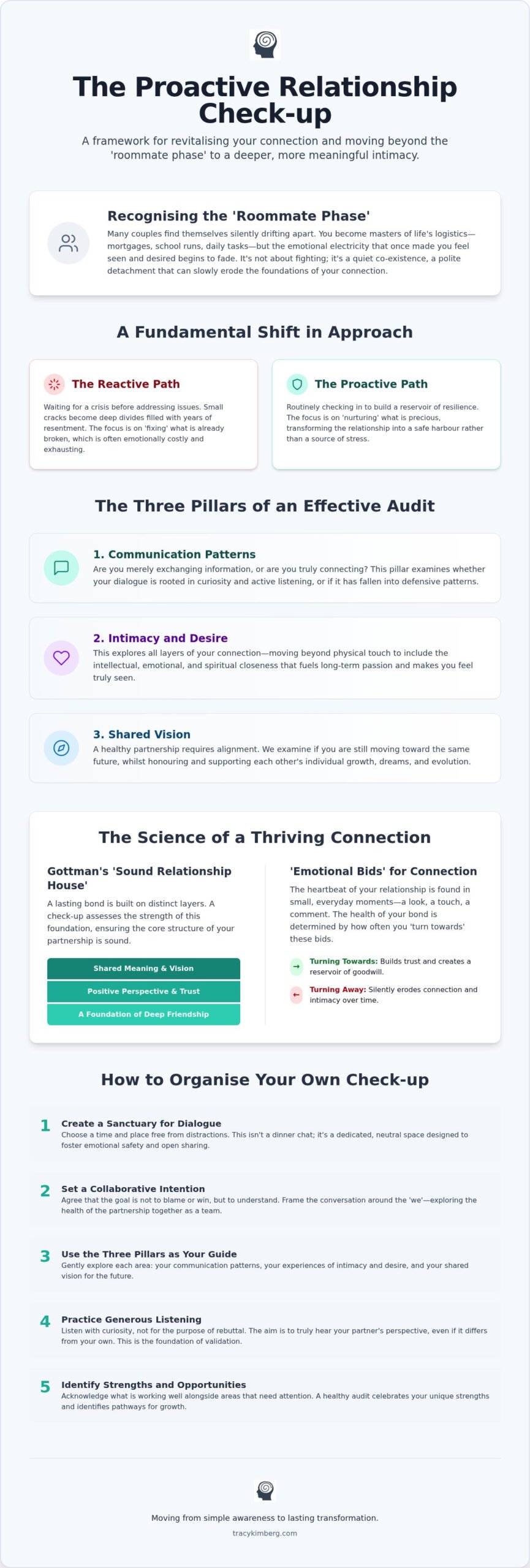
A relationship check up isn’t a post-mortem performed on a dying connection; it’s a vital, proactive wellness audit for a living, breathing partnership. At its core, this process is designed to identify the quiet strengths and subtle vulnerabilities that define your life together. It’s about looking beneath the surface of your daily interactions to see the architecture of your bond. By grounding our understanding in healthy relationship dynamics, we can see that intimacy is not a static destination but a continuous practice that requires regular attention.
Many couples eventually find themselves drifting into the ‘Roommate Phase’. This is a state where you are exceptionally efficient at managing the logistics of life, such as the mortgage, the school run, and the weekly shop, but you’ve lost the emotional electricity that once made you feel seen. Often, these logistics include underlying financial stressors; for those dealing with debt, Credit Counsellor Limited can provide guidance on solutions like IVAs to help lift the burden that weighs on a partnership. You aren’t necessarily fighting; you’re just co-existing in a state of polite detachment. Performing a relationship check up whilst things feel ‘fine’ is actually the hallmark of a high-functioning partnership. It prevents the slow, silent erosion of connection that happens when we take our partner’s presence for granted.
There is a fundamental difference between a casual ‘chat’ and a structured diagnostic check-up. A chat might happen over dinner and cover how your day went or what you’re doing at the weekend. A diagnostic audit, however, is an intentional deep dive. It’s a dedicated space where you examine the ‘we’ rather than just the ‘me’ or the ‘you’. It requires a different level of presence and a willingness to be vulnerable about your needs and fears.
Moving from Reactive to Proactive Love
The emotional cost of waiting for a crisis before seeking professional perspective is often immense. By the time many couples reach out, the ‘small cracks’ have already become deep divides, often laden with years of resentment. Relational intelligence is a muscle that we build through regular auditing. When you normalise checking in as a routine part of your life, you build a reservoir of resilience. It’s about shifting the narrative from ‘fixing what is broken’ to ‘nurturing what is precious’. This proactive stance transforms the relationship into a safe harbour rather than a source of stress.
The Three Pillars of an Effective Audit
- Communication Patterns: Are you merely exchanging information, or are you truly communicating? We look at whether your dialogue is defensive or if it’s rooted in curiosity and active listening.
- Intimacy and Desire: This pillar explores the layers of your connection. It moves beyond physical touch to include the intellectual and emotional closeness that fuels long-term passion.
- Shared Vision: A healthy partnership requires alignment. We examine whether you are still moving toward the same future goals whilst supporting each other’s individual growth and evolution.
When these future goals include starting a family, it is often beneficial to look at physical health alongside emotional connection. Accessing expert guidance from ah! fertility nutrition can help couples align their nutritional well-being with their reproductive aspirations, ensuring they are both physically and emotionally prepared for the journey ahead.
The Science of Connection: What a Healthy Relationship Actually Looks Like
To understand the health of a partnership, we must look at both the structural foundation and the emotional energy that flows through it. Dr John Gottman’s ‘Sound Relationship House’ serves as a profound diagnostic framework, suggesting that a lasting bond is built on layers of friendship, positive perspective, and shared meaning. When we conduct a relationship check up, we aren’t just looking for problems; we are assessing the strength of these foundational walls. It’s about honouring the reality that a partnership is an active, evolving ecosystem that requires consistent nourishment.
The heartbeat of this ecosystem is found in ’emotional bids’. These are the small, often mundane moments where one partner reaches out for connection, a look, a touch, or a simple comment about the weather. Success is determined by how often we ‘turn towards’ these bids rather than turning away. Over time, these micro-interactions create a reservoir of trust. Structured initiatives like the Relationship Checkup program demonstrate how tracking these patterns can significantly bolster resilience, even in high-stress environments.
However, connection also requires a delicate balance between authenticity and attachment. Gabor Maté often highlights how we sometimes sacrifice our true selves to maintain a sense of belonging, leading to hidden resentments. Similarly, Esther Perel reminds us that whilst security provides the ground we stand on, desire requires a sense of mystery and space. A truly healthy bond allows for both the safety of coming home and the freedom of individual growth. If you find yourself struggling to balance these needs, seeking relationship coaching and coaching for couples can provide the professional guidance needed to bridge the gap between safety and passion.
The Four Horsemen: Early Warning Signs
The Four Horsemen are a research-based diagnostic tool used to identify specific communication patterns that reliably predict the end of a partnership. These include Criticism, Defensiveness, Stonewalling, and, most dangerously, Contempt. Contempt is the single greatest predictor of relational breakdown because it involves speaking from a place of superiority, effectively eroding the mutual respect that holds a couple together. Performing a regular relationship check up allows you to catch these behaviours before they become your default mode of interaction.
The Power of Positive Sentiment Override
Healthy couples operate within a state of ‘Positive Sentiment Override’, where the overall positive feeling of the relationship buffers them against inevitable stresses. This is maintained by a scientific ratio of 5:1; for every one negative interaction, there must be at least five positive ones to keep the ’emotional bank account’ in credit. Identifying your favourite ways to reconnect after a disagreement, whether through humour, physical touch, or a shared ritual, is essential for maintaining this balance and ensuring your partnership remains a source of joy rather than a site of conflict.
Diagnostic vs. Dialogue: Professional Assessments vs. Home Check-ins
There is a quiet beauty in the kitchen-table conversation, where two people try to bridge the gap between their lived experiences. A self-guided relationship check up can be a wonderful starting point for couples who feel a slight drift but still possess the tools to navigate back to one another. However, we must recognise the inherent limitations of looking at our own reflection. We all carry blind spots; those unconscious patterns and defensive behaviours that often stem from our earliest survival mechanisms. When we are standing inside the frame, it’s almost impossible to see the whole picture.
A professional diagnostic differs from a casual home check-in by providing what we call a ‘safe container’. This is a structured environment where the presence of a specialist ensures that difficult truths can be spoken without the conversation collapsing into a familiar cycle of blame or withdrawal. Whilst a fifteen-minute chat might highlight a surface-level symptom, the 12-Week Relationship Recovery Process is designed to address the root cause. It moves beyond the ‘what’ of your arguments and delves into the ‘why’, offering a map through the complex emotional landscapes that DIY efforts often fail to navigate.
When to Call in a Relationship Expert
You might find that your attempts at home check-ins have become circular. If every effort to discuss your connection ends in the same repetitive argument, or if one partner feels they are constantly ‘walking on eggshells’, it is time to seek a professional perspective. A neutral third party doesn’t just listen; they disrupt the ‘stuck’ dynamics that have become entrenched over time. Professional coaching centres your individual needs whilst honouring the couple’s framework, ensuring that neither person’s voice is lost in the process.
The Professional Advantage
The transition from simple dialogue to a formal diagnostic involves the use of validated tools that quantify your partnership’s health. We move from the vague feeling that ‘things aren’t right’ to a clear, actionable understanding of specific strengths and challenges. This is where clinical expertise becomes vital, especially when navigating heavy issues like emotional neglect or the aftermath of infidelity. By choosing a professional path, you gain:
- Objective Insight: A coach identifies the systemic patterns you’ve become blind to.
- Evidence-Based Tools: Access to frameworks that move you from description to lasting transformation.
- Structured Growth: A proven programme ensures that no aspect of your intimacy is overlooked or ignored.
This professional approach turns a moment of potential crisis into a proactive adventure in healing and long-term emotional health.
How to Organise Your Own Relationship Check-up: A Step-by-Step Framework
Creating a space for a relationship check up at home requires more than just a list of questions; it demands an intentional shift in your environment and emotional state. This isn’t a conversation to be squeezed between work calls or conducted whilst you’re both exhausted in bed. It’s a ritual that honours the partnership by giving it the dedicated time it deserves. By following a structured framework, you can ensure the dialogue remains constructive rather than descending into the familiar patterns of conflict we’ve previously discussed.
Step 1: Set the Scene. Choose a neutral, distraction-free environment. This might be a quiet corner of a park or a favourite café where the presence of others encourages a certain level of emotional regulation. The goal is to step out of your domestic roles and into your roles as partners, away from the pile of laundry or the flickering television.
Step 2: The Appreciation Audit. Before addressing any friction, start with what is working. Share three specific things you’ve appreciated about each other over the past month. This isn’t just ‘fluff’; it’s a vital step in building the emotional safety required for the harder conversations to follow. It reminds you both that you are on the same team.
Step 3: Navigating the Hard Truths. When expressing a need, use ‘I’ statements to avoid triggering defensiveness. Instead of saying “You never listen,” try “I feel unheard when we discuss our finances, and I need us to find a way to communicate more clearly.” This focuses on your internal experience rather than your partner’s perceived failures.
Step 4: The Intimacy Audit. This is the time for radical honesty regarding your physical and emotional closeness. Discuss whether you feel like a team or if you’ve drifted into that ‘roommate phase’ we explored earlier. It’s about understanding how to build emotional intimacy through the courage of being truly seen and heard.
Step 5: Actionable Agreements. Conclude by setting one small, measurable goal for the coming month. This could be as simple as a weekly fifteen-minute ‘tech-free’ coffee date or a shared evening walk. Success lies in the consistency of these small shifts rather than grand, unsustainable gestures.
The Essential Questions to Ask Your Partner
- On Support: ‘How have I made you feel loved and supported this week, and where could I have done more?’
- On Growth: ‘Where do you feel we are currently drifting, and how can I help us anchor back together?’
- On Desire: ‘What makes you feel most connected to me, both intellectually and erotically, at this stage of our lives?’
Managing Defensive Behaviours
It is natural to feel a surge of defensiveness when hearing difficult feedback. This is often a survival response, a way of protecting our attachment to our partner when we feel criticised. The ‘Pause and Reflect’ method is essential here. If you feel your heart rate rising, ask for a five-minute break to breathe and centre yourself. You don’t need to solve every issue in one sitting. Taking the time to regulate your nervous system ensures that you respond from a place of love rather than fear. If you find these steps difficult to navigate alone, you may benefit from the structured support of Relationship Counselling and Coaching for Couples to help you find your way back to each other.
Beyond the Audit: Moving Toward Lasting Transformation
Gaining awareness through a relationship check up is a profound first step, yet we must recognise that awareness alone is only about 10% of the journey. The remaining 90% lies in integration; the daily, intentional practice of weaving new insights into the fabric of your shared life. It is one thing to identify a pattern of defensive behaviour whilst sitting at the kitchen table; it is quite another to choose curiosity over conflict in the heat of a real-world disagreement. Transformation happens when we move beyond simply describing our problems and begin the active work of rewiring our connection.
Maintaining the momentum of a check-up requires a commitment to continuous evolution. A partnership is not a static object to be fixed, but a dynamic ecosystem that needs regular nourishment. Sometimes, the audit reveals that the individuals within the couple need their own dedicated space to heal. Supporting the health of the partnership often involves therapy for adults or therapy for teenagers within the family unit, ensuring that each person has the emotional resources to show up fully for one another. When we take responsibility for our own internal landscape, we become better partners.
The 12-Week Relationship Recovery Path
For many couples, the insights gained from a self-guided audit highlight the need for a more robust, expert-led intervention. The 12-Week Relationship Recovery Process offers a structured, time-bound alternative to open-ended therapy, providing a clear map from relational breakdown to deep reconnection. This programme is designed to move you through the layers of your history, addressing the root causes of your drift with clinical precision and human warmth. When you embark on this coaching journey with Tracy Kimberg, you aren’t just talking about your issues; you are engaging in a powerful, transformational experience that provides the tools for long-term emotional health.
Committing to Continuous Growth
To ensure your progress sticks, make your next relationship check up a non-negotiable entry in your calendar. Whether you choose to check in monthly or quarterly, these appointments serve as a vital anchor for your bond. In some cases, a professional audit may lead to the realisation that the partnership has reached its natural conclusion. If this occurs, we utilise a Conscious Approached Divorce and separation, focusing on navigating the transition with dignity, respect, and a commitment to the well-being of everyone involved. Whether you are seeking to revitalise your spark or find a path forward, you don’t have to navigate these waters alone. Book your initial consultation today to take your check-up to the professional level and begin your journey toward a more authentic and connected future.
Your Invitation to Relational Resilience
Choosing to look honestly at your partnership is a courageous act of love. By moving from a reactive stance to a proactive relationship check up, you’ve already begun the vital work of dismantling the walls of detachment. You now understand that intimacy isn’t a static achievement but a living practice, nurtured through small emotional bids and the brave navigation of hard truths. Whether you are currently navigating the quiet ‘roommate phase’ or facing more complex divides, please remember that healing is always a possibility when approached with curiosity and professional guidance.
I invite you to transform these insights into lasting change within a safe, non-judgemental environment. My research-based approach, inspired by the work of Gottman and Perel, is designed to guide you through the complexities of human connection with both clinical precision and deep empathy. If you are ready to move beyond the audit and into a season of profound growth, you can Start your 12-Week Relationship Recovery journey with Tracy Kimberg today. Your partnership is an evolving adventure; let’s ensure its next chapter is one of vibrant connection and shared joy.
Frequently Asked Questions
How often should we do a relationship check-up?
You should aim for a comprehensive relationship check up at least once a year, whilst maintaining smaller, informal check-ins once a month. This consistent rhythm ensures that minor misalignments don’t have the space to fester into deep-seated resentments. Regularity builds the relational intelligence needed to navigate life’s inevitable stressors as a unified team.
What if my partner is resistant to doing a relationship audit?
Start by framing the audit as an act of curiosity and care rather than a search for faults. Explain that your desire stems from wanting to feel closer and more connected to them, rather than a need to critique their behaviour. When you focus on the ‘we’ and the health of the bond you both value, the conversation feels less like a confrontation and more like a shared adventure.
Is a relationship check-up the same as marriage counselling?
No, a check-up is a diagnostic tool used to assess the current health and structural integrity of your partnership, whilst counselling is the therapeutic work used to treat specific issues. Think of the check-up as the annual physical that determines if you need a more intensive recovery programme to restore your emotional well-being.
What are the most important questions to ask in a check-up?
The most vital questions focus on emotional safety and support, such as “How have I made you feel seen and loved this week?” and “What is one thing I can do to help you feel more secure in our bond?” These inquiries move beyond logistics and invite your partner to share their internal world, which is the foundation of true intimacy.
Can a check-up help if we have already experienced infidelity?
Yes, a relationship check up can provide a structured, clinical lens to evaluate whether the foundation of the partnership is still viable after a betrayal. It serves as an essential assessment phase that helps determine if you are both ready to engage in a deeper recovery process to heal the trauma of infidelity.
What should we do if our check-up reveals we are deeply unhappy?
Use that clarity as a catalyst for professional intervention rather than a reason for despair. Acknowledging deep unhappiness is often the most honest moment a couple can have; it’s the point where you stop drifting and start choosing a path forward. Whether that path leads to reconnection or a conscious separation, having an expert guide ensures the journey is handled with dignity.
How long does a typical relationship check-up take?
A self-guided home session usually requires between 60 and 90 minutes of uninterrupted time. It’s essential to choose a window where you both feel regulated and present, ensuring you have the space to use the ‘Pause and Reflect’ method if the conversation becomes emotionally charged.
Do we need a professional to do a Gottman-style check-up?
Whilst you can utilise at-home tools, a professional provides the ‘safe container’ and clinical expertise required to interpret complex data accurately. An expert identifies the systemic patterns you might be blind to and ensures that the diagnostic process leads to actionable, lasting transformation rather than repetitive arguments.

Article by
Tracy Kimberg
Tracy Kimberg is a Relationship Expert, Couples Therapist and Coach with a dedicated focus on helping couples and individuals rebuild connection, trust and emotional safety in their relationships. Drawing on the research of John and Julie Gottman, the relational insights of Esther Perel, and years of hands-on therapeutic experience, Tracy offers a warm, non-judgemental and deeply compassionate approach to modern relationships.
Based in Dorset, Tracy works with couples navigating communication breakdowns, betrayal, intimacy challenges, separation, family dynamics and life transitions. Known for creating a safe and grounded therapeutic space, she combines practical tools with emotional depth to help clients move beyond survival patterns and towards meaningful, lasting change.
With a reputation for empathy, professionalism and dedication to her clients’ growth, Tracy is passionate about helping people feel seen, understood and empowered — both within their relationships and within themselves.
Disclaimer
Disclaimer:
The information shared in this article is intended for educational and informational purposes only and should not be considered a substitute for professional therapeutic, psychological, medical or legal advice. Every individual and relationship is unique, and the perspectives offered are based on general therapeutic principles, research and professional experience.
Reading this article does not establish a therapist-client relationship with Tracy Kimberg. If you are experiencing significant emotional distress, relationship crisis, trauma, or mental health concerns, it is important to seek support from a qualified professional appropriate to your individual circumstances.
All content remains the intellectual property of Tracy Kimberg and may not be reproduced or distributed without permission.