

What if the most important conversation you have after a betrayal isn’t actually with your partner, but with yourself? When the floor drops out from beneath your life, the instinct is often to focus entirely on the relationship: the why, the how, and the what now. Yet, amongst the intrusive thoughts and the paralysing hypervigilance, your own sense of self can quickly become collateral damage. Seeking individual counselling after infidelity isn’t about ignoring the relationship; it’s about providing your own heart with the emotional triage it deserves. You’re likely feeling a chaotic mix of intense shame and overwhelming rage, wondering how you’ll ever feel like yourself again.
It’s completely normal to feel stuck in a loop of indecision, but you don’t have to stay there. This article explores how individual therapy helps you regulate a frazzled nervous system and regain your personal agency. You’ll discover how to find the clarity needed to make your next big decision with confidence, whether that involves staying to rebuild or choosing a conscious path toward separation. We will look at how to move from the noise of the crisis into a space where your own voice is finally audible again.
Key Takeaways
- Understand the “shattered mirror” effect and how betrayal disrupts your personal identity, history, and future narrative.
- Learn to manage the physiological impact of betrayal by recognising trauma responses like hypervigilance and emotional paralysis.
- Discover why individual counselling after infidelity provides the essential privacy and stabilisation needed before attempting complex couples work.
- Rebuild your internal compass by exploring how your attachment style shapes your path toward trust and self-worth.
- Gain the clarity required to make an informed choice about staying or leaving, supported by a structured, research-based recovery process.
The Shattered Identity: Why Individual Counselling is Essential After Infidelity
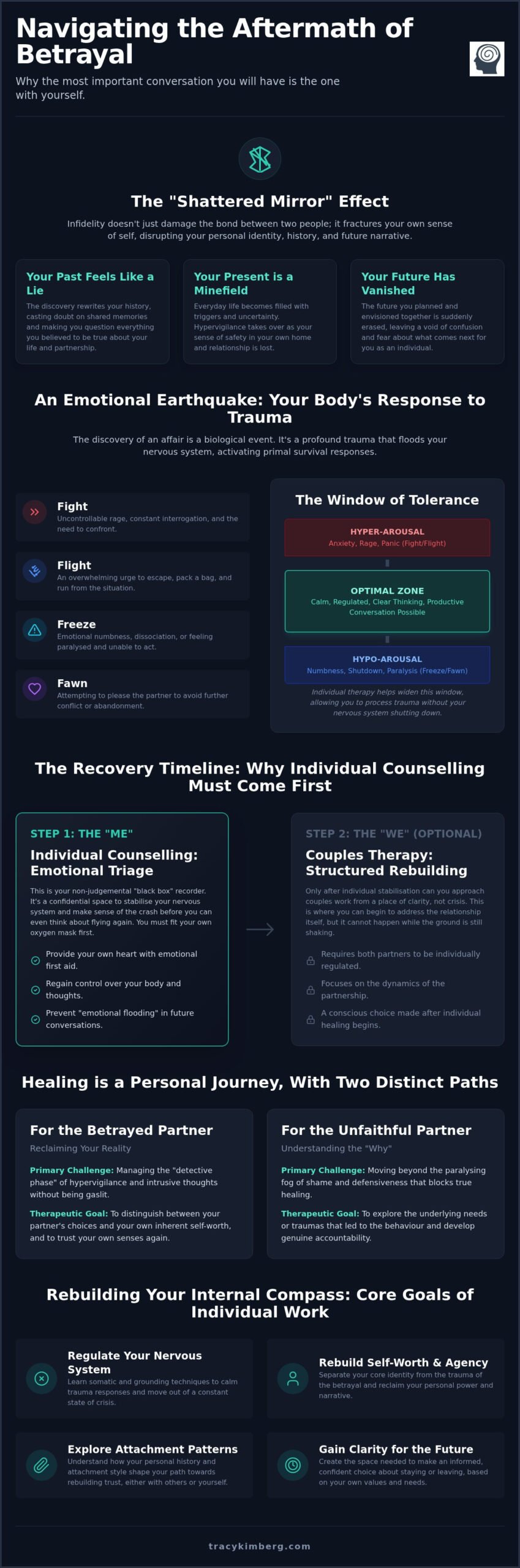
When betrayal enters a relationship, it doesn’t just damage the bond between two people; it shatters the internal mirror of the individual. This is what we call the “Shattered Mirror” effect. Suddenly, your past feels like a lie, your present is a minefield, and your future has vanished. Individual counselling after infidelity serves as a dedicated space for psychological stabilisation. It’s the essential “black box” flight recorder that helps you make sense of the crash before you try to fly again.
Betrayal often inflicts significant psychological damage, leaving you feeling untethered from your own story. Whilst couples work focuses on the “we,” individual therapy focuses on the “me.” It provides a non-judgemental witness to your shock, ensuring you don’t have to carry the weight of this trauma alone. By establishing this personal safety net, you prevent “emotional flooding” during future couples sessions. Flooding happens when the nervous system becomes so overwhelmed that productive conversation becomes impossible. Processing the initial trauma individually ensures that if you do choose to sit across from your partner later, you can do so with a regulated heart and a clearer mind.
The Betrayed Partner: Reclaiming Your Reality
If you’ve been betrayed, you’re likely grappling with the “detective phase.” This is a period of intense hypervigilance where you’re constantly scanning for more lies. Individual therapy offers a safe, controlled environment to process these intrusive thoughts without the fear of further gaslighting. It’s about distinguishing between your partner’s choices and your own self-worth. You’ll work on validating your experience, helping you move from the chaos of “what is real?” back to a place where you trust your own intuition and senses once again.
The Unfaithful Partner: Understanding the “Why” Without Defensiveness
For the partner who was unfaithful, individual sessions are a place to move beyond the paralysing fog of shame. Shame often leads to defensiveness, which blocks true healing. In this space, we explore the underlying unmet needs or personal traumas that may have contributed to “crossing the line” behaviours. We look at the psychology of compartmentalisation, helping you understand how you allowed yourself to lead a double life. The goal is to develop genuine accountability whilst maintaining your human dignity, which is the only way to offer a sincere path toward repair.
The Crisis Phase: Emotional Triage and Nervous System Regulation
Discovery of infidelity is a biological earthquake. It’s not just emotional distress; it’s a profound trauma that can manifest as Post-Traumatic Stress Disorder (PTSD). Your body is suddenly flooded with cortisol and adrenaline, keeping you in a state of high alert. This is why individual counselling after infidelity is your most urgent priority. It functions as the “oxygen mask” you must fit for yourself before you can even begin to think about the health of the partnership. You cannot rebuild a structure whilst the ground is still shaking beneath your feet.
When you’re in this crisis phase, your survival brain takes over. You might find yourself trapped in “Fight” (uncontrollable rage and interrogation), “Flight” (the sudden urge to pack a bag and run), “Freeze” (emotional paralysis or numbness), or “Fawn” (trying to please your partner to keep them close). None of these states allow for clear-headed decision-making. We work within what psychologists call the “Window of Tolerance.” If you’re outside this window, you’re either panicking or shut down. Individual therapy helps widen this window so you can actually process what has happened without your nervous system hitting a total breaking point.
Grounding Techniques for Betrayal Trauma
To manage the initial shock, we focus on somatic exercises that calm the vagus nerve. This might involve simple breathing patterns, weighted pressure, or temperature shifts to “reset” the brain’s alarm system. Establishing “safe zones” in your daily routine, where you intentionally step away from the crisis, is essential. These zones help reduce the urge to “pain-shop,” which is the compulsive need to check phones or social media for more evidence. By learning these tools, you begin to reclaim control over your own body and reduce the frequency of intrusive thoughts.
Individual Therapy as a Conflict Circuit-Breaker
Without a dedicated space to process your feelings, the home often becomes a 24/7 interrogation room. This constant venting cycle is exhausting for both partners and often re-traumatises the betrayed person. Individual work acts as a circuit-breaker, allowing you to offload the heaviest emotions in a safe environment. We can then work on a “Crisis Plan” for the first 60 days of discovery, focusing on firm boundaries and basic self-care. If you’re feeling overwhelmed right now, a professional guidance session can help you find your footing amongst the noise and start the process of stabilisation.
Individual vs. Couples Therapy: Navigating the Recovery Timeline
A common question arises in the wake of betrayal: “Should we see someone together, or should I go alone first?” Many couples feel a desperate urge to rush into the same room, hoping a therapist can quickly stitch the relationship back together. However, attempting couples work whilst the emotional wounds are still raw can sometimes do more harm than good. Individual counselling after infidelity provides the necessary foundation for any future joint work. It ensures that when you do eventually sit down together, you are doing so from a place of relative stability rather than reactive panic.
The Gottman Method, a research-based approach to relationship health, emphasises the importance of emotional presence. If one partner is constantly “flooded,” meaning their heart rate is elevated and their cognitive brain has shut down, productive conversation is impossible. Individual sessions allow for therapeutic privacy where you can explore your personal history and attachment styles without the pressure of your partner’s immediate reaction. This isn’t about keeping secrets from one another. Instead, it’s about cultivating the self-awareness and personal clarity required for the radical honesty that relational repair demands.
Whilst couples therapy focuses on the “dance” between two people, individual work focuses on your specific steps. It’s the ideal space to look at deep-seated patterns, such as anxious or avoidant attachment, that may have influenced the relationship dynamic long before the infidelity occurred. By addressing these internal blueprints, you gain a clearer understanding of your own needs and boundaries; to further explore these personal dynamics, you can visit Benessere Marriage and Family Therapy, Inc.
When Individual Therapy is the Priority
There are specific scenarios where individual work must take precedence. If there is active addiction, ongoing contact with a third party, or concerns about physical safety, couples work cannot safely begin. Additionally, if the betrayed partner is too reactive for calm dialogue, or if the unfaithful partner has not yet moved past defensiveness to find genuine remorse, individual sessions provide the essential “pre-work.” This period of stabilisation allows each person to build the emotional muscle needed for the rigours of joint recovery.
Moving Towards the 12-Week Relationship Recovery Process
Once both partners have achieved a level of individual regulation, they are much better equipped for the 12-Week Relationship Recovery Process. Individual progress acts as an accelerator for this structured journey. It ensures that you aren’t spending your joint sessions simply managing crises, but are instead moving toward meaningful solutions and a deeper level of intimacy. Transitioning from “me” problems to “we” solutions becomes a natural evolution once you have reclaimed your own sense of agency and calm.
Rebuilding Your Internal Compass: Goals of Individual Counselling
Rebuilding trust is often framed as something you do with your partner, but the most profound repair happens within yourself. Your intuition is typically the first casualty of betrayal. When you’ve been lied to, you stop trusting your own gut feelings, dismissing your inner voice as “paranoia” or “craziness.” Engaging in individual counselling after infidelity allows you to address this internal fracture. It provides a quiet laboratory where you can test your reality against your core values, helping you decide what is truly non-negotiable for your future.
We use this space to explore your attachment style, whether you lean toward being Anxious, Avoidant, or Secure. These blueprints, often formed in childhood, dictate how you respond to relational threats. By understanding these patterns, you can move from reactive survival into a state of Post-Traumatic Growth. This isn’t about “getting over” the pain; it’s about allowing the crisis to strip away old, unhelpful versions of yourself to make room for a more authentic, resilient identity. If you’re ready to start this internal repair, you can book a session for individual support to begin reclaiming your personal agency.
Esther Perel’s Concept of “Erotic Intelligence” and the Self
In the wake of an affair, the betrayed partner often feels “replaced” or “undesirable,” whilst the unfaithful partner may feel “trapped.” Esther Perel suggests that we must reclaim our sense of desirability and autonomy outside of the partnership. Individual work helps you distinguish between a “secret,” which is designed to deceive, and “privacy,” which is your right to an internal life that belongs solely to you. Erotic intelligence is the capacity to maintain a sense of mystery, autonomy, and personal vitality whilst remaining connected to others. Reclaiming this vitality is essential for your own health, regardless of whether the relationship survives; you can learn more about Holger Spanggaard and his specialised approach to sexological and psychological support.
Gabor Maté and the Roots of Behaviour
For the unfaithful partner, individual sessions are a place to investigate the “voids” or coping mechanisms that led to the betrayal. Following the insights of Gabor Maté, we look at the roots of behaviour without judgement. We ask what the affair was a “solution” to, often finding childhood attachment wounds or unmet needs for connection and validation. This isn’t an excuse for the behaviour, but it is a necessary explanation. Developing deep self-compassion whilst taking full accountability is the only way to ensure that these patterns do not repeat themselves in the future. We work to heal the wound so the “acting out” behaviour is no longer required as a form of emotional anaesthesia.
Finding Your Path Forward with Tracy Kimberg
In our culture, there’s often a silent, heavy pressure to maintain a “stiff upper lip” when life falls apart. We’re told to carry on, to keep things private, and to wait for time to heal the wounds. But betrayal isn’t a minor scrape; it’s a deep relational fracture that requires more than just endurance. Choosing individual counselling after infidelity isn’t an admission of defeat. It’s a courageous step away from the shadows of shame and into the light of radical honesty. I provide a safe, non-judgemental environment where you can finally set down the heavy burden of “just coping” and start truly living again.
My approach is built on the belief that therapy should be a proactive adventure toward a more authentic life. It’s not just about fixing what’s broken, but about discovering a version of yourself that is stronger and more self-aware than before. Whether you are in the initial shock of discovery or the long, wearying middle of the recovery process, I act as a Wise Guide to help you navigate the emotional terrain. With the flexibility of online therapy, I support individuals across the UK, ensuring that professional, research-based care is accessible wherever you are. This isn’t a cold, clinical transaction; it’s a human connection designed to foster your long-term emotional health.
A Personalised Approach to Infidelity Recovery
No two experiences of betrayal are identical. That’s why your sessions are tailored to your specific mental health needs, whether you’re battling the fog of depression or the sharp spikes of anxiety. By utilising the research-based methods of experts like John Gottman and Esther Perel, we look at the science of connection and the art of self-reclamation. My practice also extends specialised care to teenagers who may be caught in the crossfire of parental infidelity. They often feel the tremors of a relational breakdown just as keenly as the adults, and they deserve their own safe space to process the disruption to their world without feeling caught in the middle.
Your Next Steps: Booking a Consultation
The first step is often the hardest, but it’s also the most transformational. You don’t need to have all the answers or even a clear plan for your relationship to start this process. Getting started is simple, whether you prefer the convenience of online therapy or face-to-face sessions. This journey is about your health, your clarity, and your future. You deserve a space where your voice is heard and your healing is the priority, regardless of the relationship’s eventual outcome. Book a safe space to begin your individual healing journey today.
Reclaiming Your Voice Amongst the Chaos
The path following a betrayal is rarely linear, but you don’t have to navigate the wreckage alone. We’ve explored how individual counselling after infidelity provides the essential emotional triage needed to stabilise your nervous system and reclaim your sense of self. By focusing on your personal agency and understanding your attachment patterns, you create a foundation of clarity. This personal work doesn’t just help you survive the crisis; it prepares you for the rigours of relational repair if you choose to pursue it.
As a specialist in the 12-Week Relationship Recovery Process, I use a research-led approach inspired by the work of Gottman and Perel to guide you through this transition. My safe, non-judgemental UK-based practice is here to help you move from a state of panic to a place of proactive adventure. Whether you are looking to rebuild your partnership or find the strength to walk a different path, your long-term emotional health is the priority.
Start your personal recovery journey with an individual consultation. You have the power to redefine your story and find peace again.
Frequently Asked Questions
Is individual counselling better than couples therapy after an affair?
Neither approach is inherently better, but individual work is frequently the most effective starting point for emotional triage. Whilst couples therapy focuses on the relationship dynamic, individual counselling after infidelity focuses on your personal psychological stabilisation. It allows you to process the “shattered mirror” effect in a private space where you don’t have to manage your partner’s reactions alongside your own. This foundation makes future joint work significantly more productive.
Can individual therapy help me decide whether to stay or leave after infidelity?
Deciding whether to stay or leave is one of the primary goals of individual sessions. Therapy provides a neutral laboratory where you can evaluate your non-negotiables and personal values away from the noise of the crisis. By regulating your nervous system, you move from a state of reactive panic to one of informed choice. You’ll gain the confidence to make a decision that aligns with your long-term emotional health and personal agency.
Will my individual therapist tell my partner what I say in our sessions?
Your individual sessions are strictly confidential and protected by professional ethics. A therapist won’t share your disclosures with your partner, even if you are both seeing different practitioners within the same practice. This boundary is essential for creating a safe environment where you can explore difficult emotions, intrusive thoughts, or ambivalent feelings without fear of immediate relational consequences. Privacy is the cornerstone of your personal healing journey.
How long does individual counselling for infidelity typically take?
The duration of therapy depends on your specific needs, but the initial stabilisation phase often takes between eight and twelve sessions. For many, this provides enough emotional triage to move into a more structured 12-week Relationship Recovery Process. Long-term healing from betrayal trauma can take longer; it involves deconstructing deep-seated attachment patterns and rebuilding a sense of self-trust that was previously undermined by the discovery of the affair.
What if my partner refuses to go to therapy, but I want to heal?
You can absolutely pursue healing and personal growth even if your partner chooses not to engage in therapy. Your emotional well-being and recovery from betrayal are not contingent upon their participation. Individual work empowers you to reclaim your sense of self and personal agency, helping you find peace regardless of the relationship’s ultimate outcome. You’re the only person responsible for your own internal landscape and long-term emotional health.
Can individual therapy actually save my marriage after cheating?
Individual work can indirectly save a marriage by transforming how you show up in the relationship. When you take responsibility for your own triggers and emotional regulation, you stop the cycle of reactive conflict. For the unfaithful partner, it builds the empathy and accountability required for repair. For the betrayed partner, it restores the self-worth needed to engage in a healthy, restructured partnership rather than one based on constant hypervigilance.
How do I know if my therapist is the right “expert” for infidelity recovery?
A qualified expert should have a background in research-led methodologies, such as the Gottman Method or systemic perspectives influenced by Esther Perel. They should be trauma-informed, understanding the physiological impact of betrayal on the nervous system. During your initial consultation, look for a “Wise Guide” persona: someone who feels deeply knowledgeable and professional yet remains warm, accessible, and genuinely invested in your transformational journey toward success.
Is it normal to feel worse after the first few individual counselling sessions?
It’s entirely normal, and often expected, to feel a temporary increase in distress as you begin to unpack suppressed trauma. Therapy often acts like an emotional detox, bringing long-buried pain and rage to the surface so they can be processed and released. This phase is usually brief and is a sign that you’re doing the deep, necessary work. Your therapist will help you stay within your “Window of Tolerance” as you move through it.

Article by
Tracy Kimberg
Tracy Kimberg is a Relationship Expert, Couples Therapist and Coach with a dedicated focus on helping couples and individuals rebuild connection, trust and emotional safety in their relationships. Drawing on the research of John and Julie Gottman, the relational insights of Esther Perel, and years of hands-on therapeutic experience, Tracy offers a warm, non-judgemental and deeply compassionate approach to modern relationships.
Based in Dorset, Tracy works with couples navigating communication breakdowns, betrayal, intimacy challenges, separation, family dynamics and life transitions. Known for creating a safe and grounded therapeutic space, she combines practical tools with emotional depth to help clients move beyond survival patterns and towards meaningful, lasting change.
With a reputation for empathy, professionalism and dedication to her clients’ growth, Tracy is passionate about helping people feel seen, understood and empowered — both within their relationships and within themselves.
Disclaimer
Disclaimer:
The information shared in this article is intended for educational and informational purposes only and should not be considered a substitute for professional therapeutic, psychological, medical or legal advice. Every individual and relationship is unique, and the perspectives offered are based on general therapeutic principles, research and professional experience.
Reading this article does not establish a therapist-client relationship with Tracy Kimberg. If you are experiencing significant emotional distress, relationship crisis, trauma, or mental health concerns, it is important to seek support from a qualified professional appropriate to your individual circumstances.
All content remains the intellectual property of Tracy Kimberg and may not be reproduced or distributed without permission.