

Have you ever felt more alone sitting next to your partner than you do when you are actually by yourself? It is a quiet, heavy isolation that often settles in when the “spark” feels like a distant memory and every attempt at conversation feels like walking through a minefield. You might find yourself waiting for the right moment to speak, only to realise that the silence has become a habit whilst the emotional distance between you grows.
It is exhausting to live in a home where tension has replaced tenderness. You likely crave the version of “us” that felt effortless; a space where you felt truly seen and understood without having to defend your every word. This article offers a gentle way forward through psychologically grounded exercises for couples to reconnect. We will explore how to regulate your nervous systems together and bridge the emotional gap that has formed over time. By following this roadmap for relational repair, you can move past the anxiety of bringing up deep feelings and rediscover the genuine joy of your partnership.
Key Takeaways
- Understand why the “roommate phase” is a common plateau and how to recognise the subtle drift that occurs amongst the chaos of daily life.
- Discover how to use specific exercises for couples to reconnect that leverage co-regulation and oxytocin to lower stress and restore emotional safety.
- Master the “Stress-Reducing Conversation” to foster deeper intimacy by learning to listen to your partner without the instinct to “fix” their problems.
- Implement simple “Rituals of Connection” and weekly check-ins to protect your partnership from the erosion of modern life and daily chores.
- Identify the signs that self-guided work may need the support of professional relationship coaching to navigate deep-seated resentment effectively.
Understanding the Relational Drift: Why Couples Lose Connection
Connection doesn’t usually vanish in a sudden, dramatic crash. Instead, it’s often a slow, quiet receding of the tide. We call this “relational drift”, and it happens amongst the clatter of school runs, mortgage payments, and demanding careers. Before you know it, you’ve moved from being lovers and confidants to becoming efficient project managers of a shared life. Whilst you might be excellent at co-parenting or maintaining a household, you may also feel a profound “relational hunger”. This is a deep, aching desire to be truly known and seen by the person sleeping just inches away from you. Gaining a deeper perspective on Understanding Intimate Relationships helps us see that this hunger is a biological imperative, not a luxury.
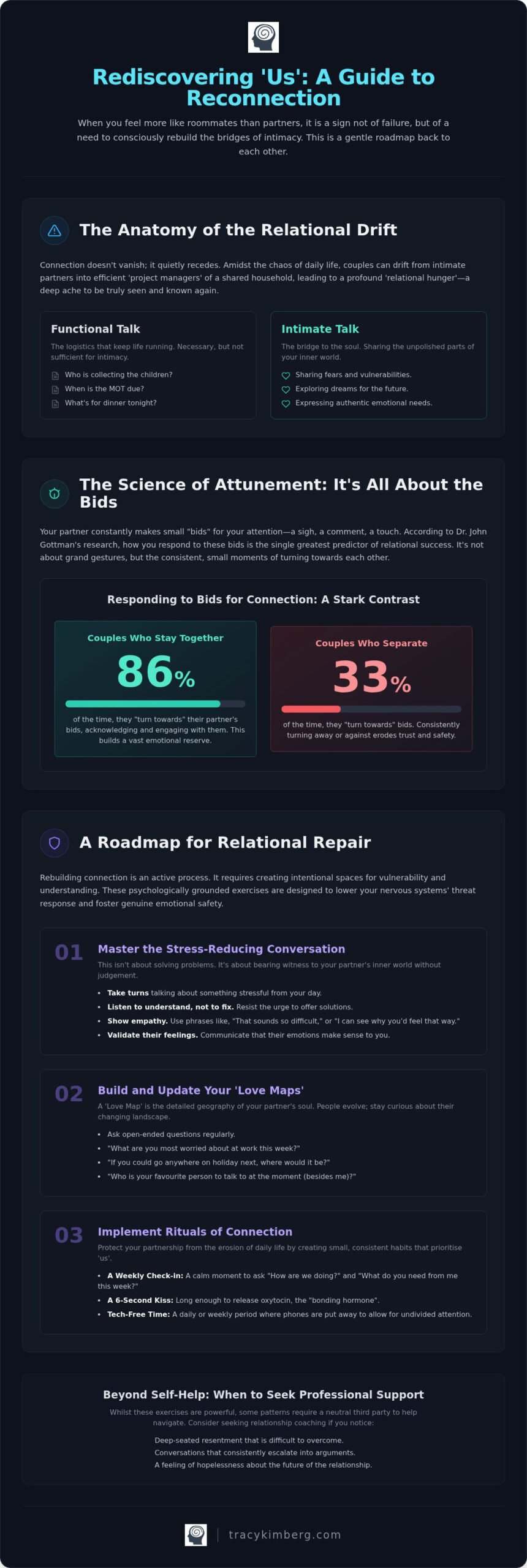
There’s a vital distinction between functional and intimate communication. Functional talk keeps the lights on; it’s the logistics of who is cooking dinner or when the car is booked for its MOT. Intimate communication is the bridge to the soul. It involves sharing fears, dreams, and the messy, unpolished parts of our internal experience. When the logistics take over, the intimacy starves. This is often the point where partners begin looking for exercises for couples to reconnect, sensing that the bridge has become dangerously thin.
The Anatomy of the ‘Roommate Phase’
In this stage, couples often lead parallel lives. You share a bed and a bank account, but your inner worlds rarely touch. You might notice a lack of curiosity about your partner’s day or a significant drop in spontaneous touch. Arguments often become “kitchen-sinking” sessions, where every past grievance is thrown into a current disagreement because the underlying emotional needs aren’t being met. Surprisingly, a total absence of conflict isn’t always a sign of health; it can signal an emotional “flatline” where both partners have simply stopped trying.
The Role of the Nervous System in Disconnect
When connection feels thin, our nervous systems often shift into survival mode. One partner might become hyper-vigilant, constantly scanning for signs of rejection or criticism. The other might withdraw into a “frozen” state, emotionally checking out to avoid further pain. In this state, your partner’s presence can actually trigger a “threat” response in your brain rather than a sense of safety. Moving from this defensive posture back to an open, receptive state is essential. Specific exercises for couples to reconnect are designed to signal to your brain that it is finally safe to come out of hiding and engage again.
The Science of Attunement: How Exercises Repair Your Bond
Repairing a relationship isn’t just about “talking through things” until you’re both exhausted. It’s about biology. When we engage in exercises for couples to reconnect, we aren’t just solving a puzzle; we’re engaging in co-regulation. This is the physiological process where our heart rates and breathing patterns begin to synchronise, signalling to the amygdala that the “threat” of isolation has passed. Research into the Science of Attunement confirms that these deep social connections are vital for our physical health, reducing cortisol and fostering a sense of profound security. By framing these moments as safety-building rather than problem-solving, we lower the stakes and make room for genuine vulnerability.
Turning Towards vs Turning Away
Every day, your partner makes “bids” for your attention. It might be a heavy sigh whilst looking at the news, a comment about a bird in the garden, or a gentle touch on the shoulder. These are invitations to connect. When you “turn towards” these bids, you make a deposit into your “Emotional Bank Account”. John Gottman’s research found that couples who stayed together turned towards each other 86% of the time, whilst those who eventually separated only did so 33% of the time. Relational Attunement is the active, intentional process of noticing and responding to a partner’s emotional state in real-time. It’s the small, daily choices that build a fortress of trust.
Love Maps: The Geography of Your Partner’s Soul
As the years pass, we often fall into the trap of thinking we have our partner “figured out”. This assumption is the death of intimacy. People are not static; they evolve, grow, and develop new fears or favourite things. Creating a “Love Map” means staying curious about the changing landscape of your partner’s inner world. What are they worried about at work this week? What is their current dream for the future? This curiosity is a powerful antidote to contempt and boredom. It transforms your partner from a familiar fixture in the house back into a mysterious, fascinating individual. Using structured exercises for couples to reconnect can help you update these maps without the conversation feeling forced or awkward.
If you feel your Love Map has become outdated and the distance feels too wide to bridge alone, a structured relationship recovery process can provide the framework to rediscover who your partner is today. Healing is an active, evolving experience that begins with the simple decision to look at each other with fresh eyes.
Core Exercises for Emotional and Physical Reconnection
Moving from the theory of attunement into the reality of daily life requires a shift in how you inhabit your shared space. Many couples search for “fun dates” when they sense a drift, but true repair often happens in the quiet, intentional moments of vulnerability. These exercises for couples to reconnect are designed to be low-barrier yet high-impact, focusing on emotional safety and physiological calm rather than just “having a good time”. Whilst the world outside may be chaotic, these practices help your relationship become the place where you can finally exhale.
One of the most profound shifts you can make is through the “Appreciation Journal”. Our brains are naturally wired to scan for threats and flaws, a phenomenon known as negativity bias. In a long-term partnership, this can make you an expert on your partner’s shortcomings whilst becoming blind to their strengths. By spending five minutes each evening writing down one specific thing you appreciated about your partner, you train your brain to notice the “good”. It might be the way they handled a stressful school run or simply how they made your favourite cup of tea. Shifting your gaze in this way changes the emotional temperature of the entire home.
Physical rituals are equally vital for grounding. The “Extended Hug” involves holding each other for at least 20 seconds without any agenda. This duration is specific; it is the time required for your bodies to release oxytocin and for cortisol levels to begin to drop. Similarly, the “Six-Second Kiss” acts as a ritual of transition. It is long enough to feel intentional and safe, marking the moment you stop being co-workers or parents and return to being partners. These micro-moments of physical affection build a sense of belonging that protects you amongst the daily rush.
The Stress-Reducing Conversation
This is a structured protocol for listening without the instinct to “fix”. The speaker focuses entirely on external stressors, such as work or family drama, avoiding any “you” statements that might trigger defensiveness in the partner. The listener’s role is purely to validate. Instead of offering solutions, try saying, “That sounds incredibly draining, I can see why you feel that way.” This simple exercise builds a “we against the world” mentality, ensuring that neither of you feels alone in your struggle.
Sensate Focus and Physical Anchoring
When tension is high, rebuilding safety in the body is essential. The “Hand on Heart” exercise involves sitting together and placing a hand on each other’s chest, feeling the rhythm of the breath. This non-sexual touch acts as a physical anchor, calming the nervous system and reminding the brain that your partner is a source of safety rather than a threat. By prioritising these micro-moments of touch, you create a foundation of physical comfort that makes deeper emotional work much more manageable.
Integrating Connection into Your Daily British Lifestyle
In our fast-paced lives, it is easy to assume that intimacy requires grand, cinematic moments. In reality, the most resilient bonds are forged in the mundane spaces between work, chores, and sleep. For many in the UK, a certain cultural reserve can make deep emotional sharing feel awkward or performative. However, integrating exercises for couples to reconnect into your daily British lifestyle doesn’t need to feel like a chore. It is about reclaiming the small, stolen moments; the time spent boiling the kettle or the twenty minutes after the children have finally gone to bed. By creating “Rituals of Connection”, you weave a safety net that catches the relationship before the drift becomes a chasm.
One essential habit is protecting the “Sacred Space” of the bedroom. The intrusion of digital life into our most private quarters is a primary driver of disconnect. When you both lie in bed scrolling through separate feeds, you are physically present but emotionally miles apart. Agreeing to leave phones in another room thirty minutes before sleep creates a vacuum that curiosity and touch can naturally fill. This boundary signals that your partnership is more important than the digital noise outside.
The Weekly Relationship Check-in
The “State of the Union” meeting is a powerful tool for clearing the air before resentment has a chance to settle. This is a dedicated 20-minute slot once a week where you sit down with a specific agenda. To keep the conversation safe and productive, start with a “soft start-up” by sharing three things you appreciated about your partner that week. Then, move into three specific questions:
- What went well in our relationship this week?
- How can I love you better next week?
- Is there anything we need to clear or “process” from the last few days?
Keeping this meeting time-limited prevents it from spiralling into a marathon argument. It transforms the relationship from a passive experience into an active, shared project where both partners feel heard and valued.
Small Gestures with Large Impact
Consistency always beats intensity when it comes to relational health. The “Tea Ritual” is a perfect example of a small act of service that signals care. Bringing your partner a cup of tea exactly how they like it, without being asked, is a silent “bid” for connection that says, “I see you, and I know what you need.” Similarly, using technology for a simple “Thinking of You” text whilst at work bridges the gap during the long hours apart. If you find that these small steps feel impossible due to deep-seated conflict, it might be time to book a session for relationship coaching to help navigate the way back to each other. These daily exercises for couples to reconnect are the building blocks of a partnership that doesn’t just survive but thrives amongst the noise of modern life.
Beyond Self-Help: When to Seek Professional Relationship Coaching
Whilst these exercises for couples to reconnect can spark significant change, there are times when the emotional distance feels too vast to navigate alone. Sometimes, the “drift” has hardened into deep-seated resentment or a pervasive sense of hopelessness. In these moments, attempting self-guided repair can occasionally feel like trying to perform surgery on oneself. It is difficult to remain objective when your own heart is on the line. Recognising that you need an outside perspective isn’t a sign that your partnership is failing; it is an admission that your relationship is valuable enough to protect with professional expertise.
One of the greatest benefits of professional coaching is the creation of a “Third Room”. This is a neutral, therapeutic space where the relationship itself becomes the client. Within this room, the power dynamics that often paralyse a couple at home are balanced by a Wise Guide. It provides a container of safety where you can finally explore difficult truths without the conversation collapsing into the familiar patterns of blame or withdrawal. Professional support offers the accountability that self-help often lacks, ensuring that the work of reconnection remains a steady, evolving priority rather than a fleeting Sunday afternoon effort.
The 12-Week Relationship Recovery Process
For couples who feel they are in a cycle of crisis management, a structured approach is often the most effective path back to intimacy. The 12-Week Relationship Recovery Process is designed to move you from a state of reactive survival into one of intentional partnership. This isn’t about “fixing” one person; it is about identifying the systemic patterns that have kept you both stuck. By following a time-bound programme, couples often feel a renewed sense of hope as they see tangible progress week by week. We work through identifying old wounds, healing the fractures in trust, and consciously building a shared future that feels both safe and exciting.
An Invitation to Heal
Choosing to seek help is a profound act of courage. It requires a vulnerability that can feel daunting, yet it is the only way to ensure the “drift” doesn’t become a permanent divide. You don’t have to wait for a total breakdown to begin the work of repair. Whether you are navigating a major transition or simply want to restore the warmth that has cooled over time, there is a path forward. I invite you to take that next step before the silence between you grows any louder. You can book a discovery call with Tracy Kimberg to begin your 12-Week Journey and rediscover the partnership you both deserve. Healing is not just possible; it is a proactive adventure that starts with a single, honest conversation.
Reclaiming Your Shared Future
Finding your way back to one another is not about grand gestures but about the quiet, consistent choice to turn towards your partner. You now have a roadmap to move beyond the “roommate phase” by prioritising emotional safety and physiological co-regulation. By implementing intentional exercises for couples to reconnect, you can begin to lower the walls of resentment and rediscover the curiosity that first drew you together. These small, daily shifts in attunement are the building blocks of a partnership that feels safe, seen, and deeply valued.
Whilst self-guided work is a powerful starting point, some fractures require a more structured approach to heal fully. If you are ready to move from survival into a thriving partnership, I invite you to Begin your 12-Week Relationship Recovery Journey with Tracy Kimberg. This Gottman-inspired, research-based programme provides a safe and non-judgemental online therapy environment designed specifically for transformational recovery from relational breakdown. You deserve a space where your relationship can be nurtured with expert care and clinical precision.
Your relationship is an evolving story, not a static condition. It takes courage to admit that the path has become difficult, but that very admission is the first step toward a deeper, more resilient bond. Healing is possible, and you don’t have to navigate the way home alone.
Frequently Asked Questions
How can I reconnect with my partner when I feel deep resentment?
Reconnecting whilst carrying resentment requires a gentle shift from focusing on your partner’s flaws to acknowledging your own unmet needs. You can begin by using an Appreciation Journal to intentionally notice small, positive actions your partner takes each day. This practice doesn’t ignore the hurt; rather, it softens the heart enough to allow for the deeper, vulnerable conversations necessary for healing.
It is often helpful to start with low-stakes physical rituals, such as a brief touch on the arm or making a cup of tea, before attempting to resolve the larger issues. These small acts of service serve as a bridge, signalling that you are still invested in the partnership despite the current pain.
What are the best exercises for couples who have stopped talking altogether?
When verbal communication has broken down, the best exercises for couples to reconnect are those that focus on non-verbal, physiological safety. The “Extended Hug” or the “Hand on Heart” exercise are powerful tools because they bypass the need for words and speak directly to the nervous system. These practices help co-regulate your bodies, reducing the “threat” response that often keeps couples in a state of silent withdrawal.
Once a basic sense of physical safety is restored, you can reintroduce low-stakes verbal sharing through “Rituals of Connection”. This might involve a simple text during the day or a five-minute check-in that focuses entirely on external stressors rather than relationship problems.
How long does it take to reconnect after a long period of emotional distance?
The timeline for reconnection varies for every couple, but consistency is far more important than speed. Research suggests that couples therapy has a positive impact on approximately 70% of those who undertake it, often showing significant progress within a few months. A structured 12-week recovery process is frequently recommended as it provides enough time to identify old patterns and establish new, healthier habits.
Can these exercises really save a marriage on the brink of divorce?
These tools can certainly save a marriage, provided both partners are willing to engage in the process of repair. Exercises for couples to reconnect act as “safety-building” mechanisms that can de-escalate high-conflict situations and re-establish a foundation of trust. Whilst self-help tools are valuable, a marriage on the brink of divorce often benefits from the “Third Room” of professional coaching to navigate deep-seated grievances safely.
What is the “Six-Second Kiss” and why is it recommended by experts?
The “Six-Second Kiss” is a ritual of connection designed to act as a physical bridge between the different roles we play in life. It is long enough to feel intentional and triggers the release of oxytocin, which lowers cortisol and fosters a sense of security. It marks the moment you stop being co-parents or colleagues and return to being intimate partners, creating a micro-moment of belonging amongst the daily rush.
How do we start these exercises if my partner is resistant to the idea?
Start by using a “soft start-up” to express your own desire for closeness rather than criticising your partner’s distance. You might say, “I’ve been feeling a bit lonely lately and I’d really love to try this small exercise to help us feel closer.” Framing the work as a positive adventure for the relationship rather than a “fix” for a broken person often reduces defensiveness and invites collaboration.
What should we do if an exercise triggers a new argument?
If an exercise leads to tension, you should stop immediately and take a “physiological time-out” for at least twenty minutes. This allows your heart rates to return to a baseline state and prevents the “flooding” that makes productive conversation impossible. Once you are both calm, you can return to the topic using the “State of the Union” format to process the trigger without falling back into the argument.
Is it possible to rebuild emotional intimacy after an affair using these tools?
Rebuilding intimacy after betrayal is a complex process, but it is entirely possible with a trauma-informed approach. These tools help to regulate the hyper-vigilance often felt by the betrayed partner and re-establish “Love Maps” that have been shattered. However, the depth of an affair usually requires the structured guidance of a professional recovery programme to manage the intense emotions of accountability and hurt whilst working toward a new version of the relationship.

Article by
Tracy Kimberg
Tracy Kimberg is a Relationship Expert, Couples Therapist and Coach with a dedicated focus on helping couples and individuals rebuild connection, trust and emotional safety in their relationships. Drawing on the research of John and Julie Gottman, the relational insights of Esther Perel, and years of hands-on therapeutic experience, Tracy offers a warm, non-judgemental and deeply compassionate approach to modern relationships.
Based in Dorset, Tracy works with couples navigating communication breakdowns, betrayal, intimacy challenges, separation, family dynamics and life transitions. Known for creating a safe and grounded therapeutic space, she combines practical tools with emotional depth to help clients move beyond survival patterns and towards meaningful, lasting change.
With a reputation for empathy, professionalism and dedication to her clients’ growth, Tracy is passionate about helping people feel seen, understood and empowered — both within their relationships and within themselves.
Disclaimer
Disclaimer:
The information shared in this article is intended for educational and informational purposes only and should not be considered a substitute for professional therapeutic, psychological, medical or legal advice. Every individual and relationship is unique, and the perspectives offered are based on general therapeutic principles, research and professional experience.
Reading this article does not establish a therapist-client relationship with Tracy Kimberg. If you are experiencing significant emotional distress, relationship crisis, trauma, or mental health concerns, it is important to seek support from a qualified professional appropriate to your individual circumstances.
All content remains the intellectual property of Tracy Kimberg and may not be reproduced or distributed without permission.