
What if your teenager’s anxiety isn’t a problem to be solved, but a message waiting to be heard? If you’re searching for help for anxious teenagers, chances are you’ve already felt that quiet dread: watching your child withdraw, sensing the distance growing, and wondering whether you’re making things better or worse every time you try to reach them.
You’re not alone in that feeling. Most parents in your position aren’t failing their child; they simply haven’t yet been given the right tools to build the bridge their teenager desperately needs. The good news is that connection, not correction, is what creates genuine healing.
In this guide, you’ll discover how to recognise the subtle signs that separate typical teenage mood shifts from genuine anxiety, and how to respond in ways that draw your child closer rather than pushing them further away. We’ll also explore when it might be time to seek professional support, and what that process can look like for your family. Consider this your compassionate, practical starting point.
Key Takeaways
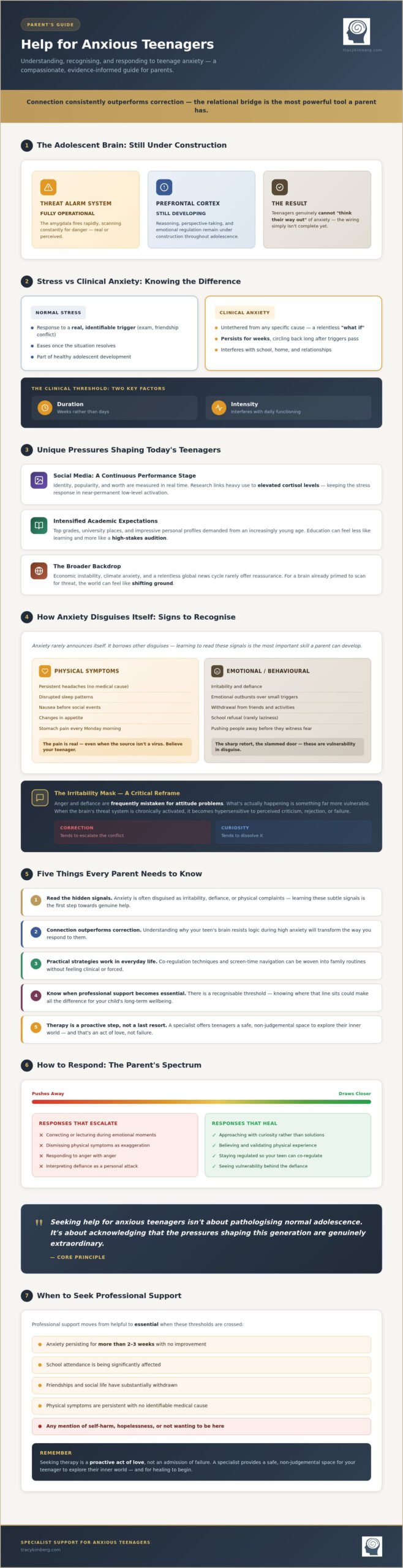
- Teenage anxiety is often disguised as irritability, defiance, or physical complaints — learning to read these subtle signals is the first step towards genuine help for anxious teenagers.
- Connection consistently outperforms correction: understanding why your teen’s brain resists logic during moments of high anxiety will transform the way you respond to them.
- Practical, research-backed strategies — from co-regulation techniques to navigating screen time without conflict — can be woven into everyday family life without feeling clinical or forced.
- There is a recognisable threshold at which professional support becomes not just helpful, but essential — and knowing where that line sits could make all the difference for your child’s long-term wellbeing.
- Therapy with a specialist like Tracy Kimberg offers teenagers a safe, non-judgemental space to explore their inner world — a proactive step towards healing rather than a last resort.
Understanding the Landscape of Teenage Anxiety in 2026
Think of the adolescent brain as a house being extensively renovated whilst its occupants are still living inside it. The alarm system, wired for survival, is fully operational. The part responsible for reasoning, perspective-taking, and emotional regulation — the prefrontal cortex — is still very much under construction. This isn’t a flaw in design; it’s the nature of adolescent development. But it does mean that when anxiety takes hold, teenagers genuinely cannot “think their way out of it” the way we might hope or expect.
Anxiety, at its core, is the brain’s threat-detection system firing in the absence of a concrete, immediate danger. It’s an internalised fear of future uncertainty, a relentless “what if” that the developing mind struggles to quiet. Understanding this distinction is the foundation of any meaningful help for anxious teenagers.
The Difference Between Typical Stress and Clinical Anxiety
Stress and anxiety are related but distinct. Stress is a response to a real, identifiable threat — an exam tomorrow, a falling-out with a friend. Anxiety is the reaction to that stress when it becomes untethered from any specific cause, circling back on itself long after the original trigger has passed. The clinical threshold hinges on two factors: duration and intensity. When anxious feelings persist for weeks rather than days, and when they begin to interfere with your teenager’s ability to function at school, at home, or in their relationships, that’s the signal that something beyond ordinary growing pains is at work.
Why 2026 Presents Unique Pressures
Today’s teenagers are growing up in conditions that have no real historical precedent. Social media platforms are no longer simply a place to connect; they’ve become a continuous performance stage where identity, popularity, and worth are measured in real time. Research consistently links heavy social media use to elevated cortisol levels in adolescents, keeping the stress response in a near-permanent state of low-level activation.
Alongside this, British teenagers face sharply intensified academic expectations. The pressure to achieve top grades, secure university places, and build an impressive personal profile from an increasingly young age has transformed education into something that can feel less like learning and more like a high-stakes audition.
Then there’s the broader backdrop: economic instability, climate anxiety, and a global news cycle that rarely offers reassurance. For a young person whose brain is already primed to scan for threat, the world can genuinely feel like shifting ground beneath their feet. Seeking help for anxious teenagers, then, isn’t about pathologising normal adolescence. It’s about acknowledging that the pressures shaping this generation are genuinely extraordinary.
Identifying the Subtle Language of Anxiety in Your Teen
Anxiety rarely announces itself clearly. It doesn’t arrive wearing a label. Instead, it tends to borrow other disguises — a stomachache before school, a sudden fury over something trivial, a slow withdrawal from the friends and activities your teenager once loved. Learning to read these signals is, in many ways, the most important skill a parent can develop when seeking help for anxious teenagers.
Physical symptoms are often the first thing families notice. Persistent headaches with no medical explanation, disrupted sleep, nausea before social events, changes in appetite — these aren’t manipulation or attention-seeking. They’re the body’s honest response to a nervous system that’s been running on high alert for too long. The gut, in particular, is exquisitely sensitive to anxiety. When your teenager says their stomach hurts every Monday morning, believe them. The pain is real, even if the source isn’t a virus.
The Irritability Mask
Perhaps the most misunderstood expression of teenage anxiety is anger. Irritability, defiance, and emotional outbursts are frequently mistaken for attitude problems or deliberate disrespect. What’s actually happening is something far more vulnerable. When the brain’s threat system is chronically activated, it becomes hypersensitive to perceived criticism, rejection, or failure. The sharp retort, the slammed door, the eye-roll that seems designed to wound — these are often a teenager’s way of pushing people away before those people can witness their fear. Correction in these moments tends to escalate the conflict. Curiosity tends to dissolve it.
School Refusal and Social Avoidance
School refusal is rarely about laziness. It’s almost always about dread: dread of being judged, of failing publicly, of navigating the complex social architecture of adolescence on a nervous system that’s already overwhelmed. Social avoidance operates on the same principle but is subtler. Your teen might still attend school whilst quietly pulling back from friendships, declining invitations, or disappearing from group chats. Watch for the shrinking, not just the absence.
Beyond the Physical: Emotional and Social Withdrawal
There’s a meaningful difference between a teenager who needs solitude to recharge and one who’s retreating out of fear. The former tends to re-emerge refreshed and engaged. The latter retreats further, narrowing their world to the few environments where they feel safe from judgement. You might notice them dropping hobbies they previously adored, or performing with visible distress in sports or creative pursuits where they once felt free. This is performance anxiety in action, and it quietly erodes a young person’s sense of identity over time.
Cognitive Patterns: Perfectionism and the “What-If” Loop
This is where most guides fall short, and it’s worth examining carefully. Anxious teenagers frequently develop an internalised belief that perfection is their only protection against criticism or rejection. If they can do everything flawlessly, nothing bad can happen. The pressure this creates is enormous, and it’s entirely invisible to the people around them.
Alongside perfectionism sits the “what-if” loop: a cognitive pattern where the brain rehearses worst-case scenarios in relentless rotation. What if I fail the exam? What if they’re laughing at me? What if something terrible happens and I can’t cope? The loop doesn’t resolve; it simply cycles. This is the brain’s misguided attempt to prepare for danger, but because the danger is imagined rather than concrete, no amount of reassurance breaks the cycle for long.
Listen for these verbal cues in your teenager’s everyday conversation:
- “What if something goes wrong?” repeated across unrelated situations
- “I can’t do it” before genuinely attempting something new
- “Everyone will think I’m stupid/weird/pathetic”
- “I just don’t want to go” with no specific reason offered
- “It doesn’t matter anyway” as a way of pre-emptively abandoning things they care about
- “I knew it would go wrong” after even minor setbacks
These phrases aren’t teenage melodrama. They’re windows into a thought pattern that, left unaddressed, tends to deepen over time. If several of these feel familiar, it may be worth exploring specialist support for your teenager before the pattern becomes more entrenched. Early recognition is one of the most powerful forms of help for anxious teenagers available to any family.
The Relational Bridge: Why Connection is the Best Antidote
Here’s something most parenting advice quietly sidesteps: you cannot think your way into your teenager’s trust. You can only feel your way there. When a young person is locked inside an anxious mind, the most powerful thing you can offer isn’t a solution. It’s a safe presence. This is the relational bridge, and building it is, arguably, the most meaningful form of help for anxious teenagers that any parent can provide.
John Gottman’s research on emotional coaching offers a compelling framework here. His work consistently demonstrates that children and teenagers who feel emotionally understood by their parents show lower physiological stress responses, recover more quickly from setbacks, and develop stronger emotional regulation over time. The mechanism is straightforward: feeling heard activates the parasympathetic nervous system, the body’s natural “rest and restore” mode. Feeling dismissed does the opposite.
Validation vs. Problem-Solving
“Don’t worry about it” is almost certainly the least helpful phrase you can offer an anxious teenager. Not because you don’t mean well, but because it signals, however unintentionally, that their inner experience is an inconvenience to be managed rather than a feeling worth understanding. Anxious minds don’t respond to dismissal; they double down.
The alternative is what Gottman calls “seek to understand before you seek to be understood.” In practice, this looks like pausing your own impulse to reassure or redirect, and instead asking a genuinely open question: “That sounds really hard. What’s the part that worries you most?” This single shift, from fixer to witness, can measurably lower a teenager’s heart rate within minutes. The body relaxes when it feels seen.
Creating a “Safe Haven” at Home
Gabor Maté’s work on the parent-child connection offers something equally important: the idea that a parent’s own nervous system is the most powerful co-regulation tool in the room. When you stay calm in the face of your teenager’s distress, you’re not being passive. You’re actively lending them your regulated state. This is physiological, not metaphorical. Calm is genuinely contagious.
Creating a safe haven at home doesn’t require grand gestures. It requires consistency in the small ones. Consider these practical anchors:
- Designated no-phone time together — even twenty minutes of undivided, screen-free presence communicates that your teenager is worth your full attention.
- Boundaries framed as protection, not punishment — rules that are explained with warmth feel like a safety net; rules delivered as ultimatums feel like a cage.
- Micro-connections woven into ordinary moments — a brief check-in during a car journey, a shared TV programme, cooking together. Trust isn’t built in a single conversation; it accumulates in these small, repeated exchanges.
The relational bridge doesn’t need to be elaborate. It needs to be reliable. When your teenager knows, without question, that home is a place where they won’t be judged for struggling, they’re far more likely to let you in when the anxiety becomes genuinely overwhelming. That open door is the foundation on which all other help for anxious teenagers is built.
Practical Strategies to Support an Anxious Teenager
Knowing your teenager is struggling is one thing. Knowing what to actually do in the moment is another entirely. Most advice aimed at parents stops at “try deep breathing together” without explaining why that works, or why your teenager might flatly refuse to try it. The strategies below go deeper than that, because genuine help for anxious teenagers requires understanding the mechanism, not just the method.
Grounding Exercises and Co-regulation
When anxiety spikes, the brain’s threat system floods the body with stress hormones before rational thought has a chance to intervene. Grounding techniques work by redirecting attention to immediate sensory experience, which pulls the nervous system back from the edge. The key is practising these before a crisis, not during one.
The 5-4-3-2-1 technique is one of the most accessible starting points. Ask your teenager to name five things they can see, four they can physically feel, three they can hear, two they can smell, and one they can taste. It sounds simple, almost too simple, but the act of anchoring attention to the present moment interrupts the “what-if” loop in a way that reassurance simply cannot.
Box breathing is equally powerful and takes under three minutes. Breathe in for four counts, hold for four, breathe out for four, hold for four. Repeat four times. This activates the vagus nerve, which directly signals the parasympathetic nervous system to downshift from high alert. The physiological shift is measurable and real.
Then there’s body doubling, perhaps the most underrated tool available to parents. Simply being present in the same room whilst your teenager works, reads, or studies can significantly reduce their ambient anxiety. You don’t need to talk. You don’t need to help. Your regulated, calm presence acts as an external anchor for their nervous system. This is co-regulation in its purest form.
Managing Digital Environments and Balance
The conversation around screen time tends to collapse quickly into conflict, largely because it’s framed as restriction rather than understanding. Before negotiating limits, it helps to understand why digital environments are so physiologically costly for anxious brains. Social media platforms are engineered for variable reward, the same mechanism behind slot machines. Each scroll delivers an unpredictable mix of validation and comparison, keeping cortisol levels elevated in a way that ordinary socialising doesn’t.
Rather than imposing blanket bans, try introducing the concept of conscious scrolling: helping your teenager notice which accounts or feeds leave them feeling energised versus depleted. This builds metacognitive awareness, which is far more durable than any parental rule. A simple question like, “How do you feel after spending time on that?” plants a seed without triggering defensiveness.
Counterbalancing screen time with green time is backed by a growing body of research linking time in natural environments to reduced cortisol and improved mood in young people. It doesn’t require a hiking expedition. A short walk, sitting in a garden, or even having a window open during homework can make a genuine difference to an anxious nervous system.
Sleep deserves its own mention here. Blue light emitted by screens suppresses melatonin production for up to two hours after exposure, which means a teenager scrolling until midnight isn’t just tired; they’re chemically prevented from winding down. For an already anxious brain, poor sleep compounds every other symptom. A consistent, phone-free wind-down routine, even thirty minutes before bed, can meaningfully shift the quality of their rest over time.
None of these strategies need to feel clinical or imposed. Introduced with curiosity rather than authority, they become tools your teenager can own. If you’d like professional guidance on how to support your child through these approaches in a structured, compassionate way, explore how specialist therapy for teenagers can help.
When to Seek Professional Support: The Path to Healing
There’s a particular kind of helplessness that settles over parents when they realise that love, patience, and every strategy they’ve tried simply isn’t enough. That recognition isn’t failure. It’s clarity. And it’s often the moment that opens the door to the most meaningful help for anxious teenagers available: working with a specialist who can reach the parts of your child that family dynamics, however warm, cannot always access.
Recognising the Threshold for Therapy
Knowing when to seek professional support isn’t always obvious. The following signals suggest the threshold has been reached:
- Self-harm or expressions of hopelessness, even if framed as “just a joke” — these require immediate professional attention.
- Significant changes in weight or eating patterns that persist beyond a few weeks.
- Total social withdrawal, where your teenager has effectively stopped engaging with peers, activities, and family life altogether.
- Chronic sleep disruption that’s affecting their ability to function at school or manage basic self-care.
- Anxiety that’s become self-reinforcing, where avoidance is now shaping every decision they make.
There’s something else worth naming here. When anxiety becomes a recurring source of conflict between parent and teenager, the family system itself can inadvertently sustain the problem. An external, neutral professional breaks that cycle in a way that even the most devoted parent cannot. It’s not a reflection on your relationship; it’s simply how human systems work.
If you are looking for this type of external guidance, you can explore Teen Therapy in Alberta to find specialised support that helps teenagers build emotional strength and resilience.
What to Expect from Therapy with Tracy Kimberg
Tracy Kimberg’s approach to teenage therapy is grounded in exactly the kind of non-judgemental, research-informed practice that anxious young people need most. Drawing on frameworks developed by Gottman and others, the work isn’t about diagnosing what’s wrong with your teenager. It’s about creating a genuinely safe space where they can begin to understand their own inner world, at their own pace.
For digital-native teenagers, online therapy can feel considerably less intimidating than sitting in an unfamiliar office. The option to engage from their own environment lowers the barrier to that first session significantly, and first sessions matter enormously when trust is fragile.
The goal isn’t simply to reduce anxiety. It’s to help your teenager build the kind of emotional resilience that stays with them long after therapy ends. Think of it less as treatment and more as a conscious adventure in self-discovery, one where your child gradually learns that their inner experience is something to understand rather than fear.
If you’re wondering whether now is the right time, that instinct alone is worth honouring. Reach out to Tracy Kimberg to explore how specialist therapy for teenagers could be the next step towards your child’s healing.
Your Teenager’s Healing Begins With a Single Step
Anxiety doesn’t have to define your teenager’s story. Throughout this guide, we’ve explored how to read the hidden language of teen anxiety, why connection consistently outperforms correction, and how practical, research-backed strategies can be woven into ordinary family life without feeling forced or clinical. The thread running through all of it is this: your teenager doesn’t need a perfect parent. They need a present one.
Knowing when to bring in specialist support is itself an act of profound love. Genuine help for anxious teenagers sometimes means stepping back and trusting someone trained to reach the parts of your child that family life, however warm, cannot always access.
Tracy Kimberg offers teenagers a safe, non-judgemental space to explore their inner world, drawing on Gottman and Perel research-based methodologies to build lasting emotional resilience. Both online and face-to-face sessions are available, making that first step as accessible as possible.
Your child’s healing isn’t a distant hope. It’s a conscious adventure waiting to begin. Book a consultation to support your teenager’s emotional health today and take that first, courageous step forward together.
Frequently Asked Questions About Help for Anxious Teenagers
How can I tell if my teenager is just stressed or has an anxiety disorder?
The clearest distinction comes down to two things: duration and interference. Stress typically eases once the trigger passes, whether that’s an exam or a social falling-out. Anxiety lingers well beyond the original cause and begins shaping your teenager’s decisions, shrinking their world over time. If you’re noticing avoidance patterns, persistent physical symptoms, or emotional withdrawal that’s lasted several weeks, that’s worth taking seriously rather than waiting out.
What should I say when my teen is having a panic attack?
Keep your voice low and steady, and resist the urge to explain or reassure with logic. Something simple like “I’m right here, you’re safe” is far more effective than “there’s nothing to worry about.” Gently invite them to breathe with you, slow and deliberate. Your regulated presence is the intervention; the words matter far less than your calm. Once they’ve settled, that’s the time for conversation, not during the peak of the panic.
Is online therapy as effective as face-to-face sessions for teenagers?
For many teenagers, online therapy is actually the more accessible starting point precisely because it removes the unfamiliarity of a clinical setting. Engaging from their own environment lowers the barrier to that crucial first session, which matters enormously when trust is still fragile. Tracy Kimberg offers both online and face-to-face sessions, allowing the format to be shaped around what feels safest and most workable for your teenager and your family.
How do I help my teen with school-related anxiety and exam pressure?
Start by separating your teenager’s worth from their results in every conversation you have, not just during exam season. Anxious teenagers often carry an invisible belief that achievement is their only protection against judgement, so consistent, unconditional messages matter enormously. Practically, help them build a structured revision routine with genuine rest built in, not as a reward but as a necessity. Sleep deprivation compounds academic anxiety significantly, so protecting their wind-down time is itself an academic strategy.
What if my teenager refuses to go to therapy?
Resistance to therapy is usually resistance to vulnerability, which is entirely understandable in a young person who’s already feeling overwhelmed. Rather than framing it as something they need because something is wrong, try positioning it as a space that’s genuinely for them, somewhere private and non-judgemental where they don’t have to manage anyone else’s feelings. Sometimes, sharing that the therapist specialises in working with teenagers, and that sessions can happen online from home, is enough to shift the conversation from refusal to curiosity.
Can social media actually cause anxiety in teenagers?
It’s more accurate to say social media amplifies anxiety in teenagers who are already neurologically primed for threat-detection. Platforms engineered around variable reward keep the stress response in a near-constant state of low-level activation, mixing validation and comparison in ways that ordinary socialising doesn’t. This doesn’t mean all screen time is harmful, but helping your teenager notice which accounts and feeds leave them feeling depleted versus energised builds a kind of self-awareness that’s far more durable than any parental restriction.
How long does it typically take for a teenager to feel better with therapy?
There’s no honest single answer here, because it depends on the depth of the anxiety, how long it’s been present, and how readily your teenager engages with the process. What most families notice is that the relationship with the therapist begins to feel safe within the first few sessions, and that shift in itself can bring meaningful relief. Lasting change in thought patterns and emotional regulation tends to unfold over months rather than weeks, and the goal is resilience that stays with them long after therapy ends.
Should I talk to the school about my teenager’s anxiety?
In most cases, yes, but how you do it matters. Before approaching the school, talk with your teenager first and get their input on what they’re comfortable with you sharing. Many young people fear being labelled or treated differently by teachers, and honouring that concern builds trust. A conversation with a form tutor or school counsellor, framed around practical adjustments rather than a diagnosis, can make a genuine difference to your teenager’s daily experience without making them feel exposed or singled out.

Article by
Tracy Kimberg
Tracy Kimberg is a Relationship Expert, Couples Therapist and Coach with a dedicated focus on helping couples and individuals rebuild connection, trust and emotional safety in their relationships. Drawing on the research of John and Julie Gottman, the relational insights of Esther Perel, and years of hands-on therapeutic experience, Tracy offers a warm, non-judgemental and deeply compassionate approach to modern relationships.
Based in Dorset, Tracy works with couples navigating communication breakdowns, betrayal, intimacy challenges, separation, family dynamics and life transitions. Known for creating a safe and grounded therapeutic space, she combines practical tools with emotional depth to help clients move beyond survival patterns and towards meaningful, lasting change.
With a reputation for empathy, professionalism and dedication to her clients’ growth, Tracy is passionate about helping people feel seen, understood and empowered — both within their relationships and within themselves.
Disclaimer
Disclaimer:
The information shared in this article is intended for educational and informational purposes only and should not be considered a substitute for professional therapeutic, psychological, medical or legal advice. Every individual and relationship is unique, and the perspectives offered are based on general therapeutic principles, research and professional experience.
Reading this article does not establish a therapist-client relationship with Tracy Kimberg. If you are experiencing significant emotional distress, relationship crisis, trauma, or mental health concerns, it is important to seek support from a qualified professional appropriate to your individual circumstances.
All content remains the intellectual property of Tracy Kimberg and may not be reproduced or distributed without permission.