

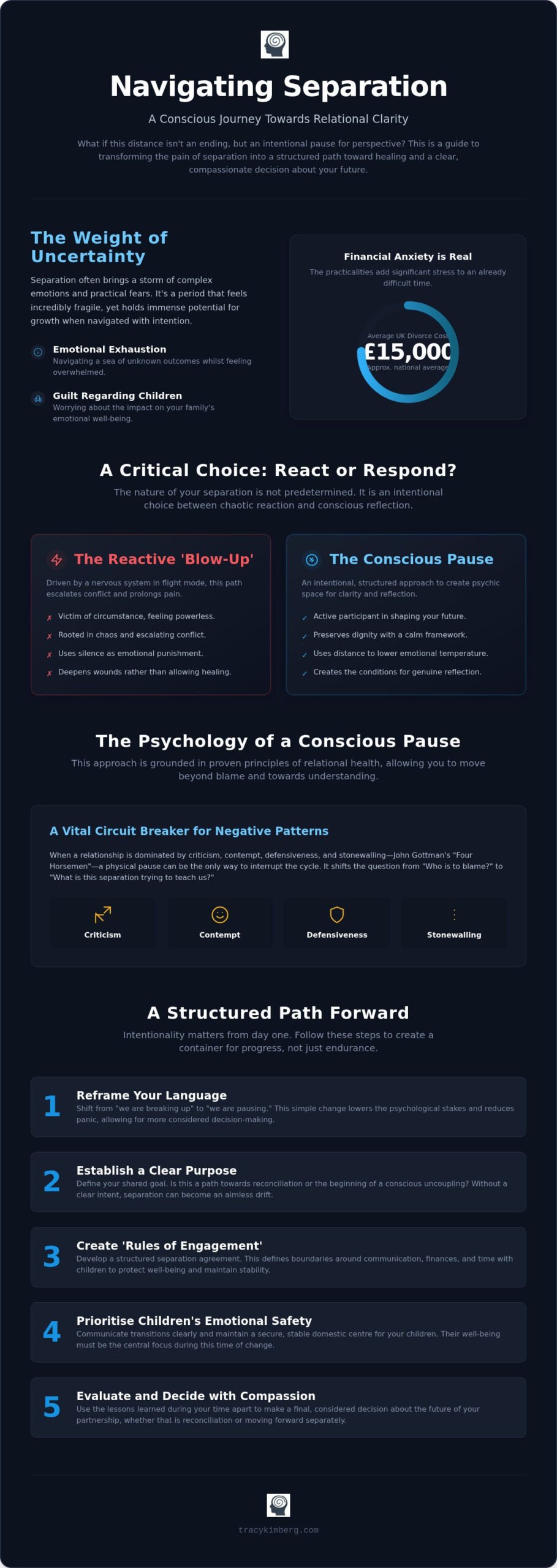
What if the distance currently growing between you and your partner isn’t a sign of failure, but a necessary pause for perspective? When you are navigating a separation, it’s common to feel as though you’re drowning in a sea of unknown outcomes and emotional exhaustion. You might be struggling with deep guilt regarding your children or feeling the sharp sting of financial anxiety, especially with the national average cost of a divorce now reaching approximately $15,000. It is a period of life that feels incredibly fragile, yet it holds the potential for profound personal evolution and clarity.
I understand that you’re looking for more than just survival; you’re seeking a way to move forward with dignity and heart. This guide will help you transform the pain of your current situation into a structured, conscious journey toward emotional healing and relational clarity. We’ll provide a clear roadmap for the next few months, focusing on how to regain your emotional stability whilst managing the practicalities of your transition. By the end, you’ll have the tools to decide whether to reconcile or move toward ending the marriage through a conscious approach that prioritises the well-being of your entire family.
Key Takeaways
- Reframe separation as a strategic tool for personal and relational clarity, allowing you to move beyond the reactive cycle of conflict.
- Understand how navigating a separation with a conscious mindset can help you manage fear and leverage physical space to gain much-needed perspective.
- Establish clear “Rules of Engagement” through a structured agreement to protect your emotional well-being and maintain stability within the home.
- Learn how to communicate transitions to your children in a way that prioritises their emotional safety and maintains a secure domestic centre.
- Discover how to evaluate the lessons learned during your time apart to make a final, compassionate decision about the future of your partnership.
Understanding the Landscape of Navigating a Separation
Separation is frequently viewed as the final, somber chapter of a relationship. However, if we shift our perspective, we can see it as a strategic tool for relational health and personal clarity. Navigating a separation isn’t merely about physical distance; it’s about creating the psychic space necessary to hear your own voice again. It feels like a labyrinth because the emotional path is rarely a straight line. You might feel a sense of liberation in the morning, only to be hit by a wave of grief or financial anxiety by dinner. This volatility is a natural part of the transition, and acknowledging this weight is the first step toward finding your way through.
There is a significant difference between a reactive “blow-up” where one partner storms out and a structured, conscious pause. The former is driven by a nervous system in flight mode, whilst the latter is an intentional choice to preserve dignity. By choosing a structured approach, you move from being a victim of your circumstances to becoming an active participant in your future. It’s about replacing the chaos of constant conflict with a calm, professional framework that allows for genuine reflection. This transition requires a steady hand and a commitment to looking at the deeper patterns of your partnership.
The Emotional Stages of Relational Transition
When you begin the process of a Marital Separation, your body often enters a state of biological shock. This isn’t just “in your head”; it’s a physiological response to the threat of losing a primary attachment. You might find yourself caught in a “tumbleweed” of unresolved arguments, where every past hurt seems to resurface at once. It’s vital to recognise that the “silent treatment” is not a substitute for a healthy boundary. Silence often acts as a form of emotional punishment, whereas a conscious separation uses distance to lower the temperature of the relationship, allowing both partners to regulate their stress responses and think clearly.
Why Intentionality Matters from Day One
The words we use to describe our experience shape our reality. Replacing the phrase “we are breaking up” with “we are pausing” can have a profound psychological benefit. It lowers the stakes and reduces the immediate panic that often leads to poor decision-making. Setting a clear purpose from the outset is essential. Are you seeking a path to reconciliation, or is this the beginning of a conscious uncoupling? Without this intentionality, the separation can become an aimless drift that only prolongs the pain. Having a “Wise Guide” or professional support creates a safe container for these difficult conversations, ensuring that your journey is one of progress rather than just endurance. This structured approach helps you maintain your centre during the most turbulent moments.
The Philosophy of Conscious Separation: Clarity amongst the Chaos
Navigating a separation requires a fundamental shift from reactive survival to conscious awareness. It’s about making choices from a place of deep clarity rather than immediate fear. Esther Perel often reminds us that desire requires space; when we are too close, we lose the ability to see one another with fresh eyes. This physical and emotional distance isn’t just about “getting away”. It’s about creating the conditions where curiosity can breathe again. When conflict becomes the primary mode of connection, a pause is often the only way to stop the emotional bleeding and rediscover your individual centre.
John Gottman’s research highlights the “Four Horsemen”—criticism, contempt, defensiveness, and stonewalling—as the primary predictors of relationship demise. When these behaviours become entrenched, a physical pause acts as a vital circuit breaker. Instead of asking “who is to blame?”, we begin to ask, “what is this separation trying to tell us?”. This shift in enquiry allows you to explore the relationship’s shadow without the constant threat of another argument. Whilst some may choose to formalise this through a legal separation agreement to provide a sense of practical security, the internal psychological work remains the priority.
Attachment Styles and the Pull to Reconnect
Our attachment styles often flare up during a split. Anxious individuals may find themselves engaging in “protest behaviour”, such as constant texting or checking social media, in a desperate attempt to regain proximity. Conversely, avoidant partners might retreat further into a shell of silence. Recognising these patterns is crucial for regulating your nervous system. The time apart is a laboratory for self-regulation; it’s an opportunity to learn how to soothe your own anxieties without relying on a partner who may currently be the source of your distress.
The Role of Radical Self-Responsibility
Radical self-responsibility is the cornerstone of a conscious split. It’s easy to fall into the “villain versus victim” narrative, but this binary thinking prevents true growth. Whilst navigating a separation, you must look at your own contributions to the relational breakdown. What was your part in the dance? Engaging in individual relationship coaching or therapy during this time provides the necessary mirror to see these patterns clearly. By taking responsibility for your own emotional health, you ensure that whatever comes next—reconciliation or a final parting—is built on a foundation of integrity rather than resentment.
Practical Steps: Creating Your Separation Agreement
Moving from the psychological “why” to the practical “how” is where many couples feel most vulnerable. Whilst the philosophy of conscious separation provides the compass, a structured agreement serves as the map. Relying on a verbal “gentleman’s agreement” is rarely enough when you are navigating a separation. In the heat of an emotional trigger, memory becomes selective; what was agreed upon in a moment of calm can easily evaporate during a late-night argument. A written framework, often called a separation contract, creates a safety rail that prevents further emotional injury and provides the structure needed for genuine reflection.
One of the most challenging but effective steps is establishing physical space. Whilst some try to separate under the same roof, this often creates a pressure cooker environment where the old patterns of conflict are constantly restimulated. Moving out isn’t an admission of defeat. Instead, it is a gift of oxygen to a relationship that is currently suffocating. This distance allows for a “cool down” period, giving both partners the chance to regulate their nervous systems without the constant presence of their primary trigger. To be effective, this pause needs a timeline. Three to six months is often the psychological sweet spot. It’s long enough to move past the initial shock, but short enough to maintain a sense of urgency regarding the relationship’s future.
Logistics and Boundaries
Success in this transition depends on the clarity of your “Rules of Engagement.” You must decide on communication frequency and channels. For example, you might agree to use email for financial logistics and keep phone calls strictly for emergencies. Financial arrangements should aim for stability; keeping joint accounts for fixed household costs whilst separating personal spending can reduce anxiety. Finally, agree on a “social script.” Deciding exactly what to tell friends, family, and colleagues ensures you aren’t blindsided by intrusive questions or conflicting narratives.
Intimacy and Exclusivity
The messy reality of separation often involves blurred lines around intimacy. It’s vital to define the status of your relationship during this period. Are you remaining monogamous, or is this a time to explore other connections? Clarity here prevents deep betrayal later. Furthermore, you must manage the urge for “break-up sex.” Whilst it offers a fleeting moment of comfort, it often confuses the nervous system and restarts the cycle of attachment, making the path to clarity much harder. Whether you choose a “No-Contact” rule or a “Low-Contact” approach for co-parenting, these boundaries must be respected to allow for individual healing.
Supporting the Family: Children and the Domestic Centre
When you are navigating a separation, the domestic centre of your world undergoes a seismic shift. Whilst the romantic bond between partners may be fracturing, the parental bond must remain an unbreakable container for your children’s emotional safety. Children are incredibly sensitive to the emotional weather of a home. They don’t just hear the arguments; they feel the tension in the silence. Putting their needs at the centre of every decision isn’t about self-sacrifice. It’s about providing the stability they need to process a transition they didn’t choose. Maintaining a united front is essential; it signals to the children that although the structure of the family is changing, the foundation of their support remains solid.
Consistency is the antidote to the anxiety that often accompanies a split. For teenagers, who are already navigating the turbulent waters of identity and autonomy, a household transition can feel like an assault on their burgeoning independence. Routine provides a sense of predictability in an unpredictable time. By keeping school schedules, extracurricular activities, and household expectations as stable as possible, you offer them a tether to reality whilst their internal world is in flux. This requires a high level of co-operation and organisation between parents, moving beyond past grievances to focus on the shared goal of healthy development.
The Parental Narrative
The story you tell your children about the separation will become part of their internal narrative for years to come. It’s vital to script this conversation beforehand, ensuring you both deliver the same message. Use simple, age-appropriate language and avoid assigning blame. The most important message to convey is that the separation is an adult decision and is absolutely not their fault. Handling the transition to two homes requires empathy and meticulous organisation. Focus on making both spaces feel like “home” rather than just a place where they stay, ensuring they have their favourite belongings and a sense of belonging in each environment.
Support for Teenagers
Teenagers often mask their distress through withdrawal or irritability, making it easy to miss signs of deeper anxiety or depression. They may feel caught in the middle, or worse, feel responsible for the emotional well-being of one of their parents. This is why teenagers often need a neutral, safe space to process their feelings without the fear of hurting either parent. Encouraging open dialogue is important, yet you must also respect their need for privacy and their right to have their own experience of the split. If you notice significant changes in their behaviour or academic performance, it may be time to seek specialised therapy for teenagers and families to help them navigate this transition with resilience.
From Separation to Recovery: Choosing the Next Chapter
After a period of intentional distance, you eventually arrive at a crossroads. The data you’ve gathered whilst navigating a separation is invaluable. You have had the opportunity to observe your own internal rhythms without the constant interference of relational conflict. Did the space between you create a renewed sense of longing, or did it reveal a profound sense of peace in your own company? This “in-between” stage is not a place of stagnation; it’s the fertile ground where your future takes root. Whether you choose to rebuild or to part ways, the goal is to make that decision from a place of conscious awareness rather than habitual reactivity.
Reconciliation isn’t simply a return to the way things were. If you choose to reunite, you are essentially starting a second relationship with the same person. This requires a radical commitment to dismantling the old patterns that led to the split. It involves building a bridge over the gaps of emotional neglect or the rubble of infidelity. This process is complex and often requires a professional scaffold to ensure the new foundation is strong enough to support your shared future. It’s about moving toward each other with a fresh set of eyes and a heart that’s been tempered by reflection.
The 12-Week Recovery Framework
For those who see a spark worth saving, the 12-Week Relationship Recovery Process offers a structured path from crisis to reconnection. This isn’t traditional talk therapy that can sometimes feel aimless. Instead, it is a goal-oriented journey designed to equip you with the practical tools needed to prevent a return to toxic dynamics. You’ll learn to move beyond the biological stress response and engage in deep, empathetic communication. By focusing on research-based methods, we work to rebuild trust and reignite the intimacy that often gets buried under the weight of domestic responsibility.
When the Choice is to Part Ways
Sometimes, the most compassionate act is to acknowledge that the romantic partnership has reached its natural conclusion. Navigating a separation can lead to the realisation that you’re better served as individuals or as co-parents rather than spouses. This is the essence of conscious uncoupling. It’s about ending the marriage with dignity, respect, and a commitment to the emotional health of everyone involved. You can transition from partners to effective co-parents by maintaining a sense of mutual respect, ensuring your children continue to feel secure amongst the change. If you’re ready to explore which path is right for you, I invite you to book a discovery call with Tracy Kimberg to discuss your path forward and begin your journey toward lasting clarity.
Embracing a Conscious Path Forward
Navigating a separation is one of the most profound transitions you’ll ever face, but it doesn’t have to be a journey you take alone. We’ve explored how a structured pause can replace reactive conflict with intentional clarity. By prioritising the emotional safety of your children and establishing clear boundaries, you transform a period of chaos into a manageable process of discovery. Whether your path leads to a renewed partnership or a dignified parting, the focus remains on your long-term emotional well-being.
My work is deeply rooted in research-led methodologies, including the insights of Gottman and Perel. I provide safe, non-judgemental online and face-to-face sessions that honour your unique experience. With specialised expertise in both adult and teenage emotional health, I am here to help your entire family find stability during this time of flux. You deserve a space where your voice is heard and your future is handled with clinical competence and heart.
Begin your journey toward clarity with a 12-Week Relationship Recovery Process
Healing is entirely possible, and a new chapter of connection and peace is waiting for you.
Frequently Asked Questions
Is separation just a precursor to divorce?
Separation is not an inevitable prelude to divorce; it’s an intentional pause designed to gain perspective. For some, it provides the necessary space to rediscover why they chose each other in the first place. For others, it confirms that the relationship has reached its natural conclusion. By choosing a conscious approach, you ensure that whatever the outcome, it is reached with clarity and mutual respect rather than reactive anger.
How long should a trial separation typically last?
A trial separation typically yields the most clarity when it lasts between three and six months. This timeframe is long enough to allow the nervous system to settle and for new individual patterns to emerge. If a separation is too short, you don’t move past the initial crisis mode. If it’s too long, you risk drifting so far apart that the emotional tether between you becomes permanently severed.
Can we still live in the same house whilst being separated?
You can live in the same house whilst separated, though it presents significant psychological challenges. This arrangement requires a rigid set of boundaries to be successful. You must define separate sleeping quarters, a schedule for shared spaces, and a clear plan for financial contributions. Without these physical and logistical markers, the old patterns of conflict are likely to resurface, making the pause less effective.
What are the rules for dating other people during a separation?
The rules for dating are entirely dependent on the agreement you establish at the beginning of your pause. Some couples choose total exclusivity to focus on their own healing, whilst others agree that the marriage is effectively on hold. To prevent deep emotional injury, you must be radically honest about your expectations. Ambiguity in this area often leads to a sense of betrayal that can make future reconciliation impossible.
How do we tell our children that we are taking a break?
Tell your children using a united, scripted narrative that focuses on their safety and stability. Use simple language to explain that you are taking some time to live apart to figure out how to be better for each other. Reassure them repeatedly that this is an adult decision and is not their fault. Focus on the practicalities of their routine to help them feel secure amongst the changes.
How often should we communicate whilst navigating a separation?
Communication frequency should be determined by your specific goals for navigating a separation. Many couples find that low contact is most beneficial during the first few weeks to allow for emotional regulation. You might agree to only discuss logistics via email once a week, keeping phone calls strictly for emergencies involving the children. This structure prevents the tumbleweed of unresolved conflict from interfering with your individual clarity.
Can relationship coaching help if only one partner wants to reconcile?
Relationship coaching is incredibly valuable even when only one partner is currently committed to reconciliation. This process, often called discernment coaching, helps the leaning-in partner manage their anxiety and the leaning-out partner explore their feelings without pressure. It provides a safe container to examine the relational dynamics honestly. This clarity ensures that any final decision is made from a place of awareness rather than guilt or obligation.
What happens if we decide to reconcile after several months apart?
Reconciling after navigating a separation involves building a completely new foundation rather than simply returning to the old one. You must treat this as the beginning of a second marriage with the same person, incorporating the lessons learned during your time apart. This transition often requires professional guidance to ensure that the old, destructive communication patterns are replaced with research-based tools that prioritise emotional intimacy and long-term relational health.

Article by
Tracy Kimberg
Tracy Kimberg is a Relationship Expert, Couples Therapist and Coach with a dedicated focus on helping couples and individuals rebuild connection, trust and emotional safety in their relationships. Drawing on the research of John and Julie Gottman, the relational insights of Esther Perel, and years of hands-on therapeutic experience, Tracy offers a warm, non-judgemental and deeply compassionate approach to modern relationships.
Based in Dorset, Tracy works with couples navigating communication breakdowns, betrayal, intimacy challenges, separation, family dynamics and life transitions. Known for creating a safe and grounded therapeutic space, she combines practical tools with emotional depth to help clients move beyond survival patterns and towards meaningful, lasting change.
With a reputation for empathy, professionalism and dedication to her clients’ growth, Tracy is passionate about helping people feel seen, understood and empowered — both within their relationships and within themselves.
Disclaimer
Disclaimer:
The information shared in this article is intended for educational and informational purposes only and should not be considered a substitute for professional therapeutic, psychological, medical or legal advice. Every individual and relationship is unique, and the perspectives offered are based on general therapeutic principles, research and professional experience.
Reading this article does not establish a therapist-client relationship with Tracy Kimberg. If you are experiencing significant emotional distress, relationship crisis, trauma, or mental health concerns, it is important to seek support from a qualified professional appropriate to your individual circumstances.
All content remains the intellectual property of Tracy Kimberg and may not be reproduced or distributed without permission.