

Fertility challenges can bring a couple together around a shared hope, yet leave each partner feeling alone with their own fears. If conversations keep turning tense, or you’re coping in different ways, counselling for couples with fertility issues can offer space to understand one another without blame.
Seeking support doesn’t mean your relationship is failing, and it doesn’t mean you have to agree on every next step. Counselling can help you speak more openly, listen with greater care and face difficult decisions as a team. It doesn’t treat infertility, replace medical care or decide what path is right for you. Instead, it can sit alongside fertility care and focus on the emotional and relational experience.
This article explains what couples counselling may help you explore, where its limits lie, and how it differs from individual therapy or fertility care. It also covers practical questions to ask when choosing a counsellor, so you can consider what kind of support feels right for both of you.
Key Takeaways
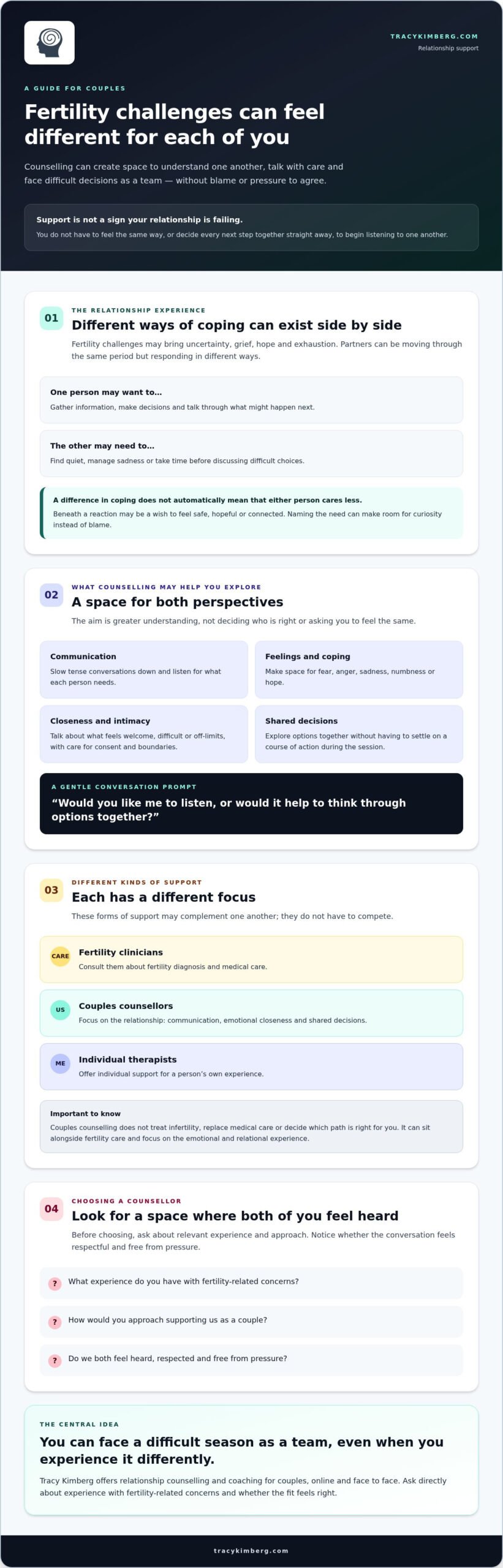
- Fertility challenges can affect partners differently. Noticing how each of you is coping can open the door to a more understanding conversation.
- Counselling for couples with fertility issues can help you explore communication, emotional closeness and shared decisions without trying to decide who is right.
- Fertility clinicians, couples counsellors and individual therapists offer different kinds of support, which may complement one another.
- Before choosing a counsellor, ask about relevant experience and approach. Consider whether you both feel heard, respected and free from pressure.
- Tracy Kimberg offers relationship counselling and coaching for couples, online and face to face. Ask directly about her experience with fertility-related concerns and whether the fit feels right.
How fertility issues can affect a couple’s relationship
Fertility challenges can bring uncertainty, grief, hope and exhaustion, sometimes within the same stretch of time. You may feel close while facing appointments together, then distant when one of you needs to talk and the other needs quiet. There’s no single way couples respond. An overview of infertility and its psychological effects can offer context, but it can’t tell you what your own experience should look like.
Couples counselling offers a confidential space to explore how each of you is experiencing this period and how you communicate with one another. It isn’t a fertility assessment or treatment. Relationship counselling focuses on the bond between you; fertility clinicians are the people to consult about diagnosis and medical care.
Why partners may experience fertility challenges differently
One partner might feel urgency to gather information and make decisions, whilst the other withdraws to manage sadness or avoid feeling overwhelmed. One person may want to keep daily life practical, while the other needs to talk about fear, loss or the future. These are possible responses, not fixed gender roles or signs of a diagnosis.
Different coping styles don’t automatically mean either person cares less or that you’re incompatible. But assumptions can take hold: “They don’t want to talk, so they don’t care,” or “They keep asking questions, so they’re pressuring me.” Beneath each response may be a wish to feel safe, hopeful or connected. Naming the need behind a reaction can help you respond with curiosity rather than blame. For example, you might ask, “What would help you feel supported right now?”
When fertility stress starts affecting communication
Conversations about appointments, treatment choices, intimacy and uncertainty can carry a lot of emotional weight. Even a practical question, such as whether to book another appointment, may feel like pressure to one partner and a request for teamwork to the other. Repeated cycles of anticipation and disappointment can leave both people with less energy for listening or reassurance.
When exchanges become tense, partners may avoid the subject, bring it up at a difficult moment or hear criticism where none was intended. Try checking what kind of support your partner wants before moving into problem-solving: “Would you like me to listen, or would it help to think through options together?” You could also agree on a time to revisit a difficult topic, rather than trying to resolve it when either of you feels overwhelmed.
Relationship tension doesn’t mean you caused fertility difficulties. Counselling for couples with fertility issues can help you notice the pattern between you, make space for each partner’s experience and practise discussing difficult decisions with care.
What counselling for couples with fertility issues can help you explore
Counselling isn’t a debate where one partner has to prove they’re right. It can offer room for both perspectives, including feelings that are difficult to express or don’t seem to match. A counsellor may help you slow a conversation down, notice what each person needs and understand how your responses affect one another. The aim is greater understanding, not pressure to feel the same or agree straight away.
Fertility can be a unique type of stress shared by a couple, though each partner may experience it differently. In counselling for couples with fertility issues, you might explore how to communicate about uncertainty, maintain emotional closeness, set boundaries with others or approach decisions as a team. You can talk through the options without having to settle on a course of action during the session.
Making space for different feelings and coping styles
A counsellor may invite each partner to name what’s present, whether that’s fear, anger, sadness, numbness or hope, and listen before moving to solutions. Curiosity can help replace blame with understanding. You might ask, “What feels hardest about this for you?” or “What do you need me to understand?” Partners can make room for uncertainty, too. You don’t need to reach an immediate decision or persuade one another to feel differently.
Talking about intimacy, connection and shared decisions
Appointments, treatment schedules and ongoing stress may affect intimacy and everyday closeness, if that’s part of your experience. Counselling can help you talk about what feels welcome, difficult or off-limits, while respecting each person’s consent, privacy and boundaries. Decisions about care remain yours to make with your partner and relevant medical professionals. A counsellor’s role is to support the conversation, not prescribe the answer.
It’s important to be clear about what relationship counselling can’t do. It cannot diagnose or treat infertility, guarantee a particular outcome or choose fertility treatment for you. Counselling can complement fertility care by supporting your relationship, but it isn’t medical fertility care. Consult fertility clinicians about diagnosis, tests and treatment options.
Tracy Kimberg offers relationship counselling and coaching for couples. Her information doesn’t confirm a fertility-specific specialism, so ask directly about her relevant experience and whether her approach feels right for both of you.
Counselling, fertility care, or individual therapy: what support fits?
Different kinds of support address different parts of the experience. Fertility professionals respond to medical questions; couples counsellors focus on the relationship and how partners communicate; individual therapists offer space to explore one person’s thoughts and feelings. These options aren’t necessarily alternatives. You may choose one, more than one or none at a particular time.
| Type of support | What it can help you explore |
|---|---|
| Fertility clinician | Medical questions, investigations, diagnosis and treatment options related to fertility. |
| Couples counsellor | Communication, emotional connection, boundaries and how you approach shared decisions. |
| Individual therapist | Your personal feelings, coping and experiences, in a space centred on you. |
What fertility professionals can help with
If you’re seeking answers about what may be affecting fertility, or have questions about investigations and treatment, speak with your fertility clinician or healthcare team. They can respond in relation to your care and explain the options available to you. Write down questions as they come up, and ask for clarification if something feels unclear. Relationship counselling can’t diagnose or treat infertility, and it shouldn’t replace medical advice.
When couples counselling or individual support may be worth exploring
You might consider couples support if conversations about care keep turning into conflict, one of you feels unheard or making shared decisions has become difficult. Counselling for couples with fertility issues can provide a place to understand the pattern between you and practise communicating more openly. It doesn’t mean your relationship has failed, and it isn’t necessary for every couple.
Individual therapy may feel more fitting if you want space to focus on your own grief, anxiety, uncertainty or other personal experiences. Some people choose individual support whilst their partner seeks their own help; others attend couples counselling alongside medical care. There’s no single correct arrangement. Consider what you want support with and whether you’d prefer to explore it together or on your own.
A useful starting point is to name the question you’re hoping to address. Is it about medical options, how you’re relating to one another or how you’re coping personally? That distinction can guide you towards the kind of professional best placed to help, without requiring you to settle every choice at once.
How to choose a counsellor and prepare for a first conversation
Choosing a counsellor is not only about finding someone who understands relationships. You’re looking for a person who can make room for both of you, including different feelings, priorities and levels of readiness. A first conversation can help you decide whether their experience and way of working feel suitable.
Use this sequence to prepare:
- Identify what you want help with. Is it communication, feeling emotionally distant or approaching decisions together? A specific example, such as an argument about appointments, can make it easier to explain what’s happening.
- Ask about relevant experience. Find out whether the counsellor has worked with couples facing relationship strain during fertility challenges.
- Discuss their approach. Ask how they support partners who see things differently or aren’t equally ready to begin.
- Assess your comfort. Notice whether you both feel listened to, respected and free to speak without pressure.
You don’t need to arrive with a polished explanation. It may be enough to say, “We’re finding it hard to talk about what comes next,” or “We’re coping differently and want to understand each other better.” That gives the counsellor a starting point without asking either of you to tell the whole story at once.
Questions to ask before beginning couples counselling
Consider asking, “What experience do you have supporting couples through fertility-related relationship strain?” and “How do you work when partners have different priorities or aren’t equally ready?” You can also ask what a session involves, whether it’s online or face to face, and how practical arrangements are handled.
Discuss confidentiality directly. Ask how privacy works for couples and what happens if one partner wants to raise something individually. A counsellor should be able to explain their approach clearly, so you can decide whether it feels comfortable and appropriate for both of you.
How to tell whether the support feels like a good fit
After an initial conversation, check in with each other. Could you speak honestly? Did the counsellor respond with respect rather than judgement, and make space for both perspectives? You don’t have to agree about everything, but neither partner should feel pushed into a decision or treated as the problem.
A first conversation can help you assess the fit; it doesn’t commit either of you to continuing. Counselling for couples with fertility issues should be shaped around your concerns, not a promised outcome or fixed timetable. If you’re considering relationship support, you can explore couples counselling and coaching with Tracy Kimberg, and ask directly about her relevant experience before deciding whether to proceed.
Taking a gentle next step with relationship support
Seeking help doesn’t mean your relationship has failed. It can simply mean you want a steadier way to understand each other through a difficult and uncertain time. You don’t need to know exactly what you want from counselling before asking questions. It’s enough to notice that you’d like more room to talk, listen or make sense of what’s happening between you.
What to expect when exploring Tracy Kimberg’s couples support
Tracy Kimberg offers relationship counselling and coaching for couples, with sessions available online and face to face. Her approach is described as research-based and inspired by relationship experts John Gottman and Esther Perel. Her information doesn’t confirm a specific fertility-counselling specialism, so if you’re looking for counselling for couples with fertility issues, ask directly about her experience supporting couples in similar circumstances.
You might also ask how she would help you make space for different perspectives, and whether the way she works feels comfortable for both of you. Tracy offers a structured 12-Week Relationship Recovery Process, but ask whether it is appropriate for your concerns and how it works before deciding. It’s reasonable to take time to consider the answers. A next step should feel informed and chosen, not rushed.
Choosing a manageable next step together
You could decide to enquire together, or first talk privately about what each of you hopes support might offer. Perhaps one partner wants to feel heard, whilst the other hopes to make difficult conversations less tense. Sharing those hopes, even if they’re different, can help you begin honestly without needing to agree on everything beforehand.
Relationship support can sit alongside appropriate fertility care. A counsellor doesn’t diagnose or treat infertility, and you can continue discussing medical questions with your healthcare team. Couples counselling focuses on the relationship: how you communicate, understand each other and approach decisions together.
If you’d like to find out whether this kind of support could fit your needs, you can explore counselling with Tracy. An enquiry can be a first step towards learning more, including asking about relevant experience and whether online or face-to-face sessions may suit you. You can decide what feels manageable, one conversation at a time.
Take the next step at a pace that feels right
Fertility challenges can affect partners in different ways, but different coping styles don’t have to become a measure of how much you care. Counselling for couples with fertility issues can offer space to listen, understand what’s happening between you and approach difficult conversations with greater care. It supports your relationship; fertility professionals remain the people to consult about diagnosis and medical treatment.
Seeking support doesn’t mean your relationship has failed, and you don’t need to have every answer before exploring it. Tracy Kimberg offers relationship counselling and coaching for couples, with online and face-to-face sessions. Her specific experience with fertility-related concerns isn’t confirmed, so ask about this and consider whether her approach feels suitable for both of you.
If you’re ready to learn more, explore counselling with Tracy. Ask about her experience with fertility-related relationship concerns and whether her approach and session format feel right for you both.
Frequently Asked Questions
Can counselling help couples cope with fertility issues?
Yes. Counselling can give partners space to understand how fertility challenges are affecting their relationship and communication. Counselling for couples with fertility issues may help you express feelings, listen to each other and approach difficult conversations with care. It doesn’t diagnose or treat infertility, change fertility outcomes or replace medical care. A fertility clinician can advise on diagnosis and treatment, while a counsellor focuses on emotional and relational experiences.
Is couples counselling only for partners who are considering separation?
No. Couples may seek counselling because they want to understand each other better, communicate more constructively or feel closer during a stressful time. You don’t need to be considering separation or be in crisis to explore support. Fertility challenges can bring up different feelings and priorities, and counselling can help make room for both partners’ experiences without assuming either person is at fault.
What happens in counselling for couples with fertility issues?
Sessions may focus on how you’re communicating, what each of you is experiencing and how you approach decisions together. You might discuss emotional closeness, boundaries or the impact of uncertainty on your relationship. The counsellor’s role is to help you explore these areas, not decide who is right or choose a fertility treatment. You can ask beforehand how sessions are structured and what happens if you disagree.
Can we attend counselling if only one partner wants to talk?
Ask a counsellor what options may suit your circumstances if one partner is unsure or not ready to attend. Couples counselling involves making space for both people, so it may help to discuss any hesitation openly rather than pressure your partner. Individual therapy can offer one person a space to explore their own feelings. Tracy Kimberg offers therapy for adults, as well as relationship counselling and coaching for couples.
Should we see a fertility specialist or a couples counsellor first?
It depends on what you need help with. For questions about fertility diagnosis, investigations or treatment, speak with a fertility professional or your healthcare team. If communication, emotional closeness or shared decisions are weighing on your relationship, couples counselling may be worth considering. You don’t necessarily have to choose one form of support over the other; relationship support can sit alongside appropriate medical care.
Can online counselling help couples dealing with fertility challenges?
Online counselling may be a practical way to access relationship support if meeting face to face doesn’t suit you. Tracy Kimberg offers online and face-to-face therapy, including relationship counselling and coaching for couples. Her information doesn’t confirm a specific fertility-counselling specialism, so ask directly about relevant experience and whether the online format and approach feel comfortable for both of you.
How do we choose a counsellor when fertility issues are affecting our relationship?
Ask about the counsellor’s experience supporting couples through fertility-related relationship strain, how they work with different priorities, and how privacy and session arrangements are handled. Then consider whether both of you feel heard, respected and free from pressure during your first conversation. You don’t have to commit straight away. A first discussion can help you assess whether the counsellor’s approach feels suitable.
Will counselling tell us whether to continue fertility treatment?
No. A counsellor shouldn’t choose fertility treatment or decide whether you should continue it. Those questions belong in conversations between you, your partner and your fertility healthcare team. Counselling can support you as you explore what matters to each of you, communicate about uncertainty and consider decisions together. You remain responsible for your choices, with medical guidance from the professionals involved in your care.
Article by
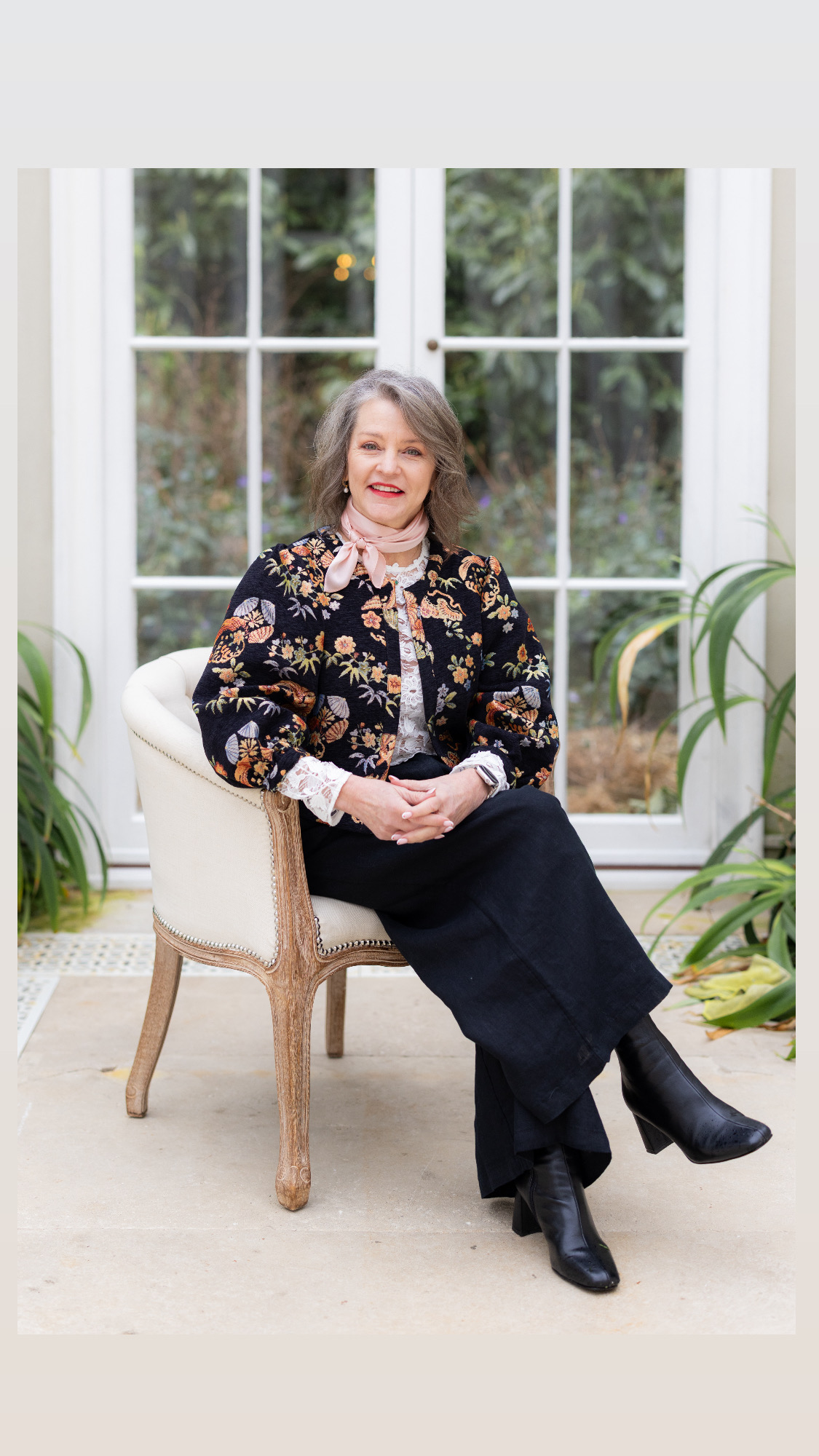
Tracy Kimberg
Tracy Kimberg is a Relationship Expert, Couples Therapist and Coach with a dedicated focus on helping couples and individuals rebuild connection, trust and emotional safety in their relationships. Drawing on the research of John and Julie Gottman, the relational insights of Esther Perel, and years of hands-on therapeutic experience, Tracy offers a warm, non-judgemental and deeply compassionate approach to modern relationships.
Based in Dorset, Tracy works with couples navigating communication breakdowns, betrayal, intimacy challenges, separation, family dynamics and life transitions. Known for creating a safe and grounded therapeutic space, she combines practical tools with emotional depth to help clients move beyond survival patterns and towards meaningful, lasting change.
With a reputation for empathy, professionalism and dedication to her clients’ growth, Tracy is passionate about helping people feel seen, understood and empowered — both within their relationships and within themselves.
Disclaimer
Disclaimer:
The information shared in this article is intended for educational and informational purposes only and should not be considered a substitute for professional therapeutic, psychological, medical or legal advice. Every individual and relationship is unique, and the perspectives offered are based on general therapeutic principles, research and professional experience.
Reading this article does not establish a therapist-client relationship with Tracy Kimberg. If you are experiencing significant emotional distress, relationship crisis, trauma, or mental health concerns, it is important to seek support from a qualified professional appropriate to your individual circumstances.
All content remains the intellectual property of Tracy Kimberg and may not be reproduced or distributed without permission.