

What if difficult behaviour is less a sign that your teenager is “being difficult” and more a signal that something needs attention? When arguments are taking over family life or your teenager is withdrawing, it’s understandable to wonder whether this is part of growing up or a sign of wider distress. Therapy for teenage behavioural problems can offer a way to explore what may be happening without blaming or labelling your teenager.
This guide will help you consider whether support could be useful and which kind might fit. We’ll look at how individual therapy gives a teenager space to explore their feelings, and how family therapy may help people understand patterns of communication and conflict. Family involvement can be valuable, but it doesn’t mean every family needs the same approach.
Tracy Kimberg offers individual therapy for teenagers in a safe, non-judgemental environment, online and face to face. As you read, you’ll find practical ways to raise the subject, consider what support may suit your teenager and decide what questions to ask when exploring therapy.
Key Takeaways
- Behaviour can prompt concern, but it doesn’t establish a diagnosis. Explore what may be happening in your teenager’s life before settling on an explanation.
- Therapy for teenage behavioural problems can help make sense of feelings, circumstances and relationship patterns without labelling or blaming your teenager.
- Individual therapy offers your teenager space to explore personal concerns, whilst family therapy focuses on interactions and communication. The right fit depends on their needs and preferences.
- Choose a calm moment to raise your concerns, listen to your teenager’s perspective and offer choices rather than presenting therapy as a punishment.
- Tracy Kimberg offers individual therapy for teenagers online and face to face in a safe, non-judgemental environment.
Therapy for teenage behavioural problems: when should parents seek support?
It can be unsettling when familiar conversations turn into arguments or your teenager begins spending much more time alone. You may wonder whether this is a passing phase or a sign that they’re struggling. Behaviour on its own can’t establish a diagnosis, and a difficult moment doesn’t tell the whole story.
Therapy for teenage behavioural problems is a way to explore the feelings, circumstances and relationships that may sit behind behaviour that concerns a family. It isn’t about labelling a teenager as the problem. Instead, therapy can offer space to understand what they’re experiencing and consider what support might help. Behaviour can communicate distress, but it doesn’t prove any one cause.
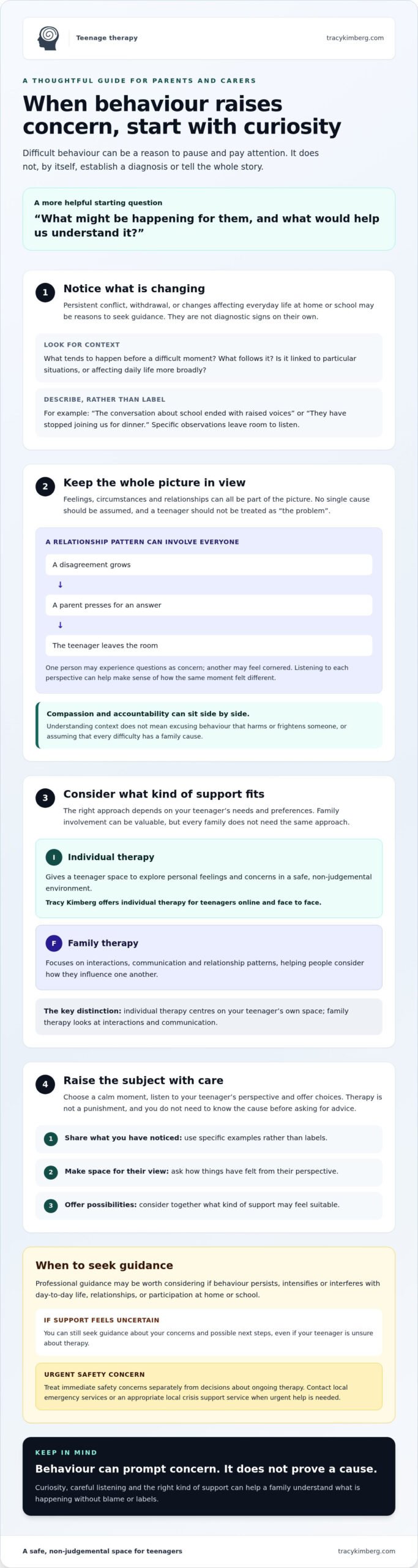
Persistent conflict, withdrawal or changes that affect home or school may be reasons to pause and pay attention. They aren’t diagnostic signs by themselves. Rather than asking, “What’s wrong with my teenager?”, try asking, “What might be happening for them, and what would help us understand it?”
What might challenging behaviour be communicating?
Stress, difficult emotions, changing relationships or life events could all be part of the picture, but no single explanation should be assumed. Behaviour also unfolds within relationships: tension can affect everyone at home without making the teenager the family problem. Approaches such as Family therapy consider how people and relationship patterns influence one another.
Try noticing patterns with calm curiosity. What tends to happen before a difficult moment? What follows it? Does it seem connected to particular situations, or is it affecting everyday life more broadly? You could note specific examples, such as when a conversation became tense or what was happening beforehand. These observations aren’t a case against your teenager; they can help you describe your concerns clearly and listen to their perspective.
When might professional support be worth considering?
Consider seeking professional guidance if the behaviour persists, intensifies or interferes with day-to-day life, relationships, or participation at home or school. You don’t need to know what’s causing the difficulty before asking for advice. If your teenager feels unsure about therapy, you can still seek guidance about your concerns and possible next steps.
If there’s an immediate safety concern, treat that separately from deciding whether ongoing therapy may help. Contact local emergency services or an appropriate local crisis support service when urgent help is needed. For non-urgent concerns, asking about support can be a measured first step, not a declaration that something is wrong with your teenager.
Why teenage behaviour needs context, not blame
A teenager’s behaviour doesn’t happen in isolation. Their experiences, feelings and relationships may interact with what’s happening around them, including at home. Looking at this wider context isn’t about deciding who is to blame. It shifts the question from “Who’s causing the problem?” to “What is happening between us, and what might each person need?”
That perspective can inform therapy for teenage behavioural problems, but it doesn’t mean every difficulty has a family cause. Stress, parenting, neurodivergence or trauma shouldn’t be assumed to explain a particular behaviour. Understanding context can help a family respond with care whilst still setting clear boundaries around behaviour that harms or frightens someone. Compassion and accountability can sit side by side.
How family patterns can shape what happens at home
Consider a cycle where a disagreement grows, a parent presses for an answer and the teenager leaves the room. One person may experience the questions as concern; the other may feel cornered. Neither perspective reveals the whole interaction or proves fault. Listening to each person can help uncover how the same moment felt different to everyone involved.
Describe what you’ve observed rather than using labels such as “difficult” or “manipulative”. For example, note that a conversation about school ended with raised voices, or that your teenager has stopped joining the family at dinner. Specific descriptions leave room for curiosity; labels can make a young person feel judged before they’ve been heard.
Why behaviour should not be treated as a diagnosis
Similar behaviours can have different explanations, and the same teenager may respond differently across situations. A parent’s observations can be valuable, but they aren’t a diagnosis. “Notice what your teenager does; don’t assume that observation tells you why, or what diagnosis, if any, applies.” An appropriately qualified mental-health professional can assess persistent concerns in the context of the young person’s individual circumstances.
There isn’t one approach that fits every teenager. If concerns continue, consider discussing them with a suitable professional and ask how they would understand your teenager’s needs. The aim isn’t to find a label as quickly as possible, but to make sense of what’s happening and consider a fitting form of support.
If individual support feels like a possible next step, Tracy Kimberg offers individual therapy for teenagers in a safe, non-judgemental environment, online and face to face. You can enquire about the available formats and whether this support may suit your teenager.
Family therapy or individual therapy for teenage behavioural problems?
Choosing support doesn’t have to mean deciding that one person is “the problem”. Family therapy looks at how people relate and communicate, whilst individual therapy gives a teenager space to explore their own experiences. Either may be worth considering as part of therapy for teenage behavioural problems, depending on what the young person needs and feels ready for.
| Family therapy | Individual therapy |
|---|---|
| May explore communication, recurring conflict and relationships between family members. | Offers the teenager a private space to discuss their feelings and experiences. |
| Participants and session format vary by practitioner and service. | Centres on the young person, with any parent involvement depending on the service and agreed arrangements. |
| May suit concerns that involve interactions across the household. | May feel like a more comfortable starting point for a teenager who wants to speak individually. |
What does family therapy focus on?
Family sessions may help people describe how they experience the same disagreement differently and notice what happens before and after conflict. The purpose is to understand interactions and consider change, not to decide who is at fault. The format, who takes part and whether it’s suitable vary between practitioners and services.
When might individual therapy feel like a better starting point?
A teenager may want room to talk about feelings or experiences they’re not ready to discuss with family. Their comfort and willingness matter. A conversation about support is more likely to feel collaborative if they can share what concerns them and have some say in the next step.
Tracy Kimberg offers individual therapy for teenagers in a safe, non-judgemental environment, online and face to face. Family sessions aren’t listed as a confirmed service, so check directly what the available therapy involves rather than assuming relatives will take part.
Can family and individual support be considered together?
It may be possible to ask a suitable practitioner whether more than one form of support could fit the situation. This isn’t a promise that services can be combined or coordinated. Before starting, ask how privacy is handled, what information may be shared and whether parent involvement is part of the particular service. Family participation isn’t automatically required for individual teenage therapy.
If individual support seems like a possible first step, you can find out more about therapy for teenagers and ask about the available format and suitability.
How to approach a teenager and choose a suitable therapist
Suggesting therapy can feel delicate, particularly if your teenager already feels criticised or misunderstood. The aim isn’t to win an argument or secure an immediate yes. It’s to open a conversation where they can hear your concern without feeling that support is a punishment for their behaviour.
How can parents raise therapy without making a teenager feel blamed?
Choose a calm moment, rather than raising the subject in the middle of a row. Keep the conversation specific and give your teenager time to respond. You might say, “I’ve noticed you seem more withdrawn lately, and I’m wondering how things are feeling for you. Would talking to someone outside the family be helpful?”
- Describe what you’ve noticed. Name a change or situation, not a label such as “difficult” or “out of control”.
- Explain your concern warmly. Let them know you’re bringing it up because you care, not because they’re in trouble.
- Listen before offering solutions. Ask what they think, then give them space to answer without rushing to persuade.
- Offer choices. If they’re open to support, discuss available formats, such as online or face-to-face sessions, where these are offered.
- Revisit the conversation. If they’re unsure, acknowledge that and ask whether you can talk about it again later.
For therapy for teenage behavioural problems to feel like support, your teenager needs to know they aren’t being sent away to be “fixed”. A gentle invitation leaves room for their perspective and can make the next step feel more manageable.
What should families ask a therapist before starting?
A first enquiry can help you understand whether a service may suit your teenager. Ask practical questions directly rather than assuming that every therapist works in the same way:
- What experience do you have supporting teenagers with concerns like ours?
- How would you approach understanding what may be contributing to the difficulty?
- Are sessions online, face to face, or available in either format?
- How do you explain confidentiality to a teenager, including its limits?
- How, if at all, might a parent be involved?
- What practical arrangements should we know about, and how do you assess whether the service is suitable?
Clear answers can help you and your teenager understand what to expect. Tracy Kimberg offers individual therapy for teenagers in a safe, non-judgemental environment, online and face to face. To ask about the available format and suitability, explore individual therapy for teenagers.
Finding teenage therapy that feels safe and manageable
Choosing support is less about finding a perfect answer straight away and more about taking a considered next step. Clarify what concerns you, think about whether individual or family support might fit, and include your teenager in the conversation where possible. Their views on speaking with someone and on the format can help make the idea feel less daunting.
Tracy Kimberg offers individual therapy for teenagers in a safe, non-judgemental environment, online and face to face. This is a confirmed service; family therapy, emergency care and psychiatric medication management aren’t listed as services. If you’re considering therapy for teenage behavioural problems, you can ask directly whether the available individual therapy seems suitable for your teenager’s concerns.
What can families expect from a first conversation?
An initial enquiry can be a chance to describe what you’ve noticed and ask about fit, without assuming a particular assessment process or outcome. Explain what has changed, how it affects everyday life and what your teenager thinks about getting support. Then ask what formats are available, what practical next steps may involve and how the service could meet their needs.
It may also help to ask how confidentiality is explained to teenagers and what, if anything, parents can expect to know. Don’t assume parent involvement works the same way across services. Clear information can help your family make a more informed choice before deciding whether to proceed.
When is a different level of support needed?
The right level of support depends on the seriousness and nature of the concern. Ongoing individual therapy may be one option to explore, but it isn’t a substitute for urgent or specialist care when that is needed. If you believe your teenager or someone else is in immediate danger, contact appropriate local emergency services or a local crisis support service.
For concerns that aren’t immediate emergencies, take time to ask questions and consider what feels manageable. A thoughtful first enquiry can help you understand whether the service is a possible fit, without committing your teenager to a particular path.
If you’d like to explore the confirmed service and ask about format and suitability, learn about individual therapy for teenagers.
Take a thoughtful next step with your teenager
Behaviour that worries you deserves attention, but it doesn’t define your teenager or reveal a diagnosis on its own. Looking at the feelings, circumstances and relationship patterns around it can help you respond with curiosity rather than blame, whilst still taking harmful behaviour seriously.
Family and individual therapy offer different kinds of support. The right starting point depends on your teenager’s needs and preferences, and a calm conversation can help them feel included rather than singled out. You don’t need to have every answer before asking what might help.
If you’re considering therapy for teenage behavioural problems, Tracy Kimberg offers individual therapy for teenagers in a safe, non-judgemental environment, online and face to face. Explore individual therapy for teenagers and ask about a suitable next step for your family.
A small, thoughtful conversation can open the way to support that feels more manageable. Your care and willingness to listen matter.
Frequently Asked Questions
Can therapy help with teenage behavioural problems?
Therapy can give a teenager space to explore what may be happening behind behaviour that concerns their family. It doesn’t assume a diagnosis or guarantee a particular outcome. Therapy for teenage behavioural problems may involve understanding feelings, circumstances and relationships, then considering what support could fit. Tracy Kimberg offers individual therapy for teenagers online and face to face in a safe, non-judgemental environment. A direct enquiry can help you ask about suitability.
Is family therapy better than individual therapy for a teenager?
Neither is automatically better; the right option depends on the teenager’s needs, preferences and professional guidance. Family therapy may focus on communication and patterns between family members, whilst individual therapy gives the young person space to discuss their own experiences. Family involvement isn’t automatically required for individual therapy. Ask a practitioner what each format involves and how they would consider which might suit your teenager.
How do I get my teenager to agree to therapy?
You can’t make the conversation feel comfortable by insisting, but you can approach it without blame. Choose a calm moment, describe what you’ve noticed and explain that you’re concerned because you care. For example: “I’ve noticed you seem under pressure, and I’d like to understand how things feel for you.” Listen to their response, offer choices where available and revisit the subject later if they’re unsure.
What happens in family therapy for teenage behaviour?
Family therapy may provide a setting for family members to discuss how they experience recurring difficulties, communication and relationships. The aim is to understand interactions and explore possible changes, not to decide who is at fault. The practitioner determines the format and who participates, so details vary between services. Ask directly what sessions involve and whether this type of support is available. It isn’t a confirmed service offered by Tracy Kimberg.
Can a teenager have individual therapy without their parents?
A teenager may have individual sessions, but whether parents need to be involved or give consent depends on the circumstances and applicable requirements. Don’t assume that every service handles this in the same way. Ask the practitioner directly about consent, confidentiality, its limits and what information may be shared with parents. Tracy Kimberg offers individual therapy for teenagers, but confirm the arrangements for your teenager before proceeding.
When should I seek urgent help for my teenager’s behaviour?
Seek urgent help if you believe your teenager or someone else is in immediate danger. Contact appropriate local emergency services or a local crisis support service rather than waiting to arrange routine therapy. For ongoing concerns that aren’t an immediate emergency, consider speaking with a suitable mental-health professional about possible support. The right next step depends on the nature and seriousness of the situation, and routine individual therapy isn’t a substitute for urgent care.

Article by
Tracy Kimberg
Tracy Kimberg is a Relationship Expert, Couples Therapist and Coach with a dedicated focus on helping couples and individuals rebuild connection, trust and emotional safety in their relationships. Drawing on the research of John and Julie Gottman, the relational insights of Esther Perel, and years of hands-on therapeutic experience, Tracy offers a warm, non-judgemental and deeply compassionate approach to modern relationships.
Based in Dorset, Tracy works with couples navigating communication breakdowns, betrayal, intimacy challenges, separation, family dynamics and life transitions. Known for creating a safe and grounded therapeutic space, she combines practical tools with emotional depth to help clients move beyond survival patterns and towards meaningful, lasting change.
With a reputation for empathy, professionalism and dedication to her clients’ growth, Tracy is passionate about helping people feel seen, understood and empowered — both within their relationships and within themselves.
Disclaimer
Disclaimer:
The information shared in this article is intended for educational and informational purposes only and should not be considered a substitute for professional therapeutic, psychological, medical or legal advice. Every individual and relationship is unique, and the perspectives offered are based on general therapeutic principles, research and professional experience.
Reading this article does not establish a therapist-client relationship with Tracy Kimberg. If you are experiencing significant emotional distress, relationship crisis, trauma, or mental health concerns, it is important to seek support from a qualified professional appropriate to your individual circumstances.
All content remains the intellectual property of Tracy Kimberg and may not be reproduced or distributed without permission.