

What if what looks like ordinary shyness is making everyday moments feel like a test? For a teenager who dreads speaking in class, joining a group or being judged by peers, therapy for teen social anxiety may offer a supportive place to understand what’s happening and explore manageable ways forward.
It can be difficult to know when to take those worries seriously, especially if your teen brushes them off or isn’t sure they want to talk. You may also be wondering what therapy involves, how your teenager’s privacy is handled and what role you’ll have as a parent. These are thoughtful questions. You don’t need to have all the answers before looking into support.
A useful starting point is the situations your teen finds hard, rather than a label alone. This guide explains how social anxiety may affect daily life, what to ask when comparing support options, and how to discuss confidentiality and parental involvement. Tracy Kimberg offers therapy for teenagers online and face to face in a safe, non-judgemental environment. You can consider whether this might suit your family and your teenager’s preferences.
Key Takeaways
- Notice whether fear of being judged is persistently limiting your teenager’s everyday life, rather than assuming it is ordinary shyness.
- Explore therapy for teen social anxiety as a collaborative space shaped around your teenager’s needs, not a one-size-fits-all approach.
- Compare individual therapy, school-based support and health-service options by considering access, privacy, setting and your teenager’s comfort.
- Ask a prospective therapist about their relevant qualifications and experience, confidentiality, parental involvement and practical arrangements.
- Consider Tracy Kimberg’s online or face-to-face therapy for teenagers as one option, and take time to assess whether the fit feels right.
What does social anxiety look like in teenagers, and when might therapy help?
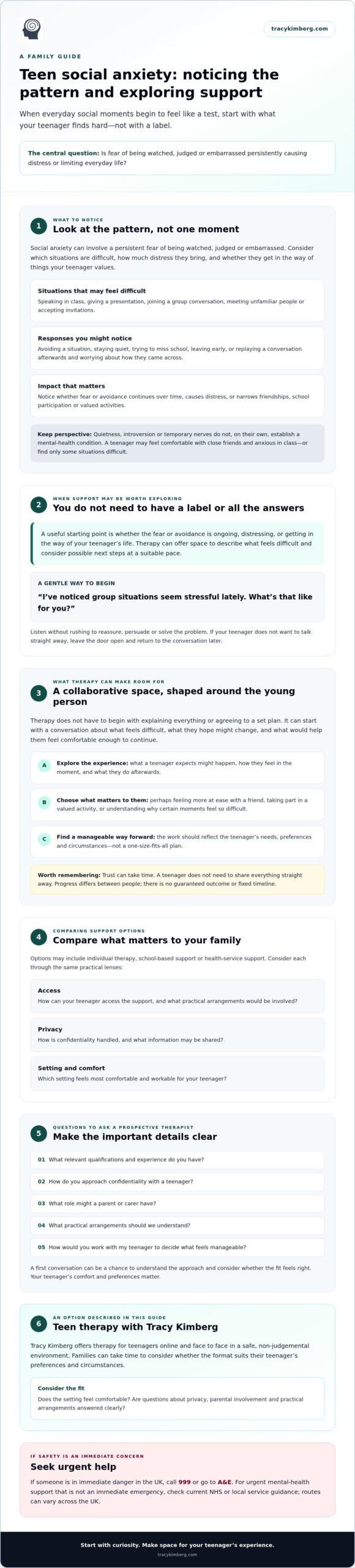
Social anxiety can be hard for a teenager to put into words, and for a parent or carer to distinguish from ordinary growing-up worries. Looking for information is a thoughtful first step, not a reason to label your teen or assume the worst.
In plain English, social anxiety involves a persistent fear of being watched, judged or embarrassed in social situations. It differs from occasionally feeling self-conscious before a presentation or awkward in a new group. The concern is that the fear may be intense or ongoing, leading someone to avoid situations or endure them with considerable distress. For a clinical overview, see Social Anxiety Disorder.
How might social anxiety affect a teenager’s everyday life?
A teenager might avoid joining a group conversation, dread speaking in class or find presentations so worrying that they try to miss school. They may turn down invitations, stay quiet around unfamiliar people or spend a long time replaying a conversation afterwards, wondering how they came across.
These experiences vary. A teen may be comfortable with close friends but anxious in class, or find one situation difficult while managing others well. Quietness, introversion or temporary nerves don’t, on their own, establish a mental-health condition. Consider the pattern: which situations are difficult, how much distress they cause, and whether they get in the way of friendships, school participation or activities your teen values.
When is it worth exploring professional support?
It may be worth exploring support when fear or avoidance continues over time, causes distress or narrows your teenager’s life. You don’t need to decide what’s happening before starting a conversation. Therapy for teen social anxiety may give a young person space to describe what feels difficult and consider next steps at a pace that feels appropriate to them.
Try opening with curiosity rather than a conclusion: “I’ve noticed group situations seem stressful lately. What’s that like for you?” Listen without rushing to reassure, persuade or solve the problem. If they don’t want to talk straight away, you can leave the door open and return to the conversation later.
If you’re worried about immediate safety, seek urgent help. In the UK, call 999 or go to A&E if someone is in immediate danger. For urgent mental-health support that isn’t an immediate emergency, check current NHS or local service guidance, as routes can vary across the UK. You don’t have to work out the right level of support alone.
How can therapy for teen social anxiety help without adding pressure?
Therapy doesn’t have to begin with a teen explaining everything or agreeing to a set plan. It can start with a conversation about what feels difficult, what they hope might change and what would help them feel comfortable enough to continue. The aim is to work alongside the young person, not make them feel they’re another problem to fix.
Social anxiety can involve what a teenager expects might happen, how they feel in the moment and what they do afterwards. A therapist and teen might explore whether fear of embarrassment influences a choice to stay quiet, avoid a situation or leave early. The Social Anxiety Disorder statistics page from the National Institute of Mental Health offers clinical context, though it focuses on US data.
There isn’t one approach that suits every teenager. The work should reflect the individual’s needs, preferences and circumstances. Ask how a therapist might work with your teen and how they would decide together what feels manageable. Progress differs between people, so there’s no guaranteed outcome or fixed timeline.
What might a teenager talk about in therapy?
They might choose to talk about feeling left out by peers, worrying that others will notice a blush or stumble over their words, or dreading a particular social situation. They don’t need to share everything straight away. Trust can take time, and a teenager can help decide what to focus on first.
Goals can grow from what matters to them: feeling more at ease with a friend, taking part in a valued activity or understanding why certain moments feel so loaded. Therapy for teen social anxiety should make room for the young person’s priorities, rather than turning a parent’s hopes into demands.
How can parents or carers support the process?
Listen with curiosity. If your teen shares a worry, try not to minimise it with “there’s nothing to worry about”, question them as though they’re being tested or rush to solve everything at once. You might say, “That sounds hard. Would you like me to listen, or help you think it through?”
Parent or carer involvement depends on the teenager’s needs and the arrangements agreed with the therapist. Ask how communication and privacy will be handled, including what information might be shared and with whom. If you’re considering individual support, you can explore teen therapy with Tracy Kimberg and consider whether it feels like an appropriate option for your family.
Which support options should families compare for teen social anxiety?
There’s no single route that suits every teenager. The best-fit support depends on the young person’s needs, what’s accessible and which setting feels comfortable enough to begin. Options can complement one another, but a teenager doesn’t automatically need every service. When comparing routes, ask how your teen would access the support, who they would speak with, what privacy arrangements apply and whether the setting feels manageable.
| Support option | Access and setting | Privacy and comfort to consider |
|---|---|---|
| Individual therapy | Arrangements may be online or face to face, depending on the therapist. Ask about availability, location and how sessions are organised. | Offers space to focus on personal concerns. Discuss confidentiality and parental involvement in advance, and consider whether your teen would feel more at ease speaking remotely or in person. |
| School-based support | Ask the school what support is available locally and how a student can access it. The setting may be familiar and connected to school life. | Your teen may value help close to where difficulties arise, or prefer not to talk about personal concerns at school. Check who they would speak with and what privacy arrangements apply. |
| Health-service routes | A GP can be a starting point for discussing concerns and asking about relevant local services or referral routes. Availability and arrangements vary. | This may suit families looking for guidance about health support. Ask what the next steps involve and include your teenager in decisions where appropriate. |
How do individual therapy and school support differ?
Individual therapy provides dedicated time to explore a young person’s concerns, within agreed arrangements for privacy and parent involvement. School-based support may feel more connected to the places and pressures a teenager experiences during the day. Neither is automatically the better choice. Ask your teen whether they would rather speak to someone outside school or get support in a familiar setting. Support in one place may also sit helpfully alongside support in another.
Could online therapy suit a socially anxious teenager?
Online sessions may make it easier to attend from a familiar place, but a screen won’t feel comfortable for everyone. Consider whether your teen can speak freely, has a private space and reliable technology, and feels at ease communicating online. Face-to-face sessions may feel more natural to some teenagers. Tracy Kimberg offers online and face-to-face therapy for teenagers; check current formats and practical arrangements directly before deciding.
As you compare therapy for teen social anxiety with other support, ask your teenager what would make a first conversation manageable. Their comfort is an important part of the decision and can help guide the next step.
How should you choose a therapist and prepare a teenager for a first conversation?
Choosing support is about finding a workable fit, not finding a perfect answer straight away. Keep the steps simple:
- Start with your teenager’s priorities. Ask what they would like help with and what feels most daunting about speaking to someone.
- Discuss practical needs. Consider online or face-to-face sessions, travel, privacy at home and any other arrangements that matter to your family.
- Ask questions. Check the therapist’s relevant qualifications and experience directly. Don’t assume they specialise in teen social anxiety based on a general service description.
- Review the fit. After an initial conversation, ask your teen what felt comfortable or uncertain. A first meeting is a chance to learn about each other, not a test or a commitment to long-term therapy.
Fit includes more than professional background. Notice whether the therapist listens, explains things clearly and makes room for your teenager’s perspective. If something feels unclear, ask for an explanation before deciding what to do next.
What questions can parents and teenagers ask a therapist?
Bring a short list, and let your teenager choose which questions they want to ask themselves. For example: “How do you approach social anxiety with teenagers?”, “How do you adapt conversations to what a young person feels ready to discuss?”, “How do confidentiality and communication with parents work?”, and “Are online or face-to-face sessions available, and what practical arrangements should we know about?”
A useful checklist sentence is: “What approach might suit my teenager, what will remain private, and how will you involve me as a parent or carer?” Ask the therapist to explain the professional guidance that applies to their role and location, including how they handle privacy and its limits.
What if a teenager is reluctant to try therapy?
Reluctance is understandable. A teenager might worry about being judged, not knowing what to say or having a parent make decisions for them. Explore that concern without shame or pressure: “What part of meeting someone feels uncomfortable?” You could offer choices where possible, such as discussing questions beforehand or considering which format feels less daunting.
If they aren’t ready, you can pause and return to the conversation calmly. You might explore teen therapy with Tracy Kimberg together, giving your teenager room to consider whether it feels like a suitable option.
Exploring teen social anxiety therapy with Tracy Kimberg
After comparing your teenager’s needs with the support available, individual therapy with Tracy Kimberg may be one option to explore. Her practice describes its environment as safe and non-judgemental, and offers therapy for teenagers online and face to face. These details can help you start a conversation, but they don’t guarantee a particular experience or mean Tracy will be the right fit for every young person.
Before making contact, check current session formats and practical arrangements directly, and ask about relevant experience and qualifications. Take time to understand what support involves before deciding whether to go further. Therapy for teen social anxiety should respect the teenager’s preferences, rather than treating their agreement as a box to tick.
What can families consider before getting in touch?
A little preparation can make the first enquiry feel less daunting. Invite your teenager to name one or two situations they’d like help understanding, such as finding it hard to speak up in a group or worrying about being judged. They don’t need to prepare a full explanation or know exactly what they want from therapy.
As a parent or carer, you might note practical questions about online or face-to-face sessions, privacy and how parents may be involved. Share the questions with your teenager, then give them space to say what matters most. Your role is to help make the conversation possible, not to speak over their experience.
Choosing support isn’t an irreversible commitment. A first enquiry can simply help you understand the options and decide together whether an initial conversation feels right. If your teenager is unsure, take that seriously and give them time to consider what would help them feel more at ease.
How can you take a gentle next step?
Keep the next step small: ask questions, talk through which format your teenager might prefer and check the practical details before making a decision. You can explore Tracy’s approach together and let your teen share what they’d want to know. There’s no need to promise a particular outcome or decide on an ongoing plan before you understand what’s offered.
If you’d like to learn more, explore therapy for teenagers with Tracy Kimberg. You can begin with a question and decide, at your own pace, whether an initial conversation feels like a suitable next step.
Take a thoughtful next step towards support
Social anxiety can shape how a teenager experiences friendships, school and everyday choices, but a label isn’t the starting point for finding help. Notice what feels difficult for your teen, and consider support when worry or avoidance is causing ongoing distress or limiting things they value.
The right therapy for teen social anxiety should take account of the young person’s needs and preferences. Asking about a therapist’s experience, approach, privacy arrangements and parent involvement can help you decide whether the fit feels comfortable. A first conversation is a chance to ask questions, not a promise to continue.
Tracy Kimberg offers individual therapy for teenagers in a safe, non-judgemental environment, with online and face-to-face options. To learn more and consider whether this support could suit your family, explore therapy for teenagers with Tracy Kimberg.
There’s no need to have everything worked out today. A calm, open conversation can be a meaningful first step, taken together and at your own pace.
Frequently Asked Questions
Is social anxiety different from shyness in teenagers?
Yes. Shyness is a temperament or a feeling of reserve, while social anxiety involves ongoing fear of being judged, embarrassed or scrutinised in social situations. A shy teenager may still take part once they feel comfortable; social anxiety may bring intense distress or lead them to avoid situations they value. Quietness or nerves alone don’t establish a condition. Consider the pattern, its impact and how your teenager describes their experience.
Can therapy help a teenager with social anxiety?
Therapy may offer a teenager space to understand what feels difficult and consider manageable ways forward. In therapy for teen social anxiety, a therapist might explore the young person’s concerns, feared situations and avoidance patterns, while adapting the work to their needs and preferences. There’s no single approach that suits everyone, and outcomes can’t be guaranteed. Ask a prospective therapist about their relevant experience and how they would work collaboratively with your teenager.
What happens in a first therapy session for a teenager?
A first session is an opportunity for the therapist and teenager to begin getting to know one another and discuss what has prompted the conversation. The young person may choose to share a concern, ask questions or simply learn what therapy might involve. They don’t have to explain everything straight away. Beforehand, ask what to expect, how the session will be arranged and whether a parent or carer may be present.
Can parents attend therapy sessions with their teenager?
Sometimes, but it depends on the teenager’s needs and the arrangements agreed with the therapist. Some young people may want a parent to join an initial conversation, whilst others may prefer time to speak independently. Ask how parent involvement is handled, how information is shared and what privacy arrangements apply. Discuss these points with your teenager, too, so their preferences are heard and everyone has a clearer idea of what to expect.
Is online therapy suitable for a teenager with social anxiety?
It can suit some teenagers, particularly if speaking from a familiar place feels more comfortable. Others may prefer meeting face to face. Consider whether your teenager can access a private space, use the required technology and feels comfortable communicating through a screen. Online therapy isn’t automatically better or easier; the young person’s preference matters. Tracy Kimberg offers online and face-to-face therapy for teenagers, though families should check current arrangements directly.
How long does therapy for teen social anxiety take?
There isn’t a set timeframe that applies to every teenager. The length of therapy can depend on the young person’s concerns, what they want from support and how the work develops. A therapist should discuss expectations with the family rather than promise a fixed result or timeline. Ask how progress will be reviewed and whether the plan can be revisited as your teenager’s needs or priorities change.
What should I do if my teenager refuses therapy?
Start by treating their reluctance as meaningful, not as defiance. Ask what feels uncomfortable: they may fear being judged, not know what to say or worry about losing control of private information. Listen without pressure or shame, and offer choices where possible, such as discussing questions first or considering a different format. If they’re not ready, give them time and return to the conversation gently. If safety is an immediate concern, seek urgent help.

Article by
Tracy Kimberg
Tracy Kimberg is a Relationship Expert, Couples Therapist and Coach with a dedicated focus on helping couples and individuals rebuild connection, trust and emotional safety in their relationships. Drawing on the research of John and Julie Gottman, the relational insights of Esther Perel, and years of hands-on therapeutic experience, Tracy offers a warm, non-judgemental and deeply compassionate approach to modern relationships.
Based in Dorset, Tracy works with couples navigating communication breakdowns, betrayal, intimacy challenges, separation, family dynamics and life transitions. Known for creating a safe and grounded therapeutic space, she combines practical tools with emotional depth to help clients move beyond survival patterns and towards meaningful, lasting change.
With a reputation for empathy, professionalism and dedication to her clients’ growth, Tracy is passionate about helping people feel seen, understood and empowered — both within their relationships and within themselves.
Disclaimer
Disclaimer:
The information shared in this article is intended for educational and informational purposes only and should not be considered a substitute for professional therapeutic, psychological, medical or legal advice. Every individual and relationship is unique, and the perspectives offered are based on general therapeutic principles, research and professional experience.
Reading this article does not establish a therapist-client relationship with Tracy Kimberg. If you are experiencing significant emotional distress, relationship crisis, trauma, or mental health concerns, it is important to seek support from a qualified professional appropriate to your individual circumstances.
All content remains the intellectual property of Tracy Kimberg and may not be reproduced or distributed without permission.