

What if suggesting therapy could be an invitation to understand each other, rather than a sign that your relationship is failing? If you’re wondering how to talk to your partner about therapy without a fight, it makes sense to feel cautious. You may be worried about the relationship while also fearing your partner will hear blame, criticism or an ultimatum.
You don’t have to present therapy as proof that something is broken, or persuade your partner in one conversation. Choose a calmer moment, explain what you hope support could offer and leave room for your partner’s response. The aim isn’t to win an argument. It’s to start a conversation about what might help you feel more connected.
This article will help you choose a constructive time to talk, express your hopes without blaming or diagnosing your partner, and respond with care if they’re unsure. You’ll also find ways to agree on a manageable next step, including exploring individual relationship support if your partner isn’t ready to attend together.
Key Takeaways
- Therapy can be an invitation to understand relationship patterns together, not a declaration that one partner is the problem.
- Choose a calmer moment, clarify why the conversation matters to you, and ask whether your partner is open to talking.
- When considering how to talk to your partner about therapy without a fight, describe your own experience and hopes rather than assigning blame.
- If your partner feels defensive or says no, pause, listen for what feels worrying and leave room to revisit the subject.
- A manageable next step could be gathering questions, exploring online or face-to-face support, or seeking individual relationship counselling if your partner isn’t ready to attend together.
Why talking about therapy can feel like criticism, even when you mean it as care
Suggesting therapy can leave you feeling exposed. You’re naming that something in the relationship matters enough to ask for help, while risking a response that makes you feel even more alone. If tension has been building, your partner may hear the suggestion through the hurt or frustration between you, rather than the care you intended.
It can help to separate seeking support from assigning blame. Relationship counselling can offer a space to understand the patterns between you, rather than deciding that one person is the problem. Couples therapy covers a range of approaches, and raising the idea doesn’t commit either of you to a particular explanation or outcome. It can simply open a conversation about what’s happening between you.
You and your partner may attach different meanings to therapy. One person might see it as a constructive step; the other might associate it with shame, failure, being judged or the relationship ending. Those meanings can shape a reaction before you’ve had the chance to explain. The first conversation doesn’t need to secure an immediate yes or resolve every difficulty. Its purpose is to make room for both of you to say what the idea brings up.
What might your partner hear when you suggest therapy?
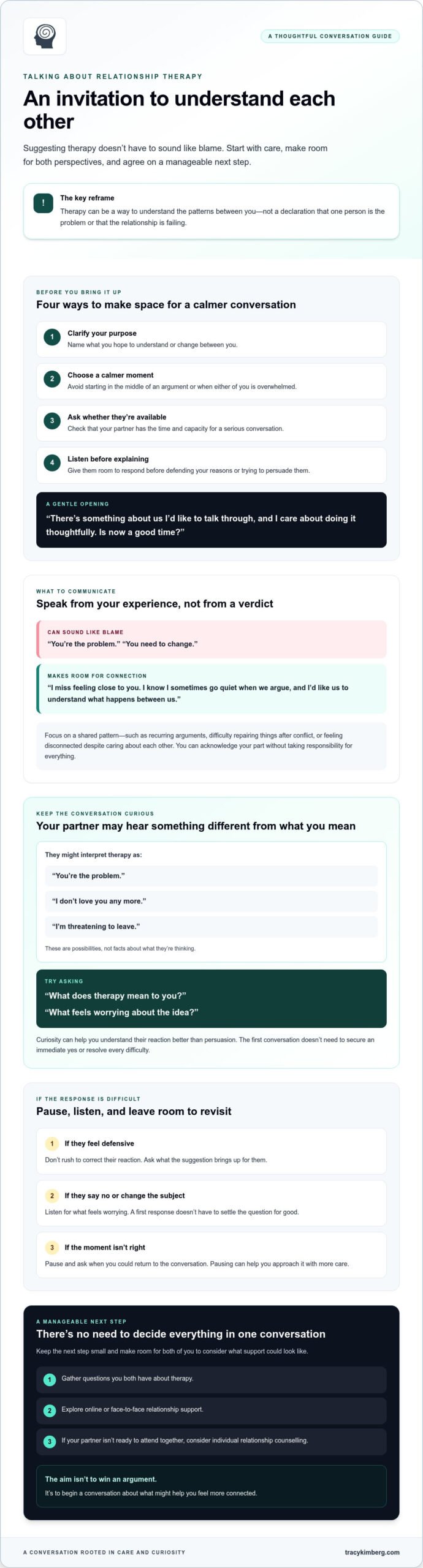
Your partner might hear, “You’re the problem”, “I don’t love you any more” or “I’m threatening to leave”. They might feel pressured to agree before they understand what you mean. These are possibilities, not facts about what they’re thinking. Rather than rushing to correct their reaction, try asking, “What does therapy mean to you?” or “What feels worrying about the idea?” Curiosity can tell you more than persuasion.
What are you hoping therapy might help with?
Before raising the subject, name the concern you want to address. It might be recurring arguments, difficulty repairing things after conflict, or feeling disconnected despite caring about each other. Describe a shared pattern rather than building a case against your partner. There’s a difference between wanting to understand how you both get stuck and demanding that they change.
A little self-reflection can help you express that difference. For example: “I miss feeling close to you. I know I sometimes go quiet when we argue, and I’d like us to understand what happens between us.” This doesn’t mean taking responsibility for everything. It shows you’re willing to look at your part in the pattern, too, and invites a conversation rather than delivering a verdict.
Preparing to Discuss Therapy With Your Partner Calmly
Some preparation can help you stay connected to what you mean if the conversation becomes difficult. You don’t need a speech or a list of everything your partner has done wrong. Keep your aim modest: make space to talk about support, then hear how the idea lands with them. Knowing how to talk to your partner about therapy without a fight starts with treating it as a shared conversation, not a case to win.
Before you begin, work through four simple steps:
- Clarify your purpose: What would you like help understanding or changing between you?
- Choose a calm moment: Don’t raise it in the middle of an argument or when either of you is already overwhelmed.
- Ask permission: Check whether your partner has the time and capacity for a serious conversation.
- Listen: Give them room to respond before explaining or defending your reasons.
A constructive conversation about therapy is an invitation, not an accusation. Rehearse one or two points so you can speak clearly, but leave space for a real exchange. If your partner seems guarded, curiosity may be more useful than trying to convince them. This perspective on why your partner gets defensive explores how criticism can be heard even when it isn’t intended.
Choose a moment when both of you can be present
Look for a private setting without immediate distractions or pressure to rush off. You might say, “There’s something about us I’d like to talk through, and I care about doing it thoughtfully. Is now a good time?” If they’re busy, exhausted or visibly distressed, ask when you could return to it. Pausing isn’t avoiding the subject. It can help you approach it with more care.
Clarify your intention before you begin
Choose one specific recurring difficulty instead of making a global judgement such as “We never communicate”. For instance: “I’ve noticed we sometimes get stuck when we discuss plans, and I’d like to understand how we each experience that.” This names a pattern without deciding who’s at fault. You can explain that therapy might help you explore it, but avoid promising what therapy will conclude or demanding that your partner change.
Before speaking, ask yourself whether you’re inviting exploration or trying to secure a particular outcome. That distinction can steady your tone. You might hope to feel closer, understand a recurring disagreement or find a better way to repair after tension. Keep the focus on what you want to understand together, then let your partner’s response shape what happens next.
What to say when you suggest couples therapy: a gentle conversation script
A script can help you find your words, but it can’t control how your partner responds. Use it as a starting point, then speak naturally and leave space for their perspective. A gentle invitation can move from care for the relationship, to your own experience, to what you hope might change, and finally to an open question.
For example: “I care about us, and I’ve been feeling sad about how often we get stuck in the same arguments. I know I have a part in that too. I wonder if talking with someone could help us understand each other better. What do you think about exploring that together?”
This wording isn’t a formula for agreement. It shares your feelings without presenting them as the whole story, and invites a response rather than demanding one. If your partner engages, start by hearing what they think. You don’t need to move straight on to choosing a therapist or discussing practical arrangements.
How can you explain your reasons without assigning blame?
Describe a specific moment or recurring pattern, and how it affects you. Avoid labels such as “selfish” or “emotionally unavailable”, and claims like “you always shut me down”. You might say, “When we disagree about plans, I sometimes feel we stop listening to each other. I’d like to understand how it feels for both of us.” Your experience matters, but your partner may see the same pattern differently.
This approach can help if you’re working out how to talk to your partner about therapy without a fight. It keeps the focus on a shared dynamic, not a diagnosis or a verdict on either person. Speak from your own perspective, then pause. Your partner’s account may add something important to your understanding.
How can you make therapy feel like a shared choice?
Present therapy as one possible source of support, not the only acceptable answer. Ask, “What questions or concerns would you want us to explore before deciding?” This shows that your partner’s hesitation deserves attention. It may also help you understand whether they’re worried about being blamed, what therapy involves or something else entirely.
Avoid raising therapy as leverage during an argument or treating attendance as proof of love. Pressure can turn an invitation into a test and make honest discussion harder. You can say that the relationship matters to you while recognising that a decision about support is something to discuss together. Start by hearing your partner’s thoughts, then consider whether there’s a next step you both feel comfortable exploring.
How to respond if your partner says no, gets defensive or changes the subject
A hesitant response can sting, especially if raising therapy took courage. Try not to treat the first reaction as the final word. Your partner may need time to consider what you’ve said, or may be reacting to what therapy represents to them. Reflect what you hear and ask an open question, such as, “It sounds like this feels worrying. What concerns you most?” Listening first doesn’t mean you have to agree. It helps you understand what may be behind the response.
If voices rise or either of you becomes overwhelmed, pause rather than pushing for an answer. You could say, “I don’t want this to turn into another argument. Could we leave it here and talk again when we’re both ready?” A pause can keep the conversation from becoming a contest over who’s right. Avoid threats, pressure or presenting a session as proof of love. Those tactics can make support feel like a demand instead of a choice.
What if your partner thinks therapy means the relationship is failing?
Acknowledge the fear without promising a particular outcome. You might say, “I can understand why it could feel like a serious step. I’m not bringing it up to say we’re doomed. I’d like us to understand what’s been difficult between us.” Seeking support can be a way to explore a relationship, not an automatic decision to stay together or separate. Give your partner room to respond rather than trying to settle every fear in one conversation.
What if your partner is not ready to attend?
Respect their answer and ask whether they’d be willing to revisit the idea later. Your partner’s reluctance doesn’t mean you’re unable to seek support for your own relationship concerns. Individual relationship counselling can help you reflect on your experience and the patterns you’re part of, without making your partner the sole focus. If fear, coercion or concerns about safety are present, prioritise individual specialist support rather than insisting on a joint discussion.
Learning how to talk to your partner about therapy without a fight doesn’t mean avoiding difficult feelings or getting an immediate yes. It means staying curious, being clear about your needs and recognising where your partner’s choice begins. If you’d like support to reflect on your relationship experience, you can explore individual relationship counselling.
Agreeing on a next step: explore couples therapy at a pace that feels manageable
You don’t have to move from one conversation straight into booking a session. A useful next step can be small: agree to think about it, gather questions or set a time to revisit the subject. Neither of you has to make a rushed decision, and you can continue the conversation with a clearer sense of what each person needs.
How can you decide whether to explore therapy together?
Start by asking what each of you would hope to understand or change. One partner might want to communicate more openly; the other might want to know how sessions work or whether they’ll be expected to take sides. Both concerns deserve room. You could write down questions about the process, format and each person’s role, then explore them together before deciding what feels right.
There isn’t one format or programme that suits every couple. Online or face-to-face support may be possibilities, depending on availability and your preferences. You might also want to ask a therapist about their approach and how they work with relationship patterns. The purpose of seeking support is to explore what’s happening and what you each need, not to guarantee a particular outcome or decide in advance who must change.
If you’re still unsure how to talk to your partner about therapy without a fight, make the next step an invitation to gather information rather than a commitment to attend. For example: “Would you be open to looking at what couples counselling involves, then talking about how we both feel?” A shared decision can begin with shared questions.
Where can you find relationship support if you are ready?
If you both feel ready to explore professional support, Tracy Kimberg offers relationship counselling and coaching for couples, with online and face-to-face therapy available. These are options to consider according to your circumstances and preferences. A therapist can offer space to examine the patterns between you, without treating the process as a verdict on either partner.
You can learn more about relationship counselling and coaching with Tracy Kimberg and consider whether her approach feels like a fit for what you hope to explore. If your partner isn’t ready to attend together, you can also reflect on your own relationship experience through individual support. Progress doesn’t have to begin with both of you agreeing to everything. Sometimes it begins with one honest conversation and a next step you can manage.
Take the next step with care and curiosity
Talking about therapy doesn’t have to settle the future of your relationship. Choosing a calmer moment, describing what you’re experiencing honestly and listening to your partner’s concerns can help keep the conversation open. If they aren’t ready, you can pause and consider support for your own relationship concerns.
Learning how to talk to your partner about therapy without a fight is less about finding perfect words and more about making an invitation without blame or pressure. The next step might simply be sharing questions and exploring what support could look like. Couples may prefer online or face-to-face sessions, depending on their needs and what’s available to them.
Tracy Kimberg offers relationship counselling and coaching for couples, with an approach informed by relationship specialists John Gottman and Esther Perel. To explore whether this support could suit what you’re hoping to work on, get in touch with Tracy Kimberg about relationship counselling and coaching.
Frequently Asked Questions
How do I bring up therapy with my partner without sounding accusatory?
Choose a calm moment and describe what you’ve noticed using specific, first-person language. For example, “I feel disconnected when we stop talking after an argument, and I’d like us to understand that pattern.” Explain what you hope support might help you explore rather than listing your partner’s faults. Then ask how the idea lands for them. The aim of how to talk to your partner about therapy without a fight is to open a conversation, not secure an immediate yes.
What should I say if my partner thinks therapy means our relationship is failing?
Acknowledge that the idea may feel worrying, then ask what therapy represents to them. You could say, “I can see why this might feel serious. I’m raising it because our relationship matters to me, and I’d like us to understand what’s been difficult.” Support can be a way to explore a relationship, not a final decision about its future. Avoid promising that therapy will save the relationship or deciding in advance what the outcome should be.
When is the best time to talk to your partner about therapy?
Choose a time when neither of you is in the middle of an argument or rushing elsewhere. Ask whether they have space for a personal conversation, and be willing to arrange another time if they don’t. A calmer setting can’t control how your partner responds, but it gives you both a better chance to listen and speak thoughtfully. If either of you is overwhelmed, pausing can be more constructive than forcing the conversation.
What if my partner refuses to go to couples therapy?
Try to understand what’s behind the refusal before arguing for therapy. Your partner may have questions, fears or practical concerns, and listening doesn’t mean you must abandon your own needs. You can respect their choice while deciding what support you want for yourself. Individual relationship counselling may offer space to reflect on your experience. If you’re worried about coercion or safety, seek appropriate individual specialist support rather than insisting on a joint session.
Can I go to relationship counselling if my partner will not come?
Yes, you can explore individual support focused on your relationship even if your partner isn’t ready to attend with you. Individual sessions can offer space to reflect on your experience, needs and possible choices. They can’t make decisions for your partner or guarantee that the relationship will change. Before beginning, ask a qualified therapist what their individual work can and cannot offer, so you have a clear sense of the support available.
Should I suggest therapy during an argument?
Usually, it’s better to raise therapy when you’re both calmer. During an argument, the suggestion may sound like criticism, a threat or an attempt to win, even if that’s not what you intend. If it comes up in the moment, consider pausing and returning to it later. You’ll have more room to explain what you hope to understand and hear your partner’s concerns without escalating the disagreement.
How do I know whether we should try couples therapy or individual counselling?
Couples therapy may be worth exploring if both partners are willing to examine relationship patterns together. Individual counselling can be an option if one partner isn’t ready, or if you want space to understand your own experience first. The right starting point depends on your circumstances and sense of safety. A therapist can explain which types of support they offer and help you consider what may suit your needs.

Article by
Tracy Kimberg
Tracy Kimberg is a Relationship Expert, Couples Therapist and Coach with a dedicated focus on helping couples and individuals rebuild connection, trust and emotional safety in their relationships. Drawing on the research of John and Julie Gottman, the relational insights of Esther Perel, and years of hands-on therapeutic experience, Tracy offers a warm, non-judgemental and deeply compassionate approach to modern relationships.
Based in Dorset, Tracy works with couples navigating communication breakdowns, betrayal, intimacy challenges, separation, family dynamics and life transitions. Known for creating a safe and grounded therapeutic space, she combines practical tools with emotional depth to help clients move beyond survival patterns and towards meaningful, lasting change.
With a reputation for empathy, professionalism and dedication to her clients’ growth, Tracy is passionate about helping people feel seen, understood and empowered — both within their relationships and within themselves.
Disclaimer
Disclaimer:
The information shared in this article is intended for educational and informational purposes only and should not be considered a substitute for professional therapeutic, psychological, medical or legal advice. Every individual and relationship is unique, and the perspectives offered are based on general therapeutic principles, research and professional experience.
Reading this article does not establish a therapist-client relationship with Tracy Kimberg. If you are experiencing significant emotional distress, relationship crisis, trauma, or mental health concerns, it is important to seek support from a qualified professional appropriate to your individual circumstances.
All content remains the intellectual property of Tracy Kimberg and may not be reproduced or distributed without permission.