

If you’ve found yourself thinking, “I’m feeling like a failure in my relationship”, you may be carrying more than one painful moment. When conflict keeps returning or closeness fades, it’s easy to turn relationship struggles into a verdict on your worth.
You may have things you want to take responsibility for, but that doesn’t mean you’re responsible for everything between you. Accountability can help you choose what to do differently; shame tends to say there’s no point trying. Those feelings deserve attention, but they don’t tell the whole story of your relationship or what may be possible.
This article will help you explore why you feel responsible, distinguish useful accountability from self-blame, and identify patterns you may be able to influence. We’ll look at compassionate next steps, whether you begin on your own or talk with your partner. Professional support can offer a collaborative space to understand the dynamic, not a verdict on either of you. You don’t need to solve everything today. Start by seeing the situation more clearly and choosing one safe, realistic step.
Key Takeaways
- Feeling like a failure in my relationship is a painful thought, not proof of my worth or the whole story of what’s happening between us.
- Look at the repeated interaction cycle, including how criticism, withdrawal or self-protection may affect connection, rather than placing the whole problem on one person.
- Practise accountability by naming a specific action and its impact, without turning it into a sweeping judgement about who you are.
- When self-blame takes over, pause, separate what you know from what you’re assuming, then choose one compassionate next step.
- If the same patterns keep returning, professional support can offer a collaborative space to understand them, whether you attend together or seek individual support.
Feeling Like a Failure in Your Relationship? Start by Naming the Feeling
If you’ve searched for “feeling like a failure in my relationship”, you may be trying to make sense of a painful thought, not asking for a verdict on your worth. Before treating “I’m failing” as the truth, try meeting it with curiosity. It may signal that something hurts, feels uncertain or matters deeply to you, but it doesn’t explain the whole story of what’s happening between you.
A difficult period in a relationship and a person’s worth are not the same thing. Partners can feel disconnected, stuck in conflict or disappointed by unmet expectations without either person being defined by those struggles. Relationships are shaped by interactions over time, as well as by each person’s hopes, histories and circumstances. This broader view of an interpersonal relationship can help make room for context, rather than reducing everything to blame.
A painful feeling deserves attention, but it isn’t a reliable conclusion about your worth or the future of your relationship.
What might “I am failing” be trying to tell you?
Self-blame can surface after a heated argument, a period of distance, a mismatch in expectations or regret about something you said or did. The thought may point towards a specific hurt or need, but it doesn’t automatically tell you what caused it. There isn’t one explanation that fits everyone.
Get curious about the moment behind the words. What happened just before you thought, “I’m failing”? Was it a particular disagreement, a recurring silence, or a hope you feel you haven’t met? Try describing the event in one sentence, without adding a judgement about yourself. Naming the situation can make the feeling easier to understand, without dismissing it or accepting its harshest judgement as fact.
Why relationship struggles are not a measure of your worth
There are two different questions to consider: “What did I do, and what impact did it have?” and “What happens between us when we respond to each other?” Your actions matter, and so does the pattern you may be caught in together. Looking at both can bring more clarity than deciding that one person is the entire problem.
Each partner has agency, but that doesn’t mean responsibility is always equal. You can reflect honestly on your own choices without taking responsibility for your partner’s behaviour or every difficulty in the relationship. Your feelings are important information about your experience, but they are not the complete evidence. For now, try to name what hurts and what you know, whilst leaving room for what you haven’t yet understood.
How Relationship Patterns Can Feed the Feeling of Failure
When the same disagreement keeps returning, it can start to feel like evidence that one person is getting everything wrong. But recurring conflict often involves an interaction between two people, not a simple story of one partner failing. Each person’s response can shape what happens next, even when their intentions are very different.
Criticism may prompt someone to defend themselves or go quiet. Withdrawal, in turn, may leave the other partner feeling unheard and more determined to get a response. Attempts to protect oneself can unintentionally deepen the distance both people are trying to escape. These are possible patterns to notice, not diagnoses or fixed roles. A person may pursue discussion in one situation and need space in another.
A relationship pattern is an interaction to examine, not a label that defines either person.
Notice the cycle beneath recurring arguments
Try tracing one difficult moment in sequence: what seemed to trigger it, how each of you responded, and what happened next? For example, one partner may raise a concern and press for a conversation; the other may feel overwhelmed and withdraw. The first partner might then push harder, whilst the second becomes quieter. Both may end up feeling alone, though neither set out to create that distance.
Write down what you observed in order, using words or actions rather than guesses about motives. “We stopped talking after I brought up the plans” leaves more room for understanding than “I always ruin everything” or “you never care”. Notice the cycle without assigning either of you a permanent part in it. The aim is to see how the interaction unfolds, not to decide who is the bad partner.
Look at context without turning it into an excuse
Reactions don’t happen in a vacuum. Stress, expectations, unmet needs or earlier experiences may influence how safe it feels to speak up, hear criticism or ask for space. An attachment-informed perspective, for instance, may invite curiosity about how people seek closeness or protect themselves when connection feels uncertain. That can help explain a response, but it doesn’t make its impact disappear.
You can hold both questions at once: “What might be happening for each of us?” and “Is this behaviour hurting me, and what needs to change?” Understanding context should support clearer choices and repair, not pressure you to accept harm or take responsibility for another person’s actions.
If it’s difficult to see the cycle from inside it, relationship counselling and coaching for couples can provide a collaborative space to explore recurring interactions without treating either partner as the problem to be judged.
Accountability or Self-Blame? How to Tell the Difference
If the thought “I’m feeling like a failure in my relationship” keeps returning, try to separate what happened from what you’re telling yourself it means. Accountability asks what you did, how it affected your partner and what you might do differently. Self-blame turns a moment or behaviour into a sweeping verdict: “I ruin everything.”
Repair starts with naming an action and its impact, not condemning your identity. That doesn’t mean taking responsibility for every conflict. A relationship can involve unequal responsibility, and some behaviours may be harmful or unsafe. The aim is honest reflection, not finding a way to blame yourself more convincingly.
| Evidence-based responsibility | Shame-based self-judgement |
|---|---|
|
“I interrupted you when you were explaining what hurt. I can listen without cutting in next time.” |
“I’m a terrible partner. I always spoil everything.” |
|
Names a particular action and its impact. |
Turns one event into a conclusion about your whole character. |
|
Focuses on a change you can make. |
Demands that you control your partner’s feelings or response. |
What healthy accountability can sound like
A sincere apology might sound like: “I raised my voice, and I can see that it made it harder for us to talk. I’m sorry. I’ll work on pausing before I respond.” This acknowledges the behaviour and its effect without making excuses or demanding immediate forgiveness. Words matter, but repair also means making a genuine effort to respond differently over time.
Ask yourself: what part of this situation is within my influence? You can choose to speak more clearly, listen or take a pause. You can’t make your partner apologise, agree with you or change. Accountability is about your choices, not control over theirs.
When blame or fear makes the situation unsafe
Disagreement can be painful, but intimidation, coercion or fear of a partner’s reaction are not simply communication problems. If you feel unsafe, you don’t have to confront your partner or try to resolve things together before seeking support. That could increase risk.
Consider reaching out privately to someone you trust or to an appropriate local support service. If you’re in immediate danger, contact emergency services. Your safety matters more than finding the perfect words to explain what’s happening.
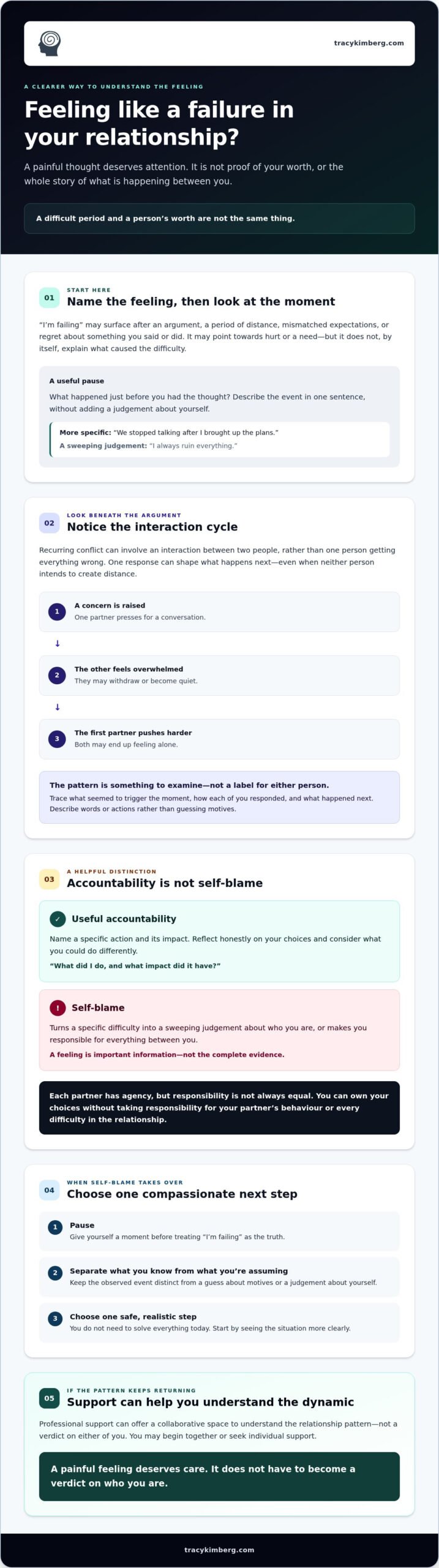
How to Respond When You Feel Like a Failure in Your Relationship
When the thought “I’m failing” takes hold, it can be tempting to rush into an apology, a confrontation or a major decision. You don’t have to settle the future of your relationship in the most painful moment. First, give yourself enough space to see what happened more clearly and choose one manageable response.
A short reflection before responding
Pause, name the thought, look for evidence and decide on one next step. Writing things down can help separate what you know from what you fear or assume. Try noting:
- What happened: Describe the specific interaction, rather than judging yourself.
- What each person did: Record observable words or actions, without guessing at motives.
- What remains uncertain: Notice what you don’t yet know about your partner’s perspective or the meaning of the moment.
Then ask yourself, “What would I say to someone I care about if they were in this situation?” Offer yourself the same fairness. Your next step could be taking time to settle, writing down what you want to say or asking for a calm conversation. It doesn’t have to be a decision about the whole relationship.
How to talk about the feeling with your partner
If it feels safe and useful to talk, focus on one interaction rather than every hurt at once. First-person language can help you share your experience without presenting an interpretation as fact. For example: “I felt discouraged after our conversation last night. I noticed I went quiet, and I’d like to understand what happened for both of us.”
Leave room for your partner’s account, too. You might ask, “How did that conversation feel from your perspective?” Listening doesn’t mean you must agree with everything. It can help reveal what your own account may be missing and make space for a more grounded discussion.
If the conversation starts escalating, suggest pausing and returning to it when you’re both better able to listen. A pause is not the same as avoiding the issue; it can help prevent a difficult moment from becoming more hurtful.
If reflecting alone feels difficult, explore individual relationship counselling as a way to understand your feelings and consider a next step, even if your partner isn’t attending.
Finding Support and a Next Step When Your Relationship Feels Stuck
Feeling distressed about your relationship deserves attention, but it doesn’t define your worth. The thought “I’m feeling like a failure in my relationship” may be a reason to pause and seek understanding, not a verdict that you or your relationship are beyond help. The next step doesn’t have to be a dramatic decision. It can be a way to see the situation with more support and perspective.
You might begin by reflecting privately on what feels stuck, or by choosing one specific concern to raise with your partner. If you’ve tried to talk and the same painful cycle keeps returning, a professional space may help you explore what’s happening between you, what each of you needs, and what choices are available. Counselling isn’t a guarantee of reconciliation, nor is it necessary for every couple. It can offer a setting to consider the relationship more carefully, without treating either partner as the problem to be judged.
When might couples or individual counselling help?
Support may be worth considering if repeated conflict or emotional distance is hard to shift, or if conversations leave you feeling more confused or alone. Relationship counselling and coaching for couples can help partners examine communication and recurring patterns together. If your partner isn’t ready or able to attend, individual relationship counselling can still give you space to understand your experience and consider your next steps.
Seeking support doesn’t commit you to one outcome. It can help you explore what matters, what you can influence and what you may need to decide. You can ask a therapist about their approach and whether it seems suitable for your situation before deciding whether to begin.
Choose a next step that feels manageable
There’s no need to have the whole path mapped out. Choose what feels safe and possible now:
- Reflect privately: Write down what you hope could change, and what you need to understand better.
- Talk with your partner: If it feels safe, raise one concern and ask how they see the situation.
- Seek professional support: Explore counselling if you’d value a professional space to consider the relationship, together or individually.
You’re allowed to take this one step at a time. If you’d like to learn more about Tracy’s approach to relationship counselling, you can explore relationship counselling with Tracy. It’s an invitation to find out whether this kind of support feels right for you, without needing to decide everything today.
Take One Compassionate Step Forward
Feeling like a failure in my relationship can feel convincing, especially when the same hurtful moments keep repeating. But distress is something to understand, not a verdict on your worth. Look for the difference between a specific action you can take responsibility for and the wider pattern you may need to explore together. Then choose one manageable next step, such as reflecting privately, starting a calm conversation or seeking support.
A professional space can help you make sense of recurring patterns and consider what you need, without deciding the outcome for you. Tracy Kimberg is a UK-based therapist specialising in relationship counselling and coaching for couples, with online and face-to-face therapy options and a structured 12-Week Relationship Recovery Process.
If you’d like to explore whether this support feels right for you, explore relationship counselling with Tracy. You don’t have to solve everything today. A clearer, kinder way forward can begin with one step.
Frequently Asked Questions
Is feeling like a failure in my relationship a sign that it is over?
No, not necessarily. The feeling can arise during conflict, distance or regret, but it can’t decide the future of your relationship on its own. Look at what’s happening between you, whether you can discuss it safely and whether change feels possible. If you feel unsafe or controlled, prioritise appropriate support rather than trying to repair things alone. You don’t have to make a major decision based on one painful thought.
Why do I feel like everything is my fault in my relationship?
Self-blame can make a confusing situation feel more manageable, but it may not reflect the whole picture. Try to identify the specific actions and interactions involved instead of concluding that you’re responsible for everything. Your partner’s choices matter too. A counsellor can help you explore what’s happening between you without turning the conversation into a search for one person to blame.
How can I stop feeling like a failure with my partner?
Start by naming the thought as a feeling, then identify the event that brought it up. Ask yourself what you know, what you’re assuming and what action is within your control. If it feels safe, talk with your partner about one concrete interaction and listen to their perspective. Aim for a thoughtful next step, not instant certainty or a demand that you fix the whole relationship alone.
Can a relationship improve if only one person wants to work on it?
One person can reflect on their behaviour, communicate needs and seek individual support, but they can’t control their partner’s choices. Relationship change involves understanding the dynamic between both people, and one person can’t do that work for their partner. If your partner isn’t ready to take part, you can still consider what support and boundaries would help you decide what feels healthy and possible for you.
Should I tell my partner that I feel like a failure?
If you feel safe talking with your partner, sharing the feeling may open a more honest conversation. Describe what’s been happening and how it affects you, rather than treating your fear as proof that either of you is at fault. You could ask how your partner sees the situation, too. If conversations lead to intimidation or fear, seek appropriate support before raising the subject directly.
Can counselling help when I feel like I am failing in my relationship?
Relationship counselling can offer a supported space to explore recurring interactions, communication and what each person needs. If your partner isn’t ready to attend, individual counselling may also be an option. Support can’t guarantee that a relationship will continue or change in a particular way. Before deciding to begin, you can ask a practitioner about their approach and whether it seems suitable for your situation.

Article by
Tracy Kimberg
Tracy Kimberg is a Relationship Expert, Couples Therapist and Coach with a dedicated focus on helping couples and individuals rebuild connection, trust and emotional safety in their relationships. Drawing on the research of John and Julie Gottman, the relational insights of Esther Perel, and years of hands-on therapeutic experience, Tracy offers a warm, non-judgemental and deeply compassionate approach to modern relationships.
Based in Dorset, Tracy works with couples navigating communication breakdowns, betrayal, intimacy challenges, separation, family dynamics and life transitions. Known for creating a safe and grounded therapeutic space, she combines practical tools with emotional depth to help clients move beyond survival patterns and towards meaningful, lasting change.
With a reputation for empathy, professionalism and dedication to her clients’ growth, Tracy is passionate about helping people feel seen, understood and empowered — both within their relationships and within themselves.
Disclaimer
Disclaimer:
The information shared in this article is intended for educational and informational purposes only and should not be considered a substitute for professional therapeutic, psychological, medical or legal advice. Every individual and relationship is unique, and the perspectives offered are based on general therapeutic principles, research and professional experience.
Reading this article does not establish a therapist-client relationship with Tracy Kimberg. If you are experiencing significant emotional distress, relationship crisis, trauma, or mental health concerns, it is important to seek support from a qualified professional appropriate to your individual circumstances.
All content remains the intellectual property of Tracy Kimberg and may not be reproduced or distributed without permission.