

What if the hardest part of divorce isn’t deciding what happens next, but staying steady while everything feels uncertain? If you’re wondering how to prepare emotionally for divorce, you may be carrying grief, anger, relief or doubt, sometimes all at once. These feelings don’t automatically mean you’re making the wrong choice, or that you should rush towards one.
It’s understandable to worry about how conflict may affect your children and family relationships, or whether emotional overwhelm will make practical decisions harder. Preparing emotionally isn’t about having every answer before you begin. It’s about recognising what you’re feeling and creating space to think, talk and choose with greater care.
This article explores the emotional and relational strain that can accompany separation, ways to approach difficult conversations, and how support can help you reflect without pressuring you to divorce or reconcile. It also explains how emotional support differs from legal advice and mediation, so you can identify the kind of help you need as you consider what comes next.
Key Takeaways
- Divorce can bring emotional and relational strain, but there is no single response you are supposed to have.
- Changes to a relationship may affect your sense of identity, belonging and everyday family life.
- Learn how to prepare emotionally for divorce without expecting yourself to feel completely calm or certain.
- Use simple reflection prompts to clarify what you fear, hope for and need before difficult conversations or decisions.
- Conscious divorce support can help you explore emotions and communication, alongside separate legal advice where needed.
The hidden costs of divorce in the UK: what emotional preparation can help you see
Divorce can bring more than practical tasks. For some people, it also means grieving shared routines, hopes for the future or a familiar sense of who they are within a relationship. Others may feel relief, anger, fear or uncertainty, sometimes several emotions in the same day. None of these responses is the “right” one, and having mixed feelings doesn’t decide what you should do next.
Emotional preparation means noticing and making space for your feelings so you can approach decisions with greater awareness. It isn’t legal or financial planning, and it doesn’t commit you to divorce or reconciliation. Learning how to prepare emotionally for divorce can start with asking what this change means to you, rather than forcing yourself to reach an answer before you’re ready.
Which emotional and relational pressures can be easy to overlook?
Even when a relationship has been painful or difficult, there may be parts of it you’ll miss: familiar rituals, shared history, a sense of belonging or the future you once imagined. Grief doesn’t erase the reasons you’re considering separation. Relief can sit alongside sadness, just as anger can coexist with care.
Repeated uncertainty or conflict may feel draining, though people experience this period differently. The relationship also needs to be renegotiated: conversations may become more focused on practical matters, and boundaries around communication, privacy or time together may need to change. For broader context, the overview of emotional problems associated with divorce describes some experiences reported by adults and children, though individual responses vary.
Why can practical uncertainty feel emotionally heavy?
Unfamiliar decisions can arrive alongside competing demands. You may be thinking about where to live, how to talk with family or how routines at work and home might change. If you’re a parent, questions about children’s everyday needs may add another layer. This combination can feel overwhelming, but it won’t affect everyone in the same way.
It can help to separate the kinds of support you need. Emotional support gives you space to explore feelings, communication and changing relationship dynamics. Legal advice addresses legal questions, while financial guidance or mediation relates to practical arrangements. Each has a different purpose, and emotional reflection can sit alongside them without replacing them. Write down the questions on your mind and group them by type. That can make it easier to see which needs attention first and where to take it.
How divorce can affect emotions, identity and family relationships
A relationship is part of how many people organise daily life and understand their place in a family. When that relationship changes, familiar routines, shared decisions and a sense of belonging may shift too. You might find yourself asking who you are outside the partnership, or how to make choices that once felt shared. These questions can arise even when separation feels necessary.
Several feelings can exist at once because a relationship can hold meaningful connection as well as real difficulty. Change may bring relief in one part of your life while you grieve another. There isn’t a required sequence of emotions. Some days you may feel clear; at other times, a conversation or change in routine may bring uncertainty back.
What might grief, relief and uncertainty look like during separation?
Emotional change can show up in ordinary moments. You might struggle to concentrate at work, notice your energy rising and falling, or revisit a decision after feeling sure about it. These experiences don’t, on their own, tell you what choice to make. Relief and sadness can sit side by side, and neither feeling alone settles whether to stay or separate.
Rather than suppressing a feeling or treating it as a verdict, pause to notice what keeps returning. Is there a particular conversation that leaves you unsettled? Are you missing a shared ritual, or needing more space? Noticing patterns and needs can help you respond with care instead of reacting in the heat of a difficult moment.
How can changing family roles affect children and co-parenting?
Children may have questions about what will change in their own lives. Where possible, offer calm, consistent explanations suited to their age and circumstances. Avoid involving them in adult disagreements or asking them to carry messages between parents. Give them room to have their own feelings without asking them to take sides or reassure either adult.
Family routines may change, but you can help children understand what you know and be honest when some answers are still unclear. When talking with them, focus on what affects their daily lives and invite their questions without expecting them to resolve adult concerns.
Small points of steadiness may help as family life adjusts. Mental Health America’s resource on Coping with the stress of divorce includes practical ideas such as maintaining routines and staying connected with supportive people. Relationship-focused therapy can also give you space to explore changing family dynamics and communication, without directing you towards divorce or reconciliation. You can learn more about relationship-focused emotional support as you consider what would feel helpful.
Emotional preparation for divorce versus avoiding difficult decisions
Preparing emotionally doesn’t mean waiting until you feel calm, certain or free from grief. It means making room to understand what you’re feeling, what matters to you and what you may need before taking a next step. Avoidance, by contrast, can keep difficult questions out of view, while a decision made during acute conflict may reflect the intensity of that moment more than your considered position. Neither pattern tells the whole story, and there’s no single right pace for everyone.
This comparison can help you notice what’s happening without turning it into a test you have to pass:
| Pattern | Possible signs | A gentle next step |
|---|---|---|
| Thoughtful preparation | You’re making space to reflect, even if you still feel unsure. | Write down the questions you want to explore and what support might help. |
| Avoidance | You repeatedly put off conversations or practical questions because they feel difficult. | Choose one small question to consider, without requiring yourself to settle everything. |
| Acute conflict | You feel pressure to make a major decision during or just after an intense argument. | If it’s safe to do so, pause and revisit the question when the immediate tension has eased. |
Does feeling unsure mean you are not ready to make any decision?
Not necessarily. Ambivalence can hold useful information: perhaps part of you wants change whilst another part fears loss, disruption or regret. It doesn’t prove you must stay or leave. You might begin by distinguishing immediate safety or wellbeing concerns from wider questions about the relationship. If safety is at risk, that needs attention in its own right; broader reflection can happen alongside appropriate support. There’s no reliable timetable for certainty, and you don’t need to force one.
When might individual or relationship-focused support help?
Therapy can offer a space to explore feelings, communication and patterns between you, whether you’re considering separation or already navigating it. Support may be individual or relational, depending on your circumstances and goals. The purpose isn’t to decide for you or steer you towards divorce or reconciliation. It can help you reflect on what you’re experiencing and which choices feel considered.
As you think about how to prepare emotionally for divorce, keep the boundaries of support clear: therapy is not legal advice or legal divorce mediation, and it isn’t a substitute for urgent help. Legal, financial and emotional questions may each call for a different kind of support.
Practical ways to prepare emotionally before and during divorce
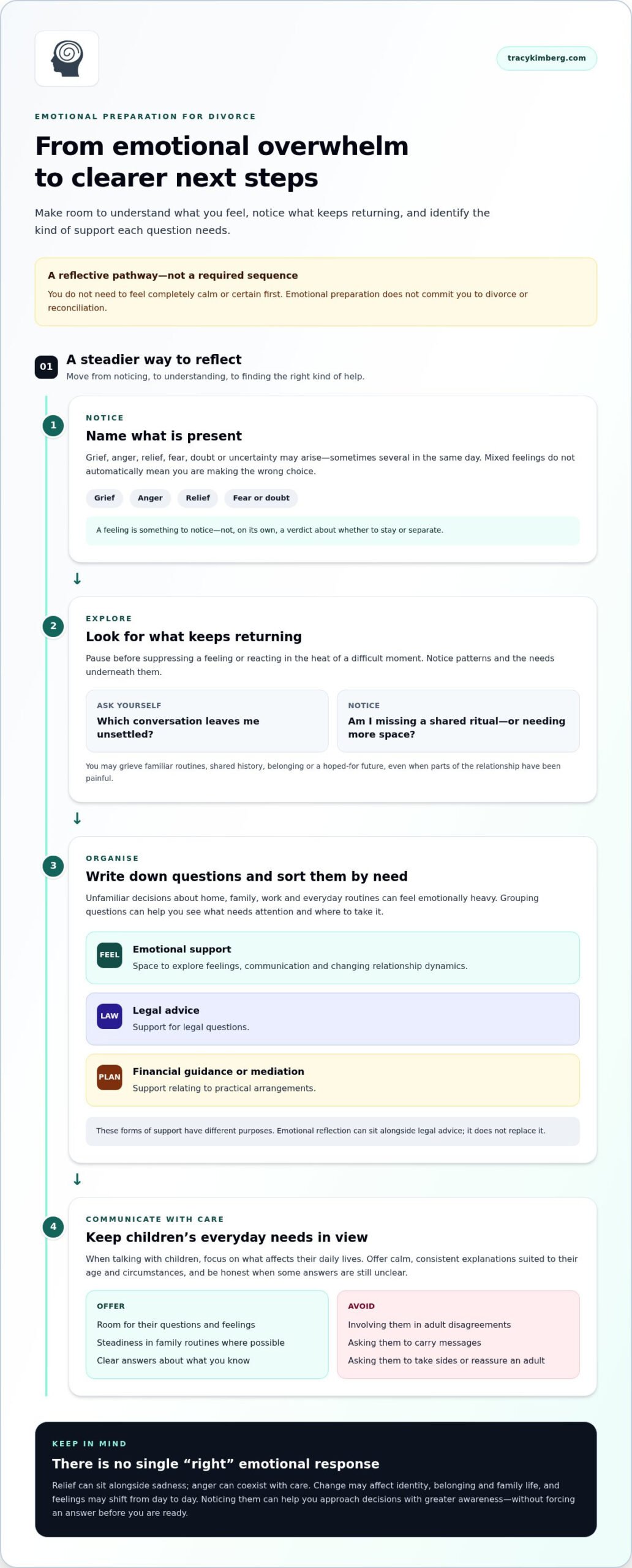
There’s no single way to prepare, and you don’t have to work through everything at once. A flexible sequence can help you notice what’s happening inside, find support and approach the next conversation or decision with more care.
- Notice your feelings. Give yourself a moment to name what’s present, without judging it. Ask: What am I feeling today? What seems to bring this feeling up?
- Identify support. Consider one trusted person or professional space where you can speak honestly. Choose what you feel ready to share, and take the time you need.
- Clarify immediate needs. Ask yourself what would help you feel more supported in the near term. What needs attention now, and what can wait?
- Plan conversations. Decide what you hope to communicate and what boundary might help you stay grounded. Write down questions beforehand so you don’t have to hold them all in your head.
- Review and adjust. Revisit your notes as circumstances change. Your needs, feelings and priorities may shift, so your plan can change too.
If everything feels overwhelming, write down one question you need help with. Then identify whether it’s emotional, legal or financial, and choose an appropriate person or professional support to raise it with.
How can you steady yourself before difficult conversations?
Where circumstances allow, choose a time when you’re less likely to be interrupted and agree on a clear purpose, such as discussing one immediate concern rather than trying to settle everything. Before you begin, consider: What do I want the other person to understand? What do I need to listen for? What can wait?
If the discussion becomes too heated to continue constructively, pausing and returning to it later may help, provided it feels safe to do so. Communication strategies aren’t appropriate in every situation. If you feel unsafe, prioritise your wellbeing and seek suitable support rather than relying on a conversation technique.
What can help create emotional support and continuity?
Choose one steady point of support: a trusted friend, a routine that helps you feel anchored, or a professional space to reflect. A short note on your phone or in a notebook can capture questions and feelings as they arise, so you don’t have to remember everything during a conversation. Prompts might include: What am I afraid of? What do I hope for? Which boundaries matter to me? What helps me feel more like myself?
Relationship-focused therapy can support reflection on changing communication and relationship dynamics, without steering you towards a particular decision. You could also use these prompts to prepare for a session or a conversation with someone you trust. If you’d like support as you reflect on your relationship and next steps, explore conscious divorce and separation support.
Conscious divorce support: a compassionate next step in the UK
Conscious separation is an emotionally aware way of approaching relationship change. It invites you to consider how you communicate, what you’re feeling and how the decisions ahead may affect the people involved. It doesn’t guarantee an amicable separation or make difficult conversations disappear. Rather, it offers a way to meet those conversations with greater awareness, where circumstances allow.
For some people, the question of how to prepare emotionally for divorce is still bound up with uncertainty about whether to separate. For others, the relationship has ended, but the emotional adjustment is ongoing. Either way, support can offer room to reflect without pushing you towards a particular outcome.
What does conscious separation support focus on?
Tracy Kimberg’s relationship-focused support centres on emotional awareness, relationship dynamics and communication during a major life transition. You might use the space to explore what feels hardest to say, how patterns between you have changed, or what you want to hold onto as family life shifts. This isn’t a fixed formula for separation, and it can’t promise conflict-free conversations.
Therapeutic support has a different role from legal help. It can help you explore your feelings and relationships, but it doesn’t provide legal advice or legal divorce mediation. If you have questions about your rights, finances or formal arrangements, those need to be addressed separately. Emotional reflection can complement that advice, helping you notice what matters to you as you consider practical choices.
How can you take a next step that feels manageable?
You don’t need to arrive with a settled decision or a complete account of what has happened. Start with what feels most difficult right now: perhaps uncertainty, a conversation you’re avoiding, or the impact of changing routines. You could also ask yourself what kind of support would feel useful, and whether you’d prefer to reflect individually or explore relationship dynamics together.
Tracy offers online and face-to-face therapy. The setting may be one practical part of deciding what feels manageable; the work can focus on making space for your emotions and understanding the relationship changes you’re facing. You’re allowed to take this at your own pace, including if you’re still deciding what you want.
If you’d like a supportive space to explore what comes next, explore relationship and separation support.
Take your next step with care
Divorce can bring grief, relief, uncertainty and practical pressure, sometimes all at once. Preparing emotionally doesn’t mean you need to feel certain or have every answer. It can begin with noticing what you’re feeling, identifying what support would help and taking time to consider important conversations and decisions.
If you’re thinking about how to prepare emotionally for divorce, relationship-focused support can give you space to reflect on your feelings, communication and changing relationship dynamics. Tracy Kimberg offers specialised support for conscious divorce and separation, alongside relationship counselling and therapy online and face-to-face. Her research-based approach is informed by relationship experts including John Gottman and Esther Perel. This emotional support complements, rather than replaces, legal advice.
You don’t have to know exactly what you want before seeking support. If you’d like a space to explore what feels difficult and what might help, explore compassionate relationship and separation support. You can take the next step at your own pace.
Frequently Asked Questions
How do I prepare emotionally for divorce?
Start by noticing what you’re feeling, without treating any emotion as proof that you should stay or leave. To understand how to prepare emotionally for divorce, write down the questions, fears and hopes that keep returning. Identify one trusted person or professional space where you can talk openly, and consider what would help you feel steadier in the near term. You don’t need to resolve every practical or relationship question at once.
Is it normal to feel relief and grief at the same time during divorce?
Yes. Relief and grief can coexist because a relationship may have included both painful experiences and meaningful connection. You might feel lighter after a difficult conversation, then miss a shared routine or the future you once pictured. Neither emotion, by itself, tells you what decision to make. Try noticing when each feeling arises and what you may need in that moment, rather than judging yourself for having mixed reactions.
Can counselling help if I am unsure whether to divorce?
Counselling can give you a space to explore uncertainty, relationship patterns and communication without directing you towards divorce or reconciliation. You might use sessions to reflect on what feels difficult, what you value and what questions remain unresolved. Support can be individual or relationship-focused, depending on your circumstances and aims. It isn’t legal advice or legal mediation, and it can’t make the decision for you.
What are the hidden emotional costs of divorce?
Possible emotional and relational demands include grieving shared hopes, adjusting to changed routines, and renegotiating communication and boundaries with a former partner. A shift in family roles or a sense of belonging may also take time to make sense of. These experiences aren’t universal, and they don’t follow one set pattern. Recognising what feels hard for you can help you identify the kind of support or space you need.
How can I prepare children emotionally for a separation?
Offer calm, age-appropriate explanations about what you know will change, and make space for children to ask questions or express feelings. Try to keep them out of adult conflict, and don’t ask them to carry messages between parents. You may not have every answer straight away; be honest about that rather than making promises you can’t be sure of. Their needs and responses will vary, so keep communication open as circumstances evolve.
What happens if I feel overwhelmed by divorce decisions?
If decisions feel overwhelming, pause and separate what needs attention now from questions that can wait. Write down what you’re unsure about, then consider which questions are emotional, legal or financial so you can seek the appropriate support for each. If it feels safe, avoid making a major choice in the middle of an intense argument. A trusted person or therapist may help you reflect, but legal questions need legal advice.
Does conscious separation mean divorce will be amicable?
No. A conscious approach means paying attention to emotions, communication and relationship dynamics as you navigate change; it can’t guarantee agreement or conflict-free conversations. Tracy Kimberg offers conscious divorce and separation support focused on the emotional and relational aspects of this transition. That support may help you reflect on how you want to communicate, but it doesn’t replace legal advice or determine the outcome of the separation.

Article by
Tracy Kimberg
Tracy Kimberg is a Relationship Expert, Couples Therapist and Coach with a dedicated focus on helping couples and individuals rebuild connection, trust and emotional safety in their relationships. Drawing on the research of John and Julie Gottman, the relational insights of Esther Perel, and years of hands-on therapeutic experience, Tracy offers a warm, non-judgemental and deeply compassionate approach to modern relationships.
Based in Dorset, Tracy works with couples navigating communication breakdowns, betrayal, intimacy challenges, separation, family dynamics and life transitions. Known for creating a safe and grounded therapeutic space, she combines practical tools with emotional depth to help clients move beyond survival patterns and towards meaningful, lasting change.
With a reputation for empathy, professionalism and dedication to her clients’ growth, Tracy is passionate about helping people feel seen, understood and empowered — both within their relationships and within themselves.
Disclaimer
Disclaimer:
The information shared in this article is intended for educational and informational purposes only and should not be considered a substitute for professional therapeutic, psychological, medical or legal advice. Every individual and relationship is unique, and the perspectives offered are based on general therapeutic principles, research and professional experience.
Reading this article does not establish a therapist-client relationship with Tracy Kimberg. If you are experiencing significant emotional distress, relationship crisis, trauma, or mental health concerns, it is important to seek support from a qualified professional appropriate to your individual circumstances.
All content remains the intellectual property of Tracy Kimberg and may not be reproduced or distributed without permission.