

What if you don’t have to decide the whole future of your relationship before you can begin an honest conversation? Uncertainty about whether things can change, fear that talks will turn to blame, and concern for children can make every next step feel loaded. Tracy Kimberg offers conscious separation support UK-based individuals and couples can use to slow down, understand what’s happening between them and consider their choices with care.
It’s understandable to hope for clarity while also fearing what it might bring. Support won’t decide whether you should stay together or separate, and it isn’t legal mediation. It can help you explore the emotional and relational sides of this transition, communicate more thoughtfully and consider how change may affect family life.
This article explains what conscious separation support involves, where its role begins and ends, and how it can help you make room for honest decisions without rushing or avoiding difficult feelings. You’ll also find practical ways to approach conversations and consider next steps with greater care, whatever you decide about the relationship.
Key Takeaways
- Separation can bring grief, relief and uncertainty at once. Notice what you’re feeling before treating any one emotion as the whole story.
- Conscious separation support UK can help you explore relationship patterns and each person’s experience without assigning blame.
- You don’t need certainty to begin. Repair-focused work, discernment and separation support each have a different purpose, and none guarantees a particular outcome.
- Approach difficult conversations in considered steps: pause, identify your needs, prepare what you want to say, agree immediate boundaries and review what changes.
- Relationship counselling and coaching with Tracy Kimberg can offer a non-judgemental space to explore communication and possible next steps.
What conscious separation support in the UK can help you navigate
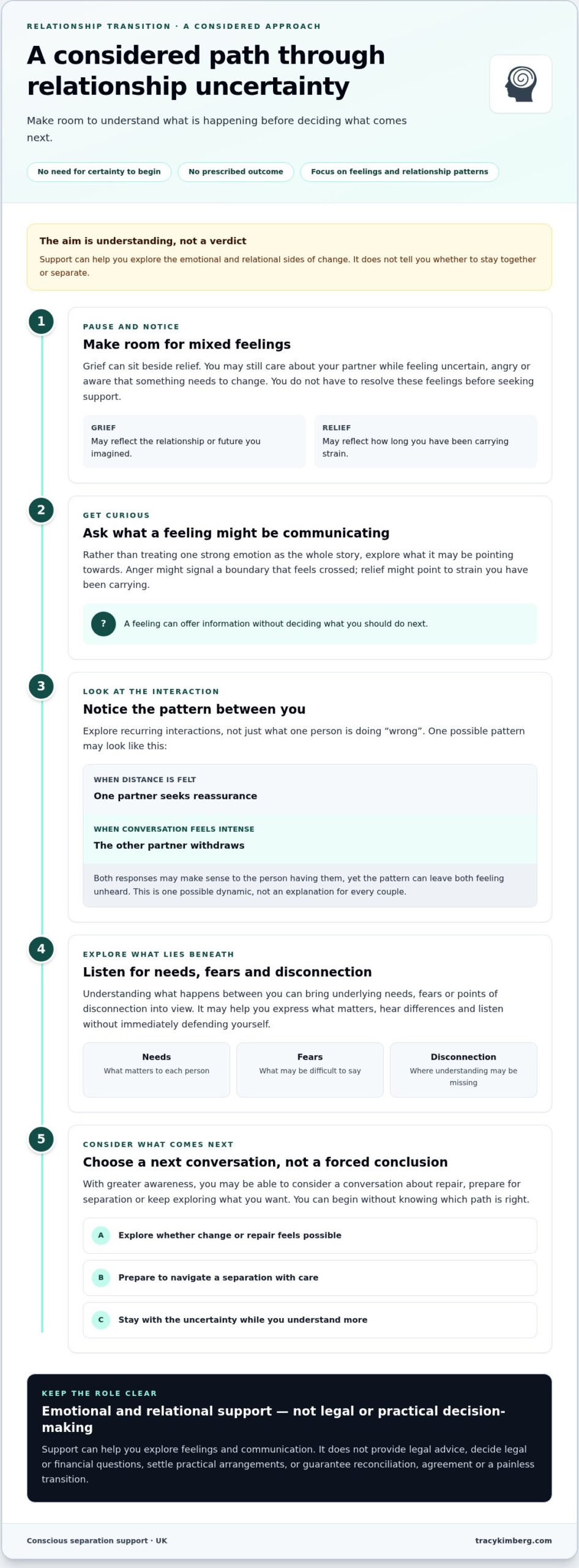
Separation rarely brings one clear feeling. Grief can sit beside relief; care for your partner or family can coexist with uncertainty about what happens next. You may miss what the relationship has been while recognising that something needs to change. You don’t have to resolve these mixed feelings before seeking support. They’re part of the experience worth understanding.
Conscious separation support offers space to explore your feelings, relationship patterns and choices as you face change, without prescribing whether you should stay together or separate. The focus is on the psychological and relational experience: what each person is feeling, how you communicate and what matters as you consider the way forward. The idea is related to conscious uncoupling, but support isn’t a formula for a perfect ending. Being conscious doesn’t mean being conflict-free, painless or certain from the outset.
Relationship-focused support is different from legal advice, mediation or making practical arrangements. It can help you explore emotions and communication, but it doesn’t decide legal or financial questions or settle arrangements for you. Its value may lie not in having every answer, but in approaching the questions with greater awareness.
What makes a separation conscious rather than simply amicable?
An amicable separation may describe a relatively cooperative relationship between former partners. A conscious approach is more about how you engage with what is happening: being honest about your feelings, noticing how familiar patterns shape difficult conversations, and taking responsibility for your own part. It doesn’t require equal certainty or agreement on every decision. Respectful conduct can still matter when sadness, anger or disagreement remains.
Who might seek conscious separation support?
Individuals and couples may seek conscious separation support from UK-based therapist Tracy Kimberg while facing disconnection, repeated conflict or a relationship crossroads. One partner may feel ready to leave while the other hopes to repair the relationship. Some people are still asking whether change is possible. You don’t need a settled decision to begin: uncertainty can be a useful starting point for exploring what each person needs and what the relationship may still hold.
How conscious separation support helps you understand the relationship transition
Support can help you put words to what’s happening inside you without turning one feeling into a final verdict. Anger might point to a boundary that feels crossed; relief might reflect how long you’ve been carrying strain. Neither feeling tells the whole story on its own. Making room for them can help you respond with more care instead of reacting from the strongest emotion in the moment.
This work isn’t about finding a villain. It’s about understanding how each person experiences the relationship and what happens between you when tension rises. A supportive space can make it easier to hear differences, reflect on what matters and prepare for more considered conversations. It can’t guarantee reconciliation, agreement or a painless transition, but it can help you meet uncertainty with greater awareness.
Making space for grief, anger, relief and uncertainty
Feelings can pull in different directions. You might grieve the future you imagined and feel relief that difficult patterns are being faced. You may still care deeply while feeling angry or unsure. Rather than judging these emotions or expecting them to resolve in a particular order, become curious about what each may be communicating. There’s no fixed timetable for grief or clarity, and you don’t have to force either.
Understanding the patterns between you
In relationship work, attention can turn to recurring interactions, rather than only to what one person is doing “wrong”. For example, one partner may seek reassurance when they feel distance, while the other withdraws when conversations feel intense. Each response may make sense from that person’s point of view, yet the pattern can leave both feeling unheard. This is one possible dynamic, not an explanation for every couple.
Exploring what happens between you can reveal the needs, fears or points of disconnection beneath familiar arguments. With that awareness, you may find new ways to express what matters, listen without immediately defending yourself, or decide what conversation is possible next. Conscious separation support UK can hold this exploration whether you’re considering repair, preparing to separate or still working out what you want.
Emotional support has a different focus from legal or practical questions. For a separate view of the wider family-law context, you can read the GOV.UK consultation on relationship breakdown. Tracy Kimberg’s relationship counselling and coaching offers space to explore the emotional and relational aspects of change, without prescribing an outcome.
Is conscious separation support right for you, or are you still deciding?
You don’t have to arrive with a firm answer. One partner may be leaning towards separation while the other hopes the relationship can change; either may still feel unsure. Conscious separation support UK can provide room to explore that uncertainty without pushing you to stay or leave. The purpose is to understand what different kinds of support are for, not to promise a particular outcome.
Repair-focused couples counselling centres on the relationship and whether both people want to work on it. Discernment gives space to consider the relationship’s direction when partners feel differently or remain undecided. Separation support focuses on the emotional and relational experience of ending or changing the relationship. These approaches aren’t necessarily mutually exclusive. What feels useful can depend on where you are now and what you most need to understand.
| Type of support | Question it can help you explore |
|---|---|
| Repair-focused work | What would it take for us to work on this relationship? |
| Discernment | How do we understand our different levels of certainty and decide what direction to take? |
| Separation support | How can we understand and approach the emotional transition with care? |
Choosing conscious separation doesn’t mean you’ll stay friends, agree on every decision or avoid conflict. It means giving attention to how you communicate and taking responsibility for your part, even when feelings are painful or views differ. For a broader introduction, read What is Conscious Separation? An Empathetic Choice.
How does separation support differ from couples counselling?
Couples counselling may focus on the relationship itself, including whether and how to repair it. Separation support gives more attention to the ending or transition: what you’re feeling and how you want to communicate through change. These aims can overlap, since reflecting on uncertainty may be part of either conversation. Neither approach is right for everyone, and seeking support doesn’t dictate your decision.
What if one partner wants to separate and the other does not?
A difference in certainty can be deeply painful, but it doesn’t make either person unreasonable. Honest communication can acknowledge what each person wants without pretending there’s agreement. Clear boundaries may help you understand what conversations are possible and what each person needs in the immediate moment. Support can help you consider these questions, but it can’t guarantee agreement, reconciliation or a particular decision.
Practical ways to approach separation with care in the UK
Emotional care can make a difficult transition feel more considered, even when there’s no simple way to remove the pain. A short sequence can help you find your footing: pause before reacting, identify what you need, prepare what you want to say, agree immediate boundaries and review what changes. You don’t have to resolve every family or practical question in one conversation.
- Pause: Give yourself space to notice what you’re feeling before beginning a difficult discussion.
- Identify needs: Consider what would help you feel heard and what needs attention first.
- Prepare: Decide what you know, what’s uncertain and what you want to discuss next.
- Agree immediate boundaries: Clarify how you’ll communicate or manage day-to-day contact for now.
- Review: Revisit what’s working and what may need to change as circumstances become clearer.
This is a guide, not a formula. A careful opening can’t guarantee the other person will respond calmly, but a clear intention may help you stay close to what you want to communicate. Conscious separation support UK can help you reflect on the emotional and relational side of these conversations. It isn’t legal advice or legal mediation, and it doesn’t decide practical arrangements. Questions about parenting, finances or day-to-day responsibilities may need attention beyond emotional counselling.
Preparing for a difficult separation conversation
Choose a moment when you can speak without unnecessary pressure, and be clear with yourself about the conversation’s purpose. You might say what you know, name what remains uncertain and identify what needs discussion next. Where possible, speak from your own experience rather than assigning blame. No script can prevent conflict, but preparation can help you communicate more deliberately and return to the main point if emotions rise.
For more ideas about keeping family needs in view, explore Amicable Separation Guidance: Putting Family First. It can complement the emotional reflection involved in planning how to speak with your partner.
Keeping children’s emotional needs in view
Children may need clear, age-appropriate communication about changes that affect family life. Where possible, adults can agree what to tell them and offer reassurance without making promises they can’t be sure of. Avoid using children as messengers or drawing them into disagreements between adults. How to Tell Kids About Separation: A Gentle Guide offers further support for approaching that conversation with care.
If you’d value a space to think through the emotional and relational aspects of separation, explore relationship counselling and coaching with Tracy Kimberg.
How Tracy Kimberg supports conscious separation and your next steps
When a relationship is changing, it can help to have somewhere to speak openly without being pushed towards a particular ending. Tracy Kimberg’s relationship counselling and coaching offers support for the emotional and relational aspects of conscious separation, with space to explore feelings, familiar patterns, communication and possible next steps.
This work isn’t legal mediation or legal advice. It doesn’t determine whether you should separate, make a partner agree or remove the difficult feelings that may accompany change. Instead, it offers a non-judgemental setting in which individuals or couples can reflect on what’s happening and what feels important now. Support is available through online and face-to-face therapy.
There’s no need to arrive with everything resolved. You might be clear that the relationship is ending but unsure how to talk about it. Or you may be questioning whether you want to leave, hoping for repair, or trying to understand why you feel pulled in different directions. Conscious separation support UK can meet you in that uncertainty, making room for a considered next step rather than a prescribed pathway.
What can you bring to an initial conversation?
Bring the questions, worries or hopes that feel most present. Perhaps you’re concerned about repeating old arguments, unsure what you want, or thinking about how a change could affect family life. You don’t need a polished explanation or a final decision. A first conversation can simply give you the chance to describe what’s happening and explore what kind of support may help you think it through.
Choosing a next step without rushing the decision
Start by noticing what would be most helpful right now. You may need space to reflect on your feelings, support with communication, or a place to explore how separation is affecting you emotionally. Your needs may shift as the situation unfolds. The next step can respond to your circumstances; it doesn’t have to settle the whole future at once.
Tracy’s approach centres awareness, communication and considered choices, whether you’re coming alone or as a couple. If you’re ready to explore what support might feel useful, explore relationship and separation support. You don’t need to have all the answers before you begin.
Take your next step with care
Separation can hold grief, relief and uncertainty together, so you don’t need to force a clear answer before you’re ready. Conscious separation support UK can offer space to understand what you’re feeling, notice patterns in the relationship and consider how to communicate with greater care.
Support doesn’t decide whether you should stay or separate, and it can’t promise agreement or a painless transition. It can help you approach the emotional and relational questions with more awareness, whether you’re still weighing your options or beginning to face change.
Tracy Kimberg specialises in relationship counselling and coaching for couples, including support for the emotional and relational aspects of conscious separation. To explore a thoughtful next step, contact Tracy Kimberg.
You don’t have to solve everything at once. A considered next step can begin with making room for an honest conversation.
Frequently Asked Questions
What is conscious separation support?
Conscious separation support is relationship-focused emotional help during uncertainty, separation or the transition that follows. It offers space to explore feelings, communication patterns and choices with greater awareness. The aim isn’t to make separation painless or ensure you agree. Support can help you approach a difficult change with honesty and care, without deciding for you whether to stay together or separate.
Can conscious separation support help if one partner is unsure?
Yes. Uncertainty can be part of the process, rather than a reason to wait until you have a final answer. A therapeutic conversation can help each person explore what they feel, what has brought them to this point and what they need to understand next. Conscious separation support UK makes room for these questions without pressuring either partner towards staying together or separating.
Is conscious separation the same as couples counselling?
Not necessarily. Couples counselling often focuses on understanding or changing the relationship, while conscious separation support attends to the emotional and relational experience of ending or changing it. There can be overlap, particularly if you’re still deciding what you want. A useful starting point is to ask what you need help exploring now, such as rebuilding connection, understanding uncertainty or approaching a transition with care.
Does conscious separation support include legal advice or mediation?
No. Tracy Kimberg’s conscious separation support focuses on the psychological and relational aspects of change, not legal divorce mediation. It can help you reflect on feelings, communication and relationship patterns, but it doesn’t determine legal rights or make practical agreements for you. Keeping emotional support distinct from legal decision-making can help you understand what each conversation is there to address.
Can separation support help us communicate more calmly?
It can help you understand what makes conversations difficult and consider clearer ways to express needs and boundaries. For example, you might explore how to raise a concern without blame or how to pause when a discussion becomes heated. Support can encourage greater awareness and care, but it can’t guarantee that conflict will disappear or that you’ll reach agreement. Each person remains responsible for their choices.
Can I access conscious separation support online in the UK?
Yes. Tracy Kimberg offers online and face-to-face therapy. Online sessions provide a way to take part remotely, while face-to-face therapy offers an in-person setting. The format that feels suitable may depend on your circumstances and preferences. Both options can support reflection on the emotional and relational aspects of separation, without promising a particular outcome or deciding what you should do next.

Article by
Tracy Kimberg
Tracy Kimberg is a Relationship Expert, Couples Therapist and Coach with a dedicated focus on helping couples and individuals rebuild connection, trust and emotional safety in their relationships. Drawing on the research of John and Julie Gottman, the relational insights of Esther Perel, and years of hands-on therapeutic experience, Tracy offers a warm, non-judgemental and deeply compassionate approach to modern relationships.
Based in Dorset, Tracy works with couples navigating communication breakdowns, betrayal, intimacy challenges, separation, family dynamics and life transitions. Known for creating a safe and grounded therapeutic space, she combines practical tools with emotional depth to help clients move beyond survival patterns and towards meaningful, lasting change.
With a reputation for empathy, professionalism and dedication to her clients’ growth, Tracy is passionate about helping people feel seen, understood and empowered — both within their relationships and within themselves.
Disclaimer
Disclaimer:
The information shared in this article is intended for educational and informational purposes only and should not be considered a substitute for professional therapeutic, psychological, medical or legal advice. Every individual and relationship is unique, and the perspectives offered are based on general therapeutic principles, research and professional experience.
Reading this article does not establish a therapist-client relationship with Tracy Kimberg. If you are experiencing significant emotional distress, relationship crisis, trauma, or mental health concerns, it is important to seek support from a qualified professional appropriate to your individual circumstances.
All content remains the intellectual property of Tracy Kimberg and may not be reproduced or distributed without permission.