

What if the purpose of counselling isn’t to prove you’re perfectly compatible, but to understand what commitment means to each of you? If you’re weighing up a shared future, pre-commitment counselling UK can give you space to explore that question without expecting you to arrive with complete certainty.
You may feel hopeful and close, yet still wonder whether you’re ready or how to talk about sensitive expectations without falling into conflict. Those questions don’t mean your relationship is in crisis. Counselling can be a proactive way to listen more carefully, notice familiar patterns and make room for differences, without asking someone else to decide your future.
This guide explains what you might explore together, how pre-commitment counselling differs from support focused on current difficulties, and how to prepare for more open conversations. Tracy Kimberg’s research-based couples work, informed by John Gottman and Esther Perel, offers a supportive space to consider communication, expectations and relationship dynamics. The aim isn’t perfect certainty. It’s a more considered choice and a clearer sense of what you want to understand.
Key Takeaways
- Pre-commitment counselling can help you explore a significant shared commitment without treating the conversation as a test you must pass.
- Consider how your values, expectations and emotional needs shape the future you’re imagining together.
- Understand how pre-commitment counselling UK differs from support focused on current relationship difficulties or coaching.
- Before talking together, note your hopes, worries and questions so both perspectives have room to be heard.
- Use the conversations to clarify what you want to understand, rather than seeking perfect certainty or a decision made for you.
Pre-commitment counselling UK: what it is and who it can help
Taking a relationship forward can bring joy, tenderness and uncertainty. You might love one another deeply and still wonder what living together, getting engaged or building a shared future will ask of you. Having questions doesn’t mean something is wrong. It may mean you’re taking the decision seriously.
Pre-commitment counselling is a guided exploration of a couple’s hopes, expectations and differences before a significant shared commitment, not a test that can guarantee compatibility. It gives you room to understand how each of you imagines the next stage and what you want to bring into it. The psychological concept of precommitment offers a useful lens on how present choices relate to future intentions. Counselling, however, focuses on what commitment means within your relationship.
What does pre-commitment counselling involve?
It involves guided conversations about what matters to you both: hopes for the future, expectations of partnership, ways of communicating and areas where your perspectives differ. A counsellor can help slow the conversation down so each person has room to speak and listen, especially when a sensitive subject tends to trigger defensiveness or silence.
The aim isn’t to score your relationship or decide whether you’re a suitable match. It’s to understand how you each make sense of life together. One partner, for example, might see moving in as a practical next step, whilst the other associates it with a deeper promise. Exploring what sits beneath those interpretations can make the difference easier to discuss without turning it into blame.
Pre-commitment counselling UK can be useful before a relationship reaches crisis point. Rather than starting with an immediate rupture, it begins with a future decision and the expectations around it. Difficult feelings still have a place in the conversation, but they’re explored in the context of what you’re considering, not treated as proof that the relationship has failed.
When might couples consider it?
Couples may seek these conversations when they’re considering engagement, cohabitation, marriage or another meaningful commitment. There doesn’t have to be a proposal or a fixed timeline. Sometimes the starting point is simply that the relationship is becoming more serious and important questions are emerging.
A loving relationship can still hold unspoken questions about independence, family, finances, intimacy or what each person understands by commitment. These subjects can feel risky to raise: you may worry that asking means you doubt the relationship. In a supportive conversation, questions become invitations to understand one another, not accusations or demands.
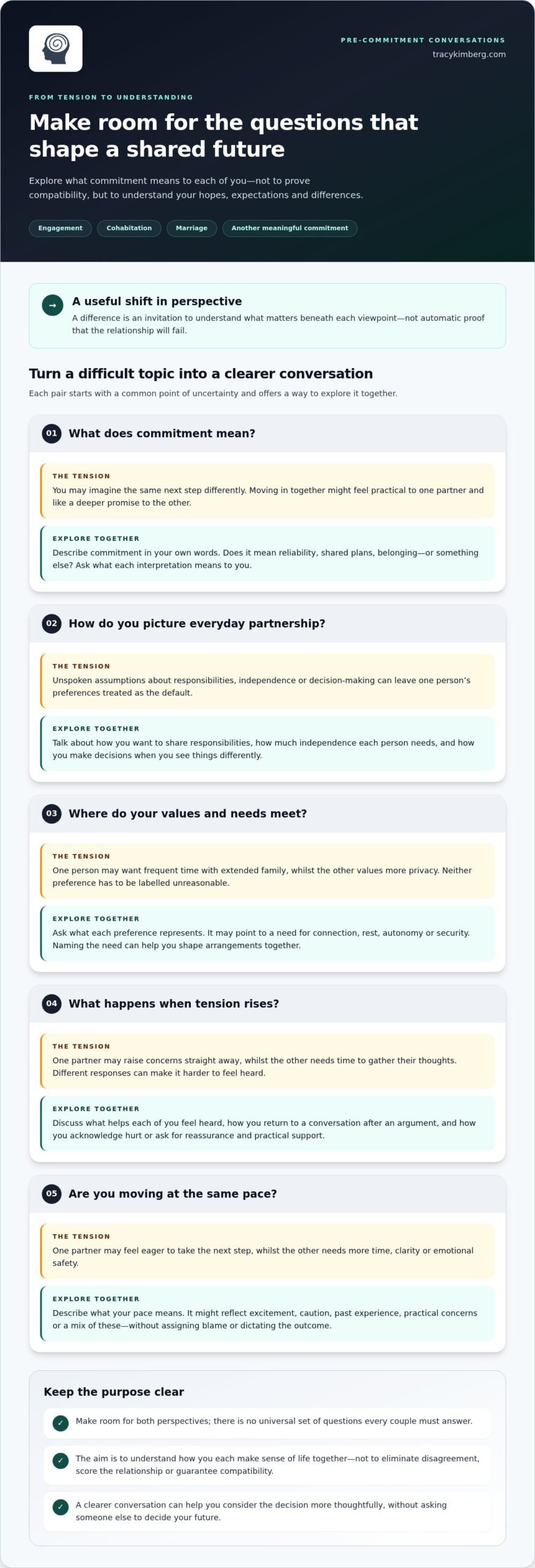
Readiness can differ. One partner may feel eager to take the next step, whilst the other needs more time, clarity or emotional safety. Rather than assigning blame, counselling can help each person describe what their pace means. It might reflect excitement, caution, past experience, practical concerns or a mix of these. Tracy Kimberg’s research-based couples work offers space to explore communication and relationship dynamics without dictating the outcome. The value lies in seeing your decision more clearly, not in being promised certainty.
What couples can explore before making a long-term commitment
There’s no universal set of questions every couple must answer before taking a relationship forward. A more useful starting point is to explore what commitment means to each of you, how you want to share everyday life, and what helps you feel connected when things are difficult. In pre-commitment counselling UK, these themes can be approached as invitations to understand one another, not as a checklist with right answers.
Differences invite discussion; they don’t automatically predict failure. What matters is whether you can become curious about what lies beneath each viewpoint and make space for both people’s needs.
Expectations, values and everyday partnership
Try describing commitment in your own words before deciding whether you agree. Does it mean reliability, shared plans, a sense of belonging or something else? Then consider how your values show up in daily life: how responsibilities are divided, how much independence each person needs, and how you make decisions when you see things differently.
Notice whose assumptions are being treated as the default. Perhaps one person imagines frequent time with extended family, whilst the other values more privacy. Neither view has to be labelled unreasonable. Ask what each preference represents. It may point to a need for connection, rest, autonomy or security. Naming that need can help you shape arrangements together instead of letting unspoken expectations take over.
Communication, conflict and emotional connection
Explore the pattern between you when tension rises. Does one partner raise concerns straight away whilst the other needs time to gather their thoughts? What helps each of you feel heard? You might discuss how you return to a conversation after an argument, acknowledge hurt, or ask for reassurance and practical support. The aim isn’t to eliminate disagreement. It’s to understand how you respond to it and what makes repair possible.
A gentle, trauma-informed approach doesn’t assume either partner has a particular history or diagnose their reactions. Instead, it recognises that people may have different sensitivities and ways of protecting themselves. Curiosity about those responses can replace quick judgement with questions such as, “What happens for you in that moment?”
Emotional and physical intimacy may also matter, though couples differ in what feels comfortable to discuss. You could explore what closeness means, how affection is expressed, and how each person communicates boundaries or changes in desire. There’s no need to force disclosure. A respectful conversation makes room for choice and consent.
Practical hopes and future plans
Depending on your circumstances, you may want to talk about finances, family relationships, children, career choices, where to live, or how you imagine balancing shared plans with individual ambitions. These topics aren’t predictions of what your life must look like. They help you see where you’re aligned, where assumptions differ and what needs further conversation.
Research into premarital counselling has considered skills such as communication and problem-solving; the academic research on premarital counselling offers further context. In a supportive conversation, you can explore these themes at a pace that respects both partners. Tracy Kimberg’s relationship counselling for couples provides space to reflect on communication, expectations and relationship dynamics without prescribing your decision.
Pre-commitment counselling versus couples therapy or relationship coaching
Seeking support doesn’t mean your relationship is failing. It can mean you want to approach an important choice with care, rather than waiting until uncertainty turns into resentment or distance. The difference between pre-commitment counselling, couples therapy and relationship coaching is often less about strict categories and more about the question you bring into the room.
Pre-commitment work centres on a future decision and the expectations attached to it. Couples therapy may be sought when present distress, recurring conflict or a sense of relationship breakdown needs attention. These focuses can overlap: an existing disagreement might be precisely what makes a future decision feel difficult. Starting proactively doesn’t mean hiding hard feelings.
How does pre-commitment counselling differ from couples therapy?
The presenting focus is usually the clearest difference. A couple considering a long-term commitment might want to understand how each partner imagines shared life, or why they feel differently about moving forward. In couples support focused on current difficulties, the immediate concern may be a painful rupture, repeated arguments or difficulty reconnecting. Both can involve communication and relationship patterns, but the starting point shapes the conversation.
These aren’t rigid labels, and a couple’s needs can shift. You might begin by exploring a future decision and discover that a current pattern needs attention too. Or you may come with a particular conflict and realise it connects to unspoken expectations about the future. A thoughtful counsellor can make room for both, without treating every difficult feeling as evidence that the relationship is in trouble.
There’s no need to wait for a breaking point to seek help. Pre-commitment counselling UK can make room for concern, ambivalence or disagreement while the relationship also contains affection and hope. Asking for support isn’t a verdict on your partnership. It’s a way to understand what’s happening between you and what you each need to consider.
How does relationship coaching compare?
Relationship coaching can support couples to understand their dynamics and work towards relationship goals. The emphasis may be on clarifying what you want to change or practise together. Counselling can also explore goals, whilst offering space to understand the feelings, meanings and patterns beneath them. There can be common ground, so the useful distinction is often the kind of conversation you’re seeking rather than the label alone.
Tracy Kimberg offers relationship counselling and coaching for couples, with a research-based approach informed by John Gottman and Esther Perel. This work can support partners in exploring communication, expectations and the dynamics shaping their choices, without prescribing whether they should commit. You can explore relationship support with Tracy as a way to begin considering what kind of conversation would feel helpful.
How to prepare for pre-commitment counselling conversations
You don’t need to arrive with a polished account of your relationship or a list of issues to solve. Preparation is a way to notice what matters to you before you’re sitting beside your partner, responding in the moment. Prepare with curiosity, not as though your relationship is facing a test with a pass mark.
Before a conversation, take a little time separately to write down what you hope for, what worries you and what you’d like to understand. Keep the notes private at first. This can help you distinguish your own feelings from what you imagine your partner expects you to say. Try finishing prompts such as “I feel hopeful about…” or “I find it difficult to talk about…” without editing your answers to sound certain or agreeable.
Questions to reflect on together
When you’re ready to share, choose a few questions that feel relevant rather than trying to cover every part of your future. You could ask:
- What does commitment mean to each of us, in our own words?
- What do we hope to preserve about our relationship as it changes?
- What feels uncertain, and what would help us understand it better?
- How do we tend to respond when we disagree, and what helps us find our way back to one another?
- How might we ask for support during a stressful period?
These prompts aren’t a compatibility checklist. You can leave out a subject, return to it later or follow a question that emerges naturally. If you give different answers, pause to ask what each answer means to that person. “I need more time” might express caution, a wish to feel heard or a practical concern. Let your partner explain before deciding what it means about the relationship.
Making difficult conversations feel more manageable
Speak from your own experience. “I feel anxious when we talk about moving” is less likely to land as an accusation than “You never want to plan anything”. Then make room for your partner’s perspective: listen to understand and reflect back what you’ve heard before offering a response. You don’t have to agree. Showing that you’re trying to grasp the feeling behind the words can help keep the conversation open.
If the conversation becomes overwhelming, slow down. You might take a pause, name what’s happening or agree to return to the subject when you’re both more settled. A pause can protect the conversation, not shut it down. One discussion doesn’t need to resolve every difference. Sometimes the useful next step is simply recognising what you still need to explore.
In pre-commitment counselling UK, these reflections can give you a clearer place to begin, whether you’re meeting with a counsellor or talking together at home. If support would help you make space for both perspectives, you can learn about Tracy’s couples counselling and coaching.
Taking the next step with pre-commitment counselling in the UK
Beginning counselling doesn’t require you to have reached a decision. You can arrive with mixed feelings, an unfinished conversation or simply a wish to understand one another more clearly. An initial conversation can help you describe what you hope to explore, whether that’s how you communicate about the future, what each of you needs to feel heard, or why a particular step feels difficult to approach.
You don’t need to present a perfect account of your relationship. It can be enough to say, “We care about each other, and we’d like help talking about what comes next.” Naming the question together gives the conversation a starting point without requiring either partner to promise an outcome.
What support with Tracy Kimberg can offer
Tracy Kimberg’s relationship counselling and coaching for couples offers a space to explore the dynamics between you, including how expectations and communication shape your experience together. Her approach is research-based and informed by relationship experts John Gottman and Esther Perel. The focus is on understanding each person’s perspective and making room for a more thoughtful conversation, not directing you towards a particular choice.
Support is available through online and face-to-face therapy. Choose the format that makes it easier for both of you to take part openly. For some couples, speaking from home feels more comfortable; others may prefer meeting face to face. What matters is having room to express yourselves and listen to one another.
A first conversation can also help clarify what you’re asking for. You might want to explore how to raise a sensitive subject, understand why you differ in readiness, or make sense of a recurring pattern. You can begin with one question and let the discussion develop from there.
Choosing a next step that feels right for both partners
Before reaching out, you could each complete the sentence, “I’d like help understanding…” Your answers may be different. That’s useful information, not a reason to postpone support. Sharing them can help you find a starting point that recognises both partners, even if you’re not yet sure what decision feels right.
Pre-commitment counselling UK can support reflection, but it doesn’t decide the future of your relationship or guarantee readiness. The aim is to help you hear what each of you is saying, notice where your hopes meet or diverge, and consider your next step with greater care. You can move at a manageable pace, returning to questions as needed rather than expecting everything to be resolved at once.
If you’d like a supportive space to begin describing what you hope to understand, get in touch with Tracy.
Let your next step begin with an honest question
You don’t have to feel completely certain before you begin a conversation. A more useful starting point may be noticing what you want to understand about your relationship and what would help you approach the future with care. Choosing to explore pre-commitment counselling UK can be a way to meet uncertainty with openness, rather than treating it as a problem that must be solved immediately.
Whatever you decide, the conversation belongs to both of you. Support can help you hear each other more clearly, but it won’t make the choice on your behalf. You remain the authors of what commitment means in your relationship, and you can take the time you need to consider it.
If you’d value a thoughtful space to explore what comes next, explore relationship counselling and coaching with Tracy. Your next step doesn’t need to be dramatic; it can simply be a willingness to keep listening, together.
Frequently Asked Questions
What is pre-commitment counselling?
Pre-commitment counselling is guided support for couples who want to explore their relationship before making a significant shared commitment. It can help you notice what you each hope for, value or feel unsure about, without turning those reflections into a pass-or-fail assessment. You might discover, for example, that you both want a shared future but have different ideas about timing. The purpose is understanding, not a verdict.
Is pre-commitment counselling only for couples who are having problems?
No. You can seek support even if the relationship feels loving and stable. Some couples want a thoughtful place to discuss a decision before taking it, whilst others want help opening a subject that keeps getting postponed. If one partner changes the topic whenever marriage comes up, for instance, counselling may help you understand what makes the conversation difficult without assuming that either person is at fault.
Can pre-commitment counselling help if one partner is unsure about marriage?
Yes. It can help you explore what marriage means to each of you and what sits behind the uncertainty. That might include concerns about timing, expectations or losing a sense of independence. The conversation shouldn’t be used to persuade or pressure the less certain partner. Instead, each person can explain their perspective, ask questions and consider what they need to make a considered choice together.
How is pre-commitment counselling different from couples therapy?
Pre-commitment counselling centres on a future decision, whilst couples therapy may begin with current distress or recurring difficulties. The focus can overlap. An argument about where to live, for example, might be both a present source of tension and a question about your shared future. The most helpful starting point is the concern you both want to understand, rather than finding the perfect label for the support.
What topics should couples discuss before getting engaged?
There’s no universal list, but you might explore what engagement represents to each of you, how you prefer to make decisions and what you expect from family involvement. If wedding planning brings tension, notice whether the disagreement is about the event itself or a deeper need, such as feeling included or having room for personal choice. You don’t need identical opinions. Aim to understand what each view means.
How many sessions of pre-commitment counselling will we need?
There isn’t a set number that suits every couple. The amount of support may depend on the questions you bring, how much you want to explore and whether other concerns arise as you talk. Rather than trying to predict a finish line, begin by identifying what would feel useful to understand. You can then discuss a suitable focus for the work and review it as your needs become clearer.
Can couples have pre-commitment counselling online in the UK?
Yes. Online counselling is an option for couples who prefer remote support or live in different places. Before a conversation, choose a private space where you can both hear and speak comfortably, and reduce interruptions where possible. If you’re joining from separate locations, agree how you’ll handle a pause so neither partner feels left out of the conversation.
Does pre-commitment counselling guarantee a couple will stay together?
No. Counselling can’t promise that you’ll stay together, marry or reach a particular decision. It can help you consider your hopes and concerns with greater care, but the choice remains yours. Talking may bring new understanding, or make an important difference between you clearer. Either way, the aim is not to secure a predetermined outcome, but to support an honest decision that reflects both partners.

Article by
Tracy Kimberg
Tracy Kimberg is a Relationship Expert, Couples Therapist and Coach with a dedicated focus on helping couples and individuals rebuild connection, trust and emotional safety in their relationships. Drawing on the research of John and Julie Gottman, the relational insights of Esther Perel, and years of hands-on therapeutic experience, Tracy offers a warm, non-judgemental and deeply compassionate approach to modern relationships.
Based in Dorset, Tracy works with couples navigating communication breakdowns, betrayal, intimacy challenges, separation, family dynamics and life transitions. Known for creating a safe and grounded therapeutic space, she combines practical tools with emotional depth to help clients move beyond survival patterns and towards meaningful, lasting change.
With a reputation for empathy, professionalism and dedication to her clients’ growth, Tracy is passionate about helping people feel seen, understood and empowered — both within their relationships and within themselves.
Disclaimer
Disclaimer:
The information shared in this article is intended for educational and informational purposes only and should not be considered a substitute for professional therapeutic, psychological, medical or legal advice. Every individual and relationship is unique, and the perspectives offered are based on general therapeutic principles, research and professional experience.
Reading this article does not establish a therapist-client relationship with Tracy Kimberg. If you are experiencing significant emotional distress, relationship crisis, trauma, or mental health concerns, it is important to seek support from a qualified professional appropriate to your individual circumstances.
All content remains the intellectual property of Tracy Kimberg and may not be reproduced or distributed without permission.