

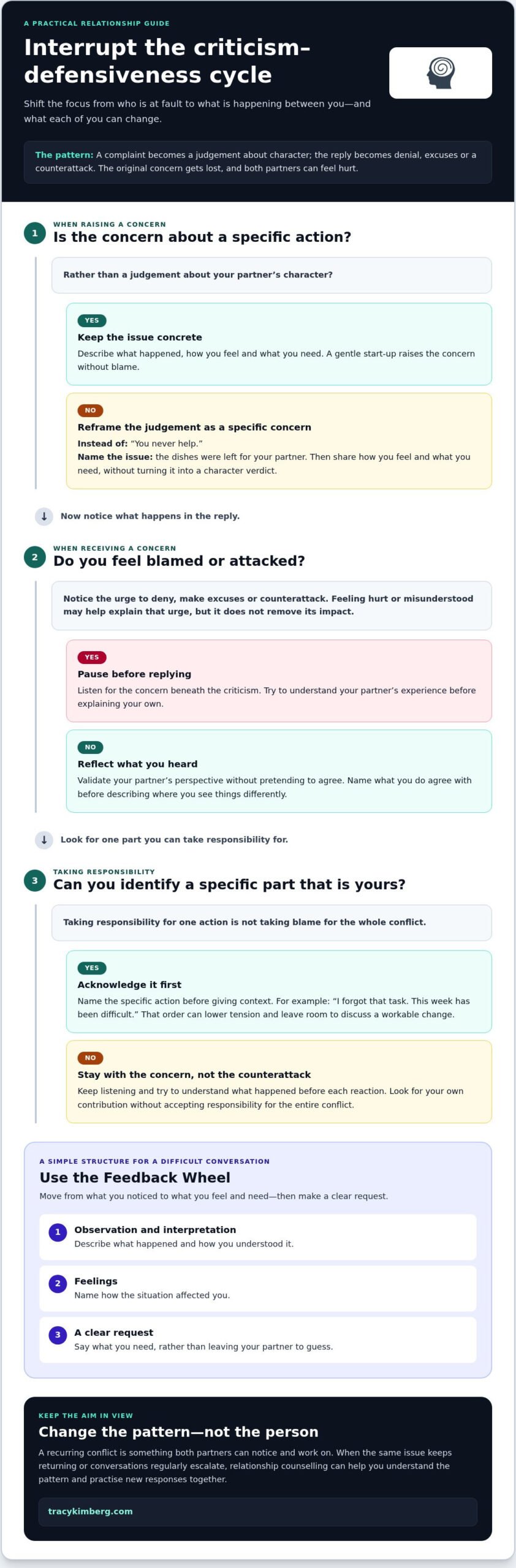
Breaking the cycle of criticism and defensiveness starts with noticing the pattern, rather than treating your partner as the problem. When you feel attacked, pause before replying, listen for the concern beneath the criticism and acknowledge any part you can take responsibility for. This small shift can make room for a calmer, more honest conversation.
Making excuses or counterattacking doesn’t mean you don’t care; you may be feeling hurt, blamed or misunderstood. And when you raise an issue, frustration can turn a complaint into a judgement about your partner’s character. The result can be painful for both of you: one person feels dismissed, the other feels under attack.
This article explores how these reactions reinforce each other and how you can begin responding differently. You’ll learn how a softer opening can express a concern without blame, and how the Feedback Wheel can help you describe what happened, share your feelings and make a clear request. The aim isn’t to avoid difficult conversations, but to make them safer and more connecting.
Key Takeaways
- Notice when a complaint turns into a judgement, and when a reply shifts into excuses or counterattacks.
- Try to see the pattern as something you’re both caught in, rather than proof that one of you is the problem.
- Open difficult conversations gently by describing what happened, how you feel and what you need.
- Use the Feedback Wheel to share your observation and interpretation, name your feelings, then make a clear request.
- When the same conflict keeps returning, relationship counselling can help you understand the pattern and practise new ways of responding together.
What is the criticize/defend cycle in a relationship?
The criticism-defensiveness cycle starts when one partner raises an issue as a personal attack and the other responds by protecting themselves. A complaint about the dishes, for example, can become an argument about character.
Criticism and defensive reactions
Criticism targets a partner’s character, while defensiveness responds to the accusation with denial, excuses, counterattacks or victimhood. A comment such as “You never help” may prompt “I do everything around here,” shifting attention from the original concern to competing grievances.
This reaction can make sense as an attempt to avoid feeling blamed, shamed or misunderstood. For some people, earlier experiences made admitting mistakes feel unsafe, so hiding, blaming or deflecting became protective responses. That history may help explain the reaction, but it doesn’t erase its impact on the conversation.
To interrupt the exchange, each partner can pause and identify their own contribution before responding. One might say, “I got defensive and didn’t hear you. I can see the dishes were left for you.” This accepts responsibility for a specific action without taking blame for the whole conflict.
Recurring conflict and relationship effects
Over time, repeated criticism and defensive replies can leave one partner feeling dismissed and the other attacked. The original issue, such as sharing household chores, stays unresolved, while each new conversation adds another layer of hurt and mistrust.
Couples may seek therapy when the same conflict keeps returning, conversations regularly escalate, or either partner struggles to feel heard. Support can help them recognise the shared pattern, understand what happens before each reaction and practise taking responsibility without turning it into blame.
Gottman identifies accepting responsibility for at least part of a problem as an antidote to defensiveness. For instance, a partner might acknowledge forgetting a task before explaining what made the week difficult. That order can lower tension and create space to discuss a positive, workable change together.
Breaking the cycle of criticism and defensiveness doesn’t require deciding who is entirely at fault. Each partner can notice their own part in the pattern: one may turn a specific complaint into a judgement, while the other answers with an excuse. Naming those actions gives the couple something concrete to change.
Gottman’s masters and disasters in relationships
John Gottman describes communication patterns that can erode connection, alongside habits that help couples manage conflict. In his approach, criticism’s antidote is a gentle start-up: express your feelings and needs without blaming your partner.
The Four Horsemen of relationship breakdown
Gottman calls criticism, defensiveness, contempt and stonewalling the Four Horsemen, patterns associated with relationship breakdown. Criticism attacks character; defensiveness deflects responsibility; contempt communicates disrespect; stonewalling withdraws from interaction. These patterns matter because they can turn a disagreement into an increasingly painful exchange, rather than an opportunity to understand the issue beneath it.
Recognising a Horseman is not a verdict on either partner. It’s a way to notice what is happening between you, then try a different response. For example, replacing a personal accusation with a specific concern shifts the conversation towards the problem itself.
Contempt and its impact
Contempt involves communicating that your partner is inferior or unworthy of respect, through ridicule, mockery or demeaning remarks. Gottman identifies it as the strongest predictor of relationship deterioration, making it especially important to recognise and address.
An eye-roll or sneering comment can make a partner feel small, not simply disagreed with. If contempt has become part of conflict, both partners may need support to understand the hurt and rebuild respectful communication. A safe therapeutic setting can help them explore this pattern without reducing either person to a label.
The Sound Relationship House model
Gottman’s Sound Relationship House presents relationship health as a structure with connected parts, including friendship and conflict management. Managing conflict sits on the fifth floor, showing that disagreements are part of the relationship’s foundation, not proof that it has failed.
This model helps couples look beyond a single argument. When conflict becomes difficult, they can consider how friendship, understanding and everyday connection shape their ability to repair and work through differences. Each part contributes to how partners meet challenges together.
Empathy in relationship communication
Empathy means making an effort to understand your partner’s experience, even when you see events differently. Listening openly and validating their perception can help them feel heard, while leaving room for you to explain your own view.
Try reflecting what you heard before responding: “I can see why that felt unfair.” Then name what you agree with before describing where you differ. This doesn’t require pretending to agree; it helps keep the conversation respectful enough for both perspectives to be discussed.
Gottman’s “masters” of relationships tend to begin difficult conversations gently, rather than leading with criticism. This offers a practical way to change the tone early. A softer opening might be, “I felt overwhelmed when we discussed the plans. Could we decide together what to prioritise?”
That shift isn’t about avoiding difficult truths. It helps couples raise concerns in a way that protects connection while making space for honest discussion. Empathy, respect and a gentle start-up each offer a different route away from the damaging pattern of the Four Horsemen.
Using a soft start-up and the Feedback Wheel
To interrupt the criticism-defensiveness cycle, pause, describe the issue without blame, and say what you feel and need. The Feedback Wheel offers a structure for making the conversation more specific and easier to hear.
Gentle start-ups and I-statements
A gentle start-up raises a concern by describing a situation, naming your feeling and stating a positive need. It matters because a blaming opening can make a partner focus on defending themselves instead of understanding the issue.
Try, “I felt worried when I didn’t hear from you about dinner. Could you let me know if plans change?” The statement names a feeling and makes a clear request without judging your partner’s character. An “I” statement isn’t a way to disguise blame: “I feel you’re selfish” still labels the other person instead of describing your experience.
Harsh phrases to avoid
Harsh start-ups use criticism, absolutes or accusations, such as “You never listen” or “You always leave everything to me.” These phrases can make a specific problem sound like a verdict on the whole relationship.
Replace “You’re so inconsiderate” with an observable detail: “The washing was still in the machine this morning.” Then explain its effect: “I felt stressed because I needed those clothes.” Avoid adding old grievances or a counter-accusation. Keeping the conversation focused on one behaviour gives both partners a clearer chance to discuss what might help.
Steps for interrupting the cycle
The Feedback Wheel offers four moves: describe what you observed, share your interpretation, express your feeling, and make a request to reconnect. Separating these parts can help partners distinguish what happened from the meaning each person attached to it.
For example: “I noticed you looked at your phone while I was speaking. I wondered if the conversation wasn’t important to you. I felt hurt. Could we put our phones aside and finish talking?” The interpretation is presented as your reading, not as proof of your partner’s intention.
- Observe: Name a specific action, such as leaving before agreeing on a plan.
- Interpret: Say what you thought it meant, and leave room for another explanation.
- Feel: Choose an emotion, such as worry or loneliness, rather than an accusation.
- Request: Ask for one practical change that could support connection.
If your partner responds defensively, slow down and listen for the concern beneath their words. You might say, “I hear that you felt criticised; I’m trying to explain what happened for me.” This acknowledges their experience without abandoning your own. If either person becomes overwhelmed, agree to pause and return to the conversation when you can both engage.
These steps aren’t a script for perfect communication. They give couples a repeatable way to notice familiar patterns, clarify meaning and make a positive attempt at repair before the exchange escalates.
Criticism as an attack on a partner’s character
Criticism shifts a conversation from a specific concern to a judgement about who your partner is. Recognising that shift helps you express what hurt without leaving the other person feeling attacked.
Criticism of a partner’s character
A complaint describes an action; criticism turns it into a character verdict. “I felt alone when you arrived late” names an experience, while “You’re selfish” attacks the person. Phrases such as “You always” and “You never” make one incident sound like proof of a permanent flaw.
That distinction matters because a partner who hears a character attack may focus on defending their worth instead of understanding the concern. Identify the specific event and its effect before speaking. For example, describe a missed call and explain that you felt worried, rather than labelling your partner careless.
Acknowledging concerns before disagreeing
Acknowledging a partner’s concern means first recognising what they experienced, then expressing your own perspective. This order can help keep the conversation focused on understanding, rather than turning disagreement into a contest over whose account is right.
You might say, “I understand that you felt excluded when I made that decision. I saw it differently, but I want to understand what mattered to you.” Acknowledgement doesn’t require agreement. It shows you’ve heard the impact before adding context or clarifying your intention.
Empathy, validation and the benefit of the doubt
Empathy means listening for the feeling beneath your partner’s words; validation recognises that their perception is real to them. If they say, “You seemed distant at dinner,” you could respond, “I can see why it came across that way,” before explaining what was happening for you.
Giving your partner the benefit of the doubt means considering a less hostile explanation before assuming intent. A short reply might reflect distraction, not rejection. Stay curious: ask what they meant, listen without interruption, and then express your own view. This approach doesn’t dismiss hurt; it makes room for both experiences.
During a conversation about separation or divorce, the stakes can make character judgements especially painful. Keep the discussion anchored to the decision at hand: name the issue, describe its effect, and ask what needs to be understood. “I’m frightened about what separation would mean for us” opens a different exchange from “You’ve destroyed this relationship.”
If you’re hearing criticism, look for the concern beneath the wording before answering the accusation. You could say, “I hear that you felt unsupported when I changed the plan. Is that what you want me to understand?” This checks your interpretation instead of assuming the worst.
When you disagree, try stating one point you understand before explaining where you differ. For instance: “I agree the decision affected you. I’d like to explain why I made it.” This sequence helps both partners discuss the issue without either having to abandon their perspective.
Recognizing the shared criticize-defend cycle
A shared criticism-defensiveness cycle is a repeating interaction, not a fixed description of either partner. One person protests a problem through criticism; the other feels attacked and defends, counters or withdraws. Each response shapes the next, so both partners can feel unheard even when each is trying to protect something important.
Notice the sequence, not just the loudest moment. A partner might raise an unfinished household task with “You never help”; the other replies, “I do more than you,” then leaves the room. The first partner may escalate the complaint to regain attention, while the second may move towards stonewalling to escape the conflict. Both reactions can deepen the same negative loop.
In Emotionally Focused Therapy for couples, criticism can function as protest, while defensiveness can function as withdrawal. This helps explain why the roles may look different beneath the surface: one person pursues contact, the other seeks distance. The useful question becomes, “What happens between us when this problem appears?” rather than, “Which of us is the problem?”
Map a recent disagreement together. Describe what each person did, what feeling followed, and what happened next. For example, one partner’s frustrated question may bring shame or fear; the other’s silence may then bring loneliness or alarm. Naming these moments can show how protection on one side triggers protection on the other.
- Spot the opening move: Was there a complaint, accusation, silence or visible withdrawal?
- Name the response: Did the other person explain, counter, blame, act like a victim or leave?
- Find the effect: Did the first partner repeat the concern, become sharper or stop trying?
- Identify the shared loop: Describe the pattern without turning either partner into the villain.
Shared does not mean identical responsibility, or that both partners caused every action. Each person remains accountable for their behaviour, including insults, intimidation or refusing to return to a discussion. But locating the cycle can reveal where either partner might interrupt it: soften a protest, acknowledge a concern, or ask for space while agreeing to resume the conversation.
Try giving the pattern a neutral name, such as “the chase-and-retreat loop”. During a calm moment, agree on a signal that means, “We’re in the pattern again.” Then pause the argument and each say what you need next: reassurance, a clearer request or time to settle before continuing. A small interruption can create a different next move.
If you’re struggling to recognise the pattern together, explore relationship counselling for couples as a way to examine recurring interactions with support.
Tracy Kimberg: Relationship Counselling and Coaching for Couples
Tracy Kimberg’s Relationship Counselling and Coaching for Couples can help partners explore recurring conflict and understand how each person experiences the pattern. It may be a useful next step when attempts to talk keep ending in blame, withdrawal or feeling unheard, or when you want support practising more constructive ways to communicate.
In counselling or coaching, you can bring a specific disagreement, such as tension about household responsibilities, and look at what happens between you. Tracy also offers a structured 12-Week Relationship Recovery Process for couples seeking focused support with their relationship dynamics. The aim is to make room for honest reflection and shared responsibility, not to decide that one partner is solely at fault.
If you’d like to explore support for your relationship, contact Tracy Kimberg.
Choose a different next step together
A difficult conversation doesn’t have to become a familiar verdict on your relationship. Begin with one intention: stay curious about what each of you is protecting, even when you disagree. That doesn’t mean accepting hurtful behaviour or setting aside your own needs. It means making room for a response that reflects what you value, rather than only what the conflict has stirred up.
Breaking the cycle of criticism and defensiveness can start with a small moment of choice: taking a breath, naming what you feel, or asking your partner what they heard. These moments won’t make every disagreement easy, but they can help you approach one another with greater care and honesty.
If you’d like support with the patterns shaping your relationship, explore ways to work with Tracy Kimberg. A more connected conversation can begin with one thoughtful step.
Frequently Asked Questions
How Can I Stop Being Defensive?
Start by slowing your reply and checking what you heard before explaining yourself. You might say, “Are you saying you felt left out when I made that plan?” If there’s a part you recognise, acknowledge it plainly: “I should have told you earlier.” Then share your perspective without using it to cancel your partner’s experience. Practising this pause can help you respond to the concern, not just the sting of hearing it.
What Are the Four Horsemen?
The Four Horsemen are criticism, defensiveness, contempt and stonewalling, patterns John Gottman associates with relationship breakdown. Each can show up differently: a personal attack, an excuse or counterattack, a put-down, or shutting down. Noticing one of these behaviours is a prompt to consider what’s happening between you, not a diagnosis of either partner. For example, name the withdrawal and ask whether you can return to the topic calmly.
What is Defensiveness, and how does it happen?
Defensiveness is a protective response to feeling blamed or attacked, often expressed through denial, excuses or counter-accusations. It can happen quickly: a partner says, “I was waiting for you,” and you hear, “You’re unreliable,” even if those words weren’t said. Notice what you’re reacting to, then ask what your partner meant. That small check can separate the concern they raised from the judgement you fear.
Why Am I Defensive With My Partner?
You may become defensive with your partner because their feedback touches a fear of disappointing them, being misunderstood or losing their respect. For instance, “Can we talk about the bills?” might sound like “You’re irresponsible” if money has been a tender subject between you. That reaction can offer a clue about what feels vulnerable. You can name it without making it your partner’s fault: “I’m worried you think I don’t care.”
What are criticism and defensiveness in relationships?
In relationships, criticism turns a concern into a judgement about a partner’s character, while defensiveness protects against the perceived accusation. Imagine one partner says, “You’re thoughtless,” and the other replies, “You’re impossible to please.” The practical issue, perhaps a forgotten errand, disappears beneath those judgements. To practise breaking the cycle of criticism and defensiveness, return to the event and ask what each person needs to address it.
Why do criticism and defensiveness create a repeating conflict cycle?
These reactions create a repeating cycle because each influences what the other person does next. If one partner criticises a late arrival, the other might counter with a complaint about past plans; the first then feels ignored and presses harder. The argument shifts from one evening to the relationship’s entire history. Recognising the escalation can help you pause and return to the original concern before adding another grievance.
How can you tell criticism from a complaint or request?
A complaint identifies a specific problem, while a request says what change would help. “The recycling hasn’t been taken out” points to an action; “You’re lazy” judges the person. A clear request adds a practical next step: “Could you take it out before bed?” This gives your partner something concrete to answer. If the request concerns a recurring issue, discuss how to share the task rather than debating each person’s character.
How can someone respond to defensiveness without escalating an argument?
Respond to the concern beneath defensive words, rather than countering each accusation. Try, “I can hear you felt blamed. I’m not asking you to take responsibility for everything; I want us to talk about this decision.” Keep your voice measured and address one issue at a time. If the exchange becomes too heated to continue productively, agree to pause and return when you can both listen and speak with care.

Article by
Tracy Kimberg
Tracy Kimberg is a Relationship Expert, Couples Therapist and Coach with a dedicated focus on helping couples and individuals rebuild connection, trust and emotional safety in their relationships. Drawing on the research of John and Julie Gottman, the relational insights of Esther Perel, and years of hands-on therapeutic experience, Tracy offers a warm, non-judgemental and deeply compassionate approach to modern relationships.
Based in Dorset, Tracy works with couples navigating communication breakdowns, betrayal, intimacy challenges, separation, family dynamics and life transitions. Known for creating a safe and grounded therapeutic space, she combines practical tools with emotional depth to help clients move beyond survival patterns and towards meaningful, lasting change.
With a reputation for empathy, professionalism and dedication to her clients’ growth, Tracy is passionate about helping people feel seen, understood and empowered — both within their relationships and within themselves.
Disclaimer
Disclaimer:
The information shared in this article is intended for educational and informational purposes only and should not be considered a substitute for professional therapeutic, psychological, medical or legal advice. Every individual and relationship is unique, and the perspectives offered are based on general therapeutic principles, research and professional experience.
Reading this article does not establish a therapist-client relationship with Tracy Kimberg. If you are experiencing significant emotional distress, relationship crisis, trauma, or mental health concerns, it is important to seek support from a qualified professional appropriate to your individual circumstances.
All content remains the intellectual property of Tracy Kimberg and may not be reproduced or distributed without permission.