

When you’re dealing with a controlling partner, start by naming the behaviour and setting a clear boundary around what you will and won’t accept. Their response may offer clues: anxiety can help explain controlling behaviour, but it doesn’t excuse pressure, blame or disregard for your choices. Look at the pattern over time rather than relying on a single explanation.
Controlling behaviour can be confusing when it’s presented as concern or helpful advice. You may care about your partner and still feel watched, criticised or responsible for keeping the peace. Wanting to understand what drives the behaviour doesn’t mean you have to dismiss its impact on you.
This guide will help you set boundaries, respond to blame-shifting, and consider whether control seems rooted in anxiety or a desire for power. You’ll also find ways to stay grounded in difficult conversations and recognise when your safety needs to come first. The aim isn’t to diagnose your partner or control their choices, but to help you understand the dynamic and decide what you need.
Key Takeaways
- Use clear, calm language to name how a behaviour affects you and state the boundary you need.
- When blame is shifted, return to the specific behaviour and avoid being pulled into a power struggle.
- Consider whether control appears linked to anxiety or to maintaining power, while focusing on its impact and pattern.
- If you’re considering leaving, think through a safety plan and keep supportive people close.
1. Assertive communication and boundary-setting
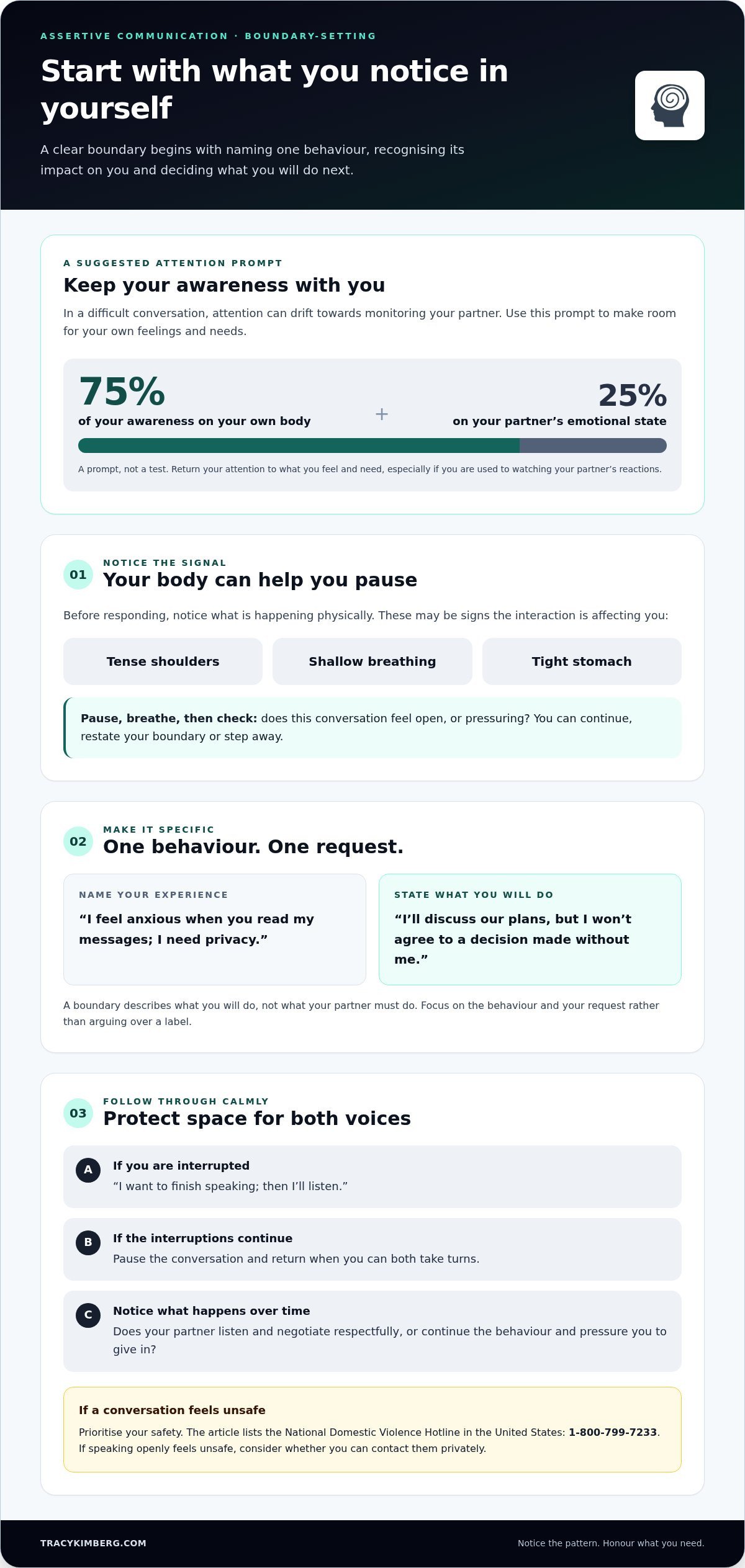
When you’re dealing with a controlling partner, assertive communication can help you express your experience clearly. Try an “I feel” statement: “I feel anxious when you read my messages; I need privacy.” Focus on one behaviour and one request. This makes your meaning clearer than arguing over whether your partner is “controlling”.
Before responding, notice what is happening in your body. Are your shoulders tense, your breathing shallow, or your stomach tight? Pause, breathe, and ask yourself whether the conversation feels open or pressuring. That can help you decide whether to continue, restate your boundary or step away. Your body’s signals can tell you how the interaction is affecting you.
One suggested practice is to keep 75% of your awareness on your own body and 25% on your partner’s emotional state during conversation. In controlling dynamics, attention may shift towards the partner, leaving less space to notice your own feelings. Use the 75/25% idea as a prompt, not a test. Return your attention to what you feel and need, especially if you’re used to monitoring your partner’s reactions.
Make your boundary specific and actionable: “I’ll discuss our plans, but I won’t agree to a decision made without me.” Then follow through calmly. If your partner interrupts, say, “I want to finish speaking; then I’ll listen.” If they keep talking over you, pause the conversation and return when you can both take turns. A boundary describes what you will do, not what your partner must do.
Repeatedly dismissing a stated boundary matters. Notice whether your partner listens and negotiates respectfully, or continues the behaviour and pressures you to give in. If you’re dealing with a controlling partner, privately noting specific incidents may help you recognise the pattern and its impact.
For relationship-abuse help in the United States, contact the National Domestic Violence Hotline at 1-800-799-7233. If speaking openly feels unsafe, consider whether you can contact them privately.
2. Blame-shifting and avoiding accountability
Blame-shifting turns a discussion about one action into an argument about your character. You might say, “You shared my private message without asking,” and hear, “You’re impossible to please.” Bring the conversation back to the behaviour: “I’m talking about the message. Can we discuss why you shared it?” This keeps the issue in focus without pulling you into defending yourself.
Accountability means recognising an action and its impact, then considering what could change next time. Listen for a response such as, “I can see that upset you. I’ll ask before sharing something personal.” By contrast, “I’m sorry you feel that way” doesn’t clearly accept responsibility. You can ask, “What do you understand about how this affected me?” Then notice whether the answer addresses your concern or shifts the blame back to you.
Repeatedly seeking reassurance can also keep you stuck. You might explain your intention again and again, hoping your partner will finally agree you meant no harm. Instead, give one clear answer, then pause: “I’ve explained what happened. I’m willing to talk about the impact, not repeat a defence.” Reassurance may ease tension briefly, but it can’t replace mutual accountability or resolve a pattern of accusations.
Avoid a power struggle by refusing to trade insults, raise the stakes or prove who is right. Try one calm statement: “I won’t continue while we’re blaming each other. I’m ready to return to the issue when we can speak respectfully.” If the conversation becomes intimidating, end it and prioritise your safety. You’re not responsible for making your partner accept your account.
Afterwards, record the event privately in plain terms: what happened, what each person said, and whether repair followed. For example, note whether an apology led to changed behaviour or another accusation. This can help you separate a difficult disagreement from a recurring pattern. If you want support to explore these dynamics, professional relationship support can offer space to consider what accountability and repair would mean for you.
3. Distinguishing anxiety-driven control from power-driven control
Anxiety may underlie controlling behaviour, but it doesn’t make that behaviour harmless. A partner might repeatedly ask where you are because uncertainty unsettles them, or insist on choosing plans because they fear things going wrong. Notice whether they can name the fear, hear how their actions affect you and try a different response. Their explanation matters, but so does what they do.
Control driven by power is more concerning when restrictions consistently preserve one person’s choices and limit the other’s. For example, a partner may decide how shared money is spent, criticise your friends or expect you to follow their preferences without discussion. Look at the pattern: do they accept your right to disagree, or use intimidation, punishment or pressure to secure compliance?
Pay attention to what happens when you don’t follow advice. A partner may become angry because rejecting their suggestion affects their self-esteem. That reaction alone doesn’t reveal its cause. Consider whether they can reflect afterwards, respect your decision and take responsibility, or whether anger becomes a way to make you comply.
To understand the dynamic, compare a specific incident with what happens afterwards. If your partner repeatedly checks your plans, can they discuss the worry and agree to stop? If they continue monitoring you or retaliate when you object, the behaviour remains controlling, whatever explanation they give. You don’t need to diagnose their motive before deciding what feels acceptable or safe.
If a friend or family member is affected, stay connected and listen without judgement. You could say, “I’ve noticed you seem worried when they check your plans. How does it feel for you?” Avoid forcing a decision or confronting their partner on your own. Ask what support would feel useful, and respect their pace while keeping the conversation open.
4. How do I make a safety plan if I’m considering leaving a controlling partner?
A safety plan turns a difficult decision into practical steps you can prepare at your own pace. Start by identifying a trusted friend or relative who knows what’s happening. Agree how you’ll reach them and what you’ll say if you need help. Staying connected can reduce isolation and give you someone to contact if plans change.
Think through a safe exit before announcing your decision. Consider where you could go, how you’d get there, and which times or routes feel safer. A friend’s home may be one option; another could be a public place where you feel secure. Avoid sharing your plan with your partner if doing so could increase risk.
Prepare essentials only if it’s safe to do so. You might organise identification, keys, medication, essential documents and items needed by children or pets. Keep them somewhere accessible, such as with a trusted person. If gathering belongings could draw attention, prioritise leaving safely over collecting possessions.
For abuse concerns in the United States, contact the National Domestic Violence Hotline at 1-800-799-7233. The National Domestic Violence Hotline is available 24 hours a day. A safety plan should reflect your circumstances, including whether your partner monitors calls, messages, or movement. Choose a way to reach support that feels safe for you.
Keep your support network informed as plans develop. For example, tell a trusted person where you’ll be and agree on a check-in that won’t attract attention. If you’re weighing relationship decisions and can speak freely without fear, explore relationship counselling and coaching for couples as a space to consider your next steps. Prioritise safety over joint conversations if you feel threatened or coerced.
Tracy Kimberg: Relationship Counselling and Coaching for Couples
Tracy Kimberg’s Relationship Counselling and Coaching for Couples can help partners explore difficult patterns, strengthen communication and consider what needs to change. It may be a next step when both people want support understanding their dynamic and working towards a healthier relationship. A structured recovery programme offers another path for couples seeking focused, long-term support.
Therapy for adults can give you space to reflect on your needs, choices and boundaries. If you feel afraid, threatened or controlled, prioritise your safety and seek individual support before considering joint conversations. Counselling can help you make sense of your experience; you don’t have to decide the future of your relationship before reaching out for support.
If you’d like to explore what support could look like, contact Tracy Kimberg or visit tracykimberg.com.
Choose your next step with care
Dealing with a controlling partner can leave you questioning your judgement and waiting for certainty before acting. You don’t need to resolve every doubt today. A meaningful next step could be telling someone you trust what’s happening, writing down what you need or taking time to consider what feels safe and respectful for you.
Let your choices be guided by your experience, not by pressure to protect your partner from discomfort. Their reasons may help explain their behaviour, but they don’t erase its effect on you. You’re allowed to seek support while deciding what you want, whether that means working on the relationship or considering a different future.
If a conversation with a professional could help you find perspective, contact Tracy Kimberg to discuss your situation. You can begin with the concern that feels most pressing, without having every answer ready. Take the next step at a pace that feels right for you, and keep your wellbeing in view.
Frequently Asked Questions
The question nobody wants to ask: Is this control or anxiety?
Notice whether anxiety is acknowledged and managed, or used to justify restricting your choices. A partner might feel unsettled when plans change, yet still listen and work on tolerating uncertainty. If they insist you must prevent their distress by obeying, the effect is controlling, whatever emotion lies underneath. You don’t need to identify their motive with certainty to take your discomfort seriously.
What if your partner is willing to change?
Willingness matters when it leads to consistent action. Notice whether your partner can describe what they did, understand its impact and make a specific effort without blaming you for setbacks. For example, if they agree to stop checking your messages, consider whether they respect your privacy in practice. You can recognise genuine effort while taking the time you need to decide whether trust is returning.
What are signs of a controlling partner versus normal relationship conflict?
Control is more likely when one person repeatedly restricts the other’s independence or expects them to obey without discussion. Examples include micromanaging everyday choices, deciding what to eat or which tickets to buy without consulting you, or hiding financial information. Normal conflict can involve frustration or disagreement, but both people can express preferences and influence decisions. The pattern and its effect on your freedom matter more than one argument.
Why do partners become controlling, and what behaviours are common?
Control can be linked to anxiety, a need to feel powerful or difficulty tolerating a partner’s independence; the reasons vary between relationships. Common behaviours include presenting criticism as helpful advice, interrupting, making unilateral decisions or manipulating a partner into doubting their perception. These patterns can overlap, so one behaviour doesn’t explain the whole relationship. Look at how often it happens and what follows when you disagree.
How can I set boundaries with a controlling partner safely?
Choose a boundary that protects a specific need, and consider the likely response before raising it. For instance, you might decide not to discuss a sensitive topic during an argument. If you fear retaliation, you don’t have to start a direct conversation. First speak privately with someone you trust and consider what support would help. Your safety matters more than persuading your partner to agree.
What should I do if my partner monitors my phone, location, money, or social contacts?
Take monitoring seriously and consider how to seek support without increasing risk. Using a trusted person’s device or speaking privately away from your partner may feel safer than using a monitored phone. Avoid sudden changes to accounts or routines if you’re concerned they could provoke a reaction. Note what’s happening only if it’s safe, and include these concerns in your safety planning.

Article by
Tracy Kimberg
Tracy Kimberg is a Relationship Expert, Couples Therapist and Coach with a dedicated focus on helping couples and individuals rebuild connection, trust and emotional safety in their relationships. Drawing on the research of John and Julie Gottman, the relational insights of Esther Perel, and years of hands-on therapeutic experience, Tracy offers a warm, non-judgemental and deeply compassionate approach to modern relationships.
Based in Dorset, Tracy works with couples navigating communication breakdowns, betrayal, intimacy challenges, separation, family dynamics and life transitions. Known for creating a safe and grounded therapeutic space, she combines practical tools with emotional depth to help clients move beyond survival patterns and towards meaningful, lasting change.
With a reputation for empathy, professionalism and dedication to her clients’ growth, Tracy is passionate about helping people feel seen, understood and empowered — both within their relationships and within themselves.
Disclaimer
Disclaimer:
The information shared in this article is intended for educational and informational purposes only and should not be considered a substitute for professional therapeutic, psychological, medical or legal advice. Every individual and relationship is unique, and the perspectives offered are based on general therapeutic principles, research and professional experience.
Reading this article does not establish a therapist-client relationship with Tracy Kimberg. If you are experiencing significant emotional distress, relationship crisis, trauma, or mental health concerns, it is important to seek support from a qualified professional appropriate to your individual circumstances.
All content remains the intellectual property of Tracy Kimberg and may not be reproduced or distributed without permission.