

Security isn’t about never feeling anxious or needing reassurance. Building a secure attachment in an adult relationship starts with repeated experiences of responsiveness, honest communication and care, including the ability to repair after a difficult moment.
If uncertainty or distance quickly stirs fear, you’re not alone in finding closeness complicated. Attachment patterns can shape how partners seek reassurance, express needs or respond to conflict, but they can shift as trust and connection grow.
In this article, you’ll learn how emotional responsiveness, clear communication and working with anxious attachment can help build greater security together. We’ll explore what secure attachment can feel like in everyday relationships, how partners can respond to one another with care, and how small changes in communication can support a more connected way forward.
Key Takeaways
- Recognising what triggers anxious or avoidant responses can help you understand recurring relationship patterns with more compassion.
- Small moments of emotional availability, reassurance and care can help partners feel safer and more connected.
- Clear requests, thoughtful listening and respectful boundaries can make difficult conversations easier to navigate.
- Therapy for adults can offer support in exploring attachment patterns and finding new ways to relate.
How to Heal Anxious Attachment and Become Secure?
Patterns can shift through repeated small choices, not one perfect conversation. Start by noticing what happens when closeness or uncertainty feels difficult.
Recognising Patterns and Triggers
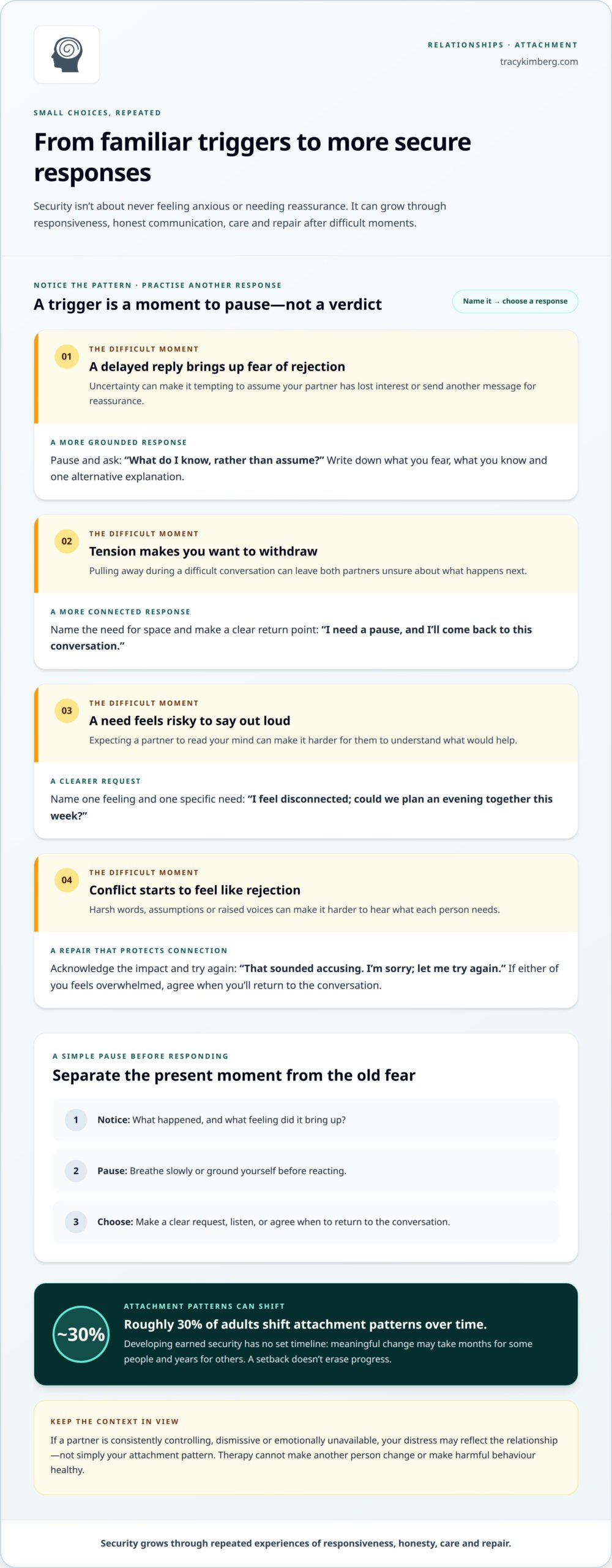
Recognising patterns means noticing the moments that prompt you to seek closeness or pull away. A delayed reply, for example, may trigger fear of rejection, while a tense conversation may lead someone with avoidant attachment to withdraw. Name the trigger, the feeling and the response. This pause can help distinguish an old fear from what your partner is doing now. If a partner is consistently controlling, dismissive or emotionally unavailable, your distress may reflect the relationship, not simply your attachment pattern. Therapy cannot make another person change or make harmful behaviour healthy.
Changing Patterns Through Small Actions
Changing patterns means practising a different response in a familiar moment. If you tend to pursue reassurance, pause before sending another message and ask what you know, rather than assuming a delayed reply means your partner has lost interest. If you tend to withdraw, stay present long enough to say, “I need a pause, and I’ll come back to this conversation.” These small actions can interrupt a pursue-withdraw cycle and make room for a healthier exchange.
Attachment Patterns Over Time
Attachment patterns can change as you experience greater safety and practise new ways of responding. Roughly 30% of adults shift attachment patterns over time, and developing earned security has no set timeline: meaningful change may take months for some people and years for others. That isn’t a deadline. It means a setback doesn’t erase progress; returning to an honest conversation after withdrawing can itself become a different experience.
Developing Security Independently
You can develop more secure habits by journalling about triggers, questioning old beliefs and practising emotional regulation before reacting. For instance, write down what you fear, what you know and one alternative explanation. Deep breathing or grounding can help you tolerate uncertainty without immediately seeking a response. Accepting care with a simple “thank you” is another small practice. These steps can support change, alongside safe relationships and therapy.
Accessibility, responsiveness, and emotional engagement
Emotional security grows when partners can reach one another with honesty and care. Small responses during stressful moments can make closeness feel safer.
Emotional Availability and Reassurance
Emotional availability means responding openly and supportively when your partner reaches out. It matters because feeling heard can make connection more comfortable, even when you see things differently. Validation might sound like, “I can understand why that felt hurtful,” without requiring agreement. If your partner feels anxious before an important meeting, a warm check-in or clear reassurance can help them feel remembered rather than alone.
Meeting Needs and Healing Past Wounds
Meeting emotional needs can create new experiences of care that soften the impact of past wounds. A partner who grew up feeling overlooked, for example, may experience connection differently when their feelings receive thoughtful attention. Couples can ask, “Would you like help solving this, or would it help more if I listened?” This shows curiosity about the need instead of making assumptions. Healing doesn’t mean the past disappears; it can mean responding to old pain with greater awareness and care.
Building Trust and Consistency
Trust grows through repeated experiences of reliability, responsiveness and care. Couples build consistency by following through on commitments, checking in when plans change and returning to conversations after taking space. These everyday actions help answer the question, “How can couples build trust and consistency over time?” Make dependable care a shared practice, rather than relying on reassurance alone.
Emotional regulation also supports connection. During stress, pause to notice body cues, such as a tight chest, then breathe slowly before responding. Distress tolerance means staying with an uncomfortable feeling without immediately escaping or trying to fix it. A brief grounding pause can help you respond with care while making space for both partners’ emotional needs.
Direct communication of needs, feelings, and boundaries
Direct communication gives partners a clearer way to express needs than expecting one another to read minds. If an insecure attachment style makes a request feel risky, name one feeling and one specific need: “I feel disconnected; could we plan an evening together this week?” This keeps the focus on connection rather than blame and gives your partner something clear to respond to.
Describe the situation, how it affects you and what would help. For example: “When plans change without a message, I feel unsettled. Please let me know when you can.” This separates the behaviour from a judgement about your partner’s character. It can also help you notice whether what you learned in childhood shapes what a situation means to you now.
Active listening means giving your partner room to finish, then reflecting what you heard: “You felt left out when I made that decision.” Ask whether you’ve understood before offering a solution. Notice non-verbal cues, such as a tense posture or a quiet voice, but don’t treat them as proof of what someone feels. A gentle check-in is more reliable than an assumption.
Boundaries describe what you can take part in, not how you control another person. You might say, “I want to discuss this, but I can’t continue while we’re shouting.” If either partner feels overwhelmed, agree when you’ll return to the conversation. Naming a need for time alone can also protect connection: “I need an hour to settle, then I’ll come back.”
Conflict doesn’t have to signal rejection. If your words come out harshly, acknowledge the impact and try again: “That sounded accusing. I’m feeling hurt, and I want us to understand each other.” Practising these skills helps you stay present, express feelings honestly and repair misunderstandings together.
What secure attachment feels like in adult relationships
Secure attachment isn’t constant harmony or a guarantee that you’ll never feel anxious. It can mean sharing difficult news without hiding your vulnerability. After a disappointing job interview, for example, you might tell your partner you feel discouraged and ask them to listen, rather than withdrawing or pretending you’re fine. Their response can offer support without either of you needing to solve everything immediately.
In practice, building a secure attachment in an adult relationship means being able to hold different views without turning disagreement into a test of love. If you differ about visiting family, explain what matters to you, hear your partner’s reasons and consider a compromise. You might not agree straight away. A respectful discussion can still preserve a sense of connection.
Intimacy also includes trusting each other with honest preferences. You could say that a particular joke hurt or that you’d like more affection, without treating the request as evidence that something is wrong with you. Your partner may need time to understand. A secure bond makes room for that conversation while taking each person’s feelings seriously.
Building a secure attachment in an adult relationship also involves being able to lean on someone without surrendering your own judgement. If you’re deciding whether to accept a new role, you can seek your partner’s perspective and make the choice that feels right to you. The clearest sign isn’t perfection: it’s having room for closeness, individuality and honest conversation, even when feelings are complicated.
Tracy Kimberg: Therapy for Adults
Therapy for Adults with Tracy Kimberg offers a space to explore the experiences and relationship patterns that make closeness, trust or communication difficult. It may be worth considering when anxiety, emotional disconnection, recurring conflict or the effects of infidelity are affecting your wellbeing and relationships. You don’t need to wait until a relationship reaches crisis; noticing that familiar reactions keep returning can be a meaningful reason to seek support.
Therapy can help you understand how earlier experiences shape present-day responses, and explore what happens when you feel rejected, overwhelmed or unable to express a need. Together, you can work towards greater emotional regulation and clearer communication, while making room for difficult feelings rather than judging them. This isn’t about assigning blame or labelling one partner as the problem. It’s an opportunity to understand your part in a relationship pattern and consider new ways to respond.
If both partners want to work on their dynamic, Relationship Counselling and Coaching for Couples can help you explore recurring difficulties together. This may be relevant when conversations repeatedly become defensive, one person pursues whilst the other withdraws, or trust feels strained. Tracy Kimberg also offers a structured 12-Week Relationship Recovery Process for addressing relationship difficulties. The right kind of support depends on whether you’re seeking individual reflection, shared relationship work or a more structured process.
Seeking support doesn’t mean you’ve failed to manage your relationship alone. It can be a considered step towards understanding what you need and how you want to relate. If you’d like to explore support, you’re welcome to contact Tracy Kimberg.
Frequently Asked Questions
How to Build Secure Attachment in an Adult Relationship?
Building a secure attachment in an adult relationship involves making choices that support trust and mutual respect over time. If you disagree about a social plan, for example, explain what matters to you and invite your partner’s view before deciding together. Notice whether both people can share preferences, negotiate and accept a different opinion. Security grows when neither person has to silence themselves to preserve closeness.
Can attachment styles change?
Yes, attachment styles can change as people have new experiences and become more aware of their responses. Someone who once avoided asking for help might gradually practise asking a trusted partner for support with a manageable concern. Change doesn’t require erasing your history or becoming a different person. It means having more choices in how you respond, rather than feeling bound to one familiar reaction.
How to Move From Avoidant to Secure Attachment?
Begin by noticing what emotional closeness brings up, then choose a small, honest way to stay engaged. If you usually change the subject when your partner asks about a difficult day, try sharing one detail and saying what would help. You can also explain that opening up feels unfamiliar. The aim isn’t constant disclosure; it’s building the ability to remain present without automatically shutting down.
What does this look like?
In everyday life, it might look like telling your partner, “I’m disappointed we can’t go, but I understand your reason.” You can acknowledge your feelings without turning them into an accusation or hiding them to avoid tension. If your partner responds differently than you hoped, ask what they meant. This leaves room for understanding instead of treating one awkward moment as proof of rejection.
What is attachment theory?
Attachment theory describes how early relationships can shape the ways people seek closeness, comfort and support throughout life. John Bowlby developed the theory, and Mary Ainsworth later expanded it. For example, a person may notice that asking for reassurance feels unsafe because past experiences taught them to expect dismissal. Understanding that link can help explain a reaction, while leaving room to respond differently in present relationships.
What does secure attachment look like in an adult relationship?
In an adult relationship, secure attachment can mean enjoying intimacy while retaining a sense of self. Partners might support each other through a career change, yet make different choices about their working lives. Each can express uncertainty or ask for comfort without assuming that needing support is weakness. The practical sign is balance: closeness matters, and individuality remains welcome too.

Article by
Tracy Kimberg
Tracy Kimberg is a Relationship Expert, Couples Therapist and Coach with a dedicated focus on helping couples and individuals rebuild connection, trust and emotional safety in their relationships. Drawing on the research of John and Julie Gottman, the relational insights of Esther Perel, and years of hands-on therapeutic experience, Tracy offers a warm, non-judgemental and deeply compassionate approach to modern relationships.
Based in Dorset, Tracy works with couples navigating communication breakdowns, betrayal, intimacy challenges, separation, family dynamics and life transitions. Known for creating a safe and grounded therapeutic space, she combines practical tools with emotional depth to help clients move beyond survival patterns and towards meaningful, lasting change.
With a reputation for empathy, professionalism and dedication to her clients’ growth, Tracy is passionate about helping people feel seen, understood and empowered — both within their relationships and within themselves.
Disclaimer
Disclaimer:
The information shared in this article is intended for educational and informational purposes only and should not be considered a substitute for professional therapeutic, psychological, medical or legal advice. Every individual and relationship is unique, and the perspectives offered are based on general therapeutic principles, research and professional experience.
Reading this article does not establish a therapist-client relationship with Tracy Kimberg. If you are experiencing significant emotional distress, relationship crisis, trauma, or mental health concerns, it is important to seek support from a qualified professional appropriate to your individual circumstances.
All content remains the intellectual property of Tracy Kimberg and may not be reproduced or distributed without permission.