

What if the argument you keep having is less about who is right and more about a pattern you’ve both learned to inhabit? Breaking negative relationship patterns starts with noticing how familiar reactions, such as criticism, withdrawal or defensiveness, can draw you into the same painful cycle.
If you’ve promised yourselves that things will be different, only to find the same tension returning, it can feel discouraging. These reactions don’t mean either of you is beyond help. They may be ways of responding to feeling hurt, unheard or unsafe. Understanding them can open space for change without dismissing their impact on your relationship.
This article explores how recurring conflict patterns take hold, how earlier experiences may shape your responses to closeness and conflict, and how therapy can help couples recognise the cycle and practise different responses. It offers a compassionate, practical guide to understanding what happens between you, so change can begin with curiosity rather than blame.
Key Takeaways
- Notice the moments when criticism, defensiveness or withdrawal begin, and how each partner’s response can keep the conflict cycle going.
- Explore how small shifts in communication can help couples move from blame towards understanding and repair.
- Recognise that early experiences may influence expectations of closeness, conflict and safety in adult relationships.
- Therapy can help partners understand their individual patterns and work towards more connected ways of relating.
Recognising criticism, defensiveness, and stonewalling
A recurring pattern often follows a recognisable sequence: one partner raises a concern, the other reacts, and both end up feeling unheard. Noticing the sequence can help you separate the problem from either person.
Criticism and defensive responses
Criticism targets a partner’s character, while a complaint identifies a specific action. “You’re selfish” attacks the person; “I felt alone when you cancelled dinner” describes an event and its impact. Defensiveness may follow as denial, counter-accusation or an explanation that dismisses the hurt. Look at what happens next: does one partner defend themselves while the other repeats the accusation more sharply? Naming the sequence can make breaking negative relationship patterns feel more possible.
Stonewalling in recurring conflict
Stonewalling may look like silence, leaving the room or turning away during a difficult conversation. For example, one partner asks about a missed commitment, the other stops responding, and the first raises their voice to get an answer. The withdrawal and pursuit then reinforce each other. A pause is different when it’s explained and the partners agree when to return. Fear, threats, physical harm or controlling behaviour can signal an unsafe relationship; this is more than a communication difficulty. In the United States, support options include domestic violence advocacy and shelter services, alongside individual counselling. Couples counselling is not a substitute for immediate safety support.
Triggers and early signals
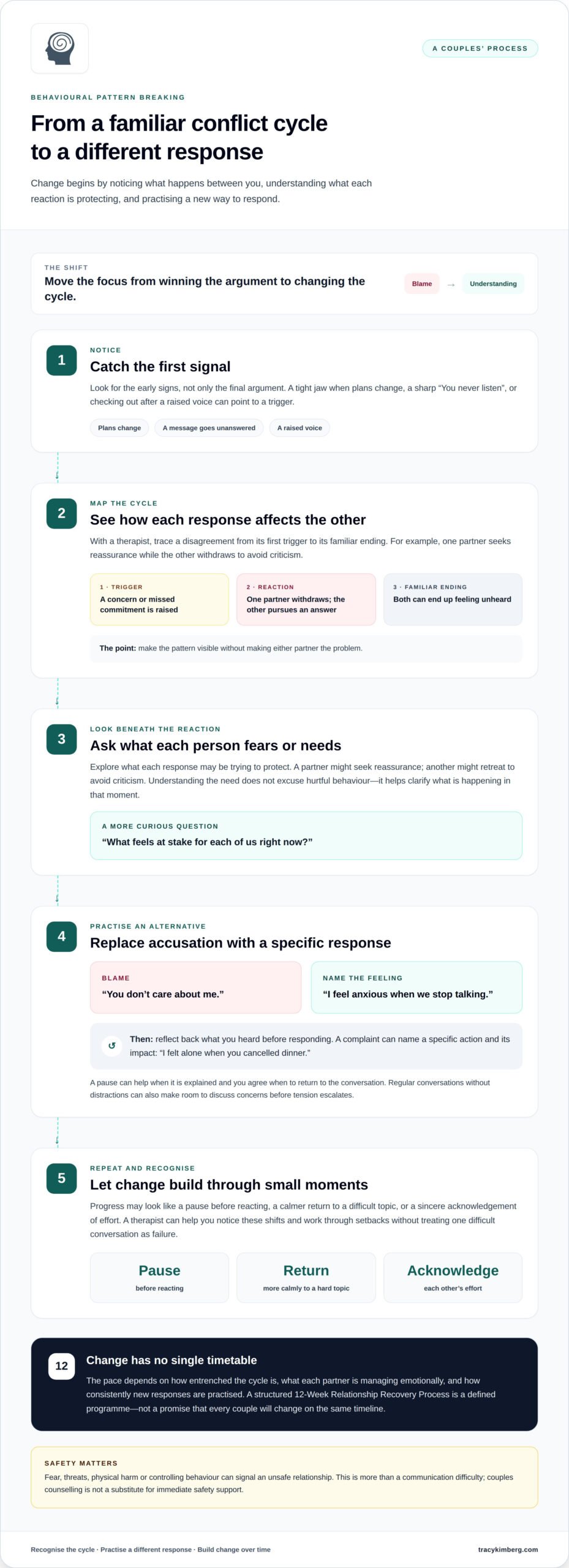
Notice the first signs, not just the final argument: a tight jaw when plans change, a sharp “You never listen”, or one partner checking out after a raised voice. These cues can point to a trigger, such as feeling dismissed when a message goes unanswered. Healthy boundaries state what you will accept and what you’ll do to protect your wellbeing, such as ending a conversation when insults begin. Recognising a repeated trigger-and-response sequence gives you a clearer starting point for therapy and a chance to respond differently.
Behavioural pattern breaking
Changing a repeated behaviour starts with understanding what each reaction is trying to protect, then practising a different response. A therapist can help shift the focus from winning an argument to changing the cycle.
Changing relationship habits
In therapy, a therapist can help partners map how a disagreement unfolds, from its first trigger to its familiar ending. For example, one partner may seek reassurance while the other withdraws to avoid criticism. Rather than assigning blame, the therapist explores what each person fears or needs in that moment. Sue Johnson described recurring couples’ conflict cycles as a relational dance, a useful way to see how each partner’s actions affect the other.
Next, the therapist can help couples practise a specific alternative. One partner might say, “I feel anxious when we stop talking,” rather than accuse the other of not caring. The other can reflect back what they heard before responding. Regular conversations without distractions can also create space to discuss concerns before tension escalates.
The pace of change
There isn’t one timetable for changing relationship habits. The pace depends on how entrenched the cycle is, what each partner is managing emotionally, and how consistently they practise new responses. A therapist also considers whether both people can participate safely and openly. A structured 12-Week Relationship Recovery Process provides a defined programme, not a promise that every couple’s changes will follow an identical timeline.
Progress can show up in small moments: a pause before reacting, a calmer return to a difficult topic, or a sincere acknowledgement of effort. A therapist can help couples notice these changes and work through setbacks without treating one difficult conversation as a failure. Change develops through repeated experiences of responding differently, not simply by understanding the pattern once.
Childhood experiences and schemas
People may repeat unhealthy relationship patterns because familiar responses can feel safer than unfamiliar ones. Someone who learned early that affection could disappear may seek constant reassurance; someone who experienced conflict as threatening may withdraw. These reactions can persist even when a present-day partner behaves differently. Repetition can reflect learned protection, not a fixed destiny.
A schema is a deep-rooted expectation about yourself, other people and relationships. It may develop through repeated experiences, such as feeling overlooked when a parent was preoccupied or being praised only for achievement. Later, a partner’s delayed reply might activate the thought, “I don’t matter”, even when there’s another explanation for the delay. The feeling is real, but the interpretation may be shaped by earlier experiences.
Consider a couple where one partner longs for closeness and the other needs space after a disagreement. If closeness once felt unreliable, the first may press for immediate reassurance. If conflict once brought criticism, the second may retreat for protection. Each response can intensify the other’s fear, creating a familiar cycle. Their history helps explain the reaction, but it doesn’t make hurtful behaviour harmless or inevitable.
Therapy can help partners connect present reactions with earlier learning, without reducing either person to their childhood. A therapist may explore what a moment means to each partner, what emotion lies beneath the response, and whether the current situation supports that conclusion. For example, “They need time alone” can be distinguished from “They’re abandoning me”. This creates room to respond to the partner in front of you, rather than only to an old expectation.
Understanding a schema isn’t about blaming parents or excusing behaviour. It can explain why certain moments feel charged and help identify where a more considered response might begin.
Understanding individual relationship patterns
Each partner has their own way of seeking closeness, handling uncertainty and protecting themselves. One may ask repeated questions after a disagreement; the other may need quiet before speaking. Those actions can carry different meanings: a request for reassurance may feel like pressure, while a pause may feel like rejection. Understanding each person’s response helps reveal how the patterns meet.
Thinking shapes what happens between an action and a reaction. A partner who sees a late reply might think, “I’m being ignored”, feel hurt and send a pointed message. Their partner may read that message as an accusation and pull away. The delay matters, but so does the story attached to it. Under emotional strain, assumptions can feel like facts.
A therapist can help partners examine this sequence without reducing either person to a label. They might explore what each partner noticed, thought, felt and did during a specific disagreement. For example, did a practical question sound critical because of its timing or tone? Did a brief answer seem cold because one partner expected comfort? These details help distinguish intention from impact.
Individual patterns can also have strengths. Planning may offer stability but become rigid when uncertainty rises; humour may ease tension but leave a partner feeling dismissed. The aim isn’t to erase a personality or make both people respond alike. It’s to understand when a familiar strategy helps, when it creates distance, and what alternative might serve the relationship better.
The key point is that thoughts influence how you respond in a relationship, but they aren’t the whole truth. With therapeutic support, couples can separate an event from its interpretation, recognise each person’s needs and build a more considered response together.
Tracy Kimberg
Tracy Kimberg supports couples who want to understand recurring conflict and respond differently. Relationship Counselling and Coaching for Couples can help partners explore how their reactions interact, what each person needs and where communication gets stuck. It may be a useful next step when the same disagreements keep returning or emotional distance is growing.
Sessions can create space to discuss difficult experiences with guidance, rather than trying to resolve everything in the heat of an argument. The focus isn’t simply on deciding who is right. It’s on understanding the relationship dynamic and considering more constructive ways to communicate, repair hurt and reconnect. Both partners’ perspectives matter, while responsibility for harmful behaviour remains with the person who chose it.
For couples seeking a dedicated approach to breaking negative relationship patterns, Tracy Kimberg offers structured pathways for working on relationship dynamics. Individual Therapy for Adults may also be appropriate when personal experiences or emotional responses are affecting a partnership and someone wants space to explore them individually. The best fit depends on whether the main need is shared relationship work or individual support.
Therapy doesn’t ask either partner to erase their history or personality. Instead, it can help make familiar responses easier to understand and create room to practise different choices. If you’re unsure where to begin, describe the recurring difficulty and what you hope might change. That gives the conversation a clear, personal starting point without requiring you to have every answer ready.
If you’d like to explore support for your relationship, contact Tracy Kimberg.
Frequently Asked Questions
What are common negative patterns in relationships?
Common patterns include avoiding difficult conversations, keeping score, blaming and repeatedly revisiting unresolved disagreements. For instance, a decision about household tasks can become a debate about who cares more, rather than a practical discussion about sharing the work. The pattern is often less about one argument than where it ends: partners feel disconnected, and the original concern remains unresolved.
How can I identify my relationship triggers and recurring behaviours?
Notice what tends to happen just before your response changes. After a tense exchange, reflect on the situation, the thought that arose, the feeling that followed and what you did next. A partner’s brief reply, for example, might prompt worry and repeated messages. Tracking these details across conversations can help you spot themes to explore in therapy.
What steps can a therapist guide couples through to help break negative relationship patterns?
A therapist can help couples agree on a shared goal, such as discussing money without ending the conversation in resentment. They may explore a recent disagreement, clarify what each partner hoped would happen and identify where their expectations differed. Together, partners can choose one interaction to approach differently, then discuss what felt useful or difficult in a later session.
How can couples counselling help partners communicate more effectively and resolve conflict?
Couples counselling offers a guided setting where each partner can explain their perspective and hear the other’s. A counsellor may slow down a disagreement about cancelled plans, for example, to distinguish practical frustration from disappointment about missed time together. This clarity can help partners discuss the issue beneath the argument and work towards an outcome that addresses both perspectives.
How can therapy help change unhealthy relationship patterns?
Therapy can help partners understand how their expectations, emotions and choices shape interactions, then practise responses that better fit the relationship they want. Progress might mean raising a concern earlier, asking for clarification instead of assuming intent, or returning to a conversation after a pause. This work supports breaking negative relationship patterns by turning insight into considered choices over time.

Article by
Tracy Kimberg
Tracy Kimberg is a Relationship Expert, Couples Therapist and Coach with a dedicated focus on helping couples and individuals rebuild connection, trust and emotional safety in their relationships. Drawing on the research of John and Julie Gottman, the relational insights of Esther Perel, and years of hands-on therapeutic experience, Tracy offers a warm, non-judgemental and deeply compassionate approach to modern relationships.
Based in Dorset, Tracy works with couples navigating communication breakdowns, betrayal, intimacy challenges, separation, family dynamics and life transitions. Known for creating a safe and grounded therapeutic space, she combines practical tools with emotional depth to help clients move beyond survival patterns and towards meaningful, lasting change.
With a reputation for empathy, professionalism and dedication to her clients’ growth, Tracy is passionate about helping people feel seen, understood and empowered — both within their relationships and within themselves.
Disclaimer
Disclaimer:
The information shared in this article is intended for educational and informational purposes only and should not be considered a substitute for professional therapeutic, psychological, medical or legal advice. Every individual and relationship is unique, and the perspectives offered are based on general therapeutic principles, research and professional experience.
Reading this article does not establish a therapist-client relationship with Tracy Kimberg. If you are experiencing significant emotional distress, relationship crisis, trauma, or mental health concerns, it is important to seek support from a qualified professional appropriate to your individual circumstances.
All content remains the intellectual property of Tracy Kimberg and may not be reproduced or distributed without permission.